Key Takeaways
- Google says its AI features rest on its core Search systems, so sound SEO still underpins visibility.
- A top-ten ranking is not required: about 38% of cited URLs in Ahrefs’ March 2026 study ranked there.
- Transfer-first sections, first-hand experience and named sources make a passage easy to quote and trust.
- AI is excellent at repetitive accuracy but not at judgment, so a person should verify every claim.
- Track progress in Search Console’s Generative AI performance report and plan for steady work, not overnight results.
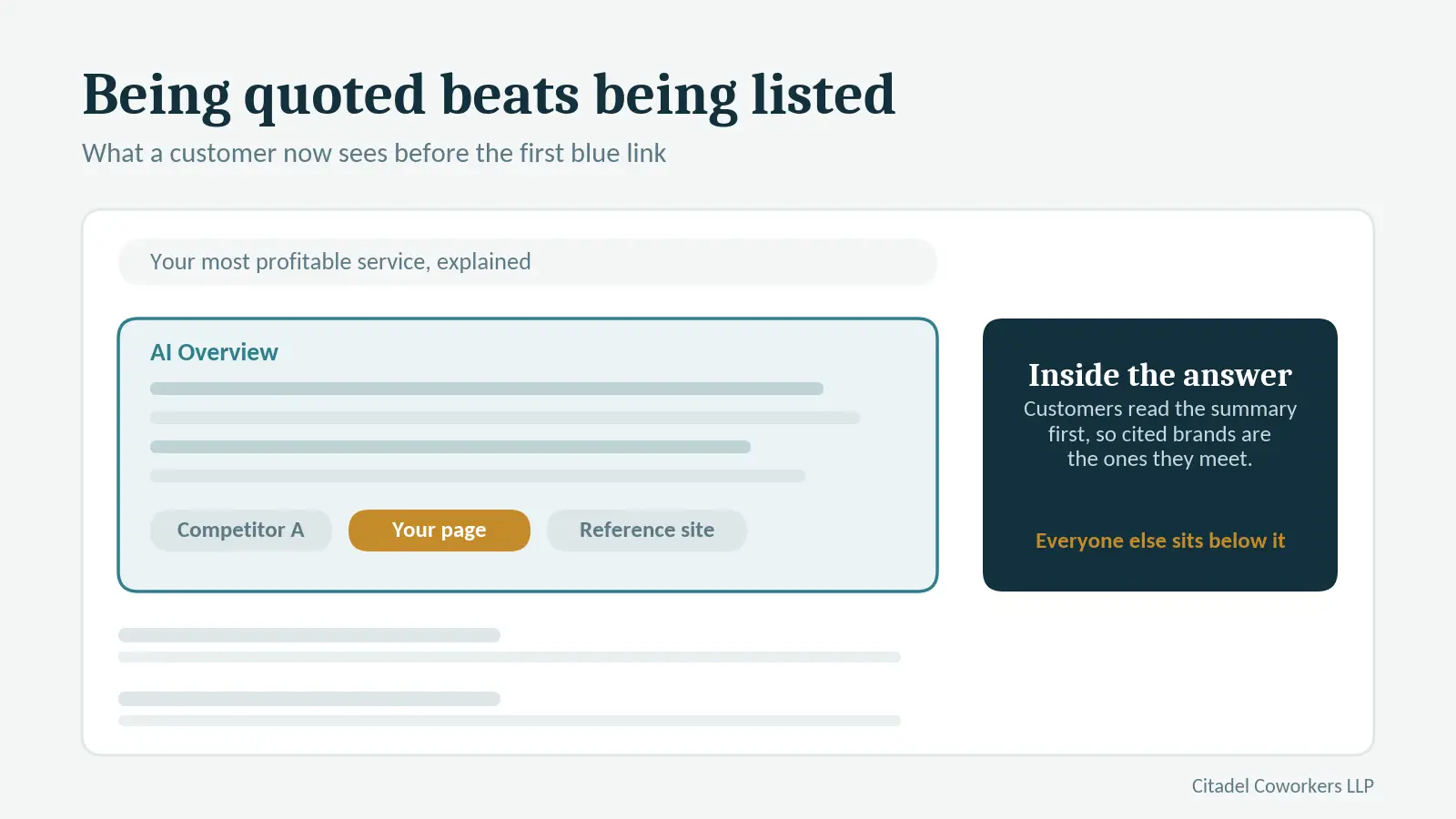
Type your most profitable service into Google and stop at the first blue link. Now look above it. A tidy paragraph has already answered your customer’s question and small source cards sit beside it.
A competitor’s name may be on one. Yours may be on none. That quiet gap decides who gets the phone call and no ranking report will flag it.
This guide explains what those source cards are, how Google chooses who earns them and what a business can realistically do about it. It also tackles a question every team is asking right now: how far should we trust AI itself?
What Does It Mean to Be Cited in an AI Overview
An AI Overview citation is a clickable source link that Google shows beside its AI-generated summary, pointing to a page that supports part of the answer. Think of it as a footnote readers can actually follow. Being cited puts your brand inside the answer rather than beneath it.
Why a Citation Now Outweighs a Ranking
AI summaries absorb clicks that rankings once earned. Seer Interactive’s 2026 update, covering roughly 5.47 million queries, found that brands cited inside an AI Overview earned approximately 120% more generic clicks per impression than uncited brands on the same query. Cited brands still trailed queries with no summary at all.
Google itself notes that people increasingly gravitate to generative AI experiences to find information. When the answer arrives before the click, the brands named in that answer inherit the trust that comes with it.
Visibility is not about ranking higher on search results. It is about being quoted. That is why this topic matters to any business whose customers begin with a search.
Can a Smaller Business Really Earn a Citation
Yes, and the evidence supports it. Google says its AI features create opportunities for more types of sites to appear.
Citation depends on whether a passage answers a question clearly, not on how large your domain is. A specialist with a clear, honest explanation of one problem offers Google something a vaguer, bigger page may not.
Do You Need a Top-Ten Ranking to Be Cited
No. In March 2026, Ahrefs analysed about 863,000 keyword results and four million cited URLs. Roughly 38% ranked in the top ten for the same query, about 31% sat between positions 11 and 100 and about 31% were outside the top 100 entirely.
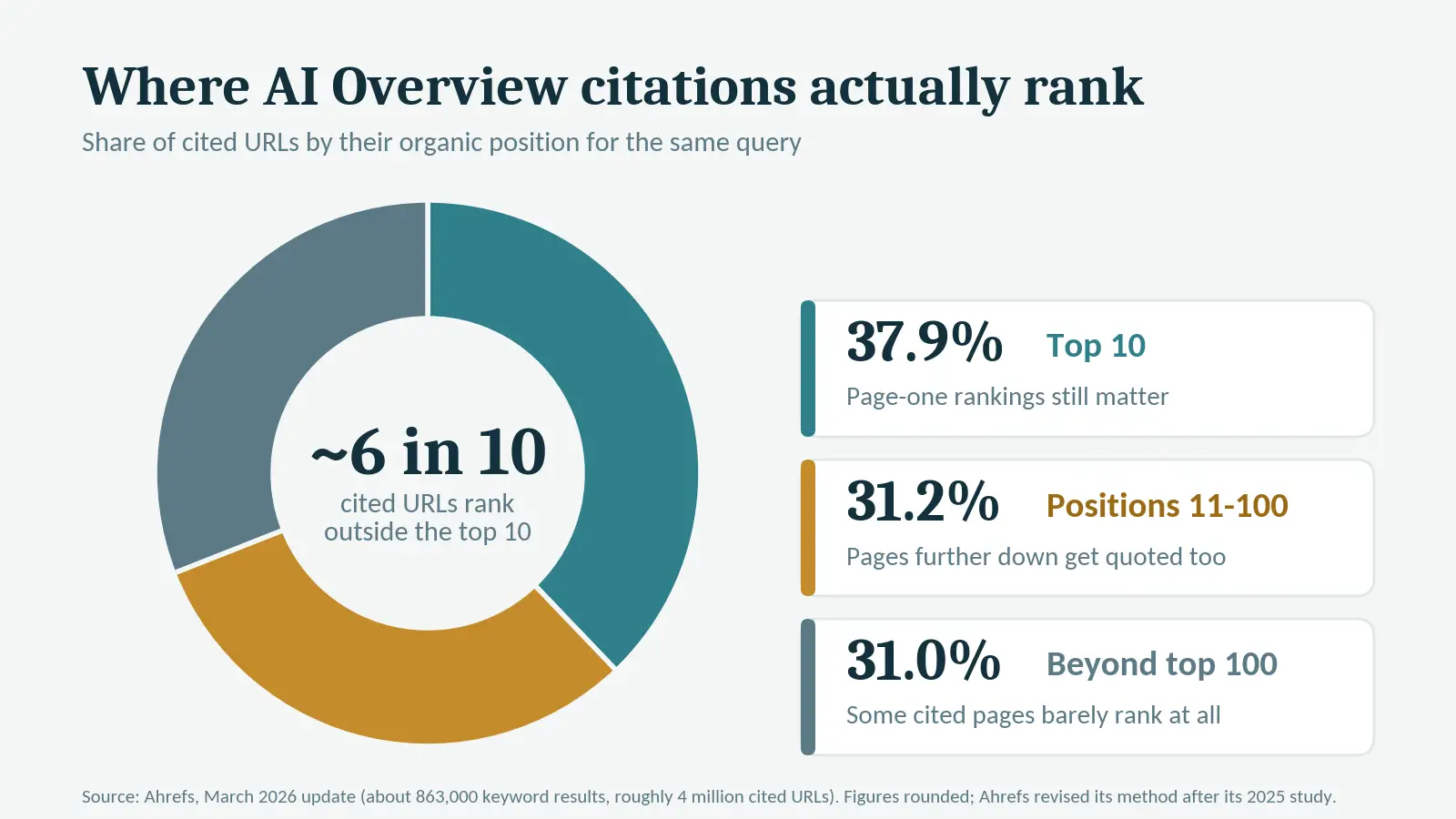
Ahrefs changed its methodology after its 2025 study, which found 76% so the two figures are not a clean trend line. Rankings still help, because eligibility still starts with Google’s own search index. They simply are not the gate.
How Google Decides Which Pages to Quote
Google describes two techniques. Retrieval-augmented generation pulls relevant pages from Search’s index so the answer rests on real documents. Query fan-out then splits one question into several related searches. Google’s own example: a question about fixing a weedy lawn can spawn searches on herbicides, chemical-free removal and prevention.
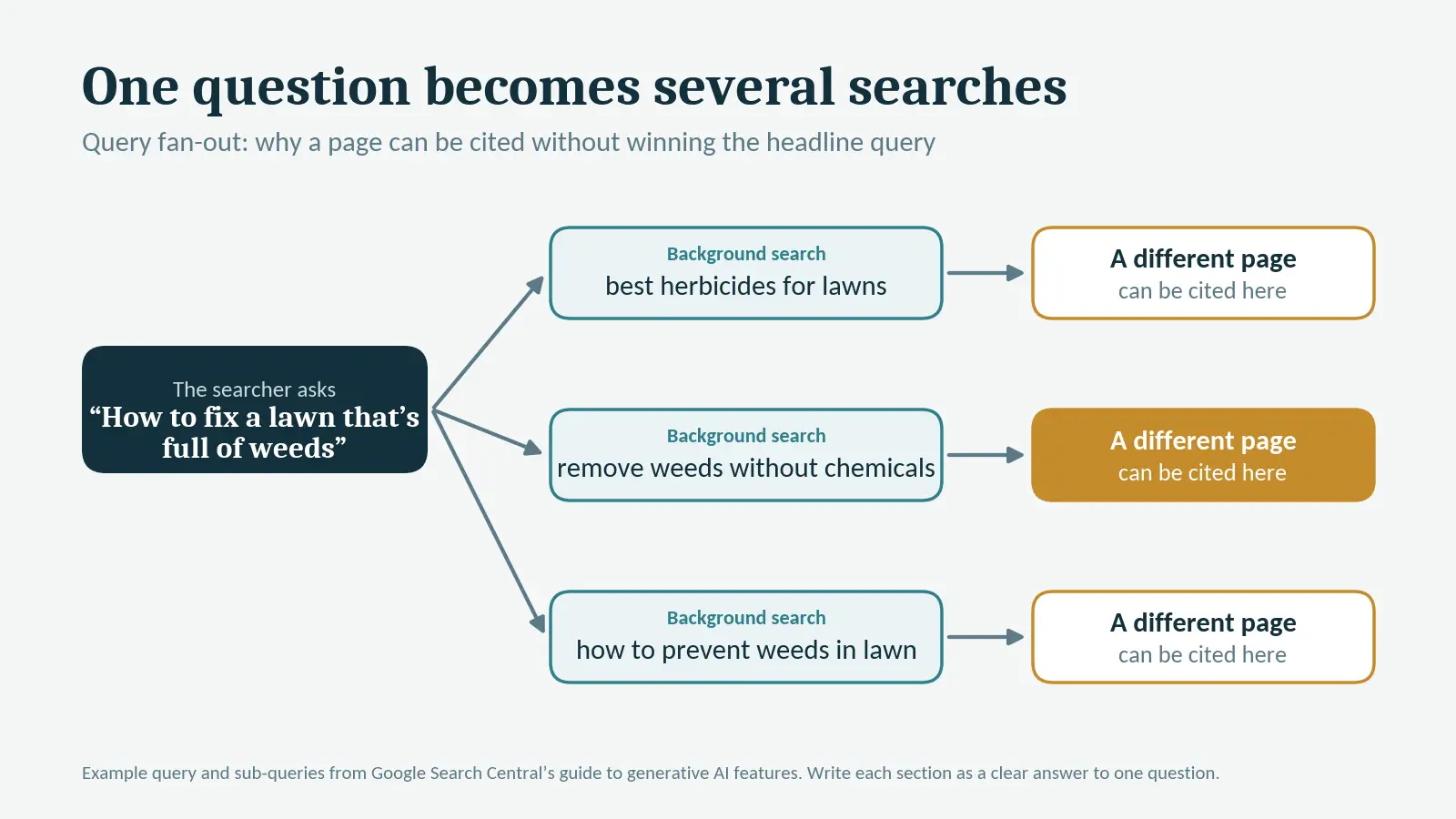
The consequence is practical. A page can be cited for a sub-question it answers well, even if it never wins the headline query. Write each section so it stands alone as a clear answer to one question.
Five Moves That Make a Page Worth Quoting
Google AI Overviews optimization starts with an unglamorous truth: Google says SEO best practices still apply, because its AI features rest on its core ranking and quality systems.
Marketers label the work generative engine optimization (GEO) or answer engine optimization. Google’s view is that it remains SEO. Within that frame, five habits stand out.
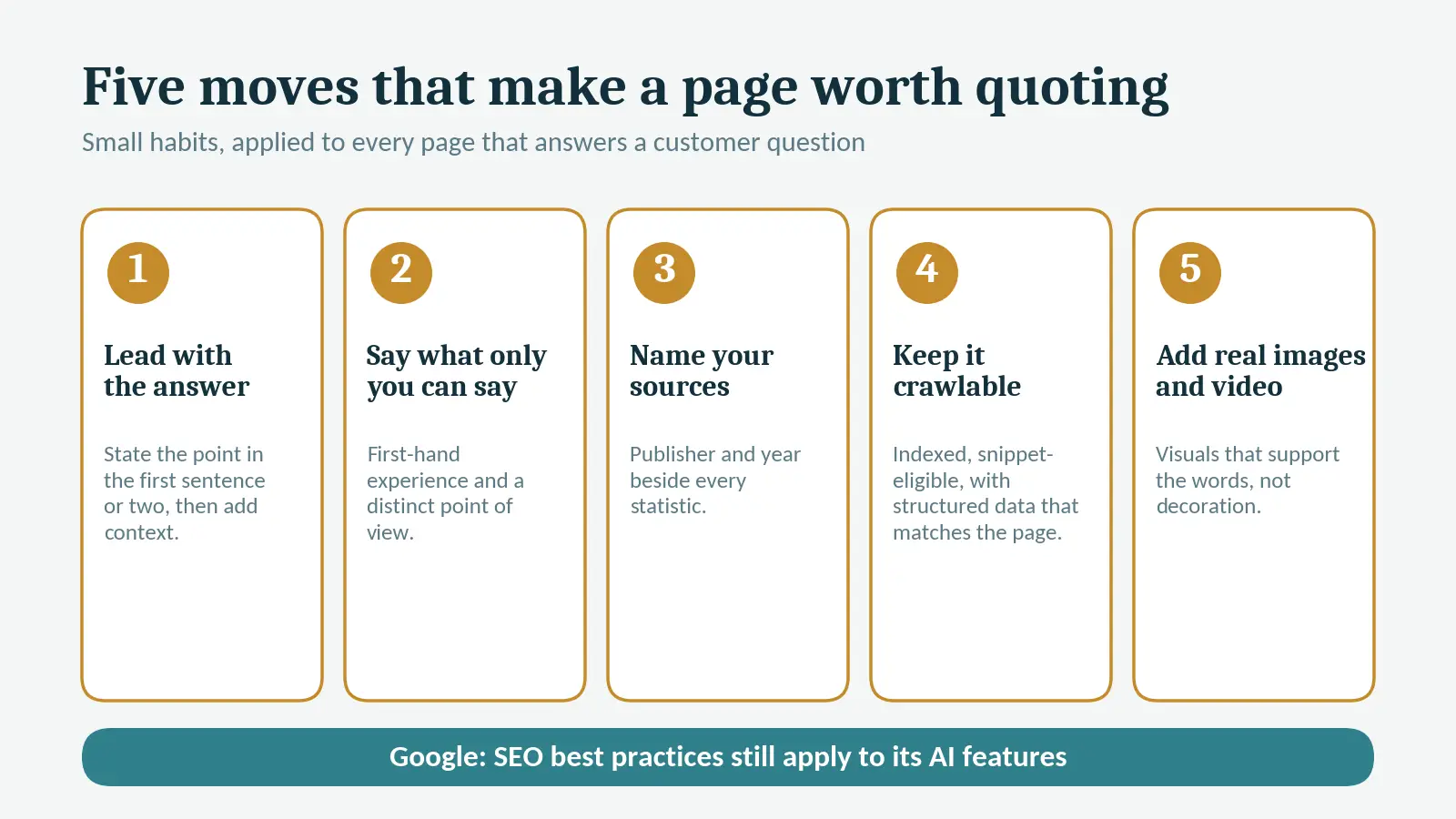
Lead each section with the answer. State the point in the first sentence or two, then add context. People and machines both find it faster.- Say something only you can say. Google asks for non-commodity content: first-hand experience and a distinct point of view, not a restatement of what already exists.
- Name your sources. Attribute statistics to a publisher and a year, so every claim can be checked.
- Keep the page crawlable. It must be indexed and eligible to appear with a snippet. Structured data helps, but it is not required and it must match the visible text.
- Support the words with real images and video. YouTube made up nearly 6% of AI Overview citations in Ahrefs’ dataset.
Here is the first habit in practice. A citation titled “Our Process” that opens with a paragraph about your mission gives a summary with nothing to quote.
The same section opening with “We work in four stages: discovery, plan, build and review” hands over a sentence that stands on its own, with detail following underneath.
Google’s guide is equally blunt about myths. For Google Search, you do not need text files, content chopped into tiny chunks, copy rewritten purely for machines or manufactured brand mentions. Other AI platforms may behave differently, so treat that advice as specific to Google.
Which Pages Should You Fix First
Start where customers decide. Service pages, process explainers, pricing guidance and the questions your sales team hears every week come first, because those are the queries where a citation turns into an enquiry.
Blog posts that restate common knowledge come last. Google calls that commodity content and it is the kind a generative model could easily produce without you. Ask one question of every page: would a customer repeat this sentence to a colleague?
Pick one service page this week and rewrite the opening of every section so it answers its own question outright. If you would like a second opinion on what to change first, Citadel Coworkers is glad to look it over with you.
Where AI Genuinely Helps And Where It Cannot Be Trusted
None of this is an argument against AI. It is a capable colleague for repetitive work. APQC research, cited in a recent Precoro guide, puts invoice error rates at roughly 2% under manual processing and below 0.8% with automation.
Drafting outlines, grouping customer questions and spotting inconsistencies across pages are similar jobs where speed and patience beat fatigue.
Trust is a separate question. In April 2026, the New York Times, working with AI startup Oumi, tested 4,326 queries and found AI Overviews answered correctly about 91% of the time with Gemini 3.
That still leaves roughly one answer in ten wrong, including mistakes on health topics. Google disputed the method, saying it does not reflect real searches. Separately, McKinsey’s 2026 survey of 1,719 respondents reports inaccuracy as the most commonly cited negative outcome of AI use.
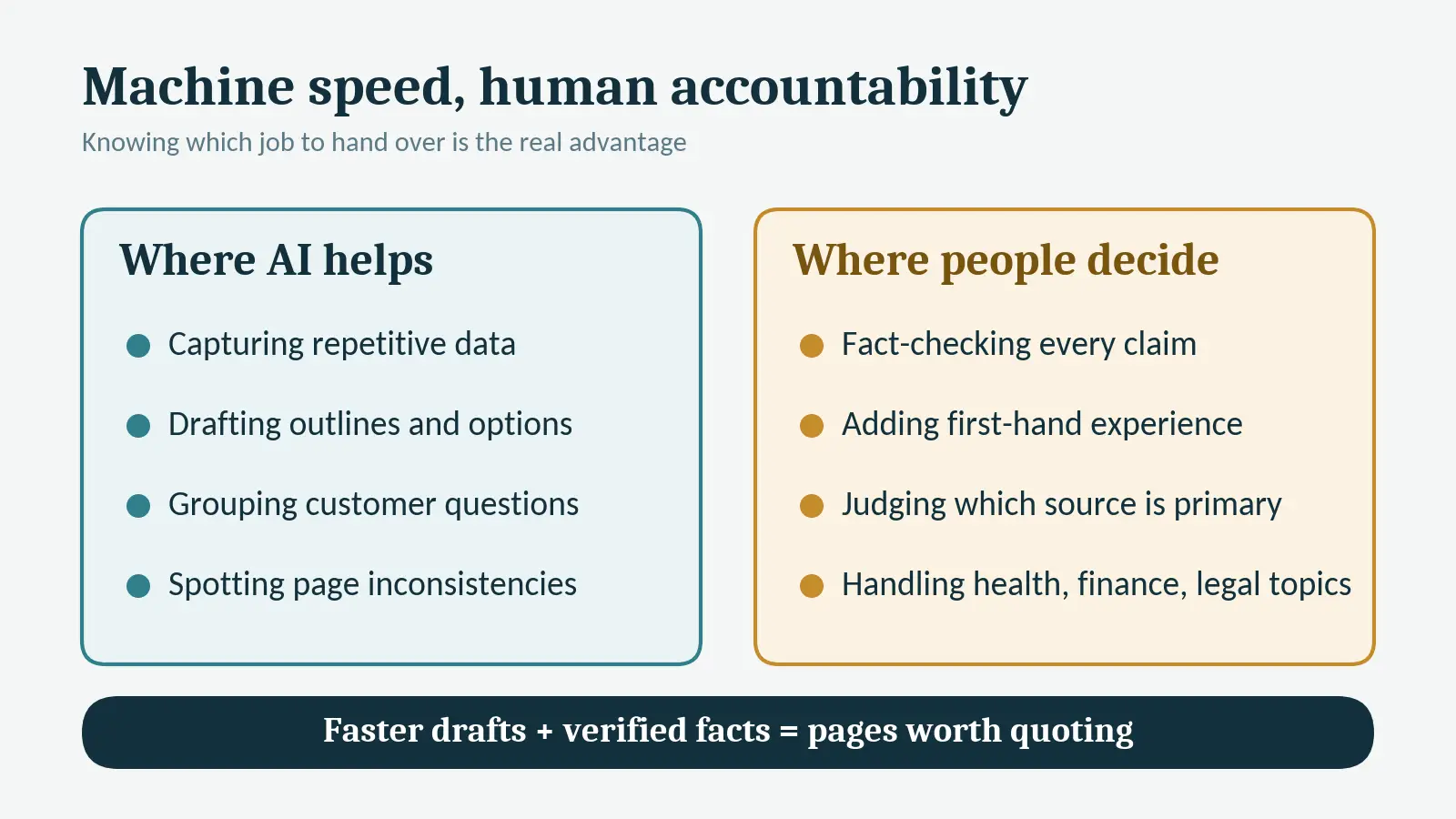
Google’s own guidance warns that AI-generated content can contain inaccuracies and should be fact-checked before it is published. That is where human judgment earns its place: deciding whether a statistic is current, whether a source is primary, what your experience adds and what a client needs to hear.
In health, finance and legal topics, a confident error carries real cost. A model cannot sit across the table from a client and sense which answer they are actually afraid to ask for.
AI Overviews reward exactly that kind of non-commodity thinking. So the advantage belongs to teams who pair machine speed with human accountability. Confidence about AI is not suspicion of it. It is knowing which job to hand over.
How Long Does It Take to Get Cited
Nobody can promise a timeline. Google states that meeting the technical requirements and following best practices does not guarantee a page will be crawled, indexed or served. Treat any fixed deadline offered by an agency as a warning sign and plan for steady work rather than an overnight result.
How to Tell Whether Your Efforts Are Working
Start with the Generative AI performance report in Google Search Console, which shows how your content performs in AI features on Search and Discover.
Then, for questions your customers truly ask, track three things: how often an AI Overview appears, how often it cites you and which pages earn the citation. Then compare the pages that earn citations with the ones you expected to.
Be wary of tools claiming access to Google’s internal metrics. Google says no third-party tool has it and any promise of guaranteed AI search optimization results deserves the same caution. Treat Google AI Overviews optimization as a monthly habit, not a one-off campaign.
Why Businesses Choose Citadel Coworkers When They Want to Be the Answer
Plenty of teams can define an AI Overview. Fewer will tell you what to leave alone. Citadel Coworkers approaches visibility the way this guide does: begin with what Google itself says, test it against evidence and keep a person accountable for every claim that goes live. That includes saying so plainly when a popular tactic is more hype than help.
Businesses tend to value three things in that approach:
- Clarity over hype: plain advice on what matters and what does not.
- Judgment over automation: AI speeds the drafting, while people own the facts and the point of view.
- Fit over formula: recommendations shaped around your services, audience and capacity.
If that is the kind of partner you have been looking for, explore how Citadel Coworkers can help your team plan its next step. A conversation costs little and often clarifies a lot.
Start With the Page Your Customers Reach First
Go back to that search. The source cards are small, yet they are where customers now begin to decide whom to trust. You will not earn that place with a trick. You earn it by being the page that answers clearly, backs its claims and shows real experience. Begin with one page this week. The brands people meet inside tomorrow’s answers are the ones doing this work patiently today.