Blog

  • Why Proprietary Research Data Is Citadel Coworkers’ Blueprint For Brand Differentiation in the AI Search Era

    Why Proprietary Research Data Is Citadel Coworkers’ Blueprint For Brand Differentiation in the AI Search Era

    Key Takeaways

    • Generic advice is being erased by AI-generated summaries. Proprietary data is the one asset that can’t be flattened into someone else’s answer.
    • AI search tools reward primary sources with real numbers over recycled tips, which makes original research central to how brands get discovered today.
    • One well-documented internal metric can outperform a long “ultimate guide” for both rankings and buyer trust.
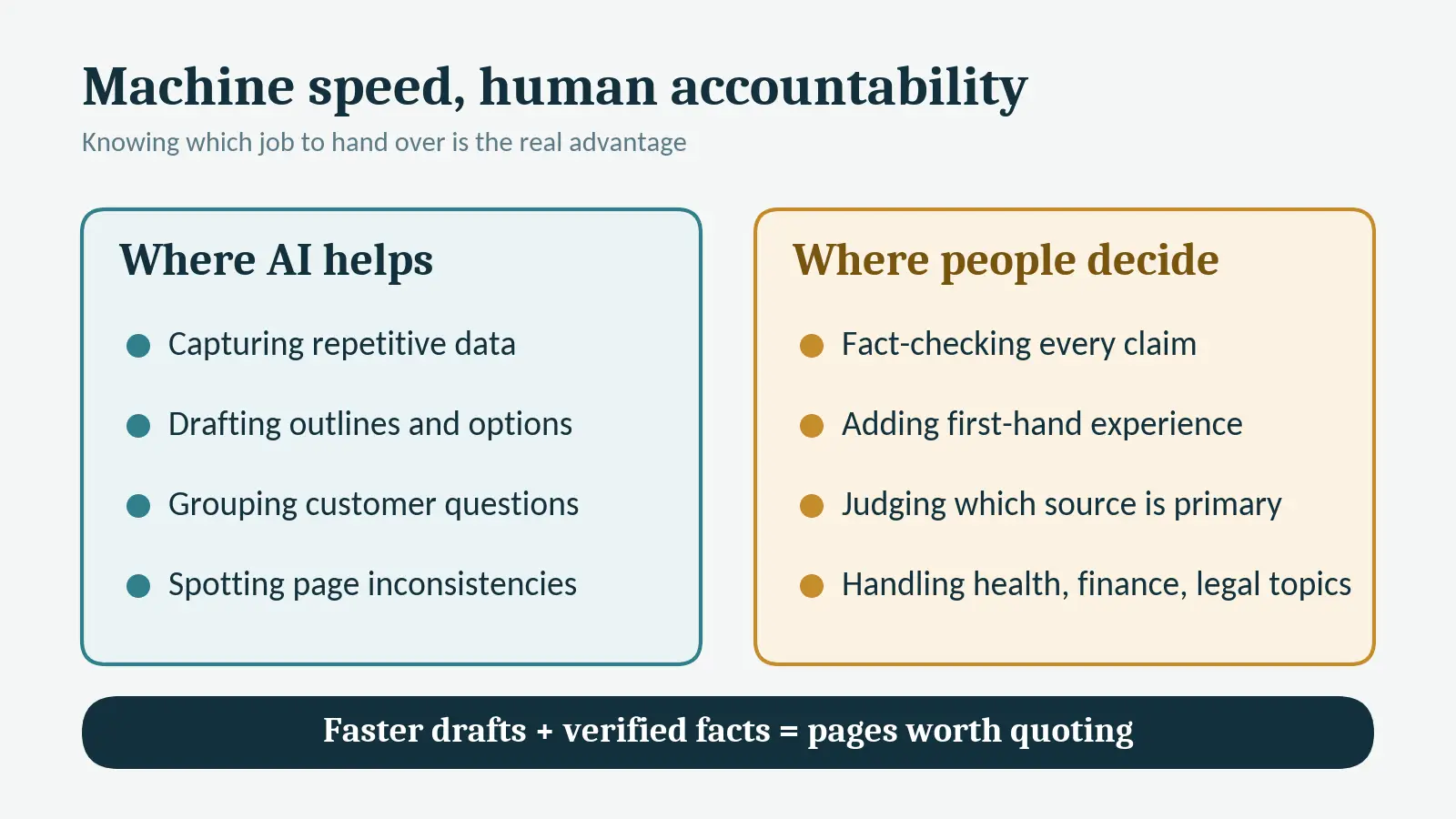
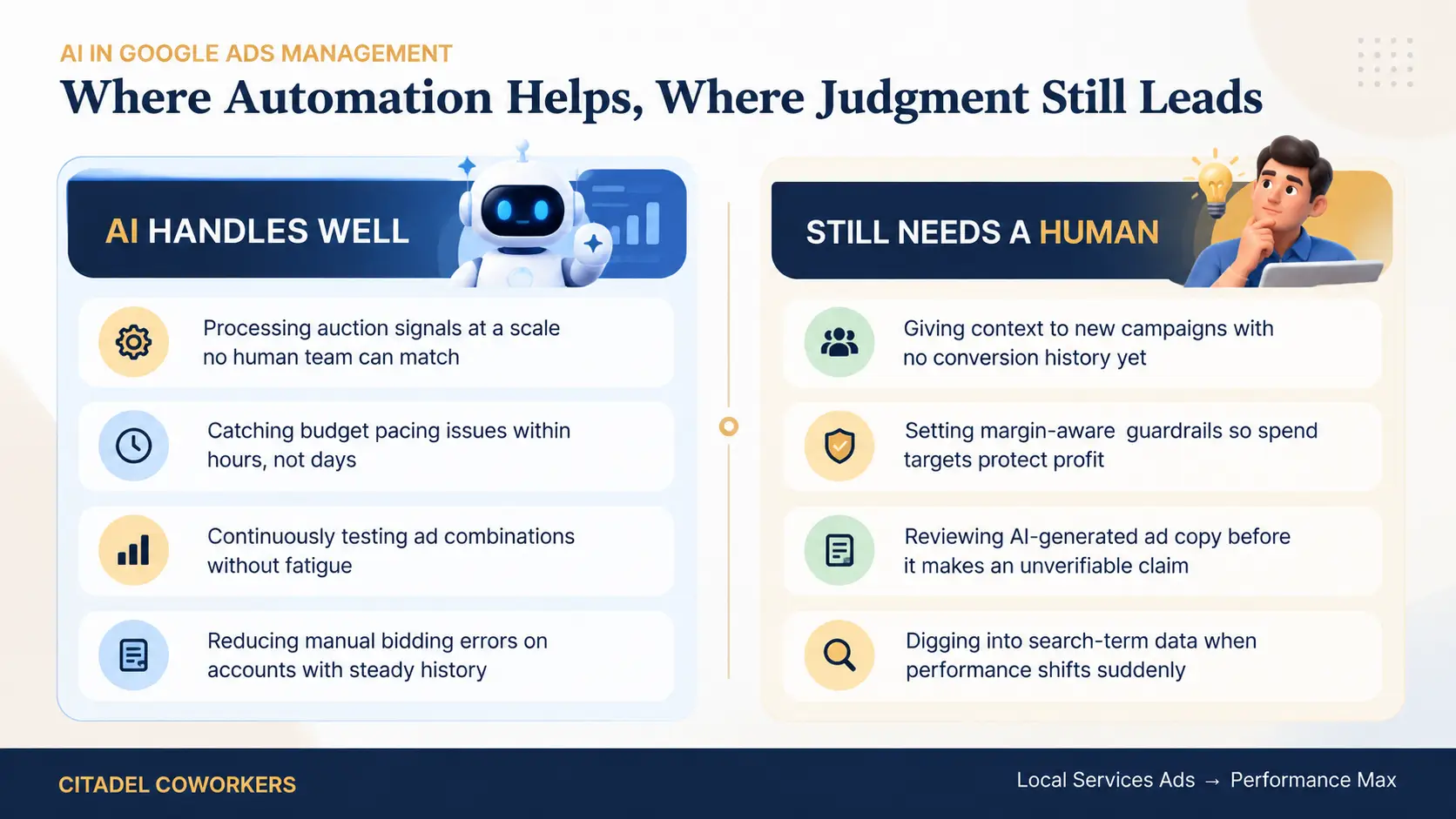
    • AI speeds up data cleaning, pattern-spotting and formatting, but interpreting what a finding means for a specific business still needs an experienced person.
    • Citadel Coworkers builds research-backed programs that turn a client’s own data into citable, ownable brand authority.

    Search has never had less friction and it has rarely delivered less that feels genuinely new. Ask almost any question and answers arrive by the thousand, most of them repeating each other in slightly different words. For a brand trying to be noticed in that noise, saturation itself has become the obstacle. Sounding credible isn’t enough when every competitor sounds credible in exactly the same way.

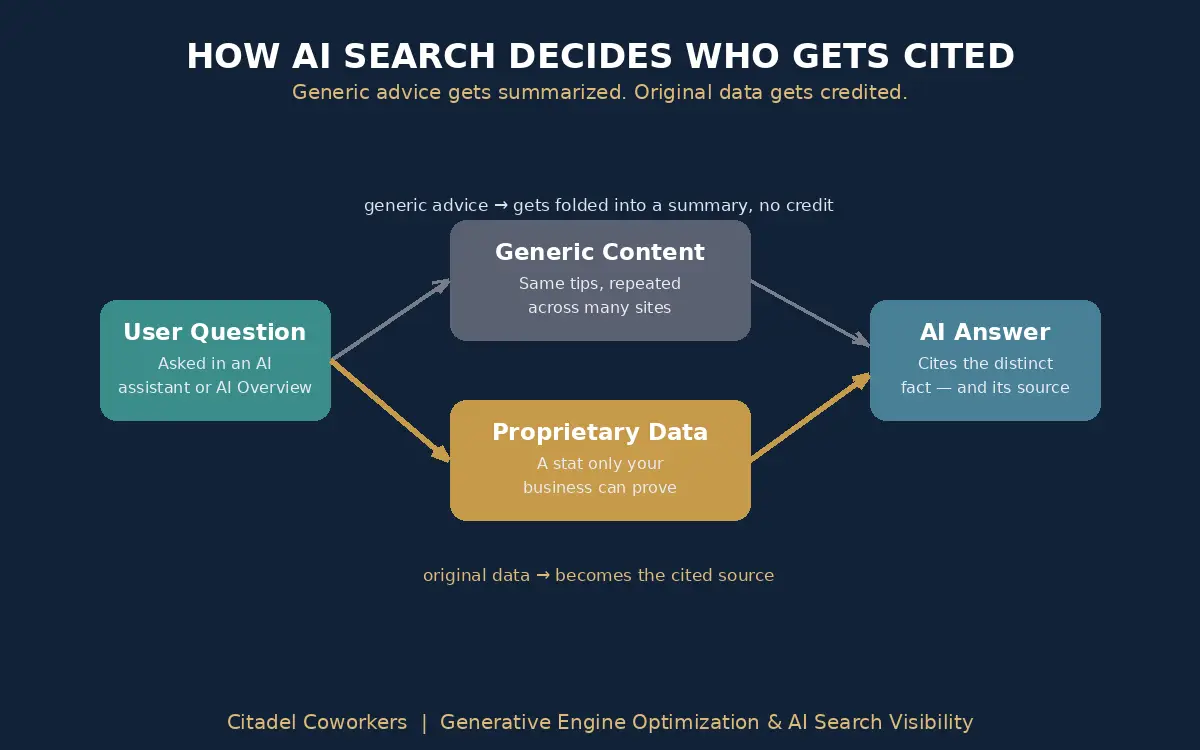
    AI has sharpened that problem rather than solved it. Search and answer engines now synthesize responses on the spot and when dozens of articles offer the same generic tips, the AI blends them into a single answer and quietly drops the redundant sources. Most content marketing produced today, however well-written, disappears into that blend, because it doesn’t say anything an algorithm hasn’t already read a hundred times.

    To be remembered, by readers and by the systems now answering on their behalf, a brand needs to publish something that cannot be blended away: its own proprietary research. That’s the discipline Citadel Coworkers builds its content programs around.

    The Content Glut Problem: Why Sounding Like Everyone Else Costs You the Sale

    Every industry now has a version of this problem. Search a topic and you’ll find dozens of articles making the same three points in a different order, wrapped in a different logo. Buyers have grown numb to it and increasingly so have the algorithms reading it.

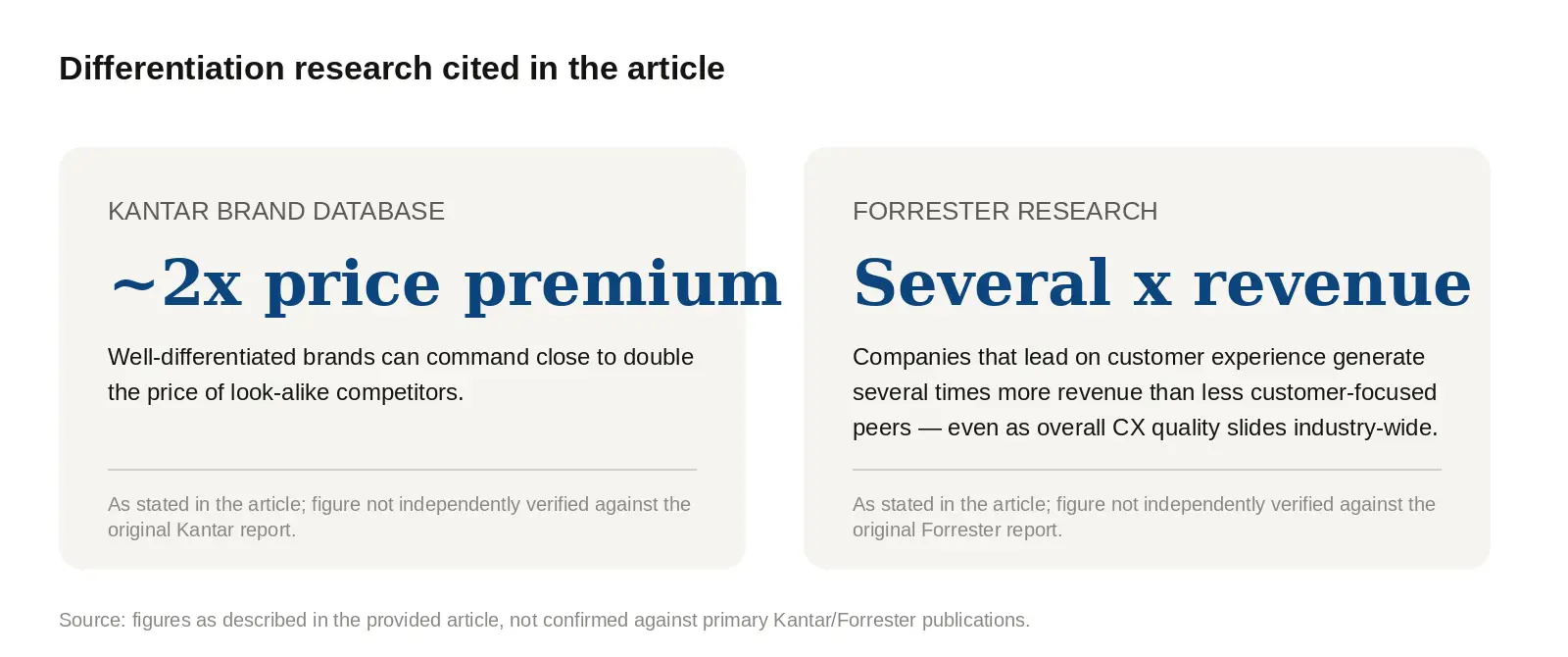
    The commercial cost is real. Research from Kantar’s global brand database points to a strong link between how distinct a brand feels and how much a customer will pay for it, with well-differentiated brands able to command close to double the price of look-alike competitors. Standing out isn’t a branding nicety anymore. It’s a pricing lever.

    Tust Citadel Coworkers

    Forrester’s research tells a similar story from the experience side: companies that lead on customer experience generate several times more revenue than less customer-focused peers, yet overall experience quality has been sliding industry-wide. Everyone is chasing the same differentiator at the same time, using the same generic playbook. That’s precisely the environment where proprietary data stops being a nice extra and starts being the deciding factor.

    How AI Search Engines Decide Which Brand Gets Credited

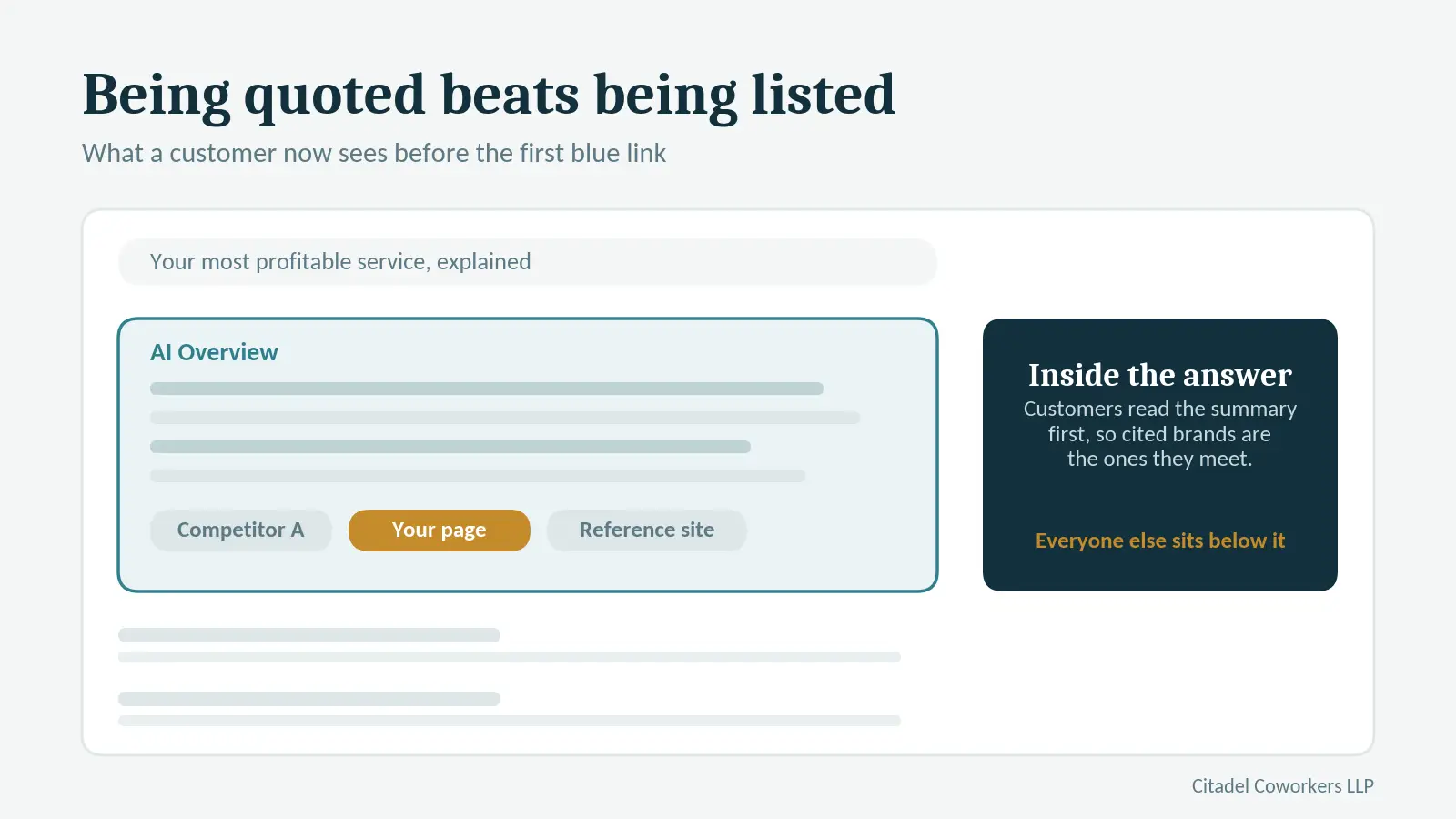
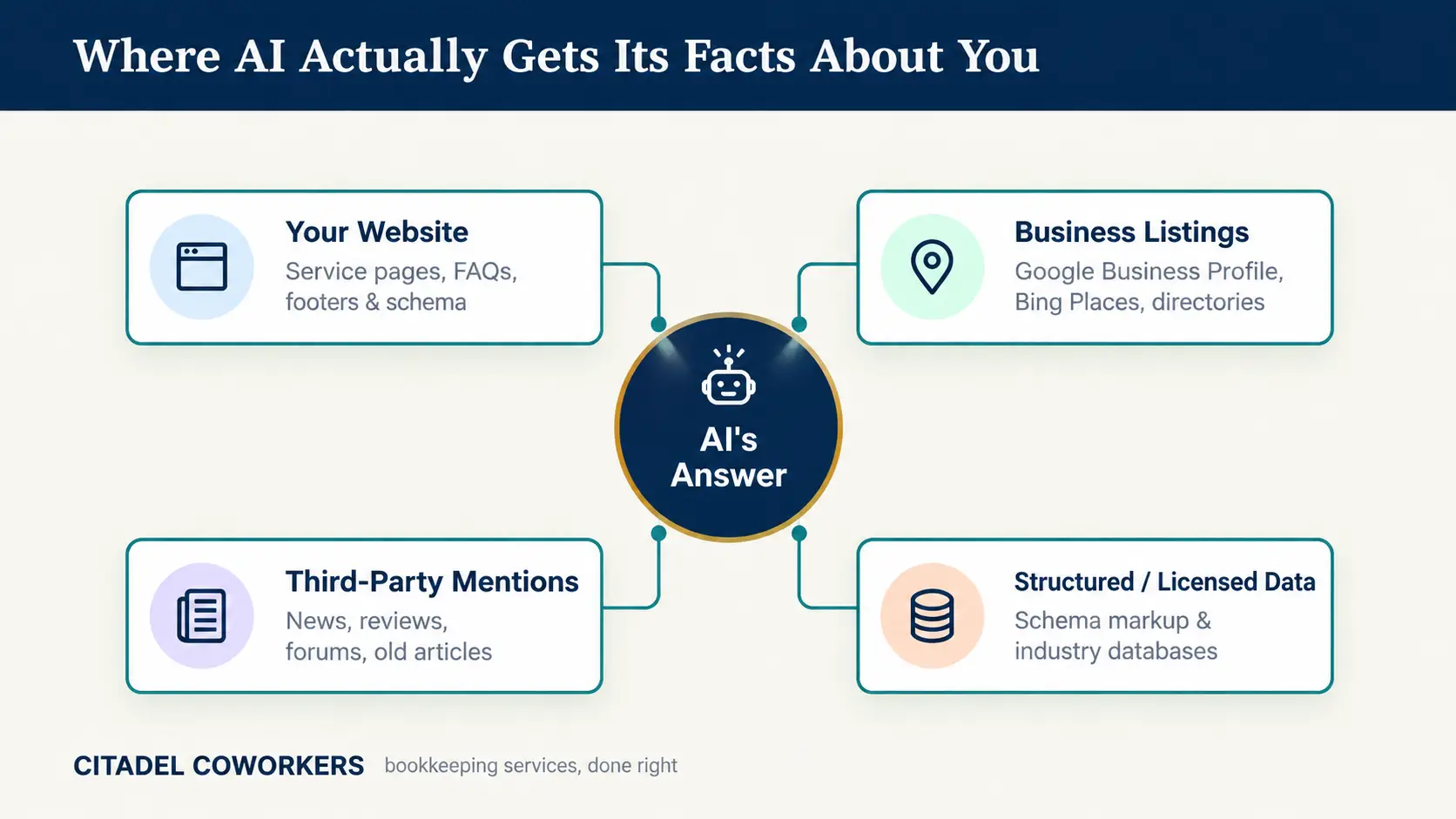
    When someone asks an AI assistant a question today, the system isn’t reading your page the way a person does. It’s running a retrieval process that pulls the most relevant, credible material to ground its answer, then writes a synthesized response, often without sending a single click back to any one source.

    Tust Citadel Coworkers

    That process rewards specificity. If ten companies all say “response time matters for customer satisfaction,” an AI engine will compress that into a generic statement and cite no one in particular. But if your business states that its own analysis of client support tickets found a measurable link between first-reply time and renewal rates, there’s nothing to compress. The AI has to attribute the number to you.

    This is the core idea behind generative engine optimization: structuring content so that AI systems have a reason to name your brand instead of averaging it away. Industry analysis suggests that content built around cited statistics and original findings performs meaningfully better in AI-generated answers than purely descriptive writing. For a brand thinking seriously about AI search visibility, that’s not a footnote. It’s the strategy.

    What Counts as Proprietary Data

    Proprietary research data is any information a business generates through its own operations, client relationships or original testing that doesn’t already exist anywhere else publicly. It’s not a press release restating an industry report; it’s a number that only exists because you measured it.

    Tust Citadel Coworkers

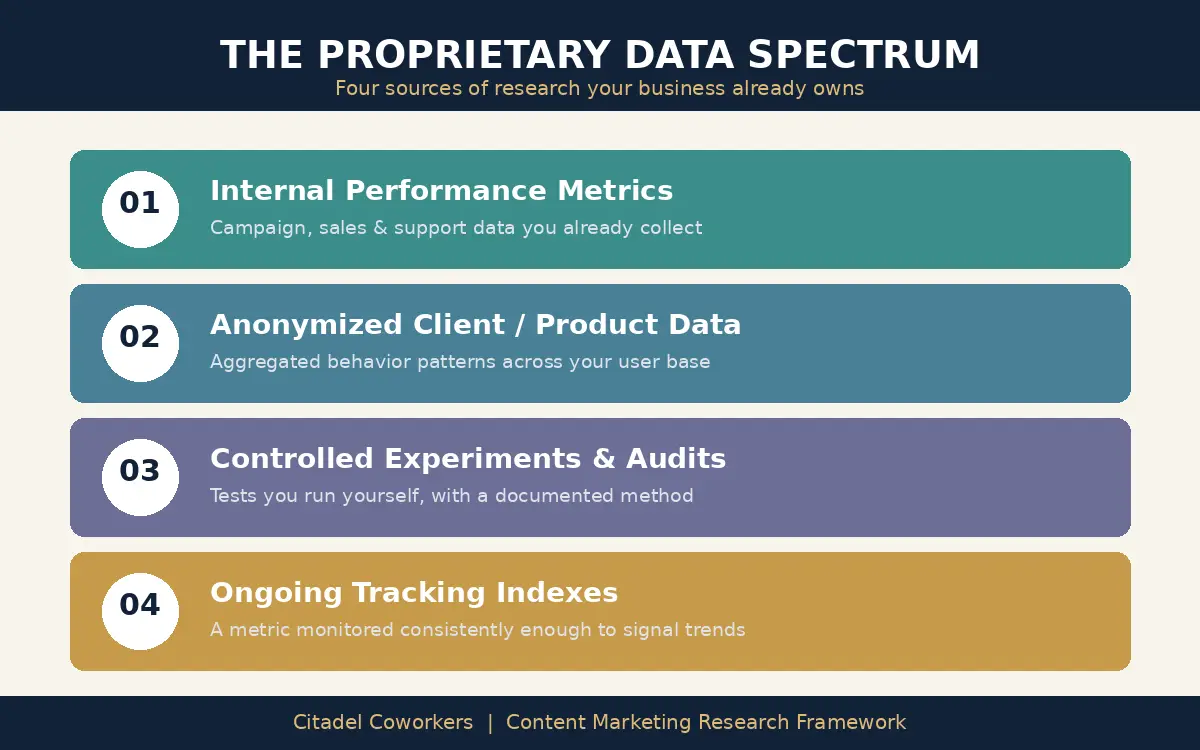
    In practice, this tends to show up in a few recognizable forms:

    • Internal performance metrics- patterns pulled from your own campaigns, sales cycles or support logs.
    • Anonymized client or product data- usage trends aggregated across your customer base.
    • Controlled experiments- a test you ran yourself, with a documented method and a real result.
    • Ongoing tracking indexes- a metric you monitor consistently enough that people start watching it for signal.

    None of these require a data science department. They require noticing what your business already produces and deciding to publish it responsibly.

    Turning Internal Numbers Into a Content Marketing Strategy That Compounds

    Most companies sit on more usable data than they realize; it’s scattered across CRMs, support platforms and spreadsheets nobody has opened since the last audit. The work isn’t collecting new data. It’s noticing what’s already there.

    At Citadel Coworkers, research engagements rarely start with a survey. They start with an audit: what does this client’s operational data already show that nobody outside the company has ever seen? That single question usually produces more publishable material than a quarter’s worth of trend-chasing blog posts.

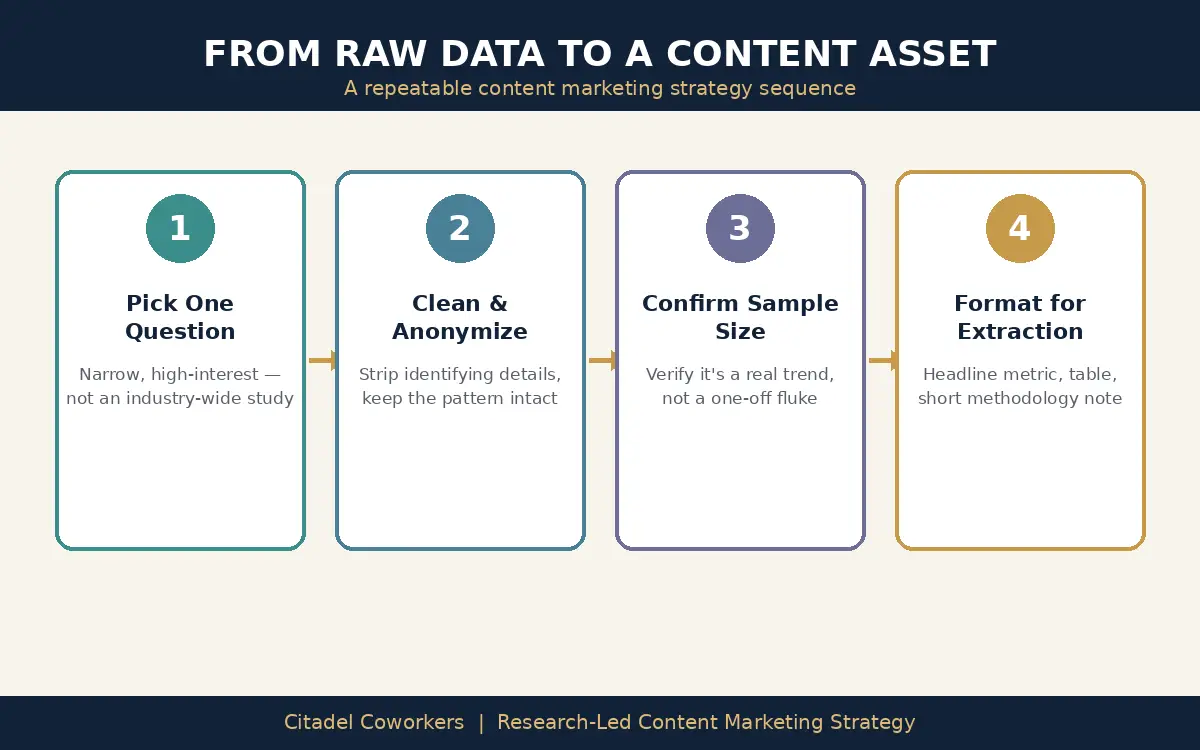
    From there, a durable content marketing strategy follows a simple sequence:

    Tust Citadel Coworkers
    • Pick one narrow, high-intent question your buyers actually ask, not a sprawling “state of the industry” report.
    • Clean and anonymize the dataset so no individual client or user is identifiable.
    • Confirm the sample is large enough to represent a real pattern, not a fluke.
    • Present the finding with a clear headline number, a short methodology note and a scannable table, so both readers and AI systems can extract it in seconds.

    Done consistently, this turns a single data asset into a recurring content engine, one that competitors can reference but never actually replicate.

    Where AI Speeds You Up And Where It Can Quietly Get You Wrong

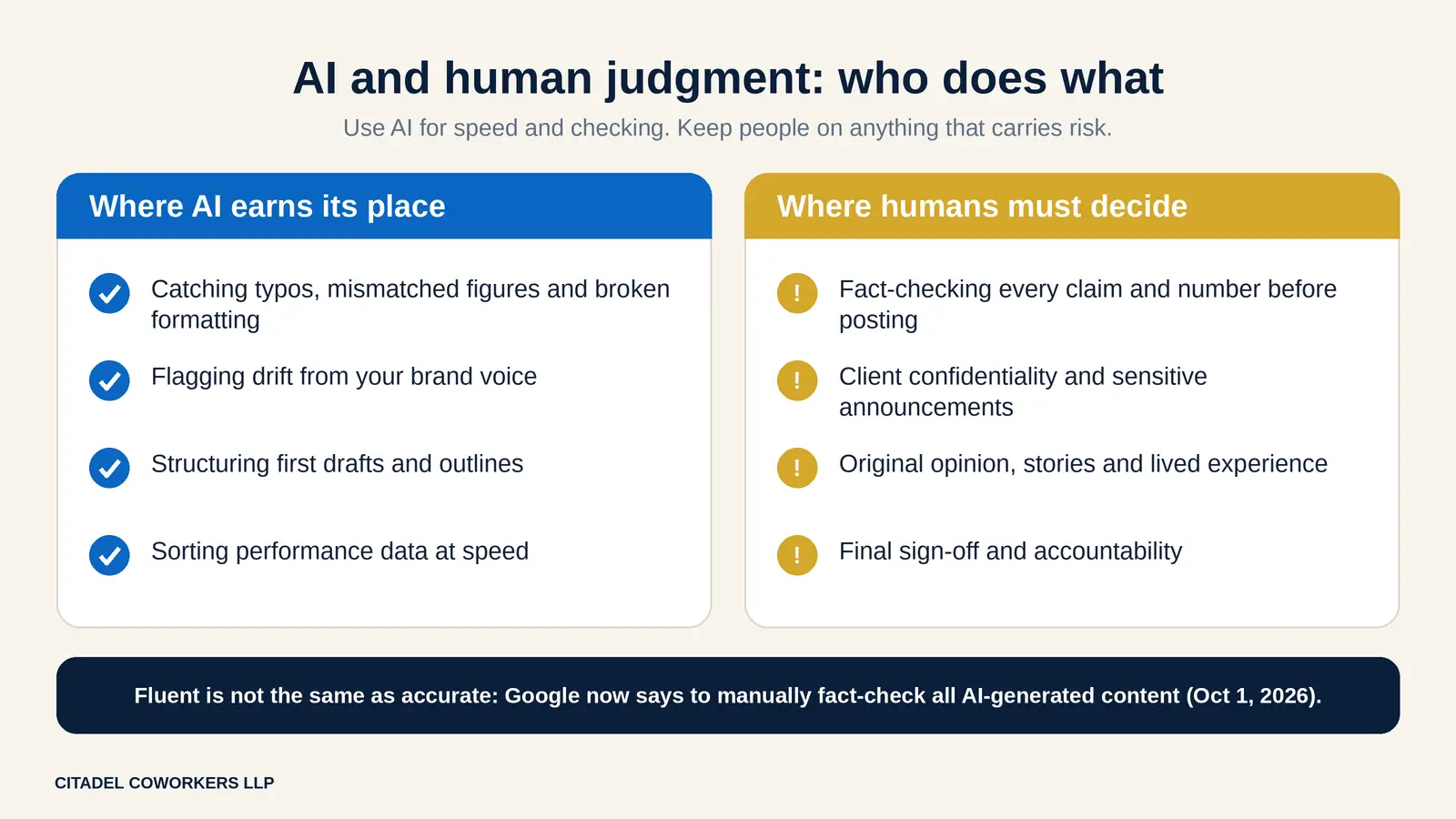
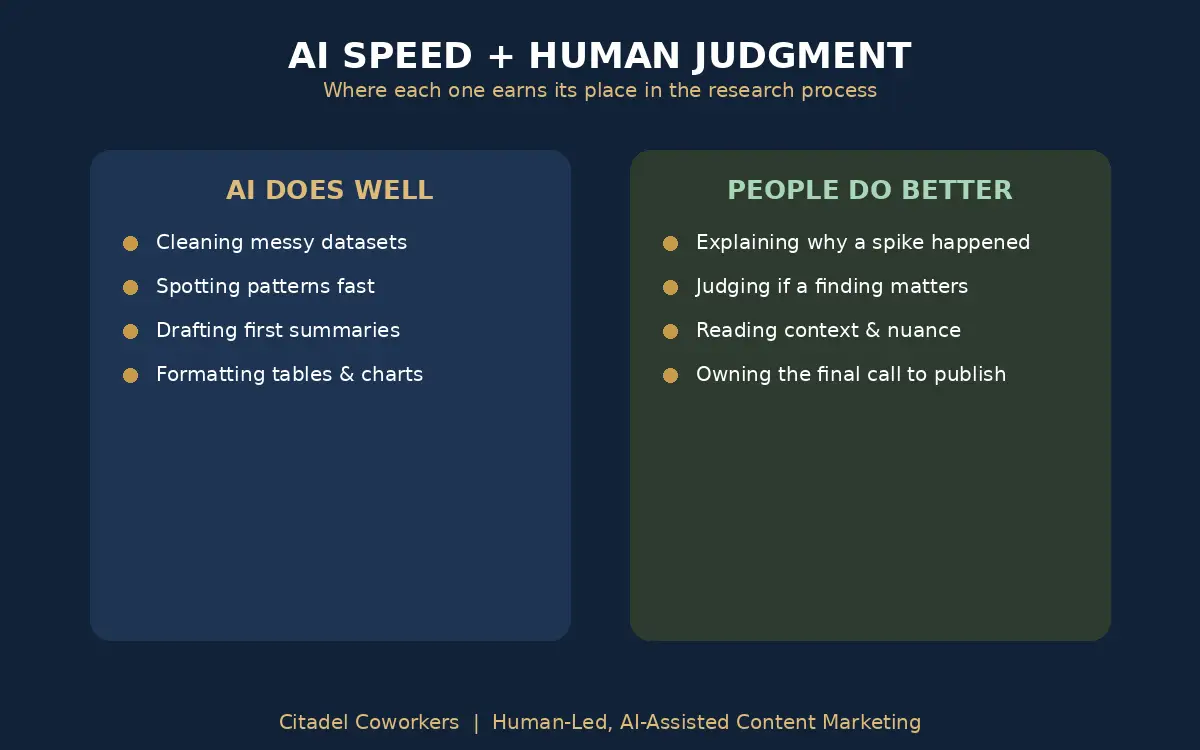
    AI has become genuinely useful in the research-to-content pipeline. It can clean messy exports, flag outliers, draft first-pass summaries and reformat a dense dataset into a readable table in minutes rather than hours. Marketers using AI well report meaningful time savings on exactly this kind of repetitive work, which frees up hours for the judgment calls that actually move a campaign forward.

    Tust Citadel Coworkers

    The trouble starts when that speed gets mistaken for understanding. An AI model can spot a correlation in a dataset, but it doesn’t know that the spike in March was a one-off promotion or that a client’s numbers looked unusual because of a platform migration that month. It also can’t tell you whether a finding is interesting enough to build a campaign around or whether it contradicts something a client told you off the record last week. That reading of context is still a human skill.

    There’s a brand-trust dimension too. A growing share of consumers say they’re less likely to choose a brand whose marketing feels visibly AI-generated and audiences are getting sharper at spotting content that’s fluent but hollow. The businesses getting this right aren’t avoiding AI. They’re using it for speed while keeping a person accountable for accuracy, tone and the final call on what actually gets published.

    Why Businesses Choose Citadel Coworkers For Research-Led Content Marketing

    Plenty of agencies offer content marketing services built around keyword lists and publishing calendars. Fewer are built around the harder, more valuable work of turning a client’s own operational data into something genuinely citable.

    Citadel Coworkers pairs research discipline with editorial craft: a methodology gets checked before a headline gets written and every dataset is reviewed by someone who understands both the client’s industry and how AI systems now evaluate sources. That combination is why clients stay for the second and third research cycle, not just the first campaign.

    If you’re curious what might already be sitting inside your own reporting dashboards, that’s a conversation worth having before your next content calendar gets planned around someone else’s ideas.

    From One Data Point to a Defensible Market Position

    Differentiation built on proprietary research compounds in a way that opinion-based content never can. Every quarter you track a metric, the dataset gets more credible and harder for a competitor to dismiss. Every citation an AI engine or journalist pulls from it reinforces your brand as the source, not a summary of someone else’s source.

    None of this requires a research team or a six-figure study. It requires an honest audit of what your business already knows, a willingness to publish it clearly and a partner who treats content marketing as a research discipline rather than a publishing schedule. Consider starting with the one question your customers ask most often; the answer may already be sitting in a spreadsheet you haven’t opened this month.

    The internet will keep producing endless variations of the same advice. What it can’t produce is your data. In a search landscape where AI increasingly decides which brand gets remembered and which one gets quietly summarized away, that difference is no longer a marketing detail. It’s the whole game.

  • Is AI SEO Worth Paying For in 2026? Citadel Coworkers Breaks It Down

    Is AI SEO Worth Paying For in 2026? Citadel Coworkers Breaks It Down

    Key Takeaways

    • Search behaviour has genuinely shifted: a large and growing share of Google queries now end without a click and AI platforms increasingly answer the question before a user ever visits a website.
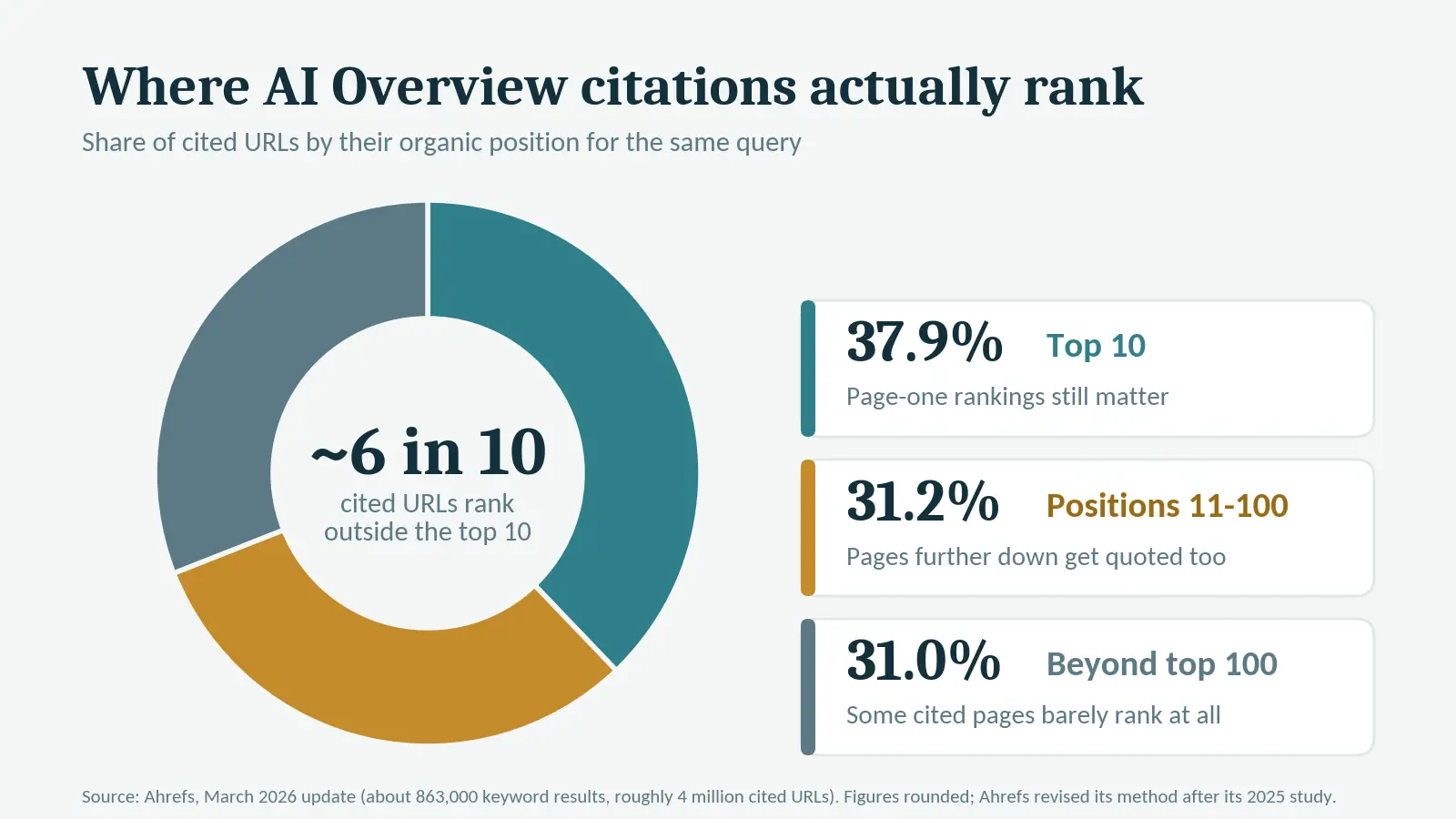
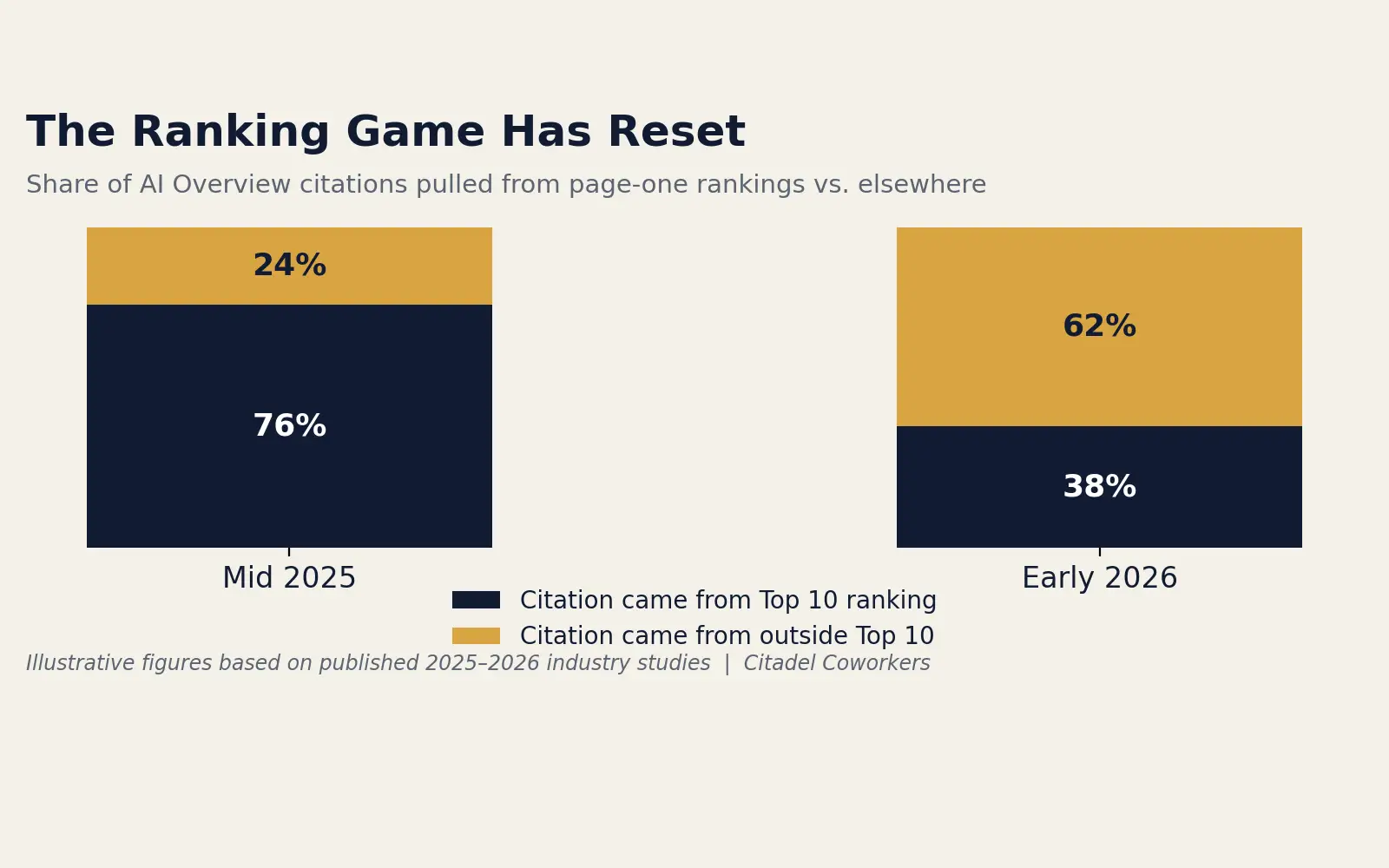
    • Ranking #1 no longer guarantees visibility. A shrinking share of AI citations comes from pages sitting in the traditional top 10, which means the competitive field has been reshuffled.
    • Paying for this kind of optimisation makes sense when it is built on a real content and technical foundation, not sold as a shortcut. The businesses winning right now are pairing automation with human editorial judgment, not replacing one with the other.

    AI SEO is everywhere right now. It’s impossible to escape the topic. Every agency has launched a new service page for it, every industry newsletter has an opinion and every other LinkedIn post is a screenshot of a brand showing up inside a ChatGPT answer. Underneath all of that noise sits one uncomplicated question: does this actually work and is it worth paying for yet?

    At Citadel Coworkers ,we hear a version of that question from a business owner almost every week, usually someone who just noticed an unfamiliar referral source in their analytics or someone tired of agencies promising “AI visibility” without being able to explain what they actually did to earn it. This piece skips the hype and gives you the honest version: what’s genuinely working, what’s still unproven and how to decide where it fits in your budget. That’s exactly where most business owners are standing right now with AI SEO.

    Why the Ground Beneath Search Has Actually Moved

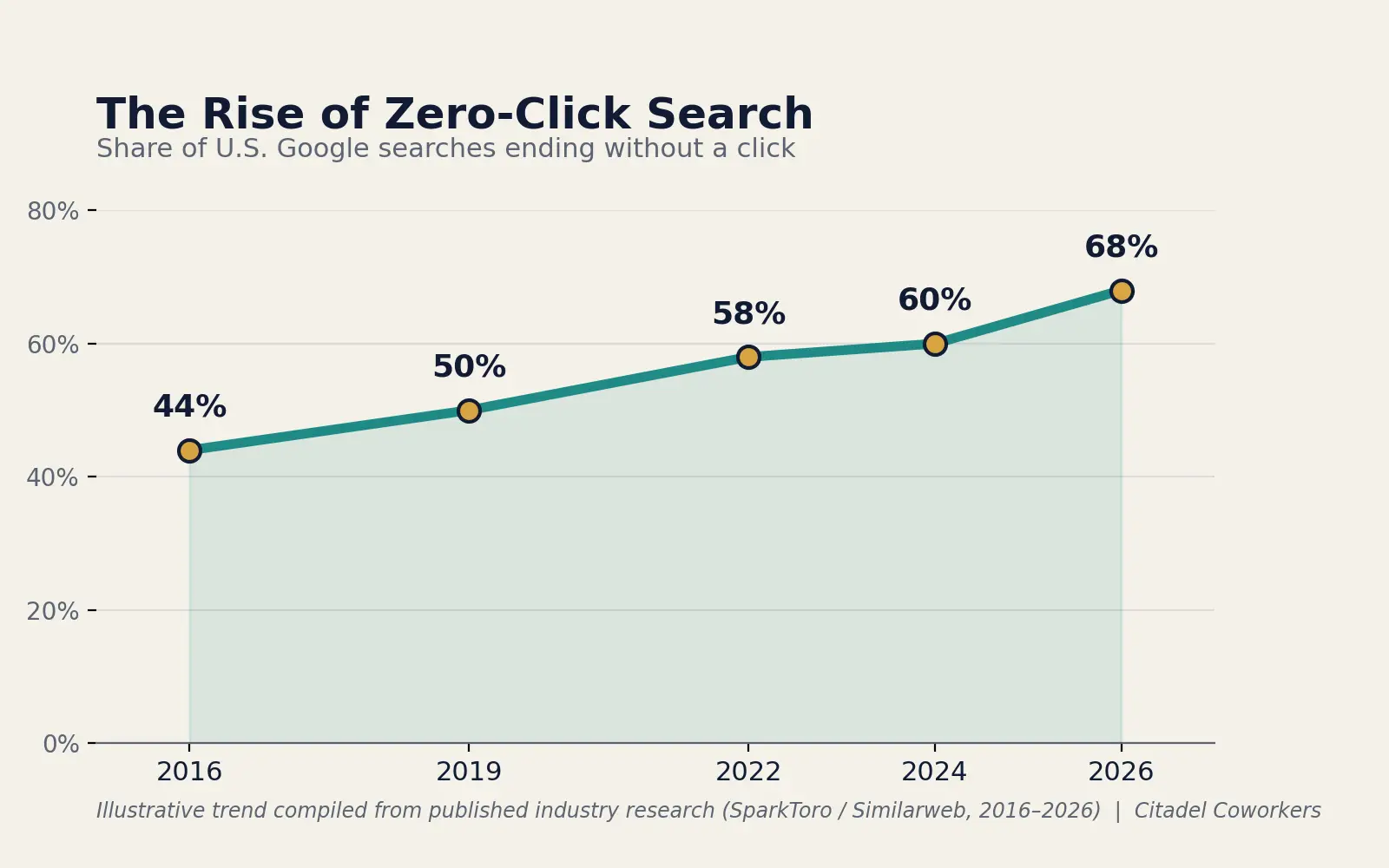
    For two decades, ranking on page one of Google was the whole game. That game hasn’t disappeared, but it has been joined by a second one: a large and rising share of searches, well over half by most recent industry estimates, now resolves without a single click, because the answer already appears on the results page or inside a chat window.

    This isn’t a fringe trend confined to tech-forward industries. Buyers researching accountants, clinics, software ad even furniture are increasingly asking ChatGPT, Perplexity or Google’s AI Overviews to summarise their options before they ever browse a website. Recent industry data suggests AI-generated overviews now touch a meaningful and growing slice of everyday searches and when they appear, far fewer users click through to any single site.

    Tust Citadel Coworkers

    For a business owner, that means visibility now depends on being cited inside an answer, not just ranked below one. This is the exact tension that AI search optimization exists to solve and it’s why the question isn’t whether to pay attention to it, but when and how much.

    What Is AI SEO

    AI SEO is the practice of optimising a website’s content, structure and authority signals so that both traditional search engines and generative AI platforms can find, understand and recommend it. It sits alongside conventional SEO rather than replacing it. The technical groundwork-site speed, clean architecture, credible content-still matters, but the target has expanded from “rank well” to “get cited and recommended”.

    Tust Citadel Coworkers

    Within that umbrella sits generative engine optimization , a narrower discipline focused specifically on earning citations inside AI-generated answers on platforms like ChatGPT, Claude and Gemini. Think of the broader strategy as the house and this one of its load-bearing rooms: distinct enough to name, but useless without the rest of the structure around it.

    How AI Is Already Reducing Errors and Sharpening Strategy

    Here’s where the honesty test really begins. AI tools have made several parts of search optimisation faster and measurably more accurate and it would be dishonest to pretend otherwise:


    • Technical audits at scale.
      AI-assisted crawlers can flag broken schema, duplicate metadata or slow-loading pages across thousands of URLs in minutes-a worry that used to take a specialist days and still missed things.
    • Content gap detection. Natural-language models can compare a site’s existing content against real query patterns, surfacing missed topics or thin pages far faster than manual research ever could.
    • Consistency checks. AI systems catch inconsistent name, address and phone data, mismatched product details or outdated claims across dozens of pages, a common source of the very errors that erode trust with both users and AI crawlers alike.
    • Pattern recognition at speed. Spotting which competitor pages are earning citations and why is a task AI can compress from days of manual comparison into a single afternoon.

    Used this way, AI isn’t replacing strategy. It’s removing the tedious, error-prone groundwork so human strategists can spend their time on judgment calls instead of spreadsheets.

    Where AI Cannot Be Trusted And Why Human Judgement Still Wins

    This is also exactly where confidence needs a ceiling. AI models can summarise a competitor’s positioning, but they cannot reliably judge tone, brand nuance or what will actually persuade a specific buyer in a specific industry. They can draft content quickly, but left unchecked, they also fabricate statistics, misattribute quotes and repeat outdated information with total confidence.

    There’s a second, quieter risk worth naming. AI platforms often cite generic, easily summarised content over genuinely distinctive expertise, simply because it’s easier to compress into an answer. A business that lets AI generate everything without editorial oversight risks becoming indistinguishable from its competitors, which is the opposite of what good marketing is supposed to achieve.

    That’s precisely why Citadel Coworkers treats AI as an accelerant for research and execution, never as a replacement for the strategist who understands a client’s market, voice and customers. The AI SEO services worth paying for are the ones where a human is still reviewing every claim, every tone choice and every fact before it goes live. Automation earns trust by being clicked, not by being unsupervised.

    Is Paying For AI SEO Actually Worth It

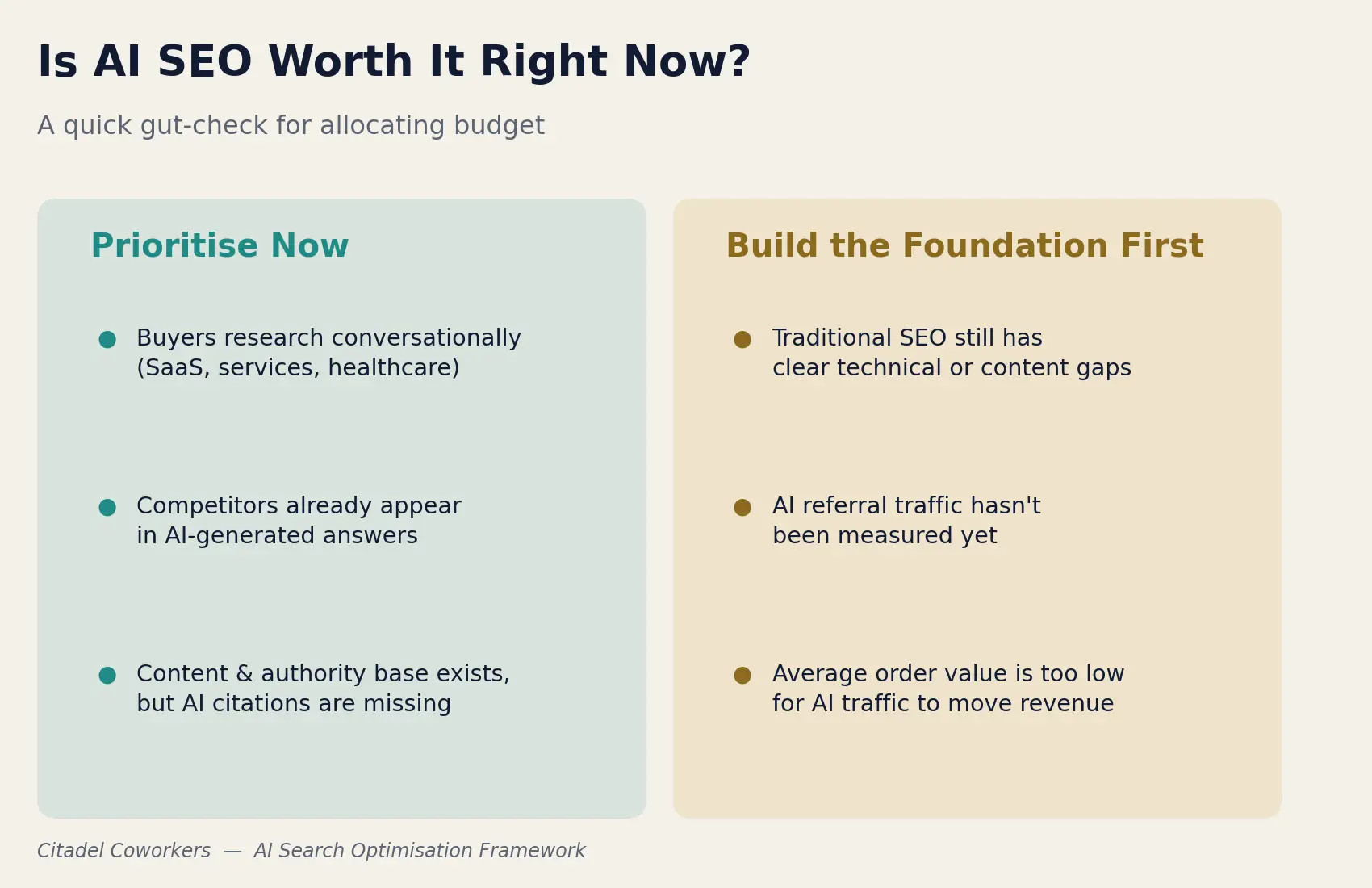
    The honest answer depends on where a business currently stands. A simple gut check helps:

    It’s likely worth prioritising now if:

    • Buyers already research the category conversationally, software, professional services, healthcare and other high-consideration purchases
    • Competitors are already appearing in AI-generated answers for relevant terms
    • The business has a decent content and authority base but isn’t showing up in AI citations yet
    Tust Citadel Coworkers

    It’s more reasonable to build the foundation first if:

    • Traditional SEO still has obvious gaps, such as thin content, technical issues or a weak backlink profile
    • AI referral traffic is currently negligible and hasn’t even been measured yet
    • Average order value is low enough that even strong AI traffic wouldn’t move revenue meaningfully

    For more businesses, this isn’t an all-or-nothing decision. It earns its place in the budget when the fundamentals are already solid enough for AI-focused work to amplify them, not invent them from scratch. Citadel Coworkers would rather tell a client to wait three months and fix their foundation than take a retainer that won’t move the needle yet.

    Why Growing Businesses Trust Citadel Coworkers With Their AI Search Strategy

    What sets an engagement apart in this space isn’t the promise of guaranteed citations. No agency controls what a language model chooses to surface and any that claims otherwise should raise a flag immediately. What matters is a partner who treats AI visibility as an extension of sound strategy, not a separate, mysterious add-on bolted onto an existing retainer.

    Citadel Coworkers approaches this by auditing where a brand currently stands across Google, ChatGPT and Perplexity before recommending a single change. That audit typically reveals quick wins, structured data gaps, missing FAQ content, and inconsistent entity signals that cost little to fix but meaningfully affect whether a brand gets mentioned at all. From there, the work blends AI-assisted research and drafting with hands-on editorial review, so content stays fast to produce and still sounds like an actual expert wrote it.

    If you’re curious where your own brand currently stands in AI-generated answers, a short visibility check is often the clearest way to find out before committing to a larger programme.

    Getting Started Without Wasting Budget

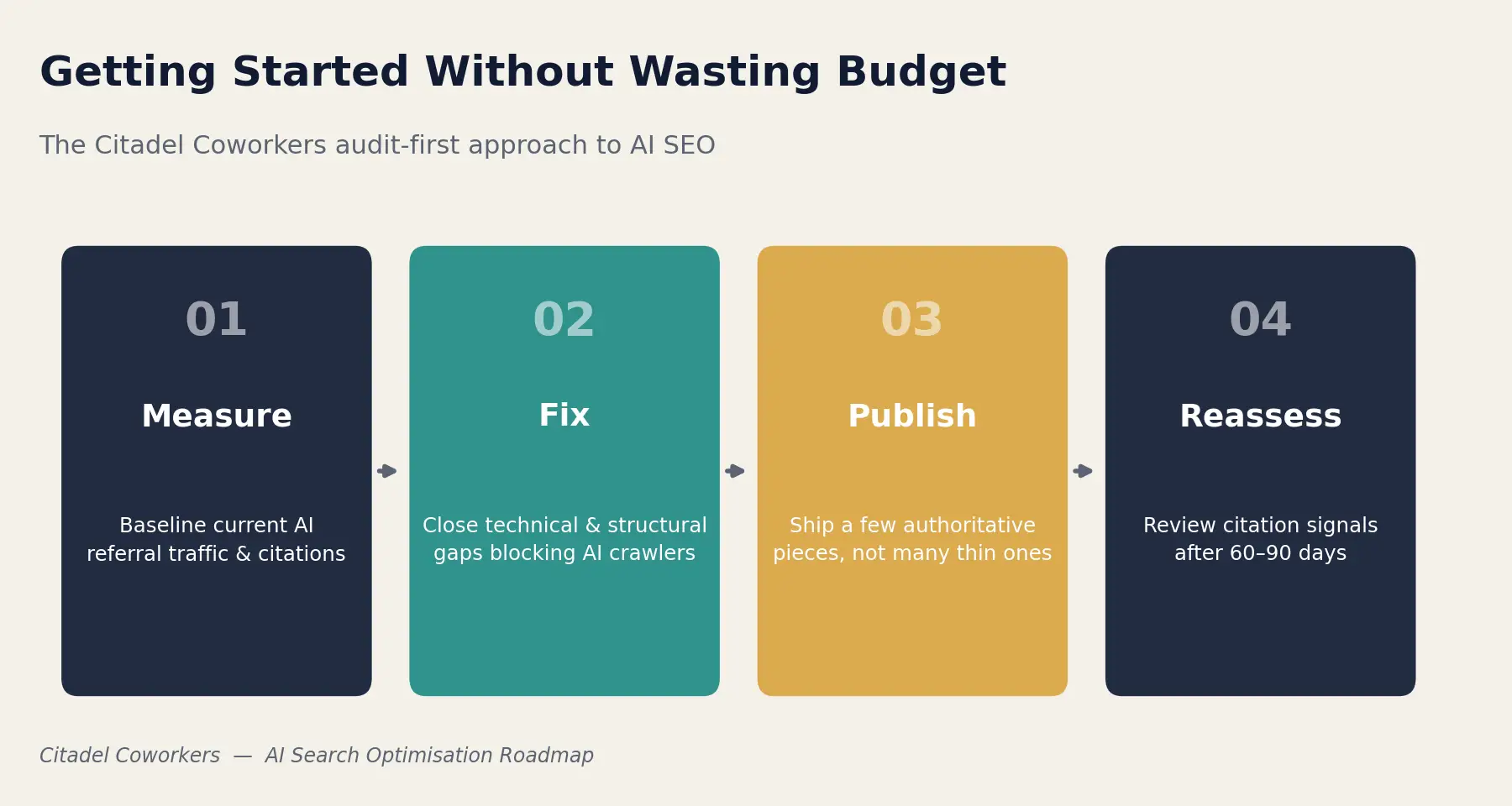
    A sensible first step rarely requires a large retainer. In practice, it tends to look like this:

    • Measure current AI referral traffic and citation appearances honestly, even if the number is small today.
    • Fix the technical and structural gaps, schema, clear headings, and factual accuracy that block AI systems from understanding the site properly.
    • Publish a small number of genuinely authoritative pieces rather than a large volume of thin, forgettable ones.
    • Reassess after 60 to 90 days, since early citation signals tend to show up before revenue does.
    Tust Citadel Coworkers

    This sequencing keeps spend proportional to evidence rather than hype, whihc is the real difference between an investment and a gamble. Businesses exploring this path with Citadel Coworkers usually start with exactly this kind of audit rather than a full-scale campaign, precisely because it removes the guesswork before any meaningful budget is committed.

    The Bottom Line

    AI hasn’t replaced the fundamentals of good marketing. It has changed where those fundamentals need to show up and how quickly a business needs to adapt to stay visible. The businesses that will look back on this moment as a turning point are the ones treating AI as a research and efficiency partner today, while keeping a human hand firmly on strategy, voice and judgment.

    That combination, more than any single tool or tactic, is what separates a brand that gets cited from one that quietly gets left out of the conversation. It’s worth deciding where you stand before the window narrows any further.

  • Google Business Profile or Business Directories: What Gets Your Business Recommended by ChatGPT and Gemini

    Google Business Profile or Business Directories: What Gets Your Business Recommended by ChatGPT and Gemini

    Key Takeaways

    • Your Google Business Profile (GBP) is the foundation AI systems like Gemini and Google AI Overviews check first, but it isn’t the whole story.
    • ChatGPT and Perplexity lean more heavily on directory listings and independent citations than on your Google listing alone.
    • AI models measure consistency, not volume: 15 accurate, matching listings outperform 50 scattered, conflicting ones.
    • AI can scan and flag listing errors faster than any human team, but deciding what’s actually correct still needs a person in the loop.

    Should you spend more time refining your Google Business Profile or getting listed across every directory that will have you? For years, the answer was simple: GBP first, directories a distant second. That answer no longer holds.

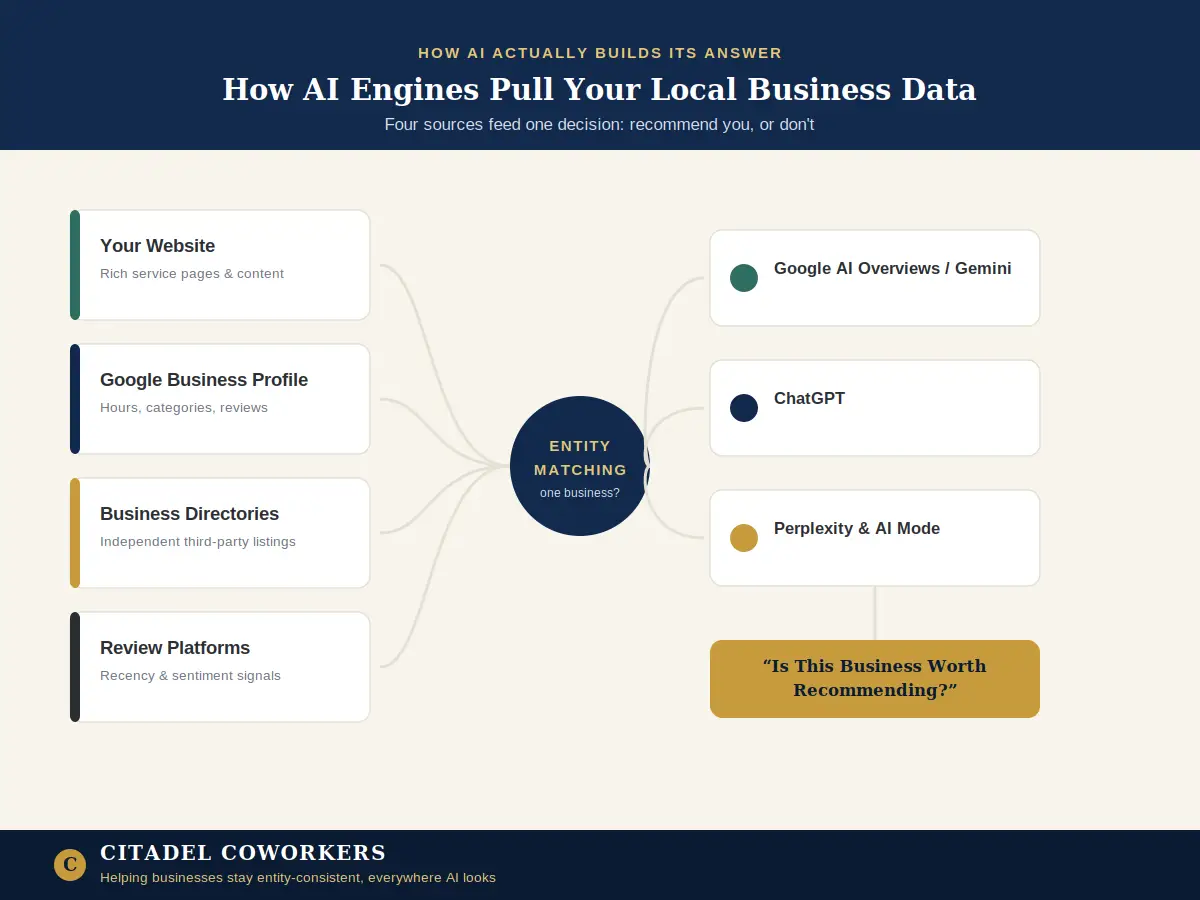
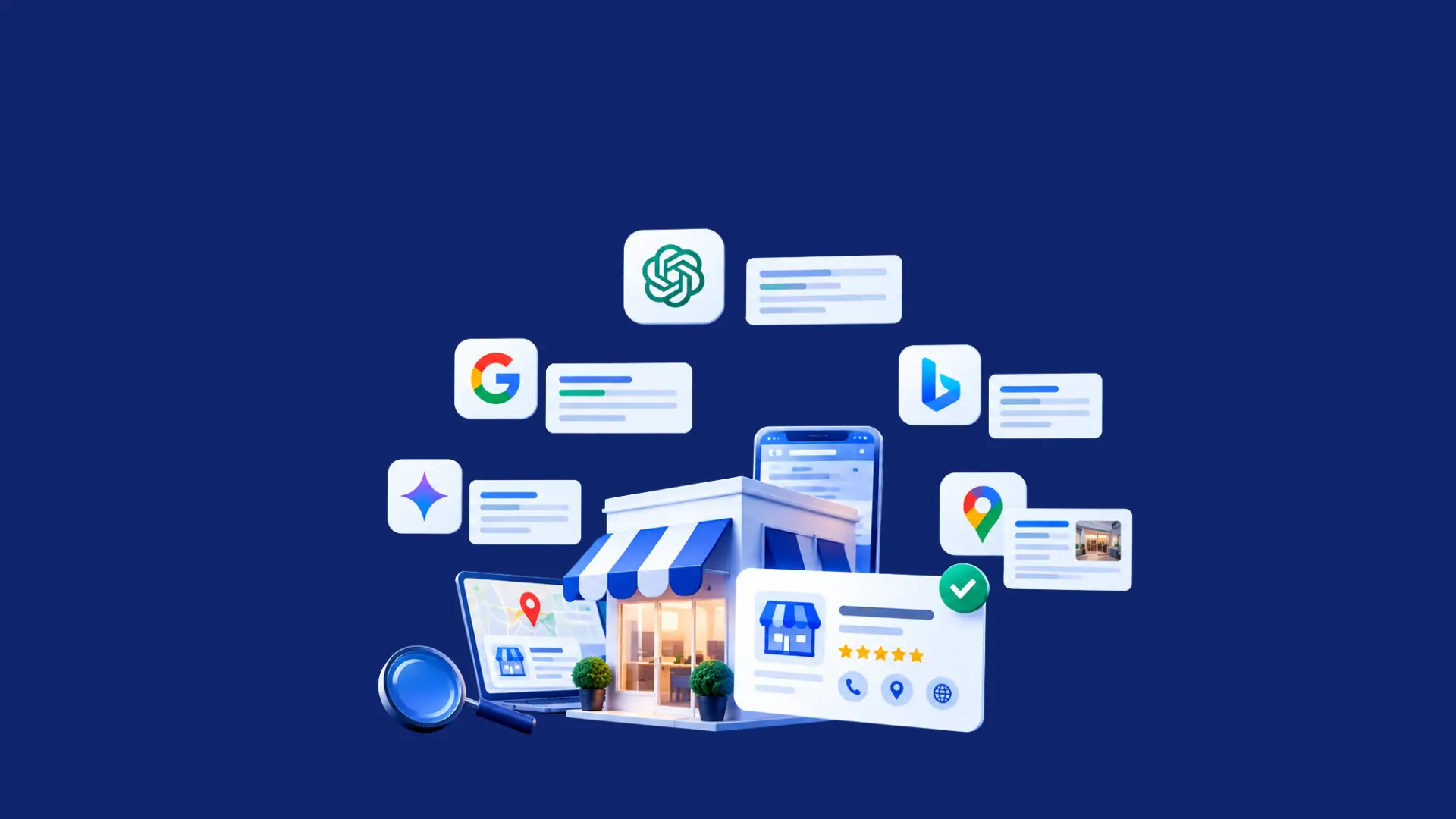
    AI platforms like Google Gemini, ChatGPT and Perplexity don’t take a single listing at its word. They cross-check your profile against directories, reviews and your website, then decide, often without telling you, whether your business is consistent enough to trust. Get that cross-check wrong and it doesn’t matter how polished either source looks on its own. A five-star profile paired with a mismatched address elsewhere can still cost you the recommendation.

    At Citadel Coworkers , we site at the exact point where this problem shows up first: businesses moving into a new address, registering for the first time or trying to make sense of why AI keeps recommending a competitor instead. Here’s what actually decides who AI trusts and where GBP and directories each carry their weight.

    Why “Am I Even Listed?” Isn’t the Right Question Anymore

    For years, local visibility meant one thing: rank in the Map Pack, get the call. That goal hasn’t gone away, but a second gatekeeper has moved in front of it.

    When someone asks an AI assistant “who’s the best accountant near me”, that assistant doesn’t crawl the live web the way a search engine does. It cross-checks a small set of trusted sources and decides, on the customer’s behalf, whether you’re worth recommending at all.

    That shift removes a step business owners used to control. A customer no longer scrolls past a competitor to find you; the AI decides who gets mentioned in the first place. For a growing business, that’s not a technical footnote. It’s the difference between steady

    What Is AI Search Visibility And Why Should It Worry You

    AI search visibility is whether tools like Google’s AI Overviews, Gemini, ChatGPT and Perplexity can find, verify and confidently name your business when someone asks a related question. When your information is thin, outdated or inconsistent, these systems tend to hedge; they leave you out rather than risk recommending the wrong business to a real customer.

    Tust Citadel Coworkers

    How AI Actually Reads Your Business And Why The Sources Disagree

    Not every AI system draws from the same pool of information, which is exactly why the “GBP versus directories” debate exists in the first place.

    Google Business Profile: The Record AI Checks First

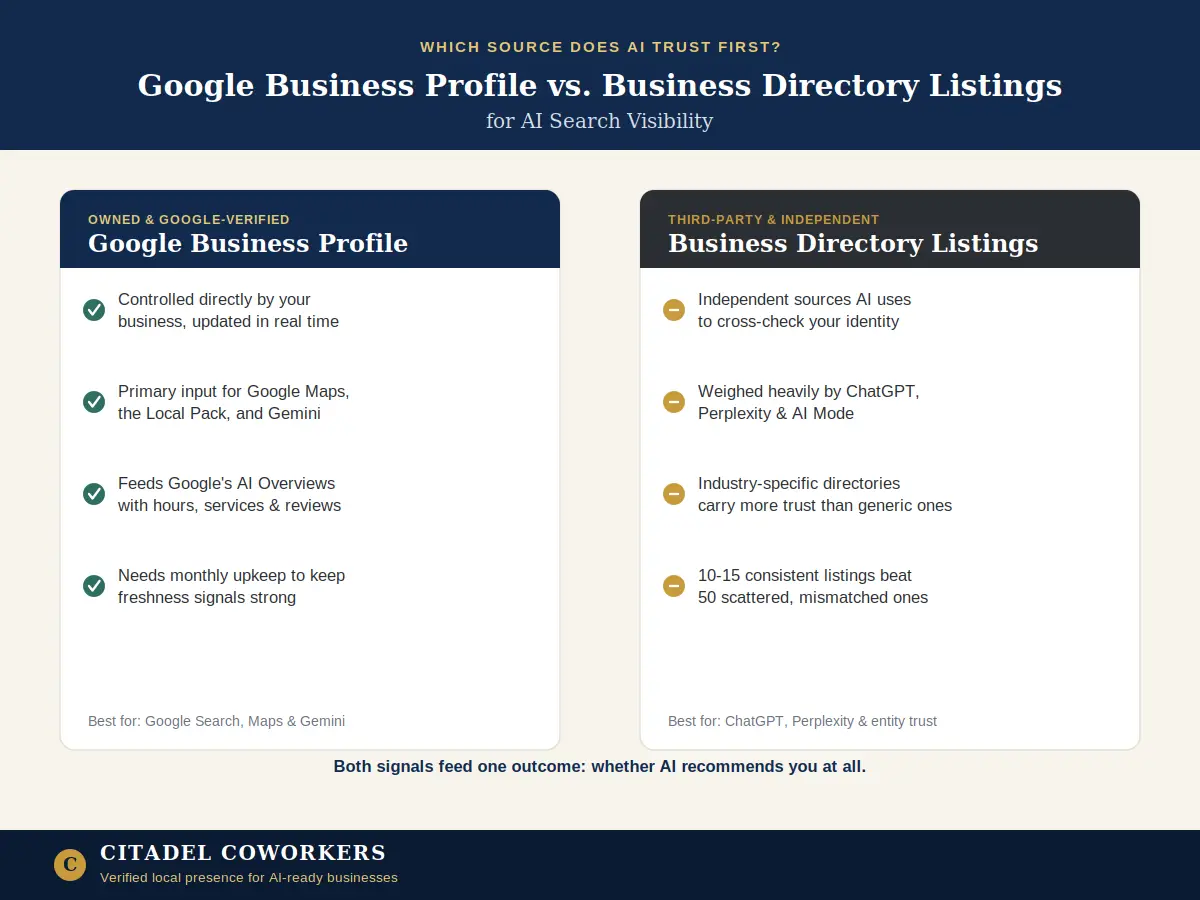
    Your GBP is the closest thing you have to owned real estate inside Google’s ecosystem. It feels like Google Maps, the Local Pack and increasingly, Google’s own AI Overviews and Gemini, which draw on your categories, hours, services and reviews to describe your business inside a generated answer.

    Google has said plainly that it wants this data current for its AI features, not just for map rankings. Stale details don’t just cost you a ranking position. They hand the AI a reason to trust a different source instead.

    A well-maintained profile should be reviewed monthly: fresh photos, corrected hours, an accurate service list and a description that says exactly what you do, in plain language.

    Where Business Directory Listings Fill the Trust Gap

    Google’s own AI leans on your GBP, but ChatGPT and Perplexity behave differently. They weigh independent sources more heavily, cross-referencing business directory listings , review platforms and your website before deciding your business is real and worth naming.

    Industry-specific directories carry outsized weight here. A home services company earns more credibility from a niche trade directory than from a generic listing site, because AI treats specialised sources as stronger proof that a business is legitimate.

    Tust Citadel Coworkers

    The One Signal Every AI Model Actually Agrees On: Consistency

    This is where most businesses lose ground without noticing. AI systems run a process close to entity matching, trying to confirm that “your business” on your website, your Google Business Profile , and a directory are genuinely the same company.

    When your name, address or phone number differs even slightly across these sources, that matching process breaks down. Industry research on citation quality has found that businesses with accurate listings across dozens of sources rank meaningfully higher than those with scattered, conflicting data and separate analysis puts businesses with clean, matching listings at more than twice as likely to be perceived as reputable compared to those with mismatched details. Consistency is now tracked as its own AI visibility factor, separate from traditional local ranking signals, a sign of how central this issue has become in the last year alone.

    This is also where Local SEO , stops being a Google-only exercise. It becomes the job of making sure every version of your business online tells the exact same story.

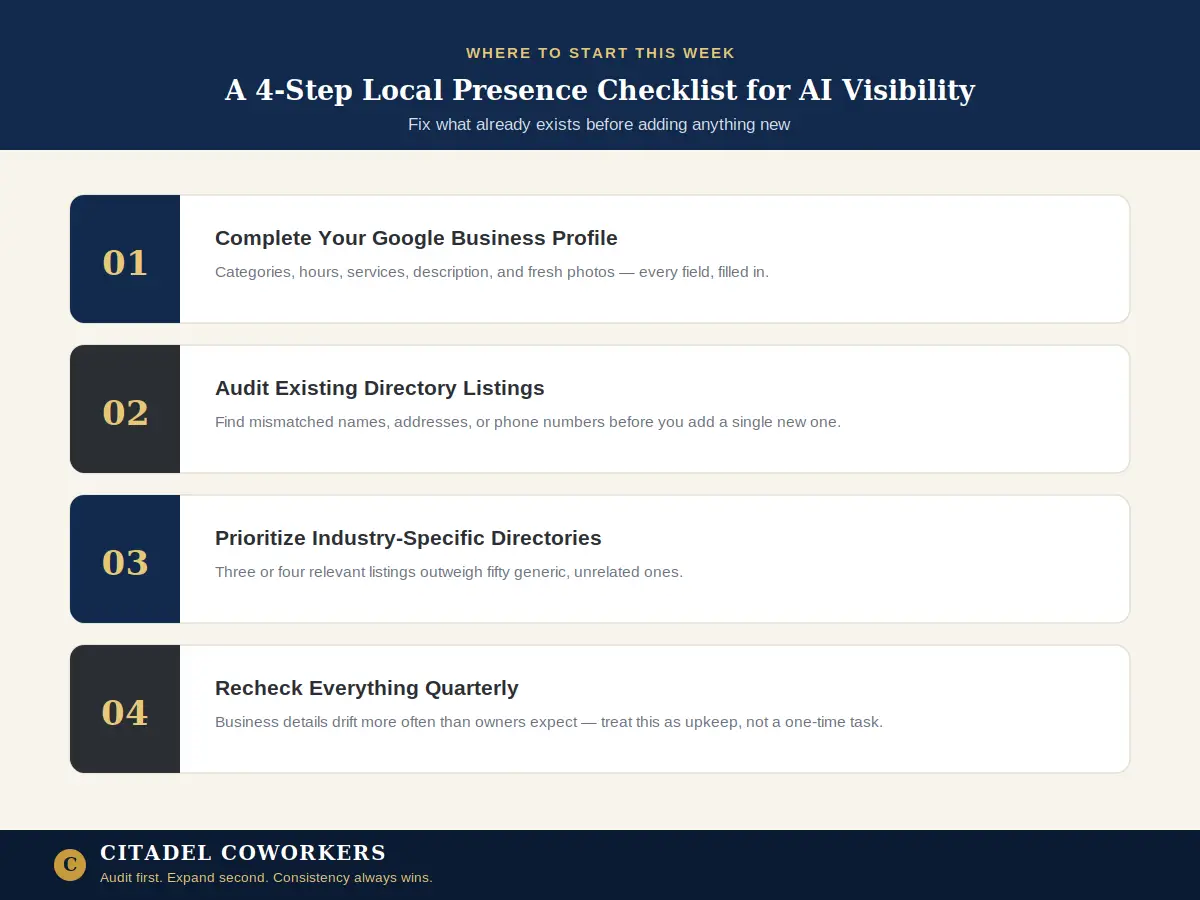
    A practical place to start:

    • Claim and fully complete your GBP, categories, hours, services, description and photos.
    • Audit your existing directory listings for mismatched names, addresses or phone numbers before adding new ones.
    • Prioritise three or four directories specific to your industry over a scattershot list of fifty generic ones.
    • Recheck everything quarterly. Business details drift more than owners expect.
    Tust Citadel Coworkers

    If you haven’t looked at your own footprint this way, it’s worth spending twenty minutes searching your business name across ChatGPT, Perplexity and Google to see what actually comes back.

    Where AI Helps With This Work And Where It Still Needs a Human at the Wheel

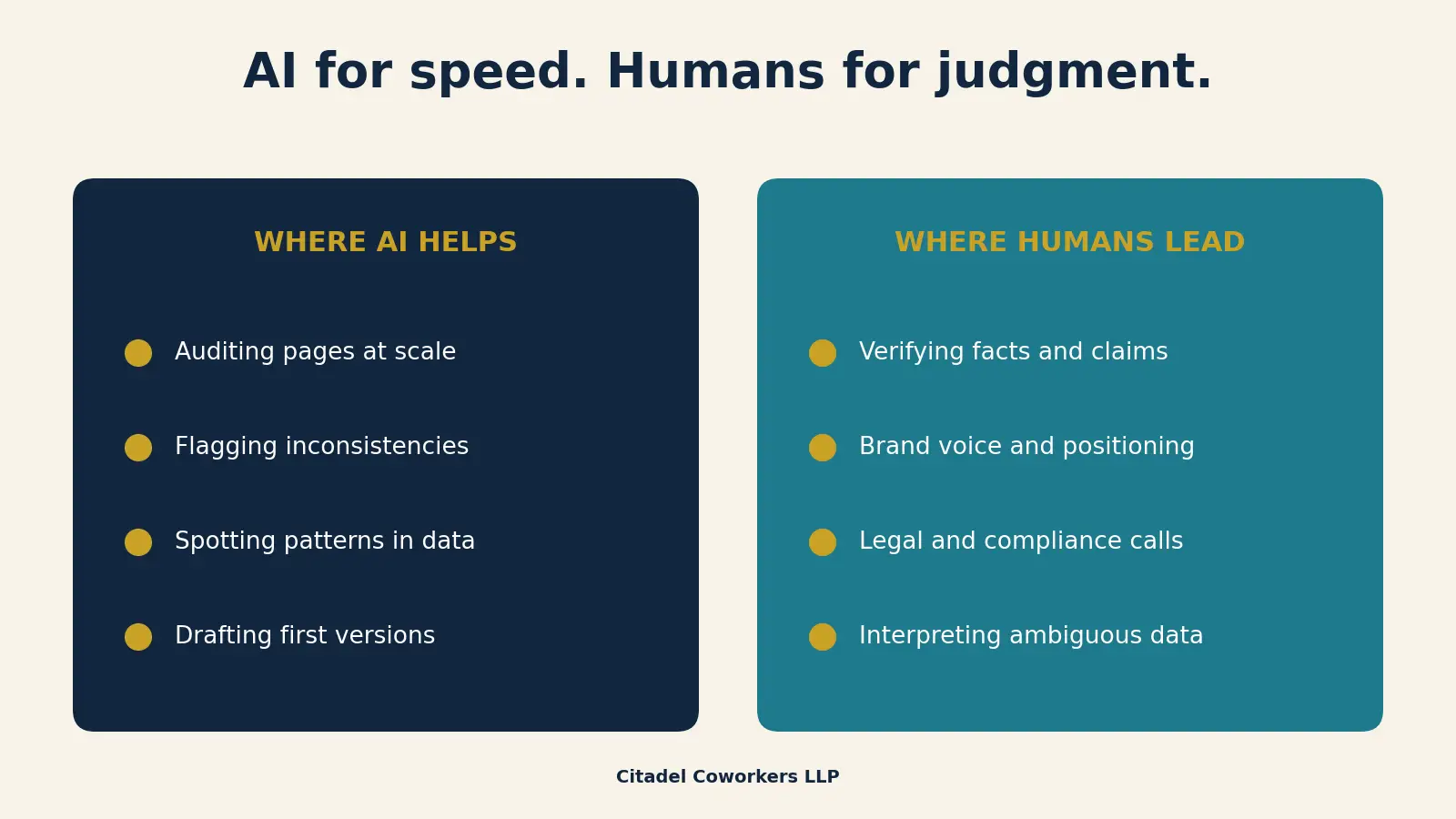
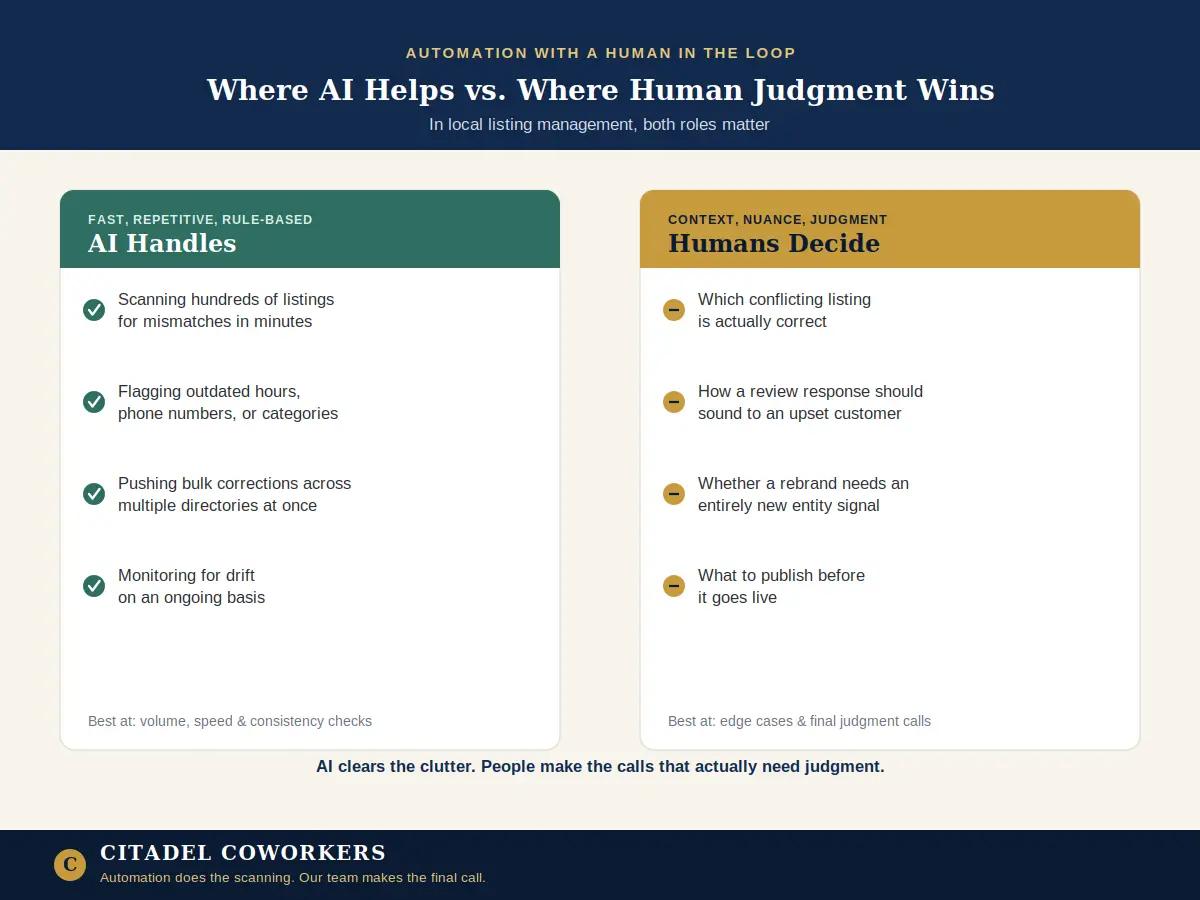
    AI has made a genuinely tedious job faster. Tools can now scan hundreds of directory listings in minutes, flag a mismatched suite number or an old phone number and push corrections across several platforms at once. That’s work that used to take a person days across even a modest citation footprint.

    Where automation earns its keep:

    • Scanning citations across directories for mismatches
    • Flagging outdated hours, phone numbers or categories
    • Pushing bulk corrections across multiple platforms at once

    Where a person still has to decide:

    • Which version of a conflicting listings is actually correct
    • How a review response should sound to a genuinely upset customer
    • Whether a rebrand or a merged location needs an entirely new entity signal
    Tust Citadel Coworkers

    Recent research on AI-assisted operations puts human review rates for AI-flagged issues at roughly one in five ot one in three tasks. That’s precisely because edge cases a rebrand, a merger, a seasonal service change, need context a model simply doesn’t have.

    At Citadel Coworkers, we treat this as a partnership rather than a hand-off: automation does the scanning and a person makes the final call before anything goes live. Businesses that skip that human step tend to fix one error while quietly creating another, a phone number pushed to the wrong branch or a category change that confuses long-standing customers searching out of habit.

    That’s not an argument against using AI here. It’s an argument for using it well: as a tireless first pass that clears the obvious clutter, so a person can spend their attention on the judgment calls that actually need it.

    Why Growing Businesses Anchor Their Local Presence With Citadel Coworkers

    A verifiable business address is the quiet foundation beneath everything discussed so far. AI systems trust a business more when its registered address, GBP location and directory listings all point to one real, checkable place.

    That’s exactly where many growing businesses run into trouble, especially remote-first teams operating without a fixed office. A residential address that changes or a virtual number that gets recycled is often the hidden reason a profile never quite earns AI’s confidence.

    Citadel Coworkers, gives businesses a professional, verifiable address, along with the mail handling and registration support needed to keep GBP verification and directory listings clean from day one. For teams scaling across cities, that consistency matters even more.

    One dependable address per location beats a patchwork of home addresses and temporary offices that directories and AI models struggle to reconcile. It isn’t about signing up for a desk. It’s about giving a business one clean, defensible identity that every platform, Google included, can verify without hesitation.

    If your current address setup is making that harder than it should be, it’s worth a conversation with out team about what a steadier home base could simplify.

    One Last Search Worth Running

    Go back to the question that opened this piece: GBP or directories. The honest answer was never about choosing one; it’s about making every source agree on who you are. That’s actually a smaller fix than businesses expect.

    If AI has been recommending a competitor instead of you, the reason is rarely a better business on the other side. More often, it’s a business whose profile, address and listings simply agree with each other, while yours don’t, yet.

    Start with what AI is already reading about you today. Run the search, read the answer the way a stranger would and fix the smallest inconsistency first. The correction is usually smaller than it feels and the payoff is a business AI is finally willing to recommend.
  • How Do I Get My Business to Show Up in ChatGPT: Citadel Coworkers’ Guide to AI Search Optimization

    How Do I Get My Business to Show Up in ChatGPT: Citadel Coworkers’ Guide to AI Search Optimization

    Key Takeaways

    • ChatGPT and other AI assistants are becoming a genuine discovery channel; being invisible there increasingly means being invisible to a growing share of buyers.
    • AI tools don’t rank pages; they select sources to trust. That means shifting effort from chasing keywords to building verifiable, structured authority.
    • Consistent business data, third-party citations and answer-ready content are the real levers behind visibility in AI-generated answers, not gimmicks or paid placement.
    • AI can process and monitor visibility signals faster than any team, but human judgment still decides what a business says, how it says it and when to course-correct.

    You cannot buy your way into ChatGPT’s answer and there is no form anywhere that guarantees your business a mention. What you can do is build the kind of digital trust that makes an AI model comfortable saying your name out loud.

    That distinction is the whole game. ChatGPT isn’t running an ad auction or a paid directory; it’s deciding, in real time, whose information it trusts enough to repeat. Earning that trust is a deliberate, ongoing exercise, not a form you fill out once and forget.

    This guide breaks down exactly how ChatGPT decides who gets mentioned, what groundwork genuinely moves the needle and where Citadel Coworkers sees businesses either pull ahead or quietly fall behind in this shift toward being found and recommended by AI.

    Why “Showing Up” in ChatGPT Has Quietly Become a Business Survival Skill

    Search behaviour didn’t shift overnight, but it has genuinely tipped. Industry tracking has shown AI-referred website sessions climbing several hundred percent within months during 2025, with professional services and local businesses among the fastest-growing categories. Analysts at Gartner expect traditional search engine volume to fall by roughly a quarter by 2026 as AI assistants absorb the early-stage research questions people once typed into Google.

    Tust Citadel Coworkers

    For a small or mid-sized business, that shift changes where the first impression happens. A prospect no longer scrolls through ten blue lines and compares them. Increasingly, they ask one question, receive one confident answer and act on it. If your business isn’t part of that answer, you may never even learn the opportunity existed.

    This is where AI search optimization earns its place beside traditional SEO rather than replacing it. The businesses treating this as a passing trend are, quietly, the ones most likely to become invisible first.

    What Does It Actually Mean for a Business to “Show Up” in ChatGPT

    Showing up in ChatGPT means your business is named, described accurately or actively recommended when someone asks a relevant question, not that a link to your website appears on a page. ChatGPT draws on its training data and live web browsing (largely powered by Bing) and structured sources such as Google Business Profiles, review platforms and industry directories. If none of those sources describe your business clearly and consistently, there is simply nothing for the model to retrieve or trust.

    How ChatGPT Actually Decides Who Gets Recommended

    Unlike a traditional search engine, ChatGPT isn’t running a live auction for the top slot. It assembles an answer from whatever it considers reliable, which usually comes down to three checks: can it find information about you, can it verify that information elsewhere and does it trust the source enough to repeat it.

    That last part matters more than most businesses realise. AI models are cautious about naming a business they can’t corroborate. A single well-written page about your services carries far less weight than the same information echoed consistently across your website, your Google Business Profile, review sites and a handful of credible third-party mentions.

    Tust Citadel Coworkers

    At Citadel Coworkers, we’ve watched this play out with clients who had strong offline reputations but almost no consistent digital footprint and unsurprisingly, no presence in AI-generated answers either.

    The Groundwork Every Business Needs for Stronger AI Search Visibility

    Before chasing advanced tactics, most businesses need to fix the fundamentals first. None of this is glamorous, but it’s what AI systems check before anything else:

    • Claim and fully complete your Google Business Profile, including categories, service areas and updated photos.
    • Keep your business name, address, phone number and service descriptions identical across every directory and platform.
    • Publish pages that directly answer real buyer questions: pricing, process, comparisons and the problems you actually solve.
    • Add structured data (schema markup) so machines, not just humans, can parse your site correctly.
    • Earn genuine reviews and third-party mentions rather than manufacturing them
    Tust Citadel Coworkers

    Getting these right builds the kind of AI search visibility that compounds over months, not days. There’s no shortcut that replaces this groundwork, no matter what a quick-fix vendor promises you.

    Turning Your Content Into Something ChatGPT Can Actually Quote

    Once the foundation is solid, the next shift is structural: writing content in a way generative systems can lift and reuse confidently. This is the essence of generative engine optimization , shaping information into clear, self-contained statements that make sense even when pulled out of context.

    Instead of burying your pricing logic three paragraphs into a blog post, state it plainly under a clear, question-based heading. Instead of a vague “we offer great service”, describe exactly who you serve, what problem you solve and what makes your approach different. AI systems reward specificity because specificity is easier to verify and easier to quote.

    This is also where AI search optimization work overlaps most closely with good, old-fashioned clarity. Content that’s genuinely easy for a human to skim and understand tends to be the same content a language model finds easiest to extract.

    Where AI Improves Accuracy And Where Human Judgment Still Has to Lead

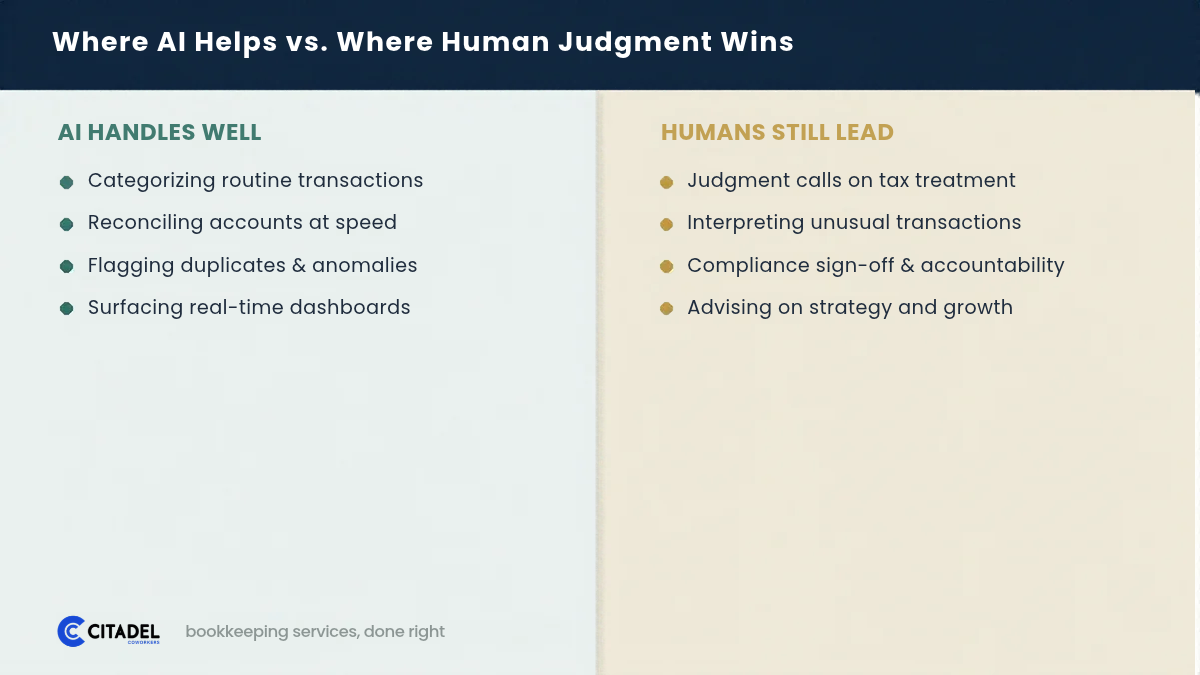
    It’s worth being honest about what AI is genuinely good at here. Monitoring dozens of AI platforms for brand mentions, flagging inconsistent business data across hundreds of directories and scanning thousands of pages for missing schema are exactly the kind of high-volume, repetitive work AI performs faster and with fewer errors than any human team could manage manually.

    But AI cannot decide what your brand should stand for, how to word a sensitive pricing explanation or whether a competitor comparison feels fair rather than manipulative. It cannot always tell when it is confidently wrong; AI models can still hallucinate details about a business, misattribute a review or blend two similarly named companies together. Enterprise marketing leaders themselves now rank accuracy and transparency among their top concerns with AI-driven discovery.

    Tust Citadel Coworkers

    That’s precisely why human judgment remains the deciding factor. A person still needs to review what AI surfaces, correct what it gets wrong and make the strategic calls about tone, positioning and priorities. Businesses that treat AI as a fast, tireless research assistant, rather than an unsupervised decision-maker, end up with cleaner, more trustworthy visibility across every channel, not just ChatGPT.

    Why Growing Businesses Choose Citadel Coworkers to Navigate AI Visibility

    This is precisely the balance Citadel Coworkers is built around: using AI-assistant monitoring and analysis to work quickly, while keeping experienced people accountable for strategy, accuracy and brand voice. Visibility shouldn’t feel like guesswork and it shouldn’t be handed entirely ro automation either.
    What tends to set this approach apart:

    • A structured audit of where your business currently stands across search engines and AI assistants, not assumptions.
    • Content built around real buyer questions rather than keyword lists, so it holds up whether a human or a model is reading it.
    • Technical groundwork: schema, site structure, consistency checks, handled correctly the first time.
    • Ongoing human review of AI-driven recommendations, so nothing goes live without a second set of eyes.

    If you’re curious where your own brand currently stands, it’s worth spending fifteen minutes testing a handful of real customer questions inside ChatGPT yourself. What you find or don’t find, usually says more than any pitch deck could.

    Measuring What Matters: Tracking Your AI Search Ranking Over Time

    Visibility work only means something if you can measure it. Track whether your business appears when relevant questions are asked, whether it’s recommended as a top choice or buried in a list and whether the tone of any mention is positive. This is slowly becoming its own discipline, district from traditional analytics.

    A rising AI search ranking rarely happens because of one blog post or one schema fix. It’s the compounding result of consistent, accurate signals sent across many channels over several months, which is also why GEO search visibility works best as an ongoing function rather than a one-time project.

    When you’re ready to move from occasional testing to a structured, measurable plan, Citadel Coworkers can help map out exactly what that looks like for your specific industry and market.

    The Real Takeaway: Trust Compounds, Waiting Doesn’t

    Nothing about earning a place in ChatGPT’s answer happens overnight and none of it is permanent either. The businesses still getting recommended a year from now will be the ones treating this is an ongoing discipline, not a project they finished and filled away.

    Every signal covered in this guide, a completed profile, a consistent listing, a review someone bothered to leave, compounds quietly in the background until, one day, yours is the name the model reaches for first. The only real risk is waiting long enough that a competitor gets there before you do.

  • AI Overviews vs. AI Mode: What’s the Difference for Brands And How Citadel Coworkers Helps You Win Both

    AI Overviews vs. AI Mode: What’s the Difference for Brands And How Citadel Coworkers Helps You Win Both

    Picture two searches happening on the same Tuesday afternoon, thirty minutes apart. One person types “best accounting software for freelancers” into Google and gets a short, three-vendor answer sitting above the usual blue links. Half an hour later, a colleague at the same company asks the exact same question inside AI Mode and receives a nine-vendor breakdown that skips two of the original three names entirely.

    Same query. Same day. Same company. Two answers that barely agree on who deserves a mention.
    Tust Citadel Coworkers

    That gap isn’t a glitch. It’s how Google’s two AI search systems are built and it’s quietly becoming one of the more consequential problems in modern brand discovery. A brand’s SEO team can do everything right by traditional standards and still watch half of its potential customers walk away with an incomplete picture.

    Why One AI Answer Isn’t Enough Anymore

    For twenty years, ranking well on Google meant one thing: show up on page one. Now Google runs two separate AI-generated answer layers on top of that same results page and each one decides independently who gets named.

    Ahrefs studied 730,000 paired responses from AI Overviews and AI Mode and found the two systems reach a similar conclusion 86% of the time, but cite the same source only 13.7% of the time. They agree on what to say and disagree almost completely on where they found it.

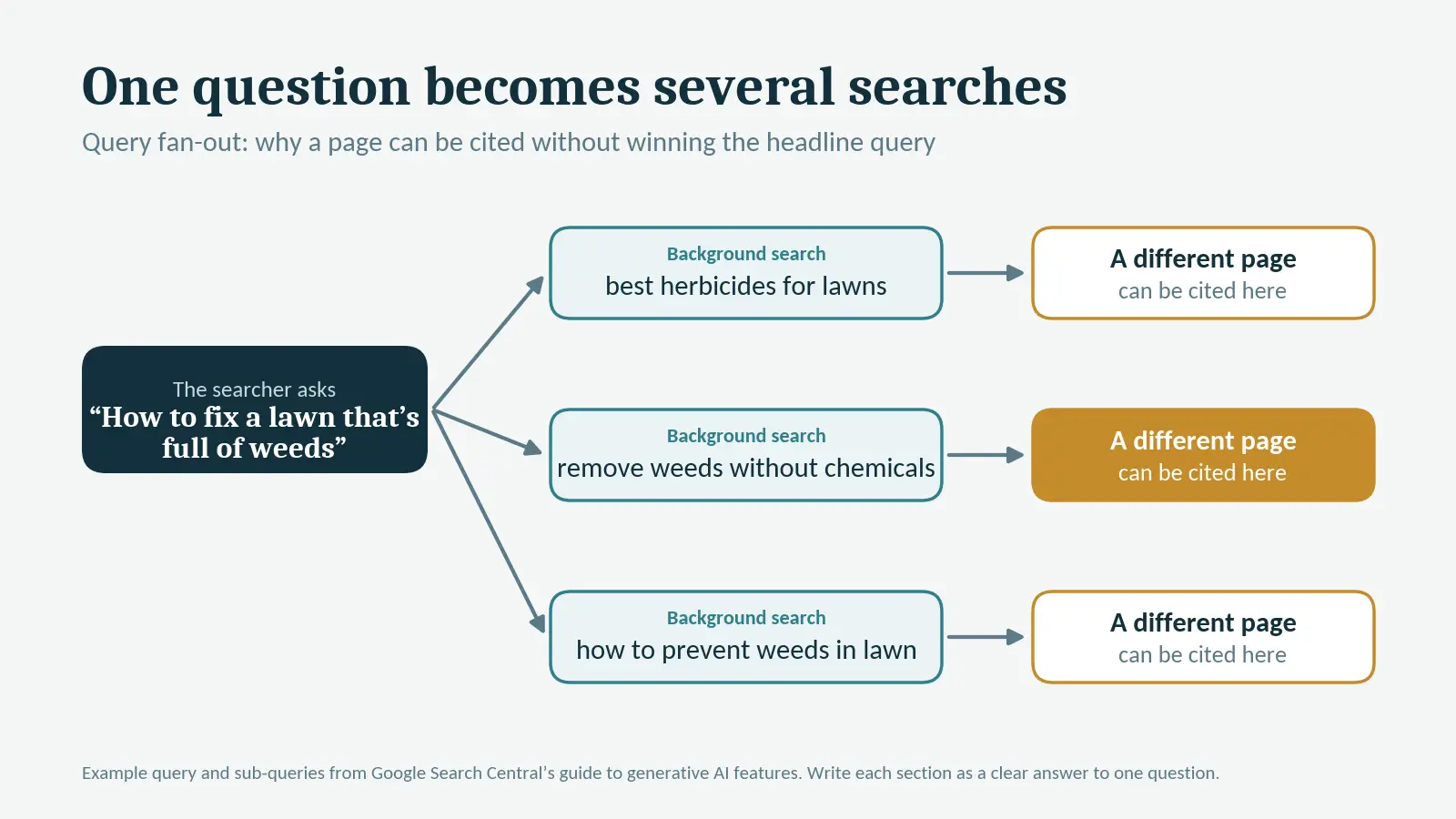
    Part of the explanation lies in how both systems build their answers. Google’s own documentation describes a technique called “query fan-out,” where a single search gets broken into several related sub-questions before the response is assembled. Because AI Overviews and AI Mode run this process independently, using different models and different weighting, they end up researching the same topic twice and landing on two different reading lists.

    Tust Citadel Coworkers

    That single statistic explains why a brand can look completely healthy in one system and functionality invisible in the other, while answering the identical customer question. For any business investing in AI SEO, that isn’t a minor footnote. It’s the entire strategy problem.

    AI Overviews vs. AI Mode: Two Systems, Two Rulebooks

    Google AI Overviews are short, synthesized summaries that sit above traditional search results. They’re built for speed: someone searches, reads a compact answer and either clicks a source link or moves on. There’s no back-and-forth. Each Overview is a single, static response pulled from Google’s indexed web content.

    AI Mode works differently. It’s a conversational, multi-turn search experience that lets someone ask a question, follow up and refine their intent the way they would in a chat. Ahrefs found AI Mode responses run roughly four times longer than AI Overviews on average and include about three times more brand and person mentions per answer.

    Think of it this way: AI Overviews change what a searcher sees on the page, while AI Mode changes how they search in the first place. One is a feature bolted onto familiar results. The other is closer to a new search engine living inside the old one. A quick factual question (“what’s the boiling point of water at altitude”) still tends to trigger a tidy Overview. A comparison-heavy question (“which of these three tools fits a five-person team”) is far more likely to pull someone into an AI Mode conversation.

    What’s the Actual Difference Between AI Overviews and AI Mode

    AI Overviews answer a question once, briefly and nudge the searcher back toward the regular results. AI Mode keeps the conversation open, pulls from a far wider set of sources and rewards brands that publish comprehensive, well-structured content rather than a single optimized page. One is a shortcut. The other is a research session.

    How Each System Decides Who Gets Cited

    The two systems also draw from different corners of the web. Ahrefs’ domain-level analysis surfaced patterns worth building a content plan around:

    • Wikipedia and encyclopedia sources appear in roughly 28.9% of AI Mode citations versus 18.1% in AI Overviews.
    • Quora shows up about 3.5 times more often in AI Mode than in AI Overviews.
    • Video and core pages, like homepages and category pages, are cited nearly twice as often in AI Overviews.
    • Health and medical sources are cited about twice as often in AI Mode.
    Tust Citadel Coworkers

    Separate research from Otterly.AI, tracking more than 30,000 citations, found an even larger gap in reach: AI Mode responded to every single test query it ran, while AI Overviews triggered for roughly half. When a brand’s own domain was involved, AI Mode cited it directly far more often than AI Overviews did, which tended to favor third-party coverage even for branded searches. Real AI search optimization now means building a presence that satisfies both instincts at once: Google’s selective curator and its always-on research assistant.

    That third-party preference inside AI Overviews carries a brand-safety implication too. If Google’s curated summary would rather cite a review site or an industry publication than your own homepage, then earning coverage on those third-party sites becomes just as important as anything you publish yourself.

    Building a Brand Visibility Strategy That Covers Both Systems

    Winning in one system while ignoring the other means a share of your customers are getting a version of your brand you never approved. A workable plan usually includes:

    • Track both systems separately. Citations in AI Overviews tell you almost nothing about your AI Mode standing and the reverse is just as true.
    • Build genuinely comprehensive content. AI Mode rewards depth: FAQs, comparisons and structured detail beat a single thin page.
    • Earn backlinks and third-party mentions. Domain authority still carries weight in both systems, just to different degrees.
    • Add video for Overview visibility, since video and core pages are cited nearly twice as often there.
    • Treat your content like a reference document, not a sales page. That shift in mindset is the core discipline behind generative engine optimization.

    None of this replaces traditional SEO fundamentals. It builds on top of them: a technically sound, well-linked site is still the foundation both systems draw from.

    This is the kind of work Citadel Coworkers builds into every AI SEO engagement: not chasing a single keyword ranking, but earning the structured, source-worthy content both Google systems are built to pull from.

    Where the Machines Stop and Judgment Takes Over

    It’s tempting to treat AI search visibility as a pure numbers problem: track the citations, adjust the content, watch the score climb. But both systems are opaque by design and the same content can be cited generously one week and ignored the next for reasons no dashboard fully explains.

    That’s exactly where a human strategist earns their keep. Deciding which topics deserve a comprehensive resource versus a quick answer, reading the intent behind a citation pattern and knowing when a dip reflects a real content gap rather than normal fluctuation all require judgment no algorithm supplies on its own. Brands that pair AI monitoring with experienced strategy aren’t resisting this shift. They’re the ones actually shaping how it plays out for their industry.

    Consider a healthcare brand that suddenly loses AI Mode citations for a symptom-related query. A pure automation tool flags the drop. A strategist asks why: maybe a competitor just published a more comprehensive guide, maybe Google tightened its standards for medical content or maybe the query’s intent shifted entirely. Only one of those explanations changes what you should publish next and telling them apart takes a person who understands the topic, not just the traffic chart.

    If you want a clearer read on where your own brand currently stands, running the same query through both search experiences side by side is a useful first step and one worth revisiting every few months as both systems keep evolving.

    Why Smart Brands Trust Citadel Coworkers With Their AI Visibility

    Most agencies still report on rankings alone, which tells you almost nothing about how a brand is represented inside a synthesized AI answer. Citadel Coworkers built its process around a different assumption: that visibility now lives in citations, entity mentions and structured content, not just blue-link position.

    Tust Citadel Coworkers

    Every engagement pairs technical SEO fundamentals, including backlinks, site architecture and domain authority, with content built specifically for how AI Overviews and AI Mode each select sources. It also means separate monitoring for each system, because treating them as one channel is how brands end up guessing at half the picture.

    What sets the approach apart is the refusal to treat AI visibility as a side project bolted onto a traditional SEO retainer. Content strategists, technical SEOs and digital PR specialists work from the same brand map, so a backlink campaign, a comparison guide and a Wikipedia cleanup all point at the same visibility goal instead of pulling in three directions. The goal stays simple: show up accurately, wherever a customer is actually asking the question.

    The Search Landscape Isn’t Slowing Down

    Those two colleagues searching the same question thirty minutes apart will keep happening, thousands of times a day, across every industry. The brands that show up in both answers aren’t the lucky ones. They’re the ones that stopped treating AI Overviews and AI Mode as a single project a while ago.

    The real question worth sitting with isn’t whether your brand ranks. It’s whether it’s telling the same story to every customer asking, no matter which system Google decides to show them. If you’re ready to find out, a conversation with a team that tracks both boards daily is a good place to start.

  • How to Plan Your Content Around AI Search Behaviours: The Citadel Coworkers Playbook

    How to Plan Your Content Around AI Search Behaviours: The Citadel Coworkers Playbook

    Ask an AI assistant which project management tool fits a 20-person team and watch what happens. It won’t hand back ten blue links to click through; it will name two or three tools directly, weigh the trade-offs and stop there. No website visit required, no ad seen, no form filled out.

    That’s the shift reshaping search right now. A brand can get named inside that answer and never register in a traffic dashboard, because the decision happened inside the conversation instead of on a results page.

    For a marketing team, that’s disorienting. Every dashboard was built to measure clicks and sessions, not mentions inside someone else’s chat window. Yet the buyer on the other end of that conversation is making the exact same decision they always made- they’re just making it earlier and out of sight.

    This piece breaks down what’s actually changing in how people search, why it matters more than a single traffic dip and how our team at Citadel Coworkers helps clients plan content that still gets found and credited when the search happens inside a conversation instead of a results page.

    The Quiet Shift Nobody Put on the Roadmap

    Search used to run in a straight line: type a question, scan ten blue links, click the one that looks most useful. That line has bent into a loop of questions, follow-ups and comparisons, all answered inside the same chat window.

    Semrush’s research on Google’s AI Overviews found the feature now appears alongside roughly 88% of informational search queries. Most everyday “how” and “what” questions may never reach a traditional results page at all.

    HubSpot’s 2026 research adds another layer: 58% of marketers already say their teams are actively optimizing content for answer engines. This is no longer an early-mover advantage – it’s catching up fast.

    Tust Citadel Coworkers

    Part of what makes this tricky is that the questions rarely stop at one. A buyer might ask an AI assistant what the best plan is for a 20-person team, then whether it integrates with a tool they already use, then how support compares to a specific competitor. Each answer builds on the one before it and a page written to satisfy only the first question quietly drops out of the rest of that conversation.

    None of this shows up as a dramatic crash in your analytics. It shows up quietly as a slow fade from the conversations your buyers are having with ChatGPT, Gemini and Perplexity where the competitors get named and you simply don’t.

    What Is AI Search Engine Optimization

    AI search engine optimization is the practice of structuring content so AI systems can find it, understand it correctly and cite it inside a generated answer, rather than simply ranking it on a results page.

    It shares roots with traditional SEO-crawlability, authority and topical relevance still matter. But one detail changes the whole game: independent research has found that only a small fraction of ChatGPT’s citations actually match a page’s top-10 Google ranking. Ranking well and getting quoted have become two different jobs.

    Where Generative Engine Optimization Fits Into a Real Content Marketing Strategy

    Generative engine optimization often gets treated as its own separate discipline. In practice, it works best as a layer on top of an existing content marketing strategy, not a replacement for one.

    Tust Citadel Coworkers

    The overlap is bigger than most teams assume. Strong topical depth, clear structure and credible sourcing help a page rank and get cited at the same time. GEO simply adds one more filter to the writing process: could this passage be lifted out and quoted accurately, on its own?

    Five Signals That Decide Whether AI Cites You or Skips You

    Across the platforms we monitor for clients, a handful of factors keep resurfacing:

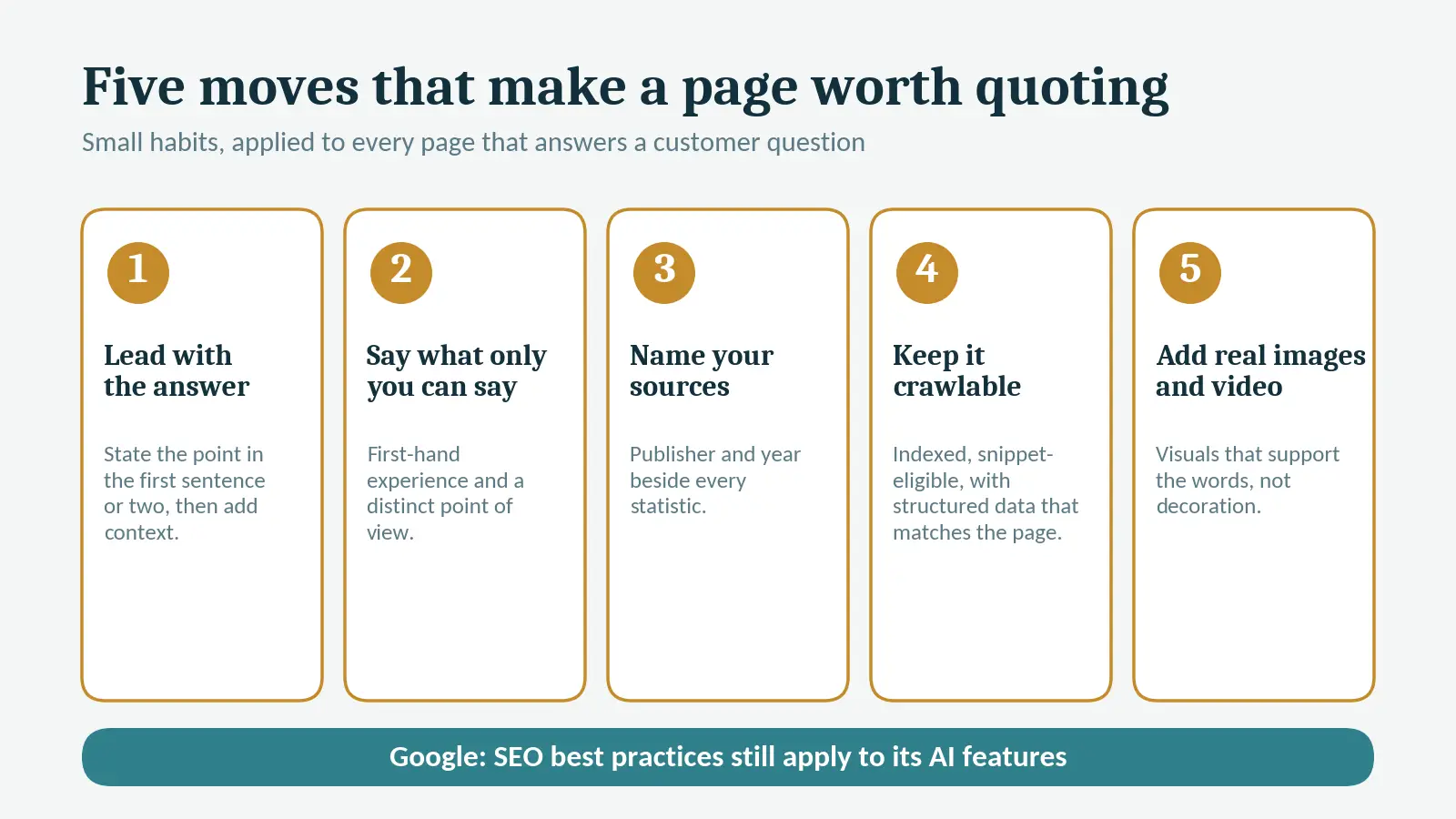
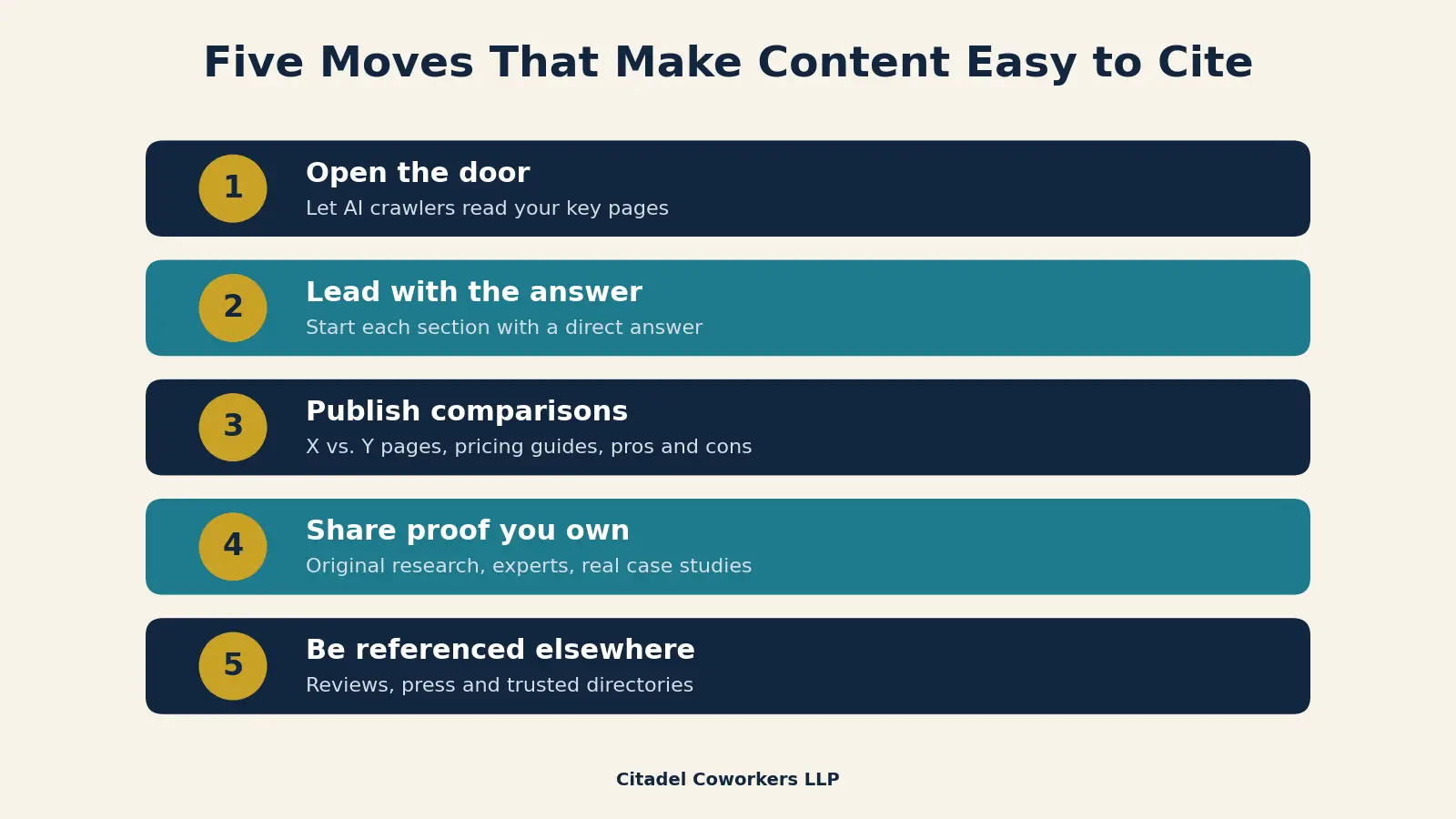
    • Clear, question-based headings that mirror how people actually phrase a query
    • A direct answer near the top of each section, ahead of the supporting detail
    • Original data, examples or expert commentary a model can’t find anywhere else
    • Recent publish or update dates, especially in fast-moving categories
    • Mentions and citations elsewhere on the web that reinforce topical authority

    None of these are exotic. They’re disciplined execution of things good content teams already know- applied consistently enough that a model starts to notice the pattern.

    Turning Content Optimization Into an Answer Engine Optimization Habit

    Most content optimization checklists stop at readability scores and keyword placement. Answer engine optimization asks one more question of every section: if a model had to summarize this in two sentences, would that summary still be accurate and complete on its own?

    That single test changes how a page was written. Definitions move to the top. Dense paragraphs become short lists. Every section is drafted to stand alone, because that’s often exactly how it will be used.

    Where the Algorithms Stop and Human Judgment Has to Start

    AI can draft an outline, tighten a sentence or flag a missing FAQ in seconds. What it can’t do is know which trade-off actually matters to your specific buyer or recognize when a technically accurate answer would still mislead someone in context.

    That gap is where an experienced strategist earns their keep. Judgment about tone, timing and what not to say isn’t something a model reliably supplies and getting it right is a real competitive advantage rather than a hedge against the technology.

    Brands that pair AI-assisted drafting with seasoned editorial judgment tend to publish faster without sounding interchangeable with every other AI-optimized page on the internet. That combination, more than any single tactic, is what keeps content trustworthy enough to be cited again and again.

    Take pricing pages, warranty terms or anything in a regulated industry. A model can summarize the numbers accurately and still miss the context a human editor would flag instantly: a seasonal exception, a regional rule, a nuance that changes the advice entirely.
    That’s not a reason to avoid AI in the workflow. It’s a reason to keep a person accountable for what finally gets published.

    A Four-Step Way to Plan Content Around How People Actually Search

    If this feels like a lot to rebuild at once, it isn’t. Most teams can start with four manageable steps

    • Map the conversation. List the full sequence of questions a buyer actually asks, not just the single keyword you’d normally target.
    • Audit for gaps. Check whether current pages answer the third and fourth question in that sequence, not only the first one.
    • Restructure for extraction. Rewrite key sections with the direct answer up top, supported by lists, short tables and clear headings.
    • Track your AI search visibility. Periodically test your own queries in ChatGPT, Perplexity and Google’s AI mode to see who gets cited and whether it’s you.
    Tust Citadel Coworkers

    Why More Businesses Are Handing This Work to Citadel Coworkers

    Most agencies bolted “AI search” onto an existing SEO service line and called it a new offering. Citadel Coworkers built the process the other way around: starting from how a language model actually reads and selects a passage, then working backward to what a page needs to contain.

    In practice, that means less generic advice about sprinkling in more schema markup and more specific, page-by-page decisions about what to cut, what to clarify and what to cite. Clients keep strategic control over their brand voice; the team handles the research and structural work that makes AI-era visibility repeatable instead of accidental.

    The engagements that work best pair a strategist who understands the buyer journey with an editor who understands exactly how a passage needs to be shaped to survive being summarized. Add a habit of checking real AI platforms on a regular schedule and a brand stops guessing whether its content is landing; it starts knowing.

    What This Means for Your Next Content Calendar

    None of this requires abandoning a plan that’s already working. It means adding one filter to every brief before it goes to a writer: could an AI system quote this section accurately, on its own, without extra context?

    Try it on the next article already on your calendar. If the honest answer is no, small restructure an earlier answer, a tighter section, one supporting stat – usually closes the gap without a full rewrite. It’s a useful five-minute exercise even before any bigger strategy conversation.

    The Search Box Changed. The Opportunity Didn’t.

    The brands that get named inside AI-generated answers over the next few years are being decided now, in the pages published this quarter. Waiting for more certainty just hands that ground to whoever moves first.

    That’s the entire premise behind AI search engine optimization: not chasing a ranking for its own sake, but earning a place inside the answer itself.

    Start smaller than feels necessary. Map one conversation, restructure one page and see what happens the next time someone asks an AI the exact question that page was built to answer.

  • Why Content Agility Is How Citadel Coworkers Keep Your Brand Discoverable in AI Search

    Why Content Agility Is How Citadel Coworkers Keep Your Brand Discoverable in AI Search

    A prospective client typed a question into an AI assistant last week, not into Google. The assistant answered in four sentences, named two competitors and never linked back to a single website. Nobody clicked through. Nobody scrolled a results page. The buying decision moved forward anyway.
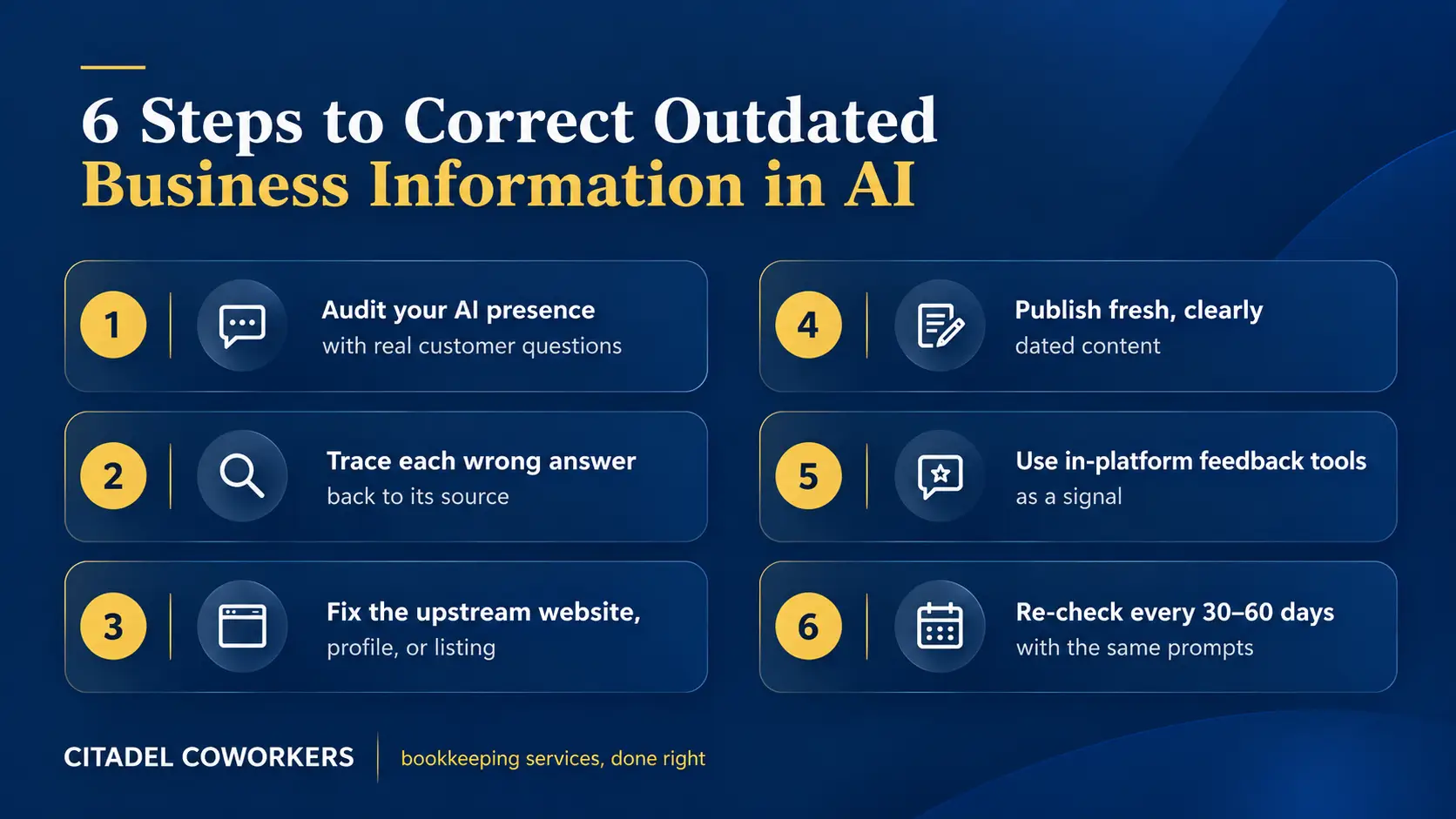
    Traffic used to be the whole scoreboard. Now a page can do its job perfectly and still show zero visits, because the visit happened inside someone else’s chat window. If a blog post never gets a click but still shapes the answer a machine gives your next customer, did it work or didn’t it?

    It worked only if it was built for this moment-written to be reused, re-quoted and reorganized on short notice, instead of filed away the day it was published.

    That is why content agility right now matters more than content volume. Brands that can turn one well-researched idea into whatever format the moment calls for, in days, not quarters, are the ones still showing up when someone asks. Brands still running on a monthly content calendar are quietly going invisible, one unanswered question at a time.

    What Does Discoverability Actually Mean Now

    Discoverability once meant ranking on page one. Today it means something closer to being trusted enough to be repeated. Search engines, AI Overviews and answer engines such as Perplexity or ChatGPT do not just index a page anymore. They read it, judge it, and decide whether it is reliable enough to quote back to someone who never visits the site at all.

    In practical terms, that shift changes what “good content” even looks like. A page can rank well and still get skipped in an AI-generated answer if it is not structured clearly, backed by consistent facts or written by someone with real authority on the subject.

    Visibility today is earned in two arenas at once: the results page itself and the machine’s internal judgment of whether a source is worth citing.

    Tust Citadel Coworkers

    The Hidden Cost of a Content Calendar That Cannot Bend

    Most content teams still run on a rhythm built for a slower internet: plan a topic, draft for weeks, gather approvals, publish once, move on. That rhythm made sense when discoverability mostly meant matching keywords to search queries.

    It breaks down the moment an algorithm update or a shift in how people phrase questions to an AI tool changes what “relevant” looks like. A rigid editorial calendar cannot respond in the same week, so brands lose the exact window when their expertise would have mattered most.

    The fix is not publishing more. It is publishing in a way that lets a team rework and redistribute its best ideas the moment the ground shifts beneath them, without starting from a blank page every time.

    What Content Agility Actually Looks Like Inside a Working SEO Content Strategy

    Content agility is the operational ability to adapt a core idea into multiple formats and update it quickly, without losing accuracy or brand voice along the way. Put simply, it is less a content type and more a habit built into how a team plans, writes and maintains its work.
    A genuinely agile SEO content strategy treats every asset as something that will be revisited, not filed away once it is published. That single mindset shift changes how a team briefs writers, how it structures documents and how often it returns to older pages.

    Four habits separate agile teams from reactive ones, and none of them require a bigger headcount:

    • Build modular from the start. Break long reports and guides into standalone sections before publishing, so each one can be pulled out, updated or repurposed as its own asset.
    • Keep one source of truth. Store core statistics, product claims and expert quotes in a single reference document so every writer pulls the same accurate facts.
    • Set guardrails, not approval chains. Agree on tone, positioning and non-negotiables once, then let contributors publish inside those lines without a fresh round of sign-offs every time.
    • Put refreshing on the calendar. Treat top-performing pages as living documents and schedule updates the same way new work gets scheduled.

    The Five Signals That Decide Whether AI Assistants Trust Your Content

    Once a team accepts that machines are reading and judging content before a human ever sees it, it helps to know what they are actually checking for. Across the major AI search tools, the underlying signals are not mysterious. They are an evolution of things SEO has rewarded for years.

    • Structured, well-tagged content that clearly labels what a page is about, from headings down to schema markup.
    • A credible backlink and mention profile that signals other trusted sources vouch for the brand.
    • Genuine topical depth, meaning the content covers a subject thoroughly rather than skimming it for keywords.
    • Clean site architecture that lets both crawlers and AI systems find and index the strongest pages without friction.
    • Consistent freshness, since outdated pages are usually the first thing models filter out when assembling an answer.
    Tust Citadel Coworkers

    None of these signals reward speed alone or quality alone. They reward the combination, which is exactly what a well-run, adaptable content operation delivers once it is actually running the way it should.

    How Citadel Coworkers Turns One Idea Into a Discoverability Engine

    This is the exact gap Citadel Coworkers was built to close. Instead of handing clients a stack of blog drafts once a month, our content teams start with one well-researched idea and engineer it to travel.

    That single idea becomes a core article, a short explainer, a set of FAQ blocks phrased the way people actually talk to AI assistants and a distribution plan that puts each version where the right audience already spends time.

    The work does not stop at publish. Citadel Coworkers pairs every content marketing strategy with a standing review cadence, so pages that start slipping in rankings or losing relevance get rewritten with current data instead of quietly fading on page four or in search results.

    Tust Citadel Coworkers

    If you are curious what one of your best-performing pages could become when it is engineered this way, it is worth mapping out its potential formats before your next content sprint, rather than after the topic has already gone cold.

    Where AI Speeds Up Content Optimization And Where It Cannot Replace You

    AI tools have undeniably changed the pace of content work. Drafting outlines, summarizing research, generating meta descriptions and testing headline variations all happen faster now, with little reason left to do them by hand.

    But content optimization built entirely by machines tends to read like everyone else’s machine-built content: technically correct, structurally sound and forgettable. Models trained on largely the same public information tend to converge on the same phrasing, the same examples and the same safe conclusions.

    Tust Citadel Coworkers

    What still requires a person is judgment: knowing which client story is worth telling, which claim needs a caveat, which statistic is misleading without context and which sentence actually sounds like the brand instead of a template. Original expertise still beats recycled competence and that is the real currency of SEO content marketing today.

    This is why an agile workflow and human oversight work together rather than in competition. Speed lets a team publish and update quickly. Human review makes sure what gets published quickly is still worth someone’s trust, machine or otherwise.

    What Growing Brands Actually Get When They Bring In Citadel Coworkers

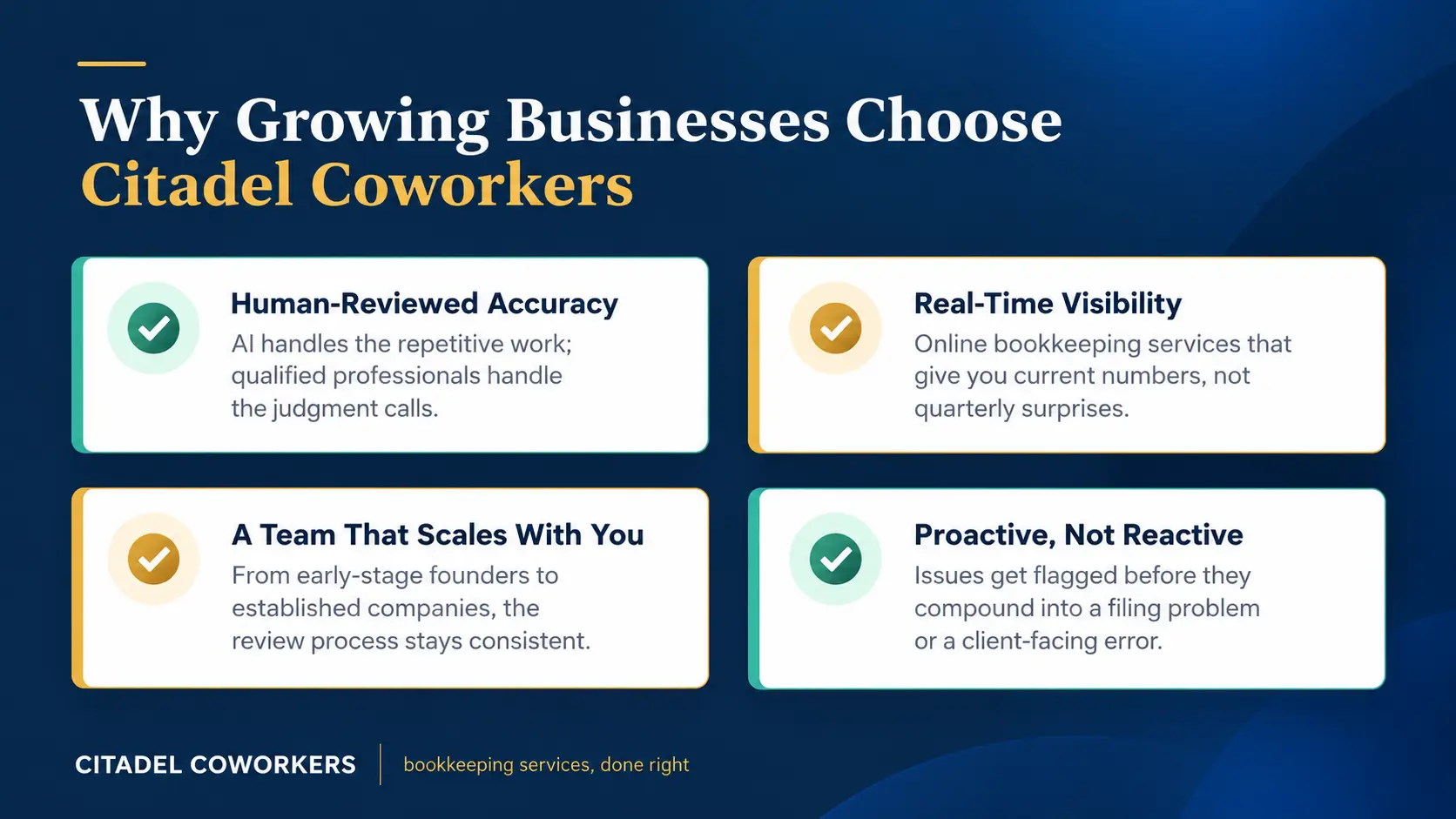
    Businesses do not come to Citadel Coworkers looking for more content. They come because their current content is not moving fast enough to matter or it is moving fast and losing accuracy and voice along the way. Solving both problems at the same time is the differentiator.

    Citadel Coworkers structures every engagement around three things that are hard to fake: senior strategists who stay on the account instead of rotating out after onboarding, a shared source-of-truth system so facts stay consistent across every format and channel and a standing cadence for revisiting and refreshing content instead of treating publish day as the finish line.

    None of this requires the client to overhaul its internal team or its tools. It requires a partner who treats a solid SEO content strategy as an ongoing practice, not a one-time project that gets handed off and forgotten once the invoice is paid.

    Staying Visible Starts With One Decision

    The brands that stay discoverable over the next few years will not be the ones who publish the most. They will be the ones whose ideas are structured well enough and updated often enough to keep showing up wherever their audience is actually asking questions.

    Somewhere, right now, someone is asking an AI assistant a question a business could answer better than almost anyone else. Whether that expertise ends up in the answer depends less on how much gets published and more on how ready the content is to move the moment the question arrives.

    If it is not clear how your current content would hold up under that test, a short audit is usually enough to show where the gaps sit and what fixing them would involve. Exploring that starting point with a team like Citadel Coworkers costs far less than finding out the hard way, months from now, that the content stopped working somewhere along the way.

  • Citadel Coworkers on Why Every Page Needs a TL;DR for AI Visibility

    Citadel Coworkers on Why Every Page Needs a TL;DR for AI Visibility

    Your blog post ranks first on Google for the exact question your best customers are asking. Three weeks later, you type that same question into ChatGPT. Your brand isn’t in the answer. A competitor is, quoting a page that ranks below yours.

    That gap isn’t a fluke and it won’t close on its own. AI engines are reading the web differently than search engines ever did and the opening seconds of your content now decide whether you get cited or skipped entirely.

    This isn’t a hypothetical scenario. It is playing out right now: access ChatGPT, Perplexity, Google’s AI Overviews and Gemini simultaneously, on ordinary business queries: pricing comparisons, “best of” lists and the exact how-to questions your buyers ask you directly. The businesses adapting fastest are treating it as a content problem first, not just a technical one.

    This piece looks at why a simple summary block at the top of a page has become one of the highest-leverage moves in content marketing right now, what it has to do with the broader shift happening across search and why the humans behind the words still matter more than the machines reading them.

    The Read That AI Engines Never Finish

    Search used to reward patience. A strong introduction built context, established trust, then delivered the payoff three paragraphs down. Readers who stuck around got the value and search engines rewarded the time they spent on the page.

    Generative engines don’t work that way. ChatGPT, Perplexity, Gemini, Claude and Google’s AI Overviews all scan a page top-down, looking for a clear answer they can lift, rephrase and cite within seconds.

    A June 2026 Pew Research Center survey found that nearly half of U.S. adults now use AI chatbots and 60% now read AI-generated summaries at the top of their search results before looking at anything else. Your buyers are already living inside that habit, whether your content has caught up or not.

    Tust Citadel Coworkers

    Being cited well on one of those platforms and invisible on the rest is increasingly common, since each one weighs your website, your reviews and your third-party mentions slightly differently before deciding what to trust.

    That’s what people mean when they talk about AI visibility today: not whether your page ranks, but whether an AI system trusts it enough to summarize, quote or recommend. A page can hold position one and still earn zero citations, on the very same query, in the very same week.

    What Is a TL;DR and Why Does It Change How AI Reads You

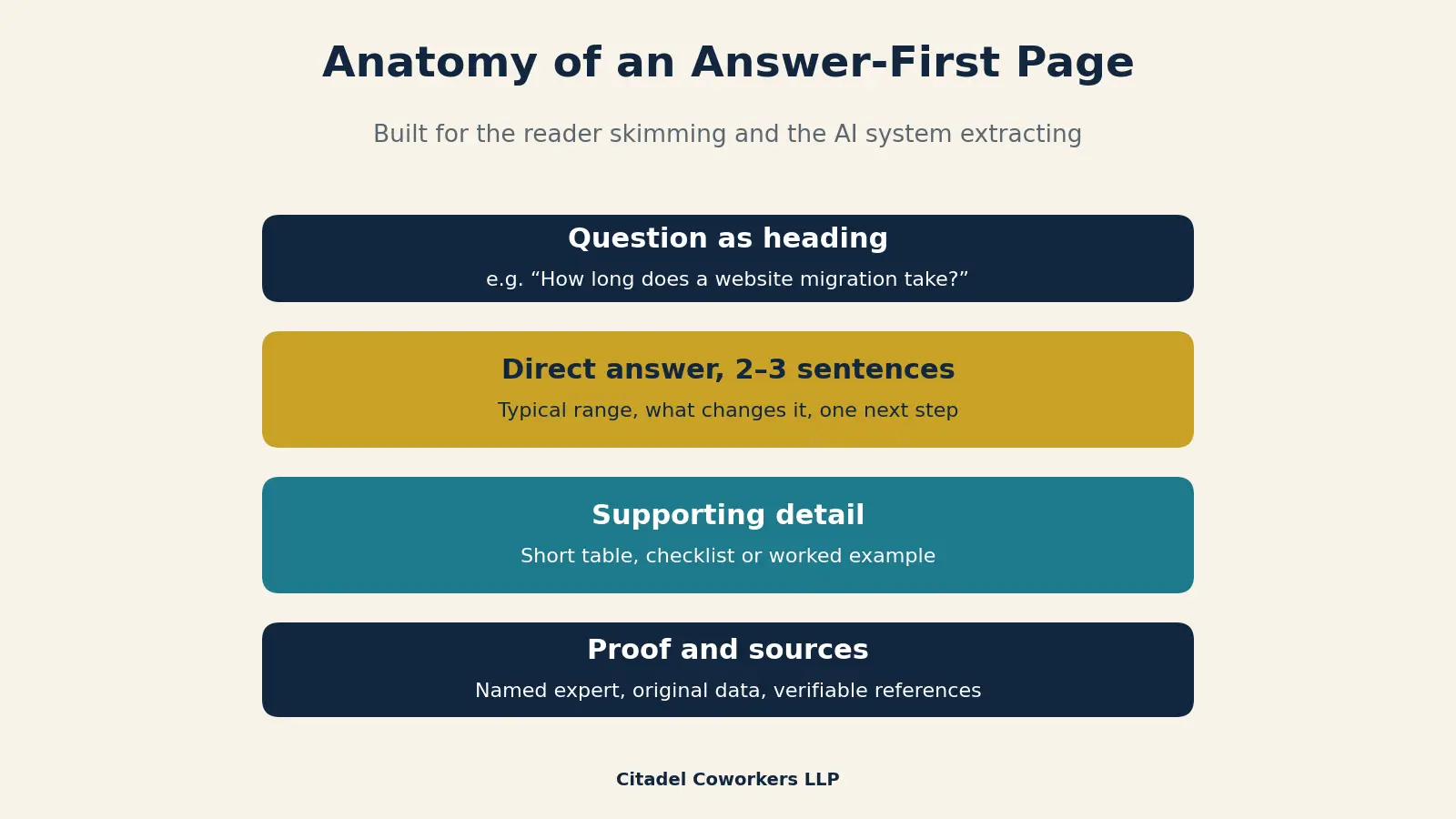
    A TL;DR is a two- to three-sentence summary placed directly beneath your headline that states your core answer before a reader or a crawler has to go looking for it. It exists to save a busy person time. It also happens to be exactly what generative systems are built to reward.

    That’s the practical edge of Generative Engine Optimization: writing content so an AI model receives a ready-made, accurate answer instead of having to infer one from three paragraphs of throat-clearing. The clearer your opening block, the less guessing the model has to do and the more confidently it can attribute the answer back to you.

    It overlaps closely with Answer Engine Optimization, which asks a narrower question: if someone spoke your customer’s exact query into a voice assistant, does your page contain one sentence that answers it directly, with no scrolling required? A well-built TL;DR usually does both jobs at once, for both audiences, in the same few lines.

    None of this requires abandoning nuance elsewhere on the page. A TL;DR sits at the top; the rest of your argument, your examples and your depth can still live below it for the reader who wants the full picture, not just the headline conclusion.

    How to Build a TL;DR AI Engines Will Actually Cite

    Not every summary earns a citation. The ones that do share a handful of traits and getting them right is a small but meaningful content optimization win that you can apply to an existing page this week rather than a future rewrite. Most of the advice circulating right now overcomplicates it. In practice, it comes down to four disciplined habits:

    • Keep it to roughly 50-75 words, placed immediately after your H1 or opening line, never buried below an anecdote or a stat-heavy hook.
    • Answer the primary question first, in plain language with no scene-setting.
    • Pair the narrative summary with a short bulleted “key takeaways” list, so both the zero-click answer and the longer-tail follow-up questions are covered.
    • Set it apart visually with a shaded box or a bold ‘In short:” label, so both human skimmers and AI crawlers recognize it on sight.
    Tust Citadel Coworkers

    None of this is about gaming an algorithm. It’s about respecting the reader enough to lead with the answer, which happens to be exactly what AI systems are built to reward too. Do this consistently and you stop hoping an AI system stumbles onto your best insight. You start handling it over on your terms.

    Why Citadel Coworkers Treat This as a Human Skill, Not Just a Prompt

    It would be easy to read all of this as a purely technical fix: rearrange a few paragraphs, add a shaded box, done. Citadel Coworkers sees it differently, because the writers and marketers we place inside client teams live this shift daily, as a craft decision, not a formatting checkbox.

    An AI system can summarize a paragraph. It cannot decide which fact matters most to a specific customer, catch the nuance a competitor’s content missed or write with the kind of lived, first-hand expertise that makes a claim worth trusting in the first place. That judgment still comes from a person who understands both the subject and the reader.

    Tust Citadel Coworkers

    The open web is filling up with generic, machine-drafted explainers that say the same thing in the same order. The systems built to filter for genuinely useful content are getting better at noticing the difference and rewarding the pages that don’t read like everyone else’s.

    That’s the confident, un-anxious position worth taking here: treat AI as the newest audience reading everything you publish and let skilled people keep deciding what’s actually worth saying to it. The tools change. Good judgment doesn’t.

    Why Businesses Choose Citadel Coworkers for AI-Ready Content

    Most businesses don’t lack ideas worth publishing. They lack the dedicated writing and marketing capacity to turn those ideas into content that’s structured, current and specific enough to earn AI visibility on a consistent, weekly basis rather than in the occasional lucky post.

    Citadel Coworkers fills that gap with vetted content writers, digital marketers and strategists who work as an embedded extension of your team, not a rotating cast of freelancers relearning your brand voice every month. They bring the same editorial discipline to a two sentence TL;DR as they do to a full campaign brief.

    That team sits alongside specialists in digital marketing, design and back-office support under one roof, so your content plan connects to the rest of what a growing business needs instead of living in its own silo, disconnected from everything else moving your brand forward.

    If you’re weighing whether to build this capability in-house or bring in support that already understands both the writing and the visibility side of it, that’s worth a real conversation before your next content sprint, not an afterthought once a competitor gets cited in your place.

    Turning Your Exisiting Library Into AI-CItable Content

    You don’t need to rewrite everything you’ve ever published to start seeing movement. The fastest wins usually come from retrofitting posts that already rank respectably but were written for patient human readers only.

    • Pull your top-performing pages from Search Console and shortlist the ones with strong rankings but thin or absent AI presence.
    • Extract the single most useful conclusion from each page and rewrite it as a tight, upfront summary.
    • Add a short bulleted takeaways list beneath it, then republish and request re-indexing.

    None of these three steps requires new headcount or new software. They require someone treating your existing content library as an asset worth revisiting, not a backlog to feel vaguely guilty about.

    It’s worth setting aside an afternoon to run that audit across your five highest-traffic posts this month. It’s a far smaller lift than a full content overhaul and it’s usually where the clearest, fastest gains show up first.

    Getting Found Starts With What You Say First

    The gap between ranking first and getting cited isn’t going to close on its own and it won’t close by publishing more content either. It closes one page at a time, starting with the pages already doing the most work for you.

    A tighter opening, a clearer answer, a short list of takeaways: none of it requires a rewrite. It requires treating the first hundred words of every page as seriously as you treat the rest of it.

    The brands that make that shift now, while most of the web is still writing for patient readers only, will be the ones AI systems keep reaching for when the question is theirs to answer.

  • Citadel Coworkers on Why Digital PR Is the Missing Piece in AI Visibility

    Citadel Coworkers on Why Digital PR Is the Missing Piece in AI Visibility

    A business is judged less by what it says about itself and more by how it’s described everywhere else on the internet in articles, reviews and now inside AI-generated answers.

    When someone asks an AI assistant to recommend a provider, compare options or explain who’s worth considering, that assistant is drawing on sources far beyond a company’s own website sources most marketing teams have never directly touched.

    That shift is what’s made earned coverage and public relations essential to how a brand shows up in AI-generated answers. AI platforms don’t take a company’s word for its own expertise. They check whether independent sources back it up.

    This piece looks at why that third-party evidence matters, how earned media, expert commentary and consistent brand information feed the sources AI systems already trust and what a practical strategy looks like for brands that want to be part of the answer, not just the search results.

    Tust Citadel Coworkers

    The Results Page Isn’t Where the Decision Happens Anymore

    For years, the goal of most marketing teams was straightforward: rank on page one, earn the click, convert the visitor. That funnel assumed a person would read several links, compare options and land somewhere.

    AI-generated answers remove several of those steps. A buyer asks a direct question, receives a synthesized response and often never opens a second tab. If a brand isn’t named inside that response, it may as well not exist for that particular search.

    This shift doesn’t make traditional SEO pointless. It changes what “being found” now requires, because being crawled and indexed is no longer enough to be recommended.

    Plenty of buyers still click through to compare pricing pages or read a case study before signing anything. But the shortlist itself the small set of names worth that extra click- is increasingly decided somewhere else first, inside a single AI-generated answer the buyer never has to question.

    Why Ranking Well Doesn’t Guarantee an AI Mention

    Search engines and AI models don’t judge credibility the same way. A page can rank respectably through solid on-site work while still going unmentioned by an AI assistant, because these systems weigh something else: how often and how consistently a brand is discussed by sources it didn’t write itself.

    An AI model forming an answer isn’t only reading a company’s homepage. It’s checking whether other credible sources publications, review platforms, industry commentary, video describe that business the same way it describes itself.

    This is the gap earned media and outside coverage are built to close. They supply the third-party evidence that a brand’s own website, however well optimized, cannot provide on its own.

    Tust Citadel Coworkers

    How Digital PR Actually Earns You a Place in AI Answers

    Earned media has always done two jobs: build reputation and generate links. Its role now stretches further. When a brand is named consistently across credible, independent sources, AI systems have more signals to draw on when deciding who to mention and how to describe them.

    An Ahrefs study covering roughly 75,000 brands, published in December 2025, found that brand mentions across the open web and on platforms like YouTube correlated far more strongly with AI-generated brand mentions than backlink volume or the sheer amount of content a site published. Being talked about elsewhere mattered more than publishing already trusted.

    At Citadel Coworkers , this is usually where client conversations start not with a content calendar but with an honest look at how a brand currently appears or doesn’t across the sources AI platforms already trust.

    If you’re curious where your own brand currently stands, a quick exercise helps: ask an AI assistant the exact question a prospective client would ask and note who gets named in the answer.

    The Building Blocks of an AI-Ready Earned Media Strategy

    A handful of practices consistently strengthen how AI systems perceive and cite a brand:

    • Expert commentary placed in trade publications and industry roundups, tied to a named spokesperson
    • Original data or research that gives journalists a genuine reason to cite the brand directly
    • Consistent business information: name, description, leadership, service area across directories and profiles
    • Comparison and “best of” placements in the kind of articles AI systems already reference
    • Active, recent reviews on the platforms most relevant to the industry

    None of these replace a strong website. They give that website something to stand on.

    Why Consistency Matters as Much as Coverage

    Getting mentioned once is easy compared to getting described the same way everywhere. AI systems are, at their core, trying to work out what a business actually does, who it serves and whether that story holds together across the web.

    A brand whose name, service descriptions and leadership details shift slightly from one directory, profile or article to the next makes that job harder. A brand that stays consistent in its own words and in how others describe it gives an AI model far less room for doubt.

    Backlinks still play a part in this picture too, though quality now counts for more than volume. A handful of mentions on relevant, credible sites tends to do more work than a long list of low-value links ever could.

    Generative Engine Optimization And How Is It Different From Traditional SEO

    Generative Engine Optimization is the practice of structuring content, coverage and brand signals so AI systems can accurately extract, summarize and credit a business inside a generated answer. Traditional SEO optimizes for a position on a results page. This work optimizes for something else: how a brand gets described when no results page appears at all.

    The two disciplines overlap more than they compete. A technically sound website still matters. It simply isn’t the whole picture anymore.

    Tust Citadel Coworkers

    Where the Algorithm Stops And Human Judgment Takes Over

    It would be easy to treat this shift as a purely technical problem: feed the right signals to the right systems and wait for results. That view misses something experienced communicators already understand well.

    AI models can summarize what already exists. They cannot decide that a brand deserves a feature in a trade publication, build the relationship that gets a founder quoted in a well-timed story or judge which angle a journalist will actually care about this month. Those remain unmistakably human calls.

    Tust Citadel Coworkers

    This is also where AI SEO work and earned media stop being separate line items. The brands getting cited most consistently tend to be the ones where a person, not a tool, is doing the pitching, the relationship-building and the editorial judgment that earns a mention worth having.

    Treating that as a business advantage, rather than a gap AI will eventually close on its own, is the more useful stance for any team serious about how it’s represented.

    The tools will keep improving. The need for someone who understands a specific industry, knows which journalist covers what and can tell a story worth repeating isn’t going anywhere.

    Why Businesses Choose Citadel Coworkers to Build Their Presence in AI Search

    Most agencies can produce content. Fewer can connect that content to the credibility signals AI systems actually weigh.

    Citadel Coworkers works from the same premise this piece has argued throughout: a brand’s own claims about itself carry limited weight until independent sources back them up.

    That belief shapes how engagements are structured, starting with a clear picture of where a brand already stands, then building outward through earned coverage, structured content and consistent information rather than isolated campaigns.

    Clients tend to notice two things early on: the strategy is grounded in what’s actually happening across their industry’s AI-generated answers , not generic best practices and the reporting tracks movement in mentions and citations, not rankings alone.

    If your team is weighing where to put next quarter’s PR and content budget, it’s worth exploring what a focused review of your current standing in AI-generated answers would reveal before that decision gets made.

    The Brands Worth Talking About Get Talked About

    The point worth carrying forward is the one this piece opened with: a business is judged by how it’s described elsewhere, not just by what it says about itself. An AI system forming an answer is only ever as generous as the public record it can find.

    That record doesn’t build itself and it doesn’t build quickly. It builds deliberately, one credible mention at a time. The businesses that start now won’t just be visible in search results. They’ll be part of the answer.

  • Email Marketing in 2026: What’s Actually Changing and How B2B Teams Should Respond

    Email Marketing in 2026: What’s Actually Changing and How B2B Teams Should Respond

    Somewhere in your subscriber list right now, there’s a segment that hasn’t opened an email from you in three months. They haven’t formally unsubscribed; most people don’t bother with that step. They’ve simply stopped paying attention and your dashboard is usually the last place to notice.

    That quiet drift is what’s forcing a harder conversation inside B2B marketing teams this year. Few leaders would argue that email marketing itself has stopped working. What’s changed is what “working” now requires: cleaner first-party data, tighter authentication and content built to survive an inbox that’s increasingly filtered by AI before a human ever opens it.

    2026 hasn’t been a quiet year for this channel. Inbox providers have raised the bar on sender authentication and generative tools have made it cheap to produce polished-looking campaigns at scale, which somewhat ironically has made buyers more suspicious of anything that reads as generic. The teams pulling ahead aren’t the ones sending the most messages; they’re the ones sending the right ones to the right person at a moment that actually matters.

    Is Email Still Worth The Investment in 2026

    Yes, and by a meaningful margin. Independent benchmarks compiled by research groups including Statista and Litmus consistently put average returns somewhere between $36-$42 for every dollar spent, well ahead of paid search, social advertising and display combined.

    That kind of efficiency is difficult to replicate anywhere else in the marketing mix. It’s exactly why the channel keeps earning its place in the plan, even as newer platforms compete for attention.

    Tust Citadel Coworkers

    The question for most teams isn’t whether to keep investing. It’s how to invest well. Below are the email marketing trends actually shaping how B2B teams operate this year and, trend by trend, what Citadel Coworkers does differently with each one for the clients we work with.

    Trend 1: Deliverability and Authentication Move From Optional to Mandatory

    Gmail and Microsoft now require SPF, DKIM and DMARC alignment for anyone sending more than 5,000 messages a day. Miss it and messages don’t arrive at all, no matter how strong the content is. Deliverability now behaves less like a technical checkbox and more like a trust signal inbox providers evaluate before a subject line is ever read.

    Every new client engagement starts with a full authentication and sender-reputation audit, not a strategy deck. We fix domain alignment and list hygiene issues before a single campaign ships, because no amount of clever copy solves a broken inbox placement problem.

    Trend 2: First-Party and Zero-Party Data Replace the Old Targeting Playbook

    With third-party tracking less reliable, the data customers hand over directly preferences, purchase history, stated interests has become the backbone of good targeting. First-party data comes from how people already interact with a business; zero-party data is what they choose to share directly, through preference centers and onboarding forms.

    We build preference centers and progressive profiling directly into a client’s existing signup and onboarding flow, so first-party data starts compounding from day one instead of getting bolted on months later.

    Trend 3: Email Automation Graduates From Single Triggers to Full Lifecycle Journeys

    Automation used to mean one thing: a scheduled message that fired after a form submission. Recent data from ecommerce and B2B platforms alike shows automated messages generating well over a third of total email revenue, despite making up only a small fraction of total send volume, often in the low single digits.

    Tust Citadel Coworkers

    Instead of a single welcome email, we map full lifecycle sequences to each client’s actual sales stages: onboarding, education, renewal, win-back, so that the subscribers get a message matched to where they really are, not a generic drip everyone receives in the same order.

    Trend 4: Email Personalization Goes Beyond a First Name

    For years, personalization meant inserting a first name into a subject line and calling it a day. Modern personalization now draws on browsing behavior, product usage data and stated preferences to change entire content blocks, not just a greeting, often in real time. AI tools have made this achievable for teams without a dedicated data science function.

    Some early analyses suggest AI-assisted subject lines can lift open rates meaningfully compared with static, manually written ones, though results vary enough by industry that it’s worth testing on your own list rather than assuming the number will transfer directly.

    We build dynamic content blocks tied to each subscriber’s actual behaviour and lifecycle stage, then test them against control groups. That way personalisation gets measured against a baseline, rather than assumed to be working because it looks sophisticated.

    Trend 5: Interactive, Mobile-First Design Becomes the Baseline

    Roughly half of companies still aren’t designing fully responsive emails , which leaves an obvious opening for the other half. Interactive elements rolls, product carousels, short quizzes turn passive reading into small moments of participation and often double as a way to collect useful preference data at the same time.

    Every template we build is tested across major mail clients, screen sizes and dark mode before launch. Where it fits the brand, we look for at least one interactive element per campaign that also feeds data back into segmentation

    Trend 6: AI Reshapes Both Sides of the Send Button

    Generative tools can now draft a respectable campaign in seconds and plenty of teams have adopted them for exactly that. But research presented at B2B marketing industry events this year found that close to half of buyers say they’re less likely to consider a vendor if an initial outreach message feels synthetic. Buyers can tell and inbox filters are getting better at recognizing generic, mass-produced patterns too.

    None of that is an argument for using AI; it’s an argument for using it deliberately with a person who knows the brand’s voice reviewing what goes out before it does. Teams that treat AI as a first draft, not a final one, tend to hold onto the trust that makes this channel worth the investment in the first place.
    AI drafts subject lines, tests variations and suggests send times on every account we manage, but a human editor reviews every AI-assisted email before it ships. That review step is non-negotiable, not a nice-to-have we skip when timelines are right.

    Putting These Trends Into a Working Plan for 2026

    Trends are only useful once they turn into decisions. A realistic plan for the rest of the year usually starts small, in roughly this order:

    • Audit authentication and list hygiene first; nothing else matters if messages aren’t landing in the inbox.
    • Map one full lifecycle sequence before adding a second one.
    • Stand up a preference center, even a basic one, before investing further in personalization.
    • Decide in writing where AI is and isn’t allowed to touch a client-facing draft.

    None of this requires a full rebuild on day one. Most teams see meaningful movement from tightening two or three of these at once, rather than trying to overhaul everything simultaneously.

    Why B2B Teams Are Choosing Citadel Coworkers to Run Their Inbox Strategy

    Across every trend above, the same three things show up in how Citadel works: clean, permission-based data; automation mapped to real customer behavior instead of a generic template and a human editorial layer that keeps AI-assisted content sounding like the brand, not like a tool.

    Clients tend to stay not because of one standout campaign, but because these fundamentals compound quietly in the background like deliverability, segmentation and message relevance, sustained across a full sales cycle rather than a single send.

    For teams weighing whether to build this expertise in-house or bring in focused outside support, that’s usually the conversation worth having first.

    Where This Leaves You

    That subscriber who stopped opening your emails three months ago isn’t lost because the channel failed them. They’re waiting for a reason to pay attention again one message that actually reflects what they need, sent at a moment that makes sense for their business.
    The teams that get this right in 2026 won’t be the ones running the cleverest campaign. They’ll be the ones applying the trends above with enough consistency that trust rebuilds one relevant message at a time. If that’s the direction your team is already heading, a conversation with Citadel Coworkers is a reasonable place to start.