

There comes a time that most businesses and finance teams know well. Yes, it’s the third week of the month we are talking about, when the accountants are still reconciling last month’s numbers. You are trying to make a pricing decision that is based on a Profit and Loss Statement that is already three weeks old.
There has been a gap between when something happens in your business and when you are finally able to see it in your financials. This is exactly the problem that AI in finance and accounting is solving right now in 2026.
AI is not about replacing your finance team or installing complicated software. It is all about what is possible by creating AI-integrated systems that will help in simplifying the daily time-consuming parts of accounting. With AI’s introduction into accounting, transactions like document intake, transaction matching, reconciliation and compliance checks have become easier to record.
In this blog, we are going to cover exactly what AI’s introduction in accounting and finance has made the difference for businesses like yours.
What AI Is Actually Doing To The Accounting Teams Right Now
Here’s what people say AI is transforming accounting and this is what it looks like in practice:
When an invoice comes in, the system reads it and is directed to extract the details from it like vendor name, amount and line items. Then it moves to match the data with the purchase order, checks for duplicates, routes it for approval and posts the entry. These same systems also work in flagging the one invoice out of two hundred that has a mismatched amount or an unfamiliar bank account number.
AI for financial reporting does not mean that there is no human involved, but rather it means that instead of assembling a report from five exports and a spreadsheet, all your finance team has to review is a draft prepared by a system.
These are not just about pilot programmers. According to a 2025 KPMG Global AI in Finance Report, 75% of finance functions have already embedded AI into at least one crore workflow. The businesses that are still running purely manual processes are increasingly the exception.
Three AI Shifts in Accounting & Finance That Actually Matter in 2026
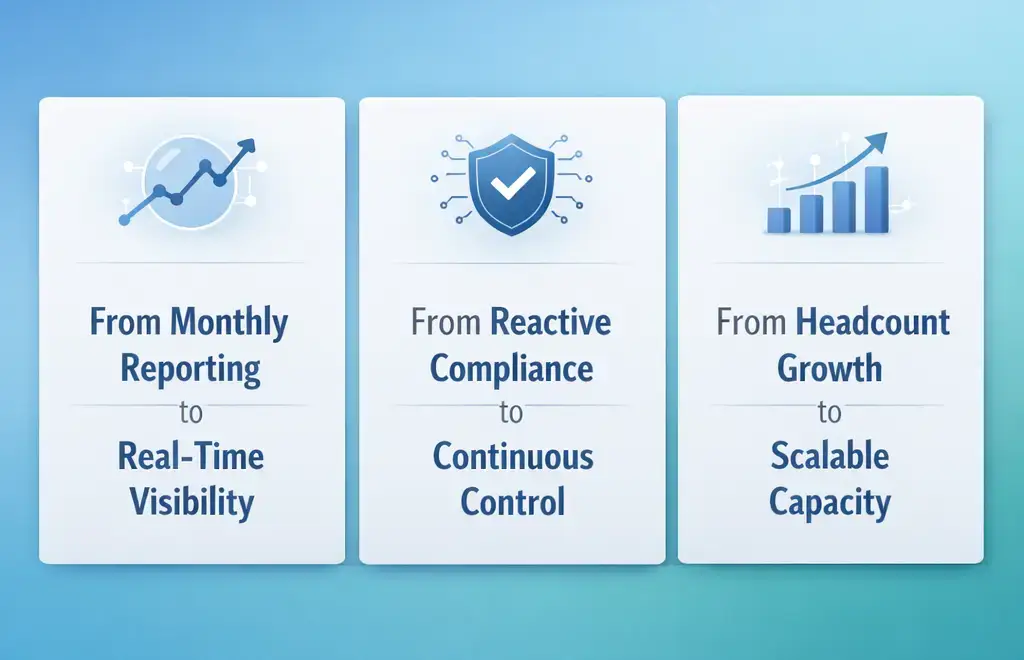
1. From Monthly Reporting to Real-Time Visibility
The close cycle each month used to be a compromise, as businesses lagged behind because processing data manually took time. AI works in your favour by removing that constraint when processing transactions and categorising them correctly, which has to be done continuously. This ensures that your financial position is no longer a snapshot from three weeks ago; it is current. You also get more benefits like pricing reviews, hiring decisions and vendor negotiations which are happening now and not last month.
2. From Reactive Compliance to Continuous Control
Compliance errors that happen while reporting often surface at the worst time they can occur, which is during an audit, at year-end or when a penalty notice arrives. AI-powered systems are used to continuously monitor transactions against regulatory rules. Tax rule changes are applied automatically without delay ensuring accuracy in all the reports maintained. These systems are also flagged before they compound.
3. From Headcount Growth to Scalable Capacity
Before AI if your transaction volume doubles, so does your accounting workload and you end up looking to hire more people. With AI accounting services for businesses, there is no need to hire more people. The system handles ten times the volume without having to worry about hiring ten times the resources. Scaling operations no longer means that you have to scale your finance headcount at the same rate.
Why Outsourced Accounting Has Become the Smarter Move
When we talk about outsourcing it’s not just about being something cost-effective. The more compelling reason to outsource finance and accounting services is access. Getting access to professionals who know how to integrate AI into workflows and a team that is already current on regulatory changes, without the cost or time of building it internally.
Building an in-house AI-enabled finance function means that you have to apply for software licences, system integrations, staff training and ongoing management. For most of the small and medium-sized businesses, this becomes a significant undertaking. Outsourced accounting with AI automation means those capabilities are already in place and you have them integrated within your workflow from very day one.
The businesses that are getting the most from this model are not the ones that handed off their accounts to save money. They are the ones who found a partner with better processes and tools than they could have built themselves and freed their internal team to focus on growth.
If your finance team is still manually pulling each and every one of the reports instead of analysing them, then the gap is worth closing now, not at your next planning cycle.
Finance Teams Who Work Smarter With Citadel Coworkers
Most accounting partners will tell you they use the latest technology. Fewer are the partners who actually show you what those changes mean for your business. At Citadel Coworkers , the difference shows up in the work itself.
Our clients get real-time financial visibility not end-of-month summaries. Reconciliations that used to take days are done automatically with AI. Reports arrive ready to be read, not in a state to be assembled. When something looks off, which can be because of an anomaly, a compliance gap or a cash flow concern, we flag it before it becomes a problem.
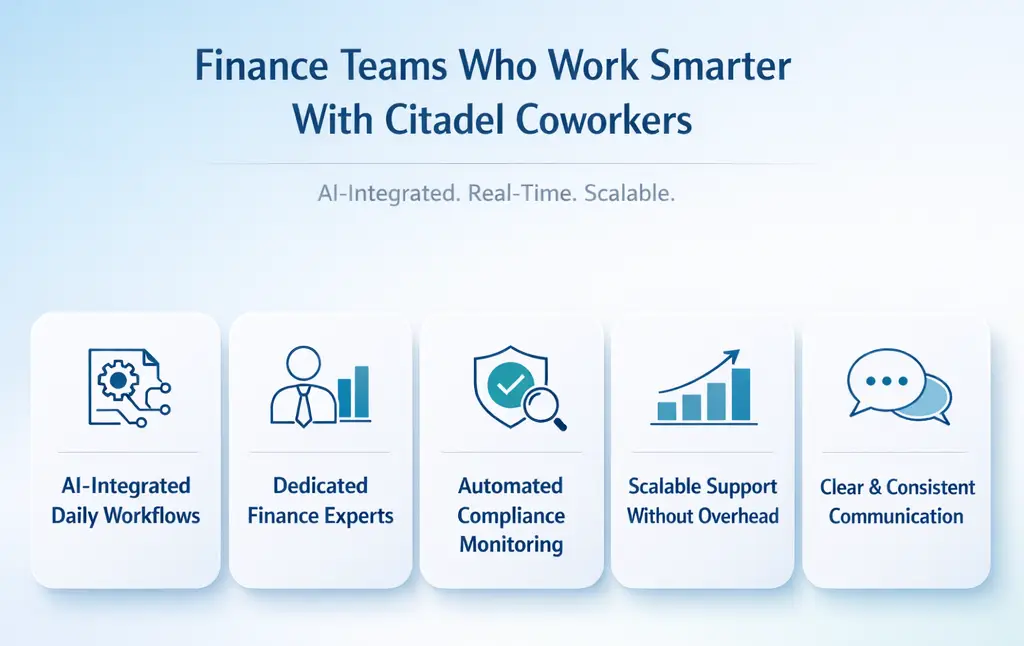
What we bring to every engagement:
- We ensure that all your daily workflows like bookkeeping, reconciliation and reporting are AI-integrated.
- You work with dedicated finance professionals who know your accounts.
- We are thoroughly conducting compliance monitoring that helps keep pace with regulatory changes automatically.
- Having scalable support grows with your business without having to worry about the overhead of growing a team.
- Consistent and clear communication so that you always know where your numbers stand.
We do not manage your accounts from a distance. We work as an extension of your team with the technology to move fast and the experience to get it right.
Where Businesses Go Wrong
AI does not fix weak processes. It exposes them.
AI helps in discovering any gaps immediately that your accounts may have, whether it is any of your historical data or your approval workflows turn out to be informal. The businesses that struggle with implementation are usually the ones that expect the technology to clean up after them.
There is also a question that is about governance. AI-generated outputs in accounting need human review whether it is about journal entries, reconciliations and compliance filings. Human intervention is important not because AI makes frequent errors, but because when it comes to taking accountability in finance it cannot be fully delegated to a system. Professional judgement still belongs to people.
The practical takeaway is to start with your most structured, highest volume processes related to accounts payable, bank reconciliation and expense categorisation. Get those right before expanding to more complex workflows.
Agentic AI: The Next Layer Already Arriving
Most of what we have described involves AI that responds to inputs. The next development that has already been adopted by leading firms goes further.
Agentic AI systems do not wait to be handed a document. They monitor conditions that help us identify what needs to happen. AI systems are trained to select the right tools, execute the work and produce outputs that are ready for review without you having to provide step-by-step instructions. Looking at accounting and finance, this means establishing end-to-end workflows that run autonomously from document intake to a review-ready set of accounts.
For businesses that are evaluating their accounting setup now, the question is not about whether your current partners use AI. It is whether their approach is built to absorb these advances as they continue to roll out.
The Practical Next Step
If your accounting functions are still running primarily on manual efforts, then the gap between you and your competitors using AI systems in their workflows is growing every quarter.
The good news is that accessing AI accounting services for businesses is no longer about needing a large IT budget or an internal technology team. The most practical route for most businesses is to outsource finance and accounting services to a team that already has these systems in place. They also have experience ensuring that the systems are deployed in a good manner.
You don’t have to rebuild your finance function from scratch; what you need is the right partner.