
Key Takeaways
- Your Google Business Profile (GBP) is the foundation AI systems like Gemini and Google AI Overviews check first, but it isn’t the whole story.
- ChatGPT and Perplexity lean more heavily on directory listings and independent citations than on your Google listing alone.
- AI models measure consistency, not volume: 15 accurate, matching listings outperform 50 scattered, conflicting ones.
- AI can scan and flag listing errors faster than any human team, but deciding what’s actually correct still needs a person in the loop.
Should you spend more time refining your Google Business Profile or getting listed across every directory that will have you? For years, the answer was simple: GBP first, directories a distant second. That answer no longer holds.
AI platforms like Google Gemini, ChatGPT and Perplexity don’t take a single listing at its word. They cross-check your profile against directories, reviews and your website, then decide, often without telling you, whether your business is consistent enough to trust. Get that cross-check wrong and it doesn’t matter how polished either source looks on its own. A five-star profile paired with a mismatched address elsewhere can still cost you the recommendation.
At Citadel Coworkers , we site at the exact point where this problem shows up first: businesses moving into a new address, registering for the first time or trying to make sense of why AI keeps recommending a competitor instead. Here’s what actually decides who AI trusts and where GBP and directories each carry their weight.
Why “Am I Even Listed?” Isn’t the Right Question Anymore
For years, local visibility meant one thing: rank in the Map Pack, get the call. That goal hasn’t gone away, but a second gatekeeper has moved in front of it.
When someone asks an AI assistant “who’s the best accountant near me”, that assistant doesn’t crawl the live web the way a search engine does. It cross-checks a small set of trusted sources and decides, on the customer’s behalf, whether you’re worth recommending at all.
That shift removes a step business owners used to control. A customer no longer scrolls past a competitor to find you; the AI decides who gets mentioned in the first place. For a growing business, that’s not a technical footnote. It’s the difference between steady
What Is AI Search Visibility And Why Should It Worry You
AI search visibility is whether tools like Google’s AI Overviews, Gemini, ChatGPT and Perplexity can find, verify and confidently name your business when someone asks a related question. When your information is thin, outdated or inconsistent, these systems tend to hedge; they leave you out rather than risk recommending the wrong business to a real customer.
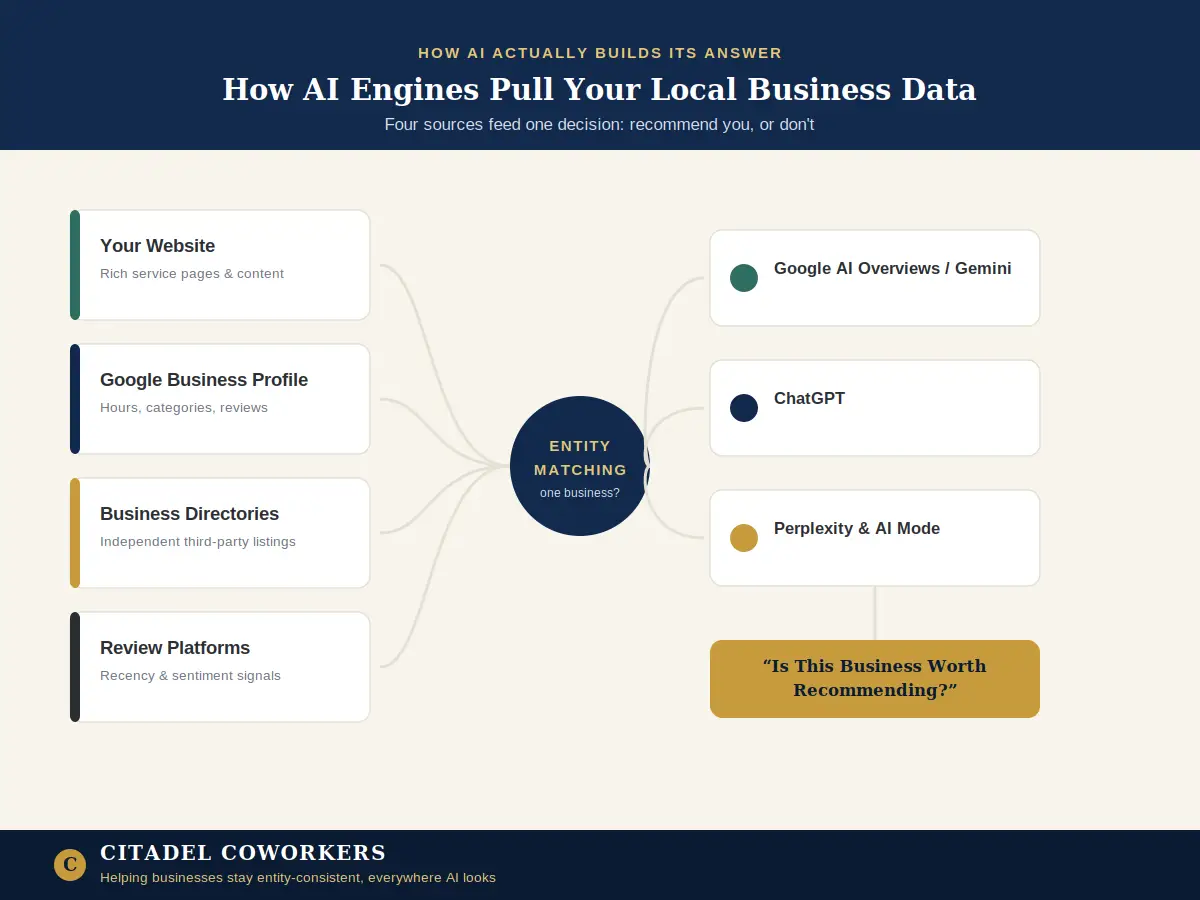
How AI Actually Reads Your Business And Why The Sources Disagree
Not every AI system draws from the same pool of information, which is exactly why the “GBP versus directories” debate exists in the first place.
Google Business Profile: The Record AI Checks First
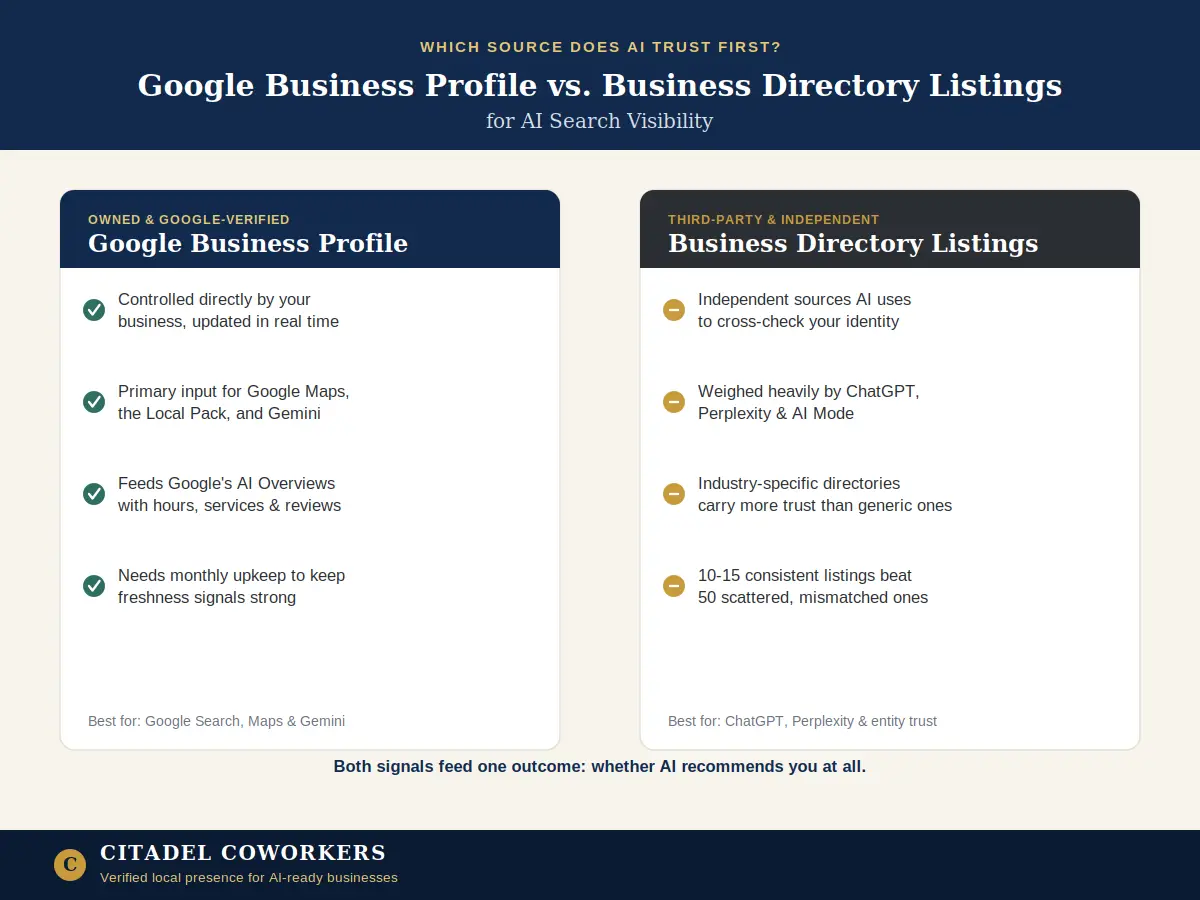
Your GBP is the closest thing you have to owned real estate inside Google’s ecosystem. It feels like Google Maps, the Local Pack and increasingly, Google’s own AI Overviews and Gemini, which draw on your categories, hours, services and reviews to describe your business inside a generated answer.
Google has said plainly that it wants this data current for its AI features, not just for map rankings. Stale details don’t just cost you a ranking position. They hand the AI a reason to trust a different source instead.
A well-maintained profile should be reviewed monthly: fresh photos, corrected hours, an accurate service list and a description that says exactly what you do, in plain language.
Where Business Directory Listings Fill the Trust Gap
Google’s own AI leans on your GBP, but ChatGPT and Perplexity behave differently. They weigh independent sources more heavily, cross-referencing business directory listings , review platforms and your website before deciding your business is real and worth naming.
Industry-specific directories carry outsized weight here. A home services company earns more credibility from a niche trade directory than from a generic listing site, because AI treats specialised sources as stronger proof that a business is legitimate.
The One Signal Every AI Model Actually Agrees On: Consistency
This is where most businesses lose ground without noticing. AI systems run a process close to entity matching, trying to confirm that “your business” on your website, your Google Business Profile , and a directory are genuinely the same company.
When your name, address or phone number differs even slightly across these sources, that matching process breaks down. Industry research on citation quality has found that businesses with accurate listings across dozens of sources rank meaningfully higher than those with scattered, conflicting data and separate analysis puts businesses with clean, matching listings at more than twice as likely to be perceived as reputable compared to those with mismatched details. Consistency is now tracked as its own AI visibility factor, separate from traditional local ranking signals, a sign of how central this issue has become in the last year alone.
This is also where Local SEO , stops being a Google-only exercise. It becomes the job of making sure every version of your business online tells the exact same story.
A practical place to start:
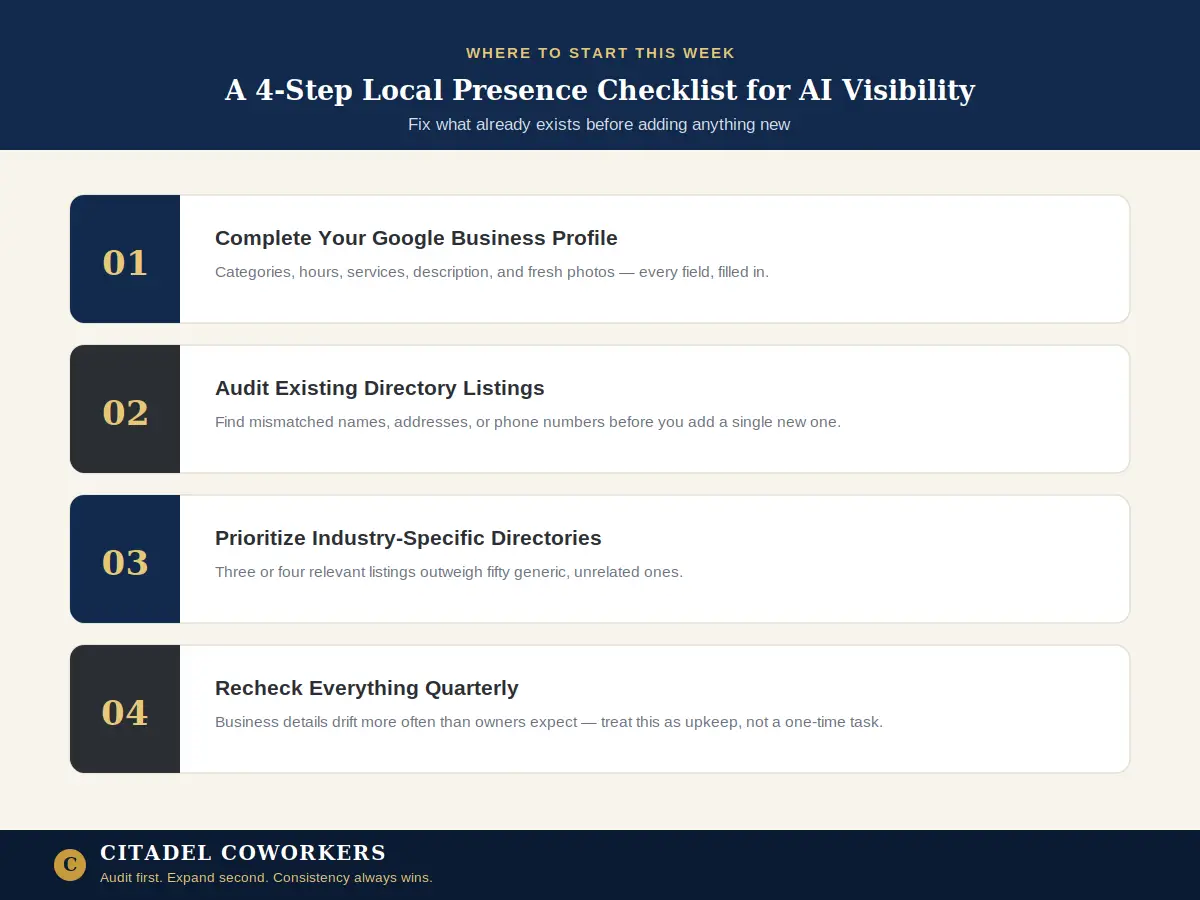
- Claim and fully complete your GBP, categories, hours, services, description and photos.
- Audit your existing directory listings for mismatched names, addresses or phone numbers before adding new ones.
- Prioritise three or four directories specific to your industry over a scattershot list of fifty generic ones.
- Recheck everything quarterly. Business details drift more than owners expect.
If you haven’t looked at your own footprint this way, it’s worth spending twenty minutes searching your business name across ChatGPT, Perplexity and Google to see what actually comes back.
Where AI Helps With This Work And Where It Still Needs a Human at the Wheel
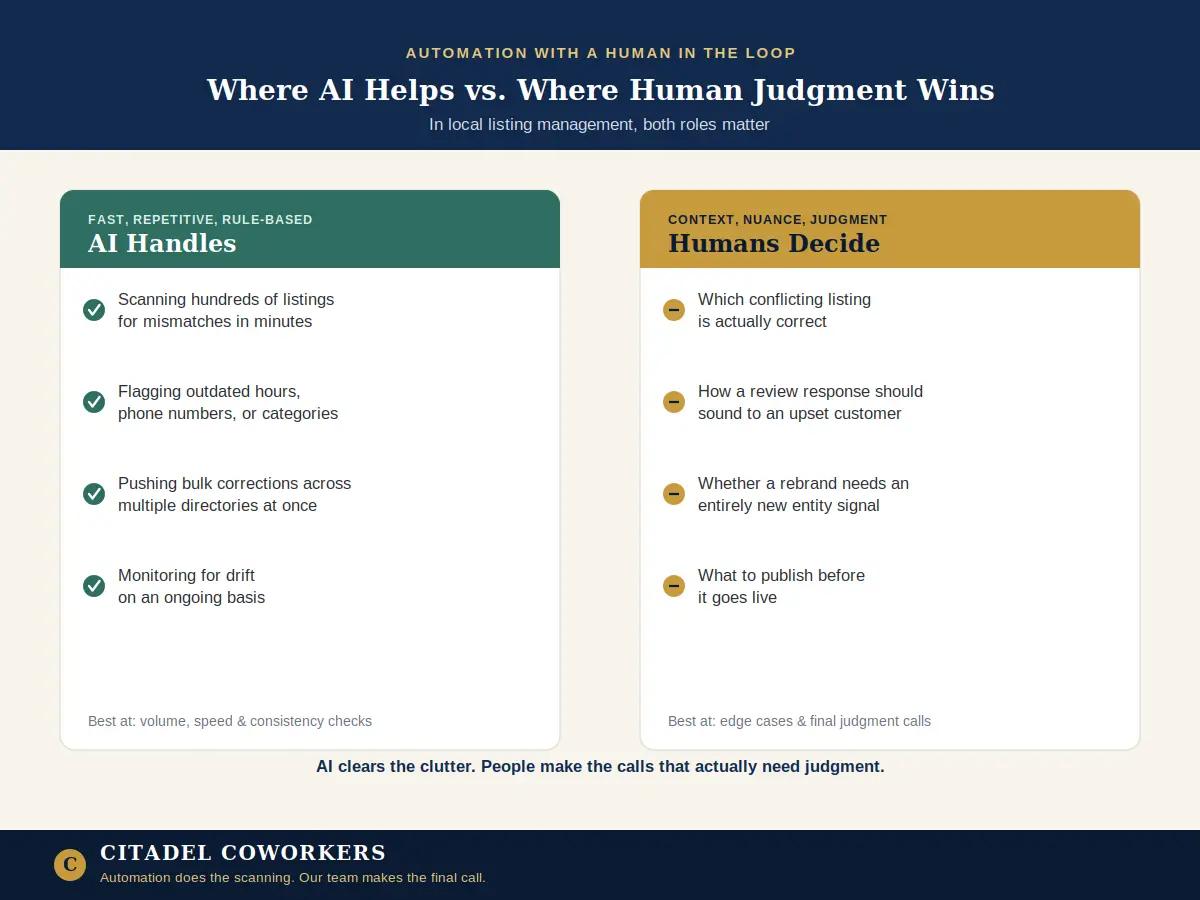
AI has made a genuinely tedious job faster. Tools can now scan hundreds of directory listings in minutes, flag a mismatched suite number or an old phone number and push corrections across several platforms at once. That’s work that used to take a person days across even a modest citation footprint.
Where automation earns its keep:
- Scanning citations across directories for mismatches
- Flagging outdated hours, phone numbers or categories
- Pushing bulk corrections across multiple platforms at once
Where a person still has to decide:
- Which version of a conflicting listings is actually correct
- How a review response should sound to a genuinely upset customer
- Whether a rebrand or a merged location needs an entirely new entity signal
Recent research on AI-assisted operations puts human review rates for AI-flagged issues at roughly one in five ot one in three tasks. That’s precisely because edge cases a rebrand, a merger, a seasonal service change, need context a model simply doesn’t have.
At Citadel Coworkers, we treat this as a partnership rather than a hand-off: automation does the scanning and a person makes the final call before anything goes live. Businesses that skip that human step tend to fix one error while quietly creating another, a phone number pushed to the wrong branch or a category change that confuses long-standing customers searching out of habit.
That’s not an argument against using AI here. It’s an argument for using it well: as a tireless first pass that clears the obvious clutter, so a person can spend their attention on the judgment calls that actually need it.
Why Growing Businesses Anchor Their Local Presence With Citadel Coworkers
A verifiable business address is the quiet foundation beneath everything discussed so far. AI systems trust a business more when its registered address, GBP location and directory listings all point to one real, checkable place.
That’s exactly where many growing businesses run into trouble, especially remote-first teams operating without a fixed office. A residential address that changes or a virtual number that gets recycled is often the hidden reason a profile never quite earns AI’s confidence.
Citadel Coworkers, gives businesses a professional, verifiable address, along with the mail handling and registration support needed to keep GBP verification and directory listings clean from day one. For teams scaling across cities, that consistency matters even more.
One dependable address per location beats a patchwork of home addresses and temporary offices that directories and AI models struggle to reconcile. It isn’t about signing up for a desk. It’s about giving a business one clean, defensible identity that every platform, Google included, can verify without hesitation.
If your current address setup is making that harder than it should be, it’s worth a conversation with out team about what a steadier home base could simplify.
One Last Search Worth Running
Go back to the question that opened this piece: GBP or directories. The honest answer was never about choosing one; it’s about making every source agree on who you are. That’s actually a smaller fix than businesses expect.
If AI has been recommending a competitor instead of you, the reason is rarely a better business on the other side. More often, it’s a business whose profile, address and listings simply agree with each other, while yours don’t, yet.
Start with what AI is already reading about you today. Run the search, read the answer the way a stranger would and fix the smallest inconsistency first. The correction is usually smaller than it feels and the payoff is a business AI is finally willing to recommend.