

Business owners who have invested in SEO understand the frustration. You put in the work, follow the strategies and yet the results feel inconsistent. Rankings are stalled, organic traffic plateaus and somewhere along the way, you start wondering whether it is the strategy or the team.
More often than not, the real challenge is access. Local talent pools are limited and in-house hiring is expensive. Settling for whoever is geographically available is the cost that rarely shows up on a spreadsheet but is clearly visible in your rankings.
The good news is that the way high-performance SEO teams are built has changed. In this blog, we will thoroughly understand how hiring an SEO team remotely helps improve the performance of your business.
Why Geography Is No Longer A Hiring Advantage
SEO is a discipline that does not require a desk in your office to be done well. A skilled technical SEO specialist can audit your site architecture from anywhere in the world. A content strategist can research your competitors and craft keyword-optimized content regardless of their time zone. A link-building expert can build relationships with publishers, whether they are based in your city or anywhere else in the world.
And yet most businesses continue to limit their search to a 30-kilometre radius. In doing so, they trade quality for convenience and their organic growth pays the price. The companies that rank consistently are not necessarily the ones with the biggest office or the largest local team. They are the ones who built the right team with the right skills, regardless of where that talent lives. That shift in thinking is where everything begins.
How To Build A Remote SEO Team That Actually Performs
Building a remote SEO team is not simply a matter of posting a job listing online and hoping for the best. It demands a methodical approach similar to the discipline you want to have with your SEO plan itself. This is how you do things properly.
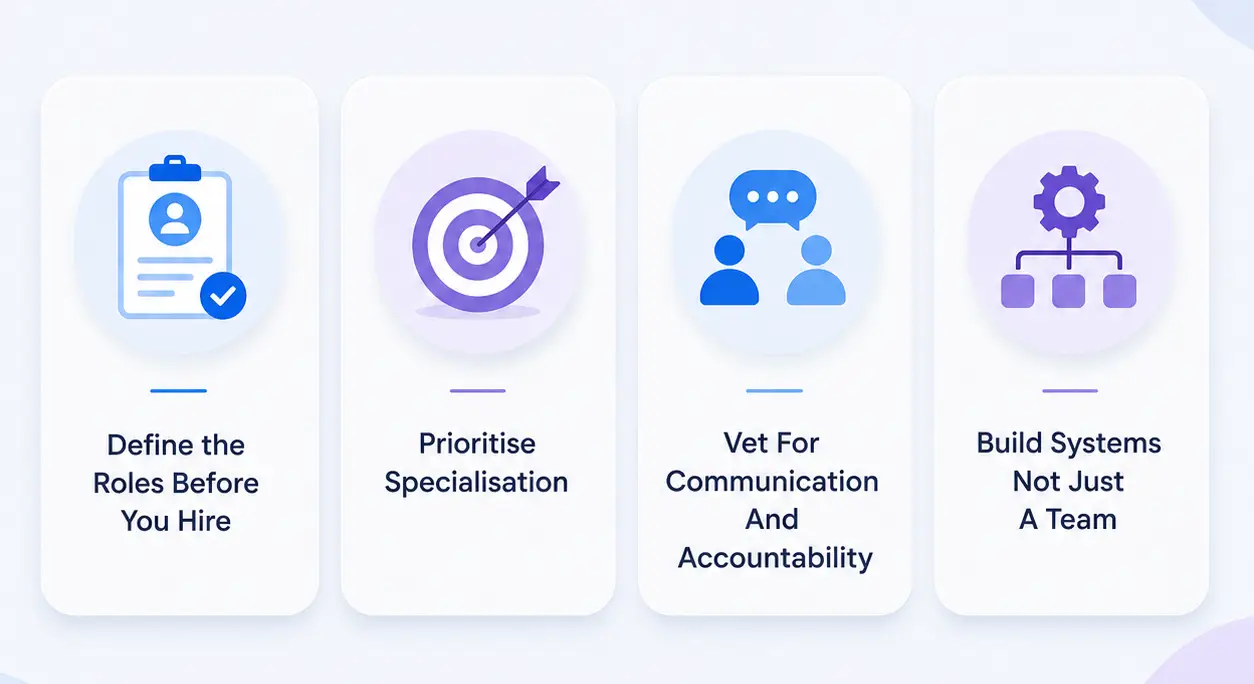
- Define the Roles Before You Hire: An SEO team is not one person doing everything. High-performance execution requires distinct roles and each with clear ownership.
- SEO strategists oversee the roadmap, aligning the SEO goals with business objectives and managing team deliverables.
- A technical SEO specialist handles site audits, crawl optimisation, page speed, indexability and site architecture.
- An on-page SEO specialist manages keyword alignment, meta elements, content structure and internal linking.
- A Content Strategist or SEO writer drives content planning and production, targeting keywords that move traffic and conversions.
- Link building specialist builds domain authority through outreach campaigns and backlink acquisition.
- SEO analyst tracks KPIs, monitors ranking and translates data into actionable insights.
- Prioritise Specialisation: One of the most common mistakes businesses make is hiring a single SEO generalist to handle everything. While this can work in the early stages, it creates a ceiling. A technical expert who also writes content and manages outreach will inevitably stretch thin and performance across all areas suffers. When you are building a remote SEO team , you have the freedom to hire remote SEO specialists who are genuinely exceptional at one thing. That specialisation compounds over time and collectively the team goes further.
- Vet For Communication And Accountability: Remote work surfaces one challenge that in-person hiring can paper over: accountability without proximity. This is why the hiring process for remote roles must go above and beyond just reviewing a portfolio. Look for candidates who can demonstrate a clear record of measurable SEO outcomes and have experience working within established workflows and tools. A skilled SEO professional who cannot communicate clearly across time zones will create friction that slows the entire team down.
- Build Systems Not Just A Team: A team without structure is a group of individuals. What separates a high-performance remote SEO team from a collection of freelancers is the operating system around them. This means defined weekly deliverables and check-ins, shared project management, clear reporting cadence tied to KPIs and a content calendar that keeps the production consistent.
What The Right Remote SEO Team Structure Looks Like
Once you have the fundamentals in place, the structure of your team will be primarily dependent on where you are on your growth journey.
- For Early-Stage Businesses: Hire one great technical SEO generalist and assist them with a content expert. At this point, the goal is traction, getting pages indexed, finding quick-win keywords and creating a publishing rhythm.
- For Scaling Businesses: This is where devoted SEO professionals begin to matter most. A technical professional who owns site health, a content strategist who establishes topical authority and a data-led analyst. This is where SEO outsourcing services come in handy and help you scale your execution without the cost of developing a full in-house staff.
- For Established Businesses: Performance at this level requires a fully role-based team. Each function has an owner. Execution is continuous and not cyclical. The SEO function begins to operate more like an internal growth engine than a marketing channel.
Why Smart Businesses Are Choosing SEO Outsourcing Services
There is a persistent myth that outsourcing SEO means sacrificing control. The reality is quite the opposite. When structured correctly, SEO outsourcing gives you something that an agency model rarely can with dedicated SEO professionals who are aligned with your business, integrated into your workflows and focused solely on your growth.
Traditional agencies manage dozens of clients simultaneously. Your account is one among many. Deliverables are often bundled, execution is cyclical and reporting is designed to summarize rather than to drive action.
A dedicated remote team operates differently. They integrate within your team and understand your brand voice, your competitors and your customers. When a page drops in rankings or a technical issue arises after a site update, they respond not at the next scheduled call.
This model is also significantly more cost-efficient. Building a specialised remote team of dedicated SEO professionals. . This can often be done for the same investment that a mid-tier agency retainer costs but with far greater output and visibility.
Why Companies Choose Citadel Coworkers For Their Remote SEO Teams
Most remote hiring solutions give you a candidate. Citadel Coworkers gives you a structure. There is a meaningful difference between the two. When you are building a remote SEO function, the challenge is rarely finding someone who knows SEO. The challenge is finding someone with the right specialisation. The right communication skills and the right work culture to integrate seamlessly into your team and do that for every role you need to fill.
Citadel Coworkers has built its model around exactly this. Here is what makes the approach distinct:
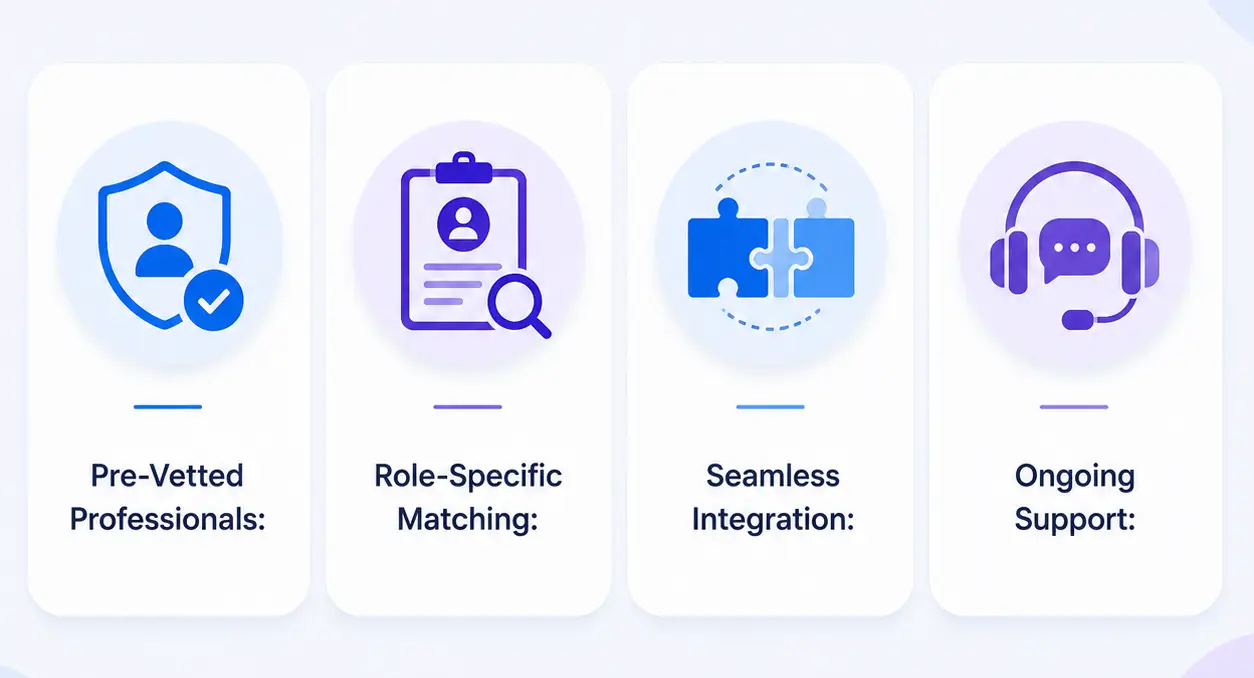
- Pre-Vetted Professionals: Every candidate is screened for functional expertise, real-world output and the ability to work within distributed team structures, not just assessed on paper qualifications.
- Role-Specific Matching: Whether you need a technical SEO specialist, a content strategist or a full-term build, the process starts by understanding your specific gaps, not by pushing a standard package.
- Seamless Integration: Remote professionals placed through CCW work within your existing tools, your workflow and your reporting structure from day one.
- Ongoing Support: The relationship does not end at placement. Performance is monitored and structured support ensures your team continues to deliver.
The Metrics That Tell You If Your SEO Team Is Working
Regardless of how your team is structured, performance must be measurable. These are the indicators that matter:
- Organic traffic growth is the most direct measure of SEO impact over time.
- Keyword ranking improvements, particularly for commercial and high-intent terms
- Domain authority and backlink quality are measures of how the web sees your site
- Organic conversion rate is affected because traffic that does not convert does not grow
- Technical site health scores which determine how well search engines can crawl and index your content
Final Thoughts
SEO is not a line item; it is an asset. A well-optimized website with consistent organic traffic, strong domain authority and a content library that ranks for the right keywords for compounding value. That value grows with every month of consistent execution and erodes with every month of inconsistency.
The businesses that treat SEO as an asset build teams designed for continuity. They hire remote SEO specialists who know the brand deeply. They invest in systems that keep execution moving. And over time, they build a channel that delivers without the constant dependency on paid spend. That is the outcome that a high-performance remote SEO team. is built to create. Not just a better ranking but a better and growing business.