
Key Takeaways
- Generic advice is being erased by AI-generated summaries. Proprietary data is the one asset that can’t be flattened into someone else’s answer.
- AI search tools reward primary sources with real numbers over recycled tips, which makes original research central to how brands get discovered today.
- One well-documented internal metric can outperform a long “ultimate guide” for both rankings and buyer trust.
- AI speeds up data cleaning, pattern-spotting and formatting, but interpreting what a finding means for a specific business still needs an experienced person.
- Citadel Coworkers builds research-backed programs that turn a client’s own data into citable, ownable brand authority.
Search has never had less friction and it has rarely delivered less that feels genuinely new. Ask almost any question and answers arrive by the thousand, most of them repeating each other in slightly different words. For a brand trying to be noticed in that noise, saturation itself has become the obstacle. Sounding credible isn’t enough when every competitor sounds credible in exactly the same way.
AI has sharpened that problem rather than solved it. Search and answer engines now synthesize responses on the spot and when dozens of articles offer the same generic tips, the AI blends them into a single answer and quietly drops the redundant sources. Most content marketing produced today, however well-written, disappears into that blend, because it doesn’t say anything an algorithm hasn’t already read a hundred times.
To be remembered, by readers and by the systems now answering on their behalf, a brand needs to publish something that cannot be blended away: its own proprietary research. That’s the discipline Citadel Coworkers builds its content programs around.
The Content Glut Problem: Why Sounding Like Everyone Else Costs You the Sale
Every industry now has a version of this problem. Search a topic and you’ll find dozens of articles making the same three points in a different order, wrapped in a different logo. Buyers have grown numb to it and increasingly so have the algorithms reading it.
The commercial cost is real. Research from Kantar’s global brand database points to a strong link between how distinct a brand feels and how much a customer will pay for it, with well-differentiated brands able to command close to double the price of look-alike competitors. Standing out isn’t a branding nicety anymore. It’s a pricing lever.
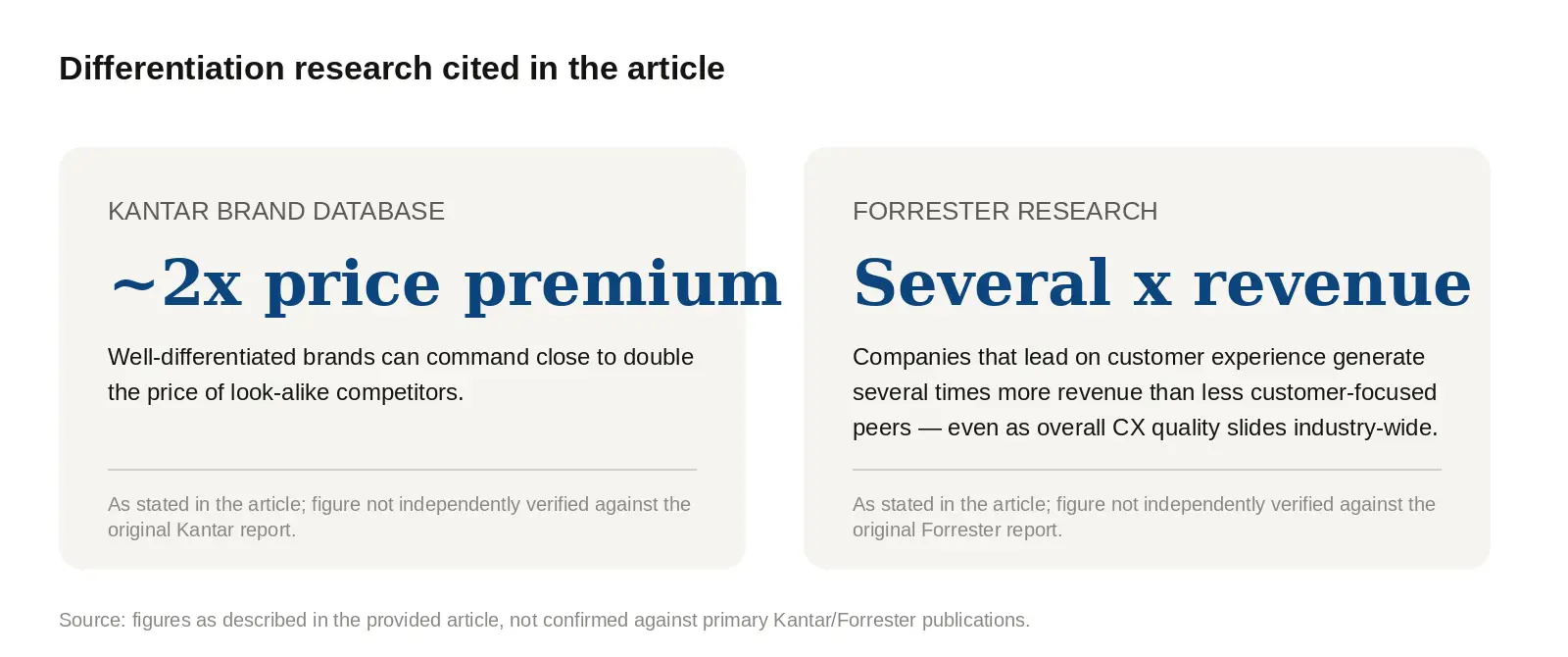
Forrester’s research tells a similar story from the experience side: companies that lead on customer experience generate several times more revenue than less customer-focused peers, yet overall experience quality has been sliding industry-wide. Everyone is chasing the same differentiator at the same time, using the same generic playbook. That’s precisely the environment where proprietary data stops being a nice extra and starts being the deciding factor.
How AI Search Engines Decide Which Brand Gets Credited
When someone asks an AI assistant a question today, the system isn’t reading your page the way a person does. It’s running a retrieval process that pulls the most relevant, credible material to ground its answer, then writes a synthesized response, often without sending a single click back to any one source.
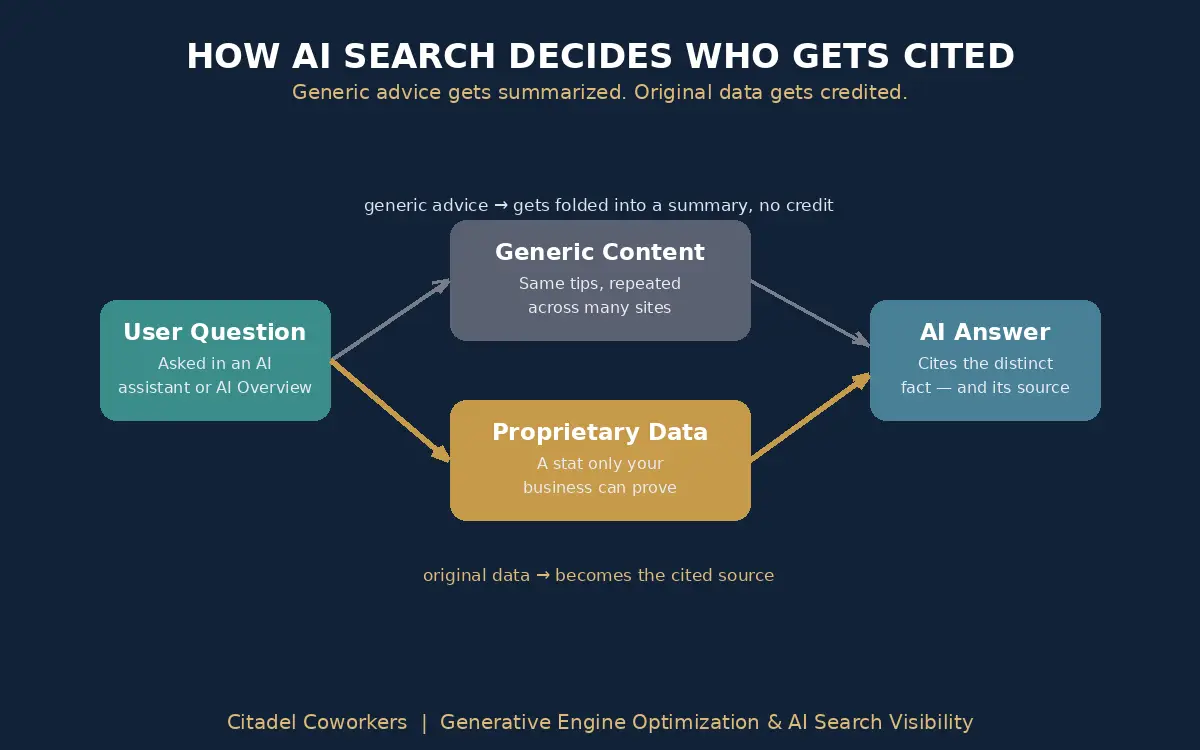
That process rewards specificity. If ten companies all say “response time matters for customer satisfaction,” an AI engine will compress that into a generic statement and cite no one in particular. But if your business states that its own analysis of client support tickets found a measurable link between first-reply time and renewal rates, there’s nothing to compress. The AI has to attribute the number to you.
This is the core idea behind generative engine optimization: structuring content so that AI systems have a reason to name your brand instead of averaging it away. Industry analysis suggests that content built around cited statistics and original findings performs meaningfully better in AI-generated answers than purely descriptive writing. For a brand thinking seriously about AI search visibility, that’s not a footnote. It’s the strategy.
What Counts as Proprietary Data
Proprietary research data is any information a business generates through its own operations, client relationships or original testing that doesn’t already exist anywhere else publicly. It’s not a press release restating an industry report; it’s a number that only exists because you measured it.
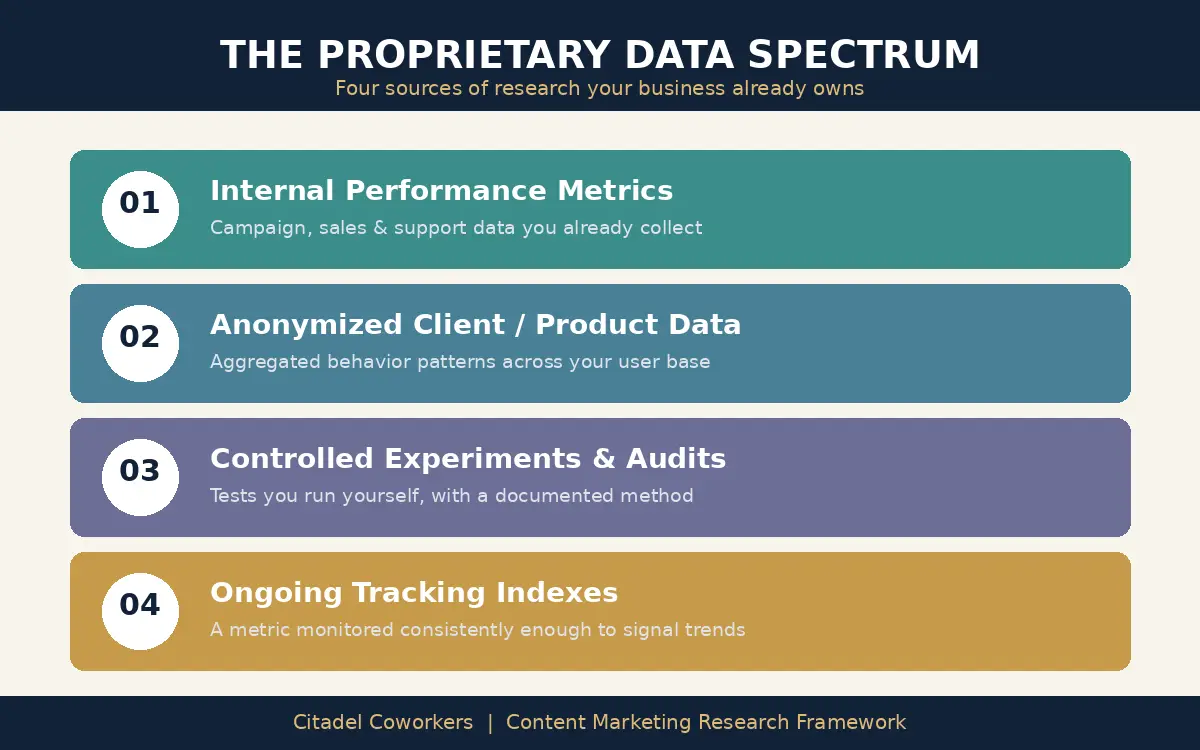
In practice, this tends to show up in a few recognizable forms:
- Internal performance metrics- patterns pulled from your own campaigns, sales cycles or support logs.
- Anonymized client or product data- usage trends aggregated across your customer base.
- Controlled experiments- a test you ran yourself, with a documented method and a real result.
- Ongoing tracking indexes- a metric you monitor consistently enough that people start watching it for signal.
None of these require a data science department. They require noticing what your business already produces and deciding to publish it responsibly.
Turning Internal Numbers Into a Content Marketing Strategy That Compounds
Most companies sit on more usable data than they realize; it’s scattered across CRMs, support platforms and spreadsheets nobody has opened since the last audit. The work isn’t collecting new data. It’s noticing what’s already there.
At Citadel Coworkers, research engagements rarely start with a survey. They start with an audit: what does this client’s operational data already show that nobody outside the company has ever seen? That single question usually produces more publishable material than a quarter’s worth of trend-chasing blog posts.
From there, a durable content marketing strategy follows a simple sequence:
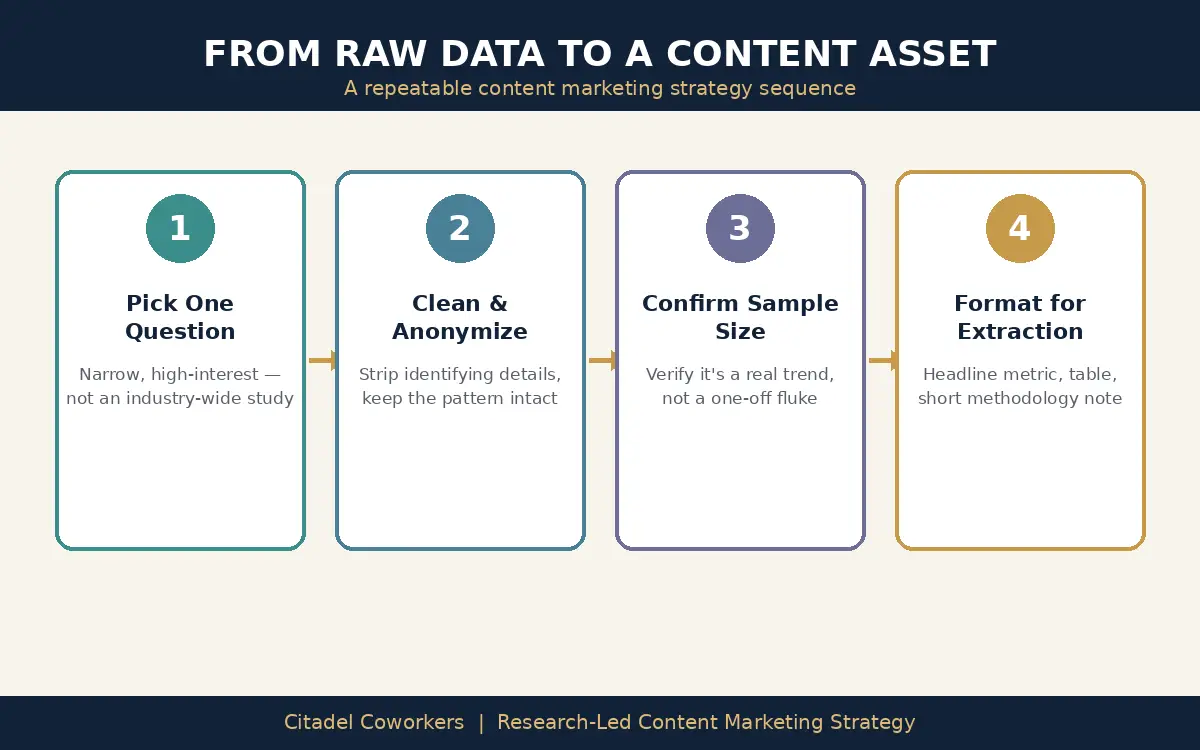
- Pick one narrow, high-intent question your buyers actually ask, not a sprawling “state of the industry” report.
- Clean and anonymize the dataset so no individual client or user is identifiable.
- Confirm the sample is large enough to represent a real pattern, not a fluke.
- Present the finding with a clear headline number, a short methodology note and a scannable table, so both readers and AI systems can extract it in seconds.
Done consistently, this turns a single data asset into a recurring content engine, one that competitors can reference but never actually replicate.
Where AI Speeds You Up And Where It Can Quietly Get You Wrong
AI has become genuinely useful in the research-to-content pipeline. It can clean messy exports, flag outliers, draft first-pass summaries and reformat a dense dataset into a readable table in minutes rather than hours. Marketers using AI well report meaningful time savings on exactly this kind of repetitive work, which frees up hours for the judgment calls that actually move a campaign forward.
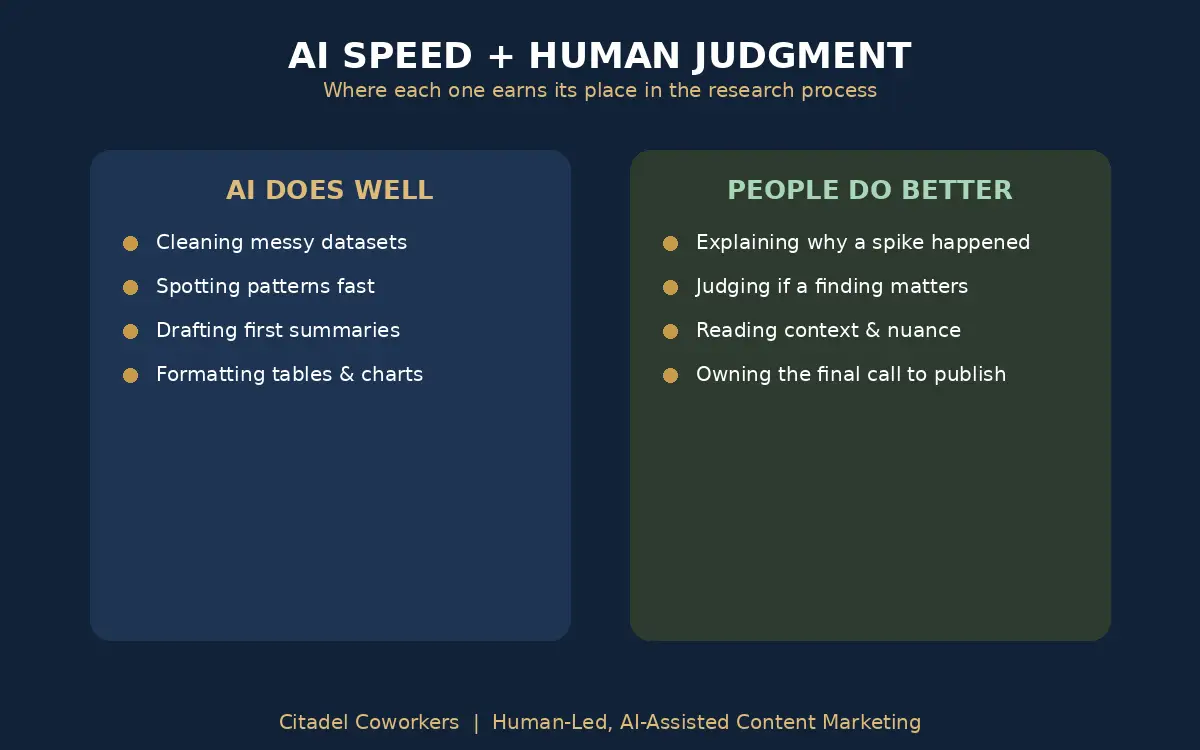
The trouble starts when that speed gets mistaken for understanding. An AI model can spot a correlation in a dataset, but it doesn’t know that the spike in March was a one-off promotion or that a client’s numbers looked unusual because of a platform migration that month. It also can’t tell you whether a finding is interesting enough to build a campaign around or whether it contradicts something a client told you off the record last week. That reading of context is still a human skill.
There’s a brand-trust dimension too. A growing share of consumers say they’re less likely to choose a brand whose marketing feels visibly AI-generated and audiences are getting sharper at spotting content that’s fluent but hollow. The businesses getting this right aren’t avoiding AI. They’re using it for speed while keeping a person accountable for accuracy, tone and the final call on what actually gets published.
Why Businesses Choose Citadel Coworkers For Research-Led Content Marketing
Plenty of agencies offer content marketing services built around keyword lists and publishing calendars. Fewer are built around the harder, more valuable work of turning a client’s own operational data into something genuinely citable.
Citadel Coworkers pairs research discipline with editorial craft: a methodology gets checked before a headline gets written and every dataset is reviewed by someone who understands both the client’s industry and how AI systems now evaluate sources. That combination is why clients stay for the second and third research cycle, not just the first campaign.
If you’re curious what might already be sitting inside your own reporting dashboards, that’s a conversation worth having before your next content calendar gets planned around someone else’s ideas.
From One Data Point to a Defensible Market Position
Differentiation built on proprietary research compounds in a way that opinion-based content never can. Every quarter you track a metric, the dataset gets more credible and harder for a competitor to dismiss. Every citation an AI engine or journalist pulls from it reinforces your brand as the source, not a summary of someone else’s source.
None of this requires a research team or a six-figure study. It requires an honest audit of what your business already knows, a willingness to publish it clearly and a partner who treats content marketing as a research discipline rather than a publishing schedule. Consider starting with the one question your customers ask most often; the answer may already be sitting in a spreadsheet you haven’t opened this month.
The internet will keep producing endless variations of the same advice. What it can’t produce is your data. In a search landscape where AI increasingly decides which brand gets remembered and which one gets quietly summarized away, that difference is no longer a marketing detail. It’s the whole game.
Leave a Reply