

Running payroll for a ten-person team is straightforward. You are aware of the numbers, your deadlines and your compliance requirements.
Now, let’s say your team is fifty people and then a hundred. You are hiring across cities, maybe across borders, the tax structure varies, and the labour law differs. The pay cycles that once took you just a day now consume an entire week and even then, something slips through.
This is the reality for most businesses that grow faster than their payroll infrastructure. The frustrating part is that it rarely happens all at once. It creeps up with every new hire or location, one regulation at a time, until the process that once ran quietly in the background becomes one of the loudest operational challenges in the room.
The businesses that navigate this well are not necessarily the ones with the biggest HR teams or the most sophisticated software. They are the ones who recognised early enough that payroll at scale is a specialist function and made deliberate decisions to treat it like one.
That decision for a growing number of organisations globally starts with understanding what remote payroll specialists can actually do and what becomes possible when the right support structure is in place.
Why Businesses Keep Getting This Wrong
Most companies approach payroll expansion the same way they approach everything else by hiring more people internally. It feels like the safe choice, but it comes with a cost that rarely shows up on a single line item. The cumulative weight of salaries, benefits, training, compliance upskilling, infrastructure and the risk of turnover.
Around 65% of enterprises globally cited regulatory compliance as the top reason for outsourcing payroll. Because when you are managing payroll across regions, tax laws change, labour regulations shift and the error of margin shrinks. One miscalculation can result in penalties that far outweigh the cost of getting it right from the start.
Growing businesses do not need more hands doing the same thing. They need the right expertise, applied at the right scale at the right time.
How Remote Payroll Specialists Actually Work
There is often a misconception that outsourcing payroll means handling over control, but in practice, it looks quite different.
Remote payroll specialists are not a replacement for your finance or HR function. They are an extension of it. They manage the end-to-end processing from data collection and calculation to tax filing and compliance reporting while your internal team retains oversight and strategic direction.
The benefits are practical and measurable:
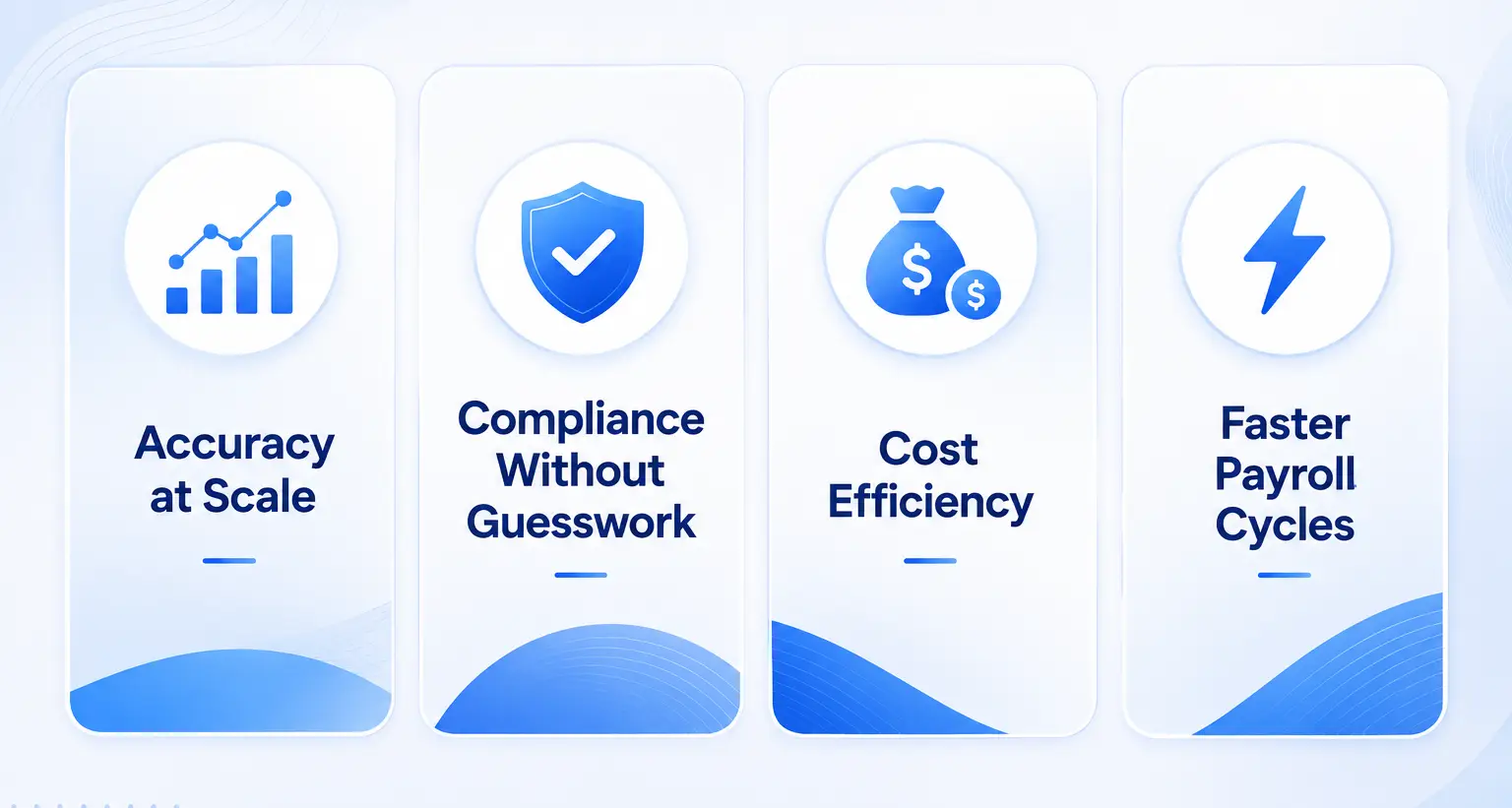
- Accuracy at Scale: Recent market data shows that outsourcing reduces payroll error rates by as much as 72% and administrative processing time by as much as 63%.
- Compliance Without Guesswork: Specialist teams monitor regulatory changes across jurisdictions in real time, ensuring your organization stays compliant as laws move.
- Cost Efficiency: Recruiting and training an internal payroll team with multi-jurisdiction knowledge is costly and outsourcing replaces that expense with a predictable service model.
- Faster Payroll Cycles: Advanced payroll systems with AI integration (such as the ones deployed in early 2025) have exhibited 40% faster payroll cycles. So, the delay that costs businesses both time and employee trust is a thing of the past.
The Case For Offshore Payroll Support
Offshore payroll support is quickly becoming a strategically viable choice for firms trying to control their payroll expenditures without losing quality.
Offshore personnel deliver deep functional expertise at a fraction of the expense of establishing similar capacity locally. When done right, they fit into defined procedures, follow data security standards and interface with your existing HR and finance systems.
It’s not only about finding a cheaper option, but it’s also about choosing a partner that knows the technical and regulatory needs of your business environment. With the right offshore model, businesses have achieved meaningful reductions in payroll operational costs while simultaneously improving turnaround times and accuracy.
What Payroll Process Outsourcing Looks Like In Practice
Payroll process outsourcing goes beyond simply running payroll on your behalf. At its best, it encompasses the full lifecycle of payroll management from onboarding employees into compliant payroll structures to managing tax filings, handling statutory deductions which generate payslips and producing audit-ready reports.
For businesses scaling quickly this breadth matters. The alternative is patching together internal processes as you grow, which creates fragmentation. Data lives in too many places, compliance gets reactive rather than proactive and your team spends more time correcting errors than building processes that actually work.
A well-structured outsourcing model eliminates that fragmentation. Everything runs through a defined system, managed by people whose entire professional focus is on payroll and not other responsibilities.
Why Companies Choose Citadel Coworkers And Keep Coming Back
There is no shortage of payroll solutions in the market. What separates one from another is rarely the technology; it is the people behind it and the intent with which the service is designed.
Citadel Coworkers was built around a simple belief: that growing businesses deserve access to the same quality of payroll expertise that large enterprises take for granted without having to build an entire department to get there. Here is what that looks like in practice:
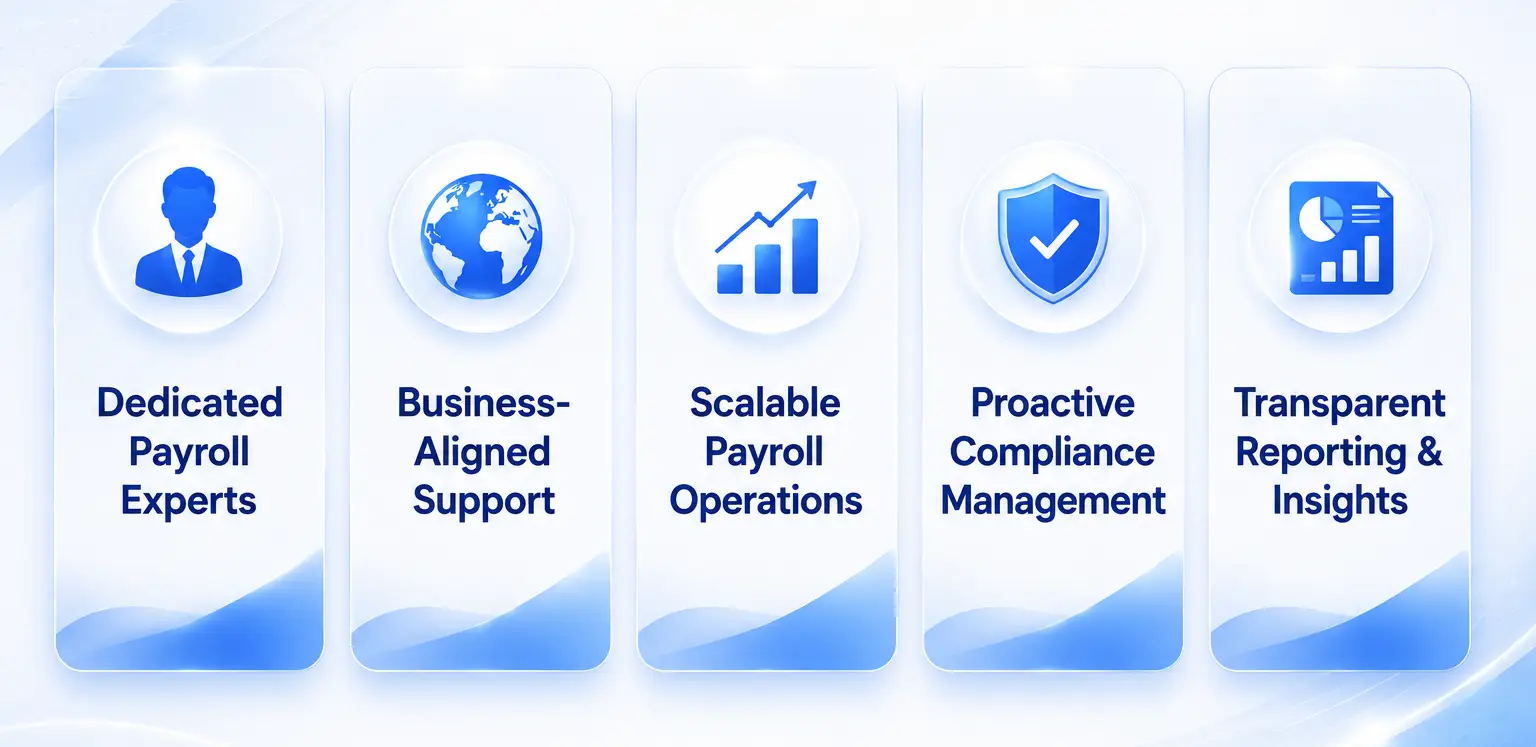
- Dedicated remote payroll specialists who are assigned to your account and understand your business, not a rotating support queue.
- Offshore payroll support is structured to match your operational hours, your compliance requirements and your reporting standards.
- Scalable engagement models that grow with your headcount, whether you are processing payroll for 30 employees or 3,000
- Proactive compliance management across regions so your team is never caught off-guard by regulatory changes
- Transparent reporting that gives your finance and HR leaders the data they need to make informed decisions
The goals are not simply to process your payroll. It is to make payroll one less thing your leadership team has to worry about, so that they can focus on the decisions that actually move the business forward.
If your team is spending more time managing payroll than managing growth, it may be time to explore what a different model looks like. Payroll outsourcing services do not just solve an operational problem; they create capacity for what matters more.
Scaling Without The Strain
Growth is rarely linear and payroll should not be the thing that slows it down.
The businesses that scale well are the ones that make deliberate choices early about what to build internally and what to entrust to specialists. Payroll with its combinations of technical complexity, regulatory sensitivity and operational volume, is one of the clearest candidates for that kind of strategic decision.
Citadel Coworkers exists for exactly this kind of moment. When payroll has grown beyond what your current setup was designed for and you need a partner who can step in with expertise, structure and reliability without disruption or delay. Scaling your payroll operations does not have to mean scaling your problems. With the right support in place it can be exactly the opposite.