

Key Takeaways
- ChatGPT and other AI assistants are becoming a genuine discovery channel; being invisible there increasingly means being invisible to a growing share of buyers.
- AI tools don’t rank pages; they select sources to trust. That means shifting effort from chasing keywords to building verifiable, structured authority.
- Consistent business data, third-party citations and answer-ready content are the real levers behind visibility in AI-generated answers, not gimmicks or paid placement.
- AI can process and monitor visibility signals faster than any team, but human judgment still decides what a business says, how it says it and when to course-correct.
You cannot buy your way into ChatGPT’s answer and there is no form anywhere that guarantees your business a mention. What you can do is build the kind of digital trust that makes an AI model comfortable saying your name out loud.
That distinction is the whole game. ChatGPT isn’t running an ad auction or a paid directory; it’s deciding, in real time, whose information it trusts enough to repeat. Earning that trust is a deliberate, ongoing exercise, not a form you fill out once and forget.
This guide breaks down exactly how ChatGPT decides who gets mentioned, what groundwork genuinely moves the needle and where Citadel Coworkers sees businesses either pull ahead or quietly fall behind in this shift toward being found and recommended by AI.
Why “Showing Up” in ChatGPT Has Quietly Become a Business Survival Skill
Search behaviour didn’t shift overnight, but it has genuinely tipped. Industry tracking has shown AI-referred website sessions climbing several hundred percent within months during 2025, with professional services and local businesses among the fastest-growing categories. Analysts at Gartner expect traditional search engine volume to fall by roughly a quarter by 2026 as AI assistants absorb the early-stage research questions people once typed into Google.
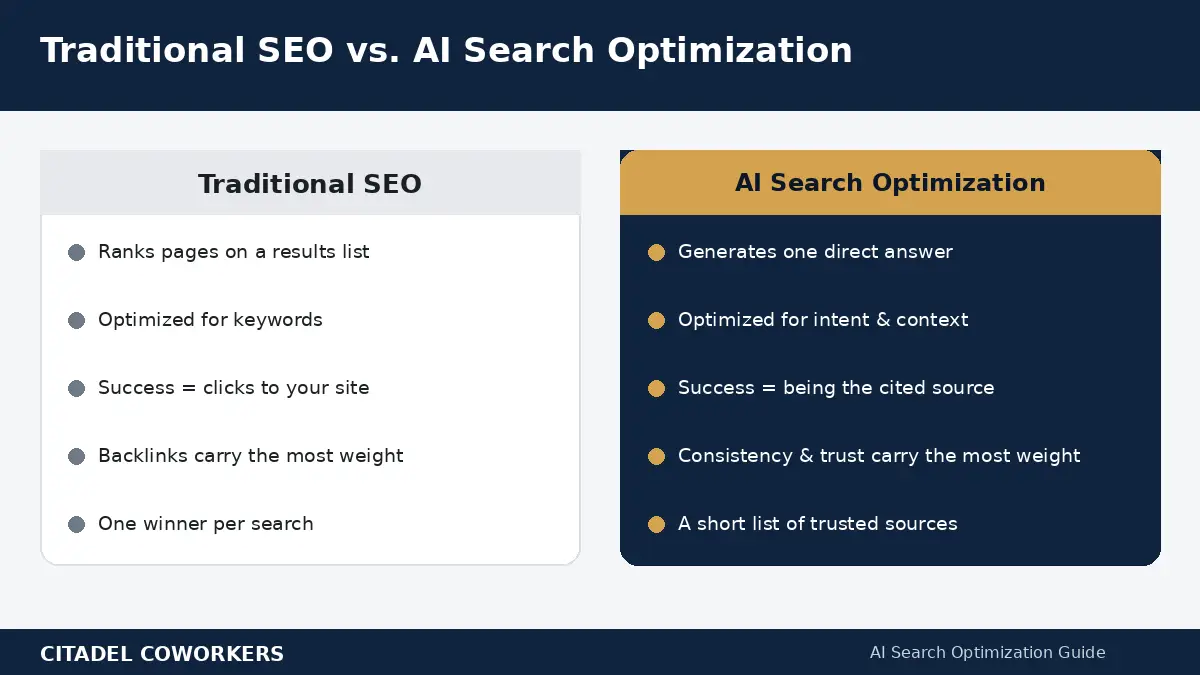
For a small or mid-sized business, that shift changes where the first impression happens. A prospect no longer scrolls through ten blue lines and compares them. Increasingly, they ask one question, receive one confident answer and act on it. If your business isn’t part of that answer, you may never even learn the opportunity existed.
This is where AI search optimization earns its place beside traditional SEO rather than replacing it. The businesses treating this as a passing trend are, quietly, the ones most likely to become invisible first.
What Does It Actually Mean for a Business to “Show Up” in ChatGPT
Showing up in ChatGPT means your business is named, described accurately or actively recommended when someone asks a relevant question, not that a link to your website appears on a page. ChatGPT draws on its training data and live web browsing (largely powered by Bing) and structured sources such as Google Business Profiles, review platforms and industry directories. If none of those sources describe your business clearly and consistently, there is simply nothing for the model to retrieve or trust.
How ChatGPT Actually Decides Who Gets Recommended
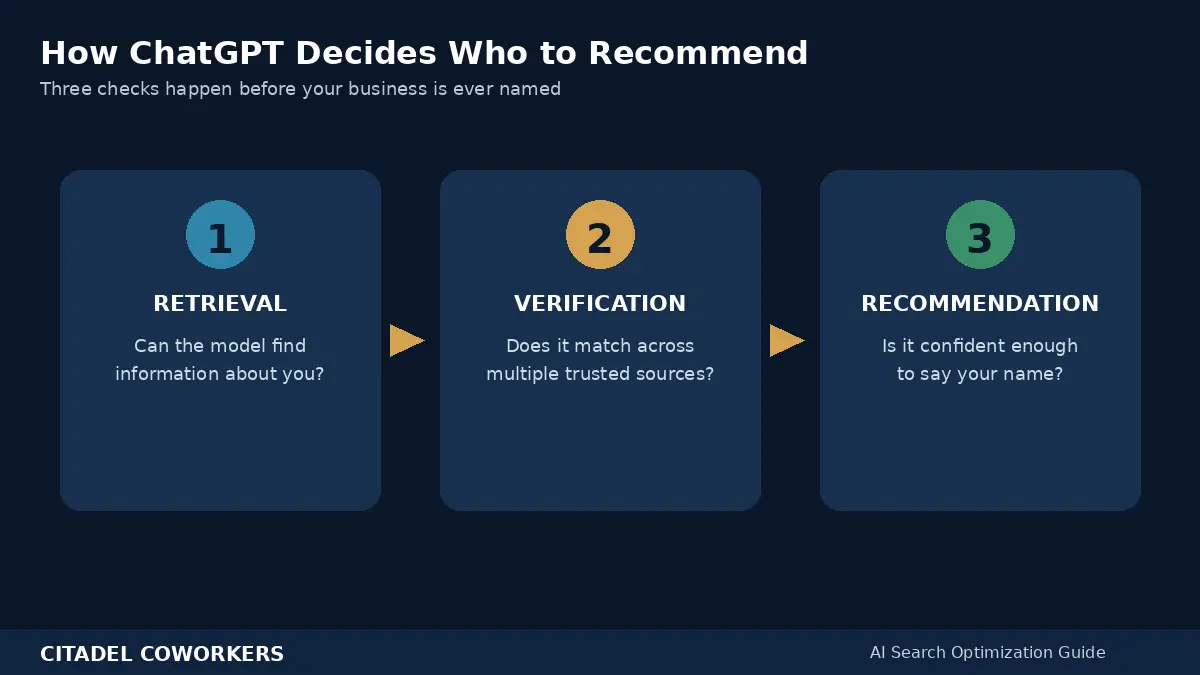
Unlike a traditional search engine, ChatGPT isn’t running a live auction for the top slot. It assembles an answer from whatever it considers reliable, which usually comes down to three checks: can it find information about you, can it verify that information elsewhere and does it trust the source enough to repeat it.
That last part matters more than most businesses realise. AI models are cautious about naming a business they can’t corroborate. A single well-written page about your services carries far less weight than the same information echoed consistently across your website, your Google Business Profile, review sites and a handful of credible third-party mentions.
At Citadel Coworkers, we’ve watched this play out with clients who had strong offline reputations but almost no consistent digital footprint and unsurprisingly, no presence in AI-generated answers either.
The Groundwork Every Business Needs for Stronger AI Search Visibility
Before chasing advanced tactics, most businesses need to fix the fundamentals first. None of this is glamorous, but it’s what AI systems check before anything else:
- Claim and fully complete your Google Business Profile, including categories, service areas and updated photos.
- Keep your business name, address, phone number and service descriptions identical across every directory and platform.
- Publish pages that directly answer real buyer questions: pricing, process, comparisons and the problems you actually solve.
- Add structured data (schema markup) so machines, not just humans, can parse your site correctly.
- Earn genuine reviews and third-party mentions rather than manufacturing them
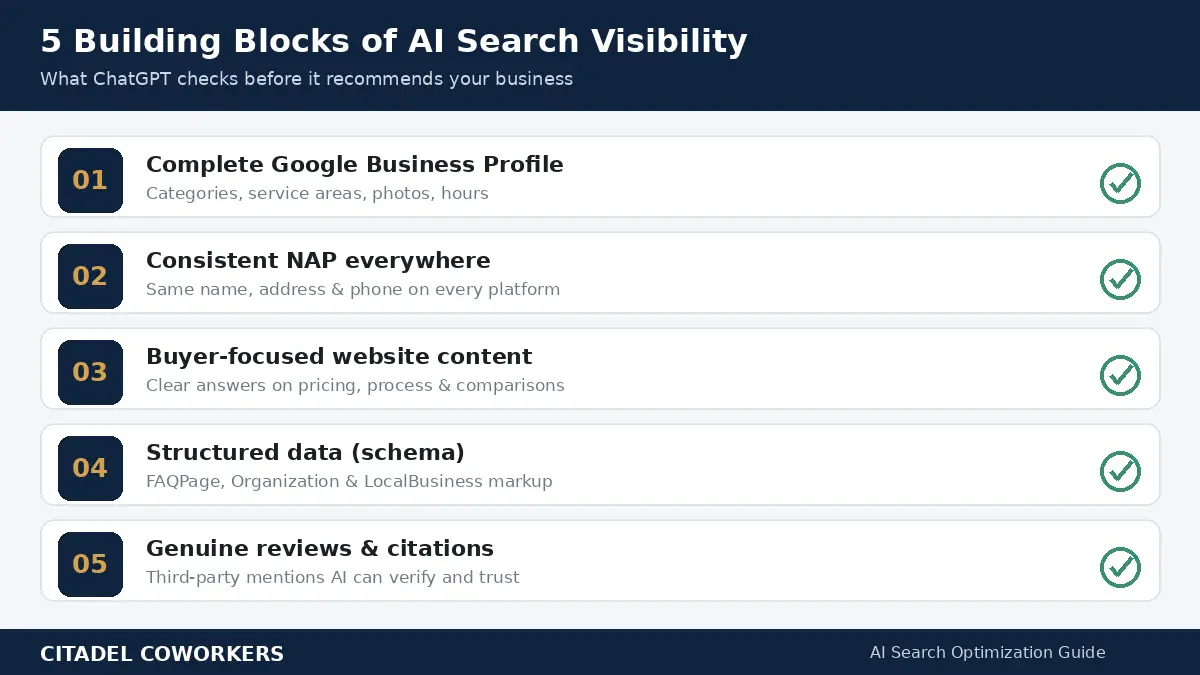
Getting these right builds the kind of AI search visibility that compounds over months, not days. There’s no shortcut that replaces this groundwork, no matter what a quick-fix vendor promises you.
Turning Your Content Into Something ChatGPT Can Actually Quote
Once the foundation is solid, the next shift is structural: writing content in a way generative systems can lift and reuse confidently. This is the essence of generative engine optimization , shaping information into clear, self-contained statements that make sense even when pulled out of context.
Instead of burying your pricing logic three paragraphs into a blog post, state it plainly under a clear, question-based heading. Instead of a vague “we offer great service”, describe exactly who you serve, what problem you solve and what makes your approach different. AI systems reward specificity because specificity is easier to verify and easier to quote.
This is also where AI search optimization work overlaps most closely with good, old-fashioned clarity. Content that’s genuinely easy for a human to skim and understand tends to be the same content a language model finds easiest to extract.
Where AI Improves Accuracy And Where Human Judgment Still Has to Lead
It’s worth being honest about what AI is genuinely good at here. Monitoring dozens of AI platforms for brand mentions, flagging inconsistent business data across hundreds of directories and scanning thousands of pages for missing schema are exactly the kind of high-volume, repetitive work AI performs faster and with fewer errors than any human team could manage manually.
But AI cannot decide what your brand should stand for, how to word a sensitive pricing explanation or whether a competitor comparison feels fair rather than manipulative. It cannot always tell when it is confidently wrong; AI models can still hallucinate details about a business, misattribute a review or blend two similarly named companies together. Enterprise marketing leaders themselves now rank accuracy and transparency among their top concerns with AI-driven discovery.
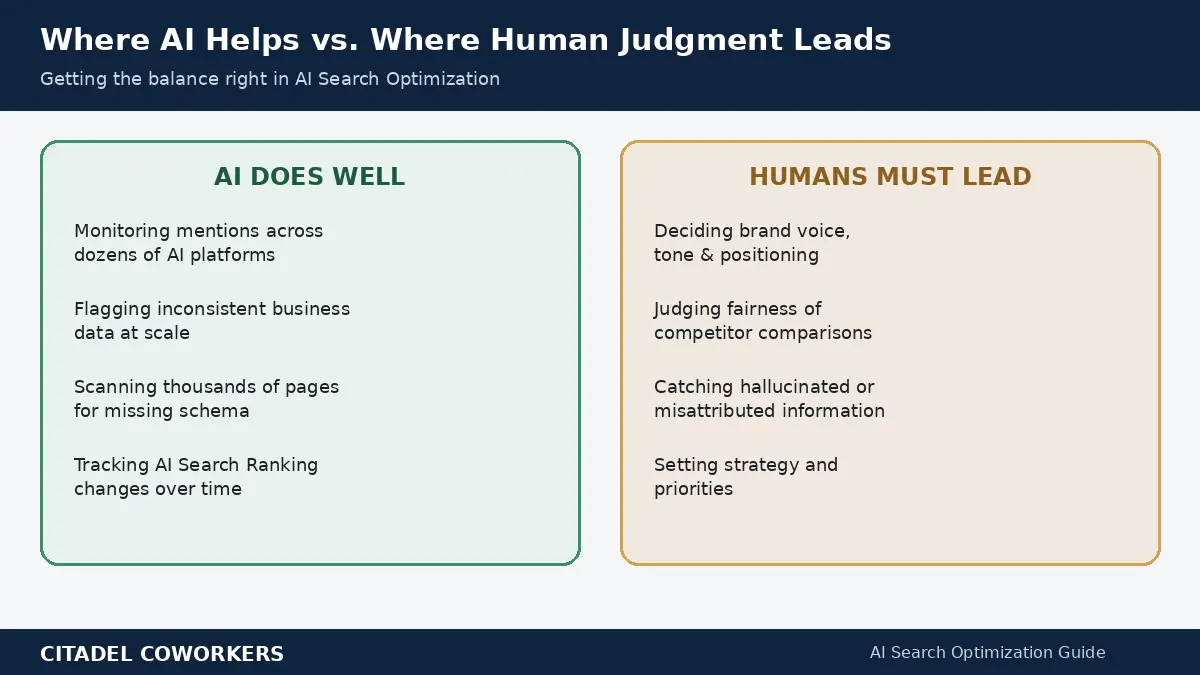
That’s precisely why human judgment remains the deciding factor. A person still needs to review what AI surfaces, correct what it gets wrong and make the strategic calls about tone, positioning and priorities. Businesses that treat AI as a fast, tireless research assistant, rather than an unsupervised decision-maker, end up with cleaner, more trustworthy visibility across every channel, not just ChatGPT.
Why Growing Businesses Choose Citadel Coworkers to Navigate AI Visibility
This is precisely the balance Citadel Coworkers is built around: using AI-assistant monitoring and analysis to work quickly, while keeping experienced people accountable for strategy, accuracy and brand voice. Visibility shouldn’t feel like guesswork and it shouldn’t be handed entirely ro automation either.
What tends to set this approach apart:
- A structured audit of where your business currently stands across search engines and AI assistants, not assumptions.
- Content built around real buyer questions rather than keyword lists, so it holds up whether a human or a model is reading it.
- Technical groundwork: schema, site structure, consistency checks, handled correctly the first time.
- Ongoing human review of AI-driven recommendations, so nothing goes live without a second set of eyes.
If you’re curious where your own brand currently stands, it’s worth spending fifteen minutes testing a handful of real customer questions inside ChatGPT yourself. What you find or don’t find, usually says more than any pitch deck could.
Measuring What Matters: Tracking Your AI Search Ranking Over Time
Visibility work only means something if you can measure it. Track whether your business appears when relevant questions are asked, whether it’s recommended as a top choice or buried in a list and whether the tone of any mention is positive. This is slowly becoming its own discipline, district from traditional analytics.
A rising AI search ranking rarely happens because of one blog post or one schema fix. It’s the compounding result of consistent, accurate signals sent across many channels over several months, which is also why GEO search visibility works best as an ongoing function rather than a one-time project.
When you’re ready to move from occasional testing to a structured, measurable plan, Citadel Coworkers can help map out exactly what that looks like for your specific industry and market.
The Real Takeaway: Trust Compounds, Waiting Doesn’t
Nothing about earning a place in ChatGPT’s answer happens overnight and none of it is permanent either. The businesses still getting recommended a year from now will be the ones treating this is an ongoing discipline, not a project they finished and filled away.
Every signal covered in this guide, a completed profile, a consistent listing, a review someone bothered to leave, compounds quietly in the background until, one day, yours is the name the model reaches for first. The only real risk is waiting long enough that a competitor gets there before you do.