
Picture two searches happening on the same Tuesday afternoon, thirty minutes apart. One person types “best accounting software for freelancers” into Google and gets a short, three-vendor answer sitting above the usual blue links. Half an hour later, a colleague at the same company asks the exact same question inside AI Mode and receives a nine-vendor breakdown that skips two of the original three names entirely.
Same query. Same day. Same company. Two answers that barely agree on who deserves a mention.
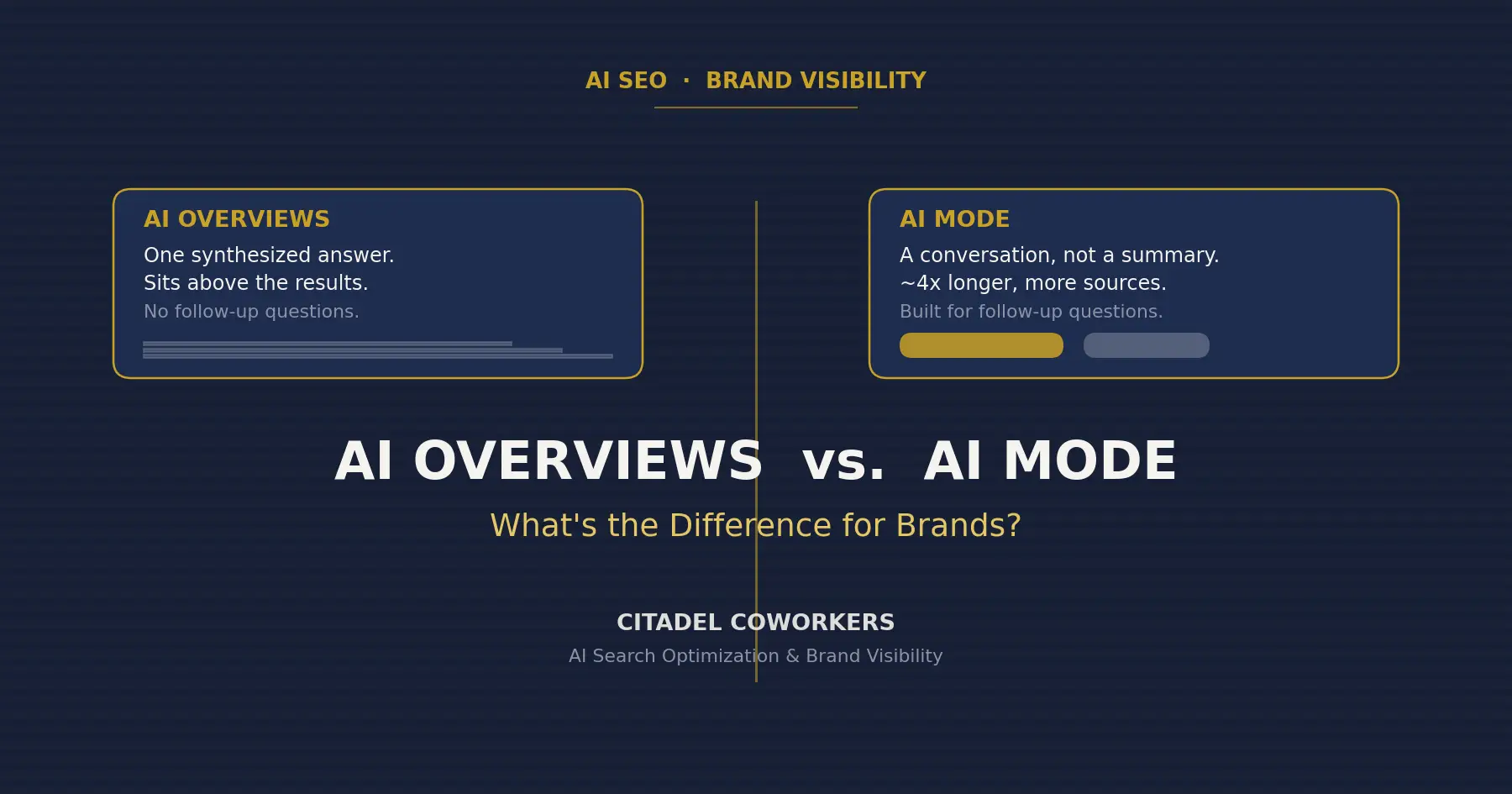
That gap isn’t a glitch. It’s how Google’s two AI search systems are built and it’s quietly becoming one of the more consequential problems in modern brand discovery. A brand’s SEO team can do everything right by traditional standards and still watch half of its potential customers walk away with an incomplete picture.
Why One AI Answer Isn’t Enough Anymore
For twenty years, ranking well on Google meant one thing: show up on page one. Now Google runs two separate AI-generated answer layers on top of that same results page and each one decides independently who gets named.
Ahrefs studied 730,000 paired responses from AI Overviews and AI Mode and found the two systems reach a similar conclusion 86% of the time, but cite the same source only 13.7% of the time. They agree on what to say and disagree almost completely on where they found it.
Part of the explanation lies in how both systems build their answers. Google’s own documentation describes a technique called “query fan-out,” where a single search gets broken into several related sub-questions before the response is assembled. Because AI Overviews and AI Mode run this process independently, using different models and different weighting, they end up researching the same topic twice and landing on two different reading lists.
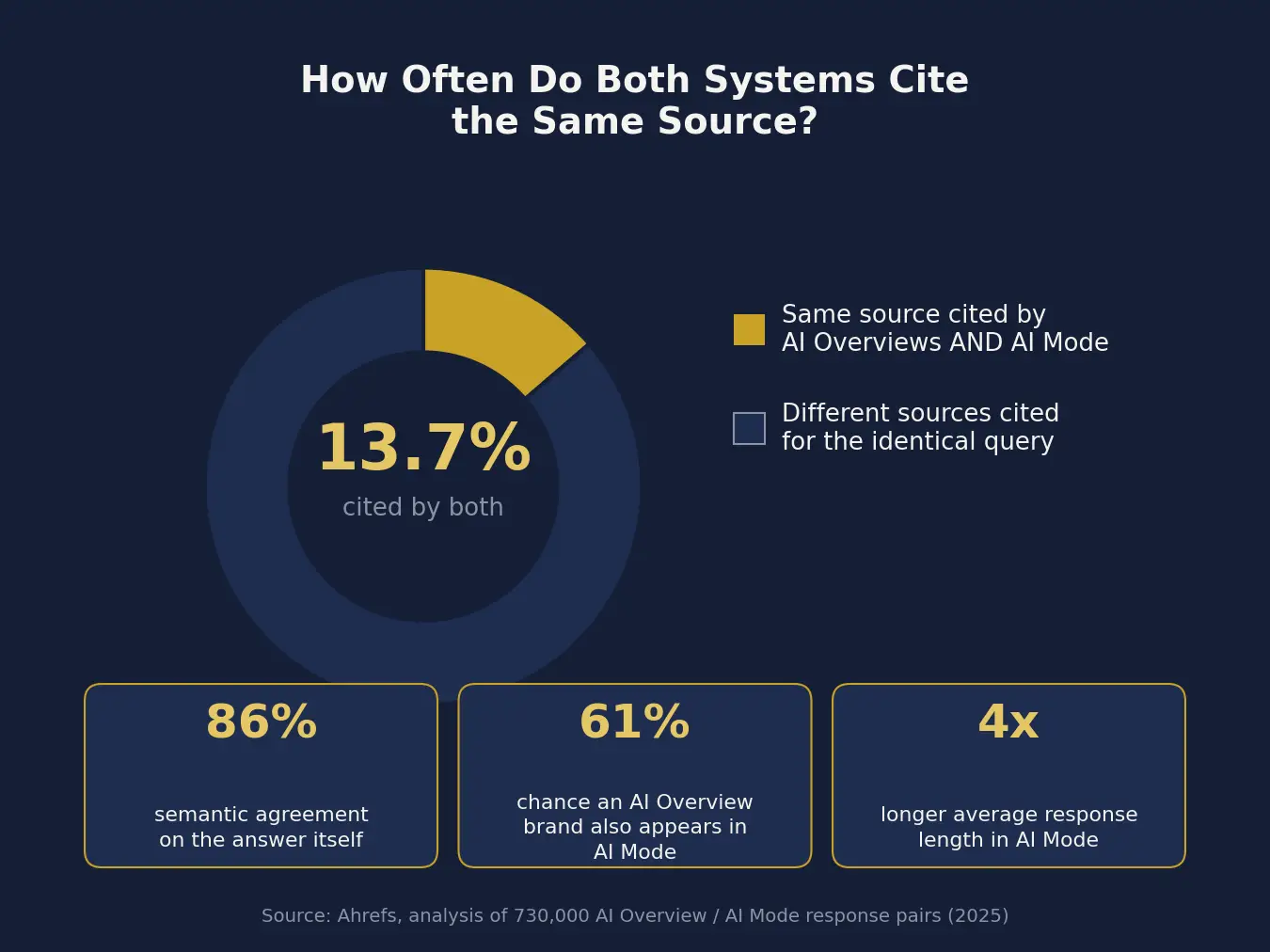
That single statistic explains why a brand can look completely healthy in one system and functionality invisible in the other, while answering the identical customer question. For any business investing in AI SEO, that isn’t a minor footnote. It’s the entire strategy problem.
AI Overviews vs. AI Mode: Two Systems, Two Rulebooks
Google AI Overviews are short, synthesized summaries that sit above traditional search results. They’re built for speed: someone searches, reads a compact answer and either clicks a source link or moves on. There’s no back-and-forth. Each Overview is a single, static response pulled from Google’s indexed web content.
AI Mode works differently. It’s a conversational, multi-turn search experience that lets someone ask a question, follow up and refine their intent the way they would in a chat. Ahrefs found AI Mode responses run roughly four times longer than AI Overviews on average and include about three times more brand and person mentions per answer.
Think of it this way: AI Overviews change what a searcher sees on the page, while AI Mode changes how they search in the first place. One is a feature bolted onto familiar results. The other is closer to a new search engine living inside the old one. A quick factual question (“what’s the boiling point of water at altitude”) still tends to trigger a tidy Overview. A comparison-heavy question (“which of these three tools fits a five-person team”) is far more likely to pull someone into an AI Mode conversation.
What’s the Actual Difference Between AI Overviews and AI Mode
AI Overviews answer a question once, briefly and nudge the searcher back toward the regular results. AI Mode keeps the conversation open, pulls from a far wider set of sources and rewards brands that publish comprehensive, well-structured content rather than a single optimized page. One is a shortcut. The other is a research session.
How Each System Decides Who Gets Cited
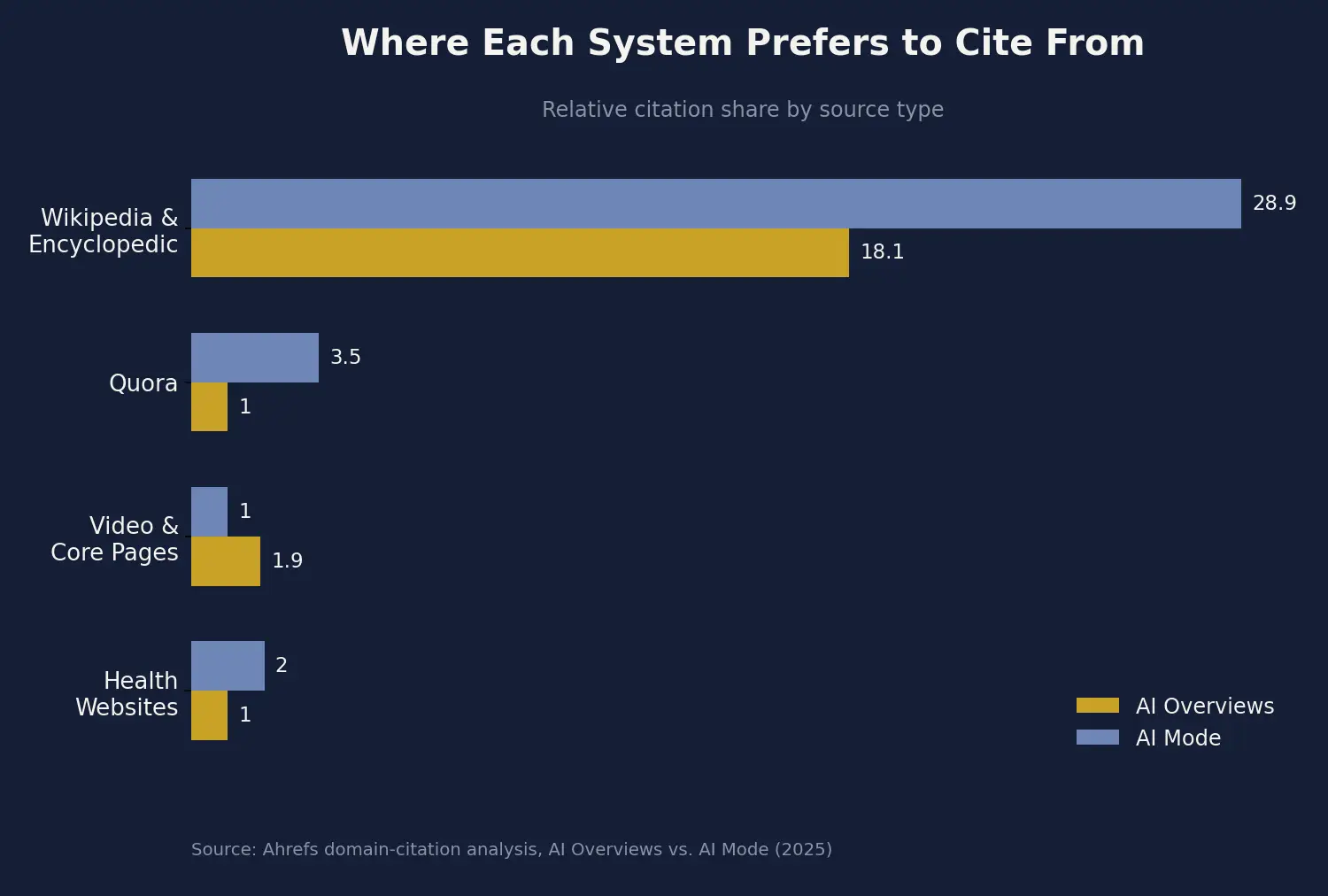
The two systems also draw from different corners of the web. Ahrefs’ domain-level analysis surfaced patterns worth building a content plan around:
- Wikipedia and encyclopedia sources appear in roughly 28.9% of AI Mode citations versus 18.1% in AI Overviews.
- Quora shows up about 3.5 times more often in AI Mode than in AI Overviews.
- Video and core pages, like homepages and category pages, are cited nearly twice as often in AI Overviews.
- Health and medical sources are cited about twice as often in AI Mode.
Separate research from Otterly.AI, tracking more than 30,000 citations, found an even larger gap in reach: AI Mode responded to every single test query it ran, while AI Overviews triggered for roughly half. When a brand’s own domain was involved, AI Mode cited it directly far more often than AI Overviews did, which tended to favor third-party coverage even for branded searches. Real AI search optimization now means building a presence that satisfies both instincts at once: Google’s selective curator and its always-on research assistant.
That third-party preference inside AI Overviews carries a brand-safety implication too. If Google’s curated summary would rather cite a review site or an industry publication than your own homepage, then earning coverage on those third-party sites becomes just as important as anything you publish yourself.
Building a Brand Visibility Strategy That Covers Both Systems
Winning in one system while ignoring the other means a share of your customers are getting a version of your brand you never approved. A workable plan usually includes:
- Track both systems separately. Citations in AI Overviews tell you almost nothing about your AI Mode standing and the reverse is just as true.
- Build genuinely comprehensive content. AI Mode rewards depth: FAQs, comparisons and structured detail beat a single thin page.
- Earn backlinks and third-party mentions. Domain authority still carries weight in both systems, just to different degrees.
- Add video for Overview visibility, since video and core pages are cited nearly twice as often there.
- Treat your content like a reference document, not a sales page. That shift in mindset is the core discipline behind generative engine optimization.
None of this replaces traditional SEO fundamentals. It builds on top of them: a technically sound, well-linked site is still the foundation both systems draw from.
This is the kind of work Citadel Coworkers builds into every AI SEO engagement: not chasing a single keyword ranking, but earning the structured, source-worthy content both Google systems are built to pull from.
Where the Machines Stop and Judgment Takes Over
It’s tempting to treat AI search visibility as a pure numbers problem: track the citations, adjust the content, watch the score climb. But both systems are opaque by design and the same content can be cited generously one week and ignored the next for reasons no dashboard fully explains.
That’s exactly where a human strategist earns their keep. Deciding which topics deserve a comprehensive resource versus a quick answer, reading the intent behind a citation pattern and knowing when a dip reflects a real content gap rather than normal fluctuation all require judgment no algorithm supplies on its own. Brands that pair AI monitoring with experienced strategy aren’t resisting this shift. They’re the ones actually shaping how it plays out for their industry.
Consider a healthcare brand that suddenly loses AI Mode citations for a symptom-related query. A pure automation tool flags the drop. A strategist asks why: maybe a competitor just published a more comprehensive guide, maybe Google tightened its standards for medical content or maybe the query’s intent shifted entirely. Only one of those explanations changes what you should publish next and telling them apart takes a person who understands the topic, not just the traffic chart.
If you want a clearer read on where your own brand currently stands, running the same query through both search experiences side by side is a useful first step and one worth revisiting every few months as both systems keep evolving.
Why Smart Brands Trust Citadel Coworkers With Their AI Visibility
Most agencies still report on rankings alone, which tells you almost nothing about how a brand is represented inside a synthesized AI answer. Citadel Coworkers built its process around a different assumption: that visibility now lives in citations, entity mentions and structured content, not just blue-link position.
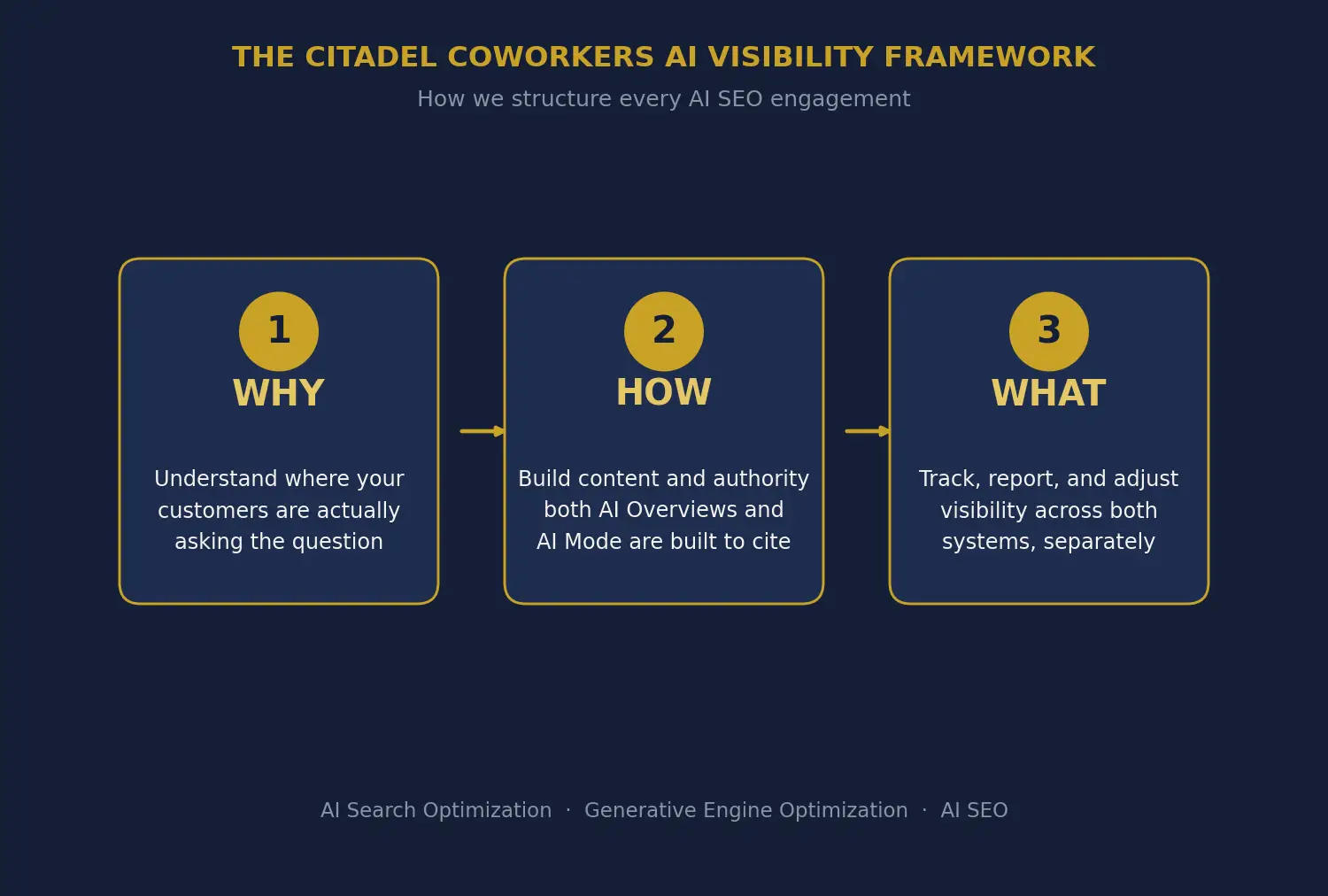
Every engagement pairs technical SEO fundamentals, including backlinks, site architecture and domain authority, with content built specifically for how AI Overviews and AI Mode each select sources. It also means separate monitoring for each system, because treating them as one channel is how brands end up guessing at half the picture.
What sets the approach apart is the refusal to treat AI visibility as a side project bolted onto a traditional SEO retainer. Content strategists, technical SEOs and digital PR specialists work from the same brand map, so a backlink campaign, a comparison guide and a Wikipedia cleanup all point at the same visibility goal instead of pulling in three directions. The goal stays simple: show up accurately, wherever a customer is actually asking the question.
The Search Landscape Isn’t Slowing Down
Those two colleagues searching the same question thirty minutes apart will keep happening, thousands of times a day, across every industry. The brands that show up in both answers aren’t the lucky ones. They’re the ones that stopped treating AI Overviews and AI Mode as a single project a while ago.
The real question worth sitting with isn’t whether your brand ranks. It’s whether it’s telling the same story to every customer asking, no matter which system Google decides to show them. If you’re ready to find out, a conversation with a team that tracks both boards daily is a good place to start.