
Key Takeaways
- Search behaviour has genuinely shifted: a large and growing share of Google queries now end without a click and AI platforms increasingly answer the question before a user ever visits a website.
- Ranking #1 no longer guarantees visibility. A shrinking share of AI citations comes from pages sitting in the traditional top 10, which means the competitive field has been reshuffled.
- Paying for this kind of optimisation makes sense when it is built on a real content and technical foundation, not sold as a shortcut. The businesses winning right now are pairing automation with human editorial judgment, not replacing one with the other.
AI SEO is everywhere right now. It’s impossible to escape the topic. Every agency has launched a new service page for it, every industry newsletter has an opinion and every other LinkedIn post is a screenshot of a brand showing up inside a ChatGPT answer. Underneath all of that noise sits one uncomplicated question: does this actually work and is it worth paying for yet?
At Citadel Coworkers ,we hear a version of that question from a business owner almost every week, usually someone who just noticed an unfamiliar referral source in their analytics or someone tired of agencies promising “AI visibility” without being able to explain what they actually did to earn it. This piece skips the hype and gives you the honest version: what’s genuinely working, what’s still unproven and how to decide where it fits in your budget. That’s exactly where most business owners are standing right now with AI SEO.
Why the Ground Beneath Search Has Actually Moved
For two decades, ranking on page one of Google was the whole game. That game hasn’t disappeared, but it has been joined by a second one: a large and rising share of searches, well over half by most recent industry estimates, now resolves without a single click, because the answer already appears on the results page or inside a chat window.
This isn’t a fringe trend confined to tech-forward industries. Buyers researching accountants, clinics, software ad even furniture are increasingly asking ChatGPT, Perplexity or Google’s AI Overviews to summarise their options before they ever browse a website. Recent industry data suggests AI-generated overviews now touch a meaningful and growing slice of everyday searches and when they appear, far fewer users click through to any single site.
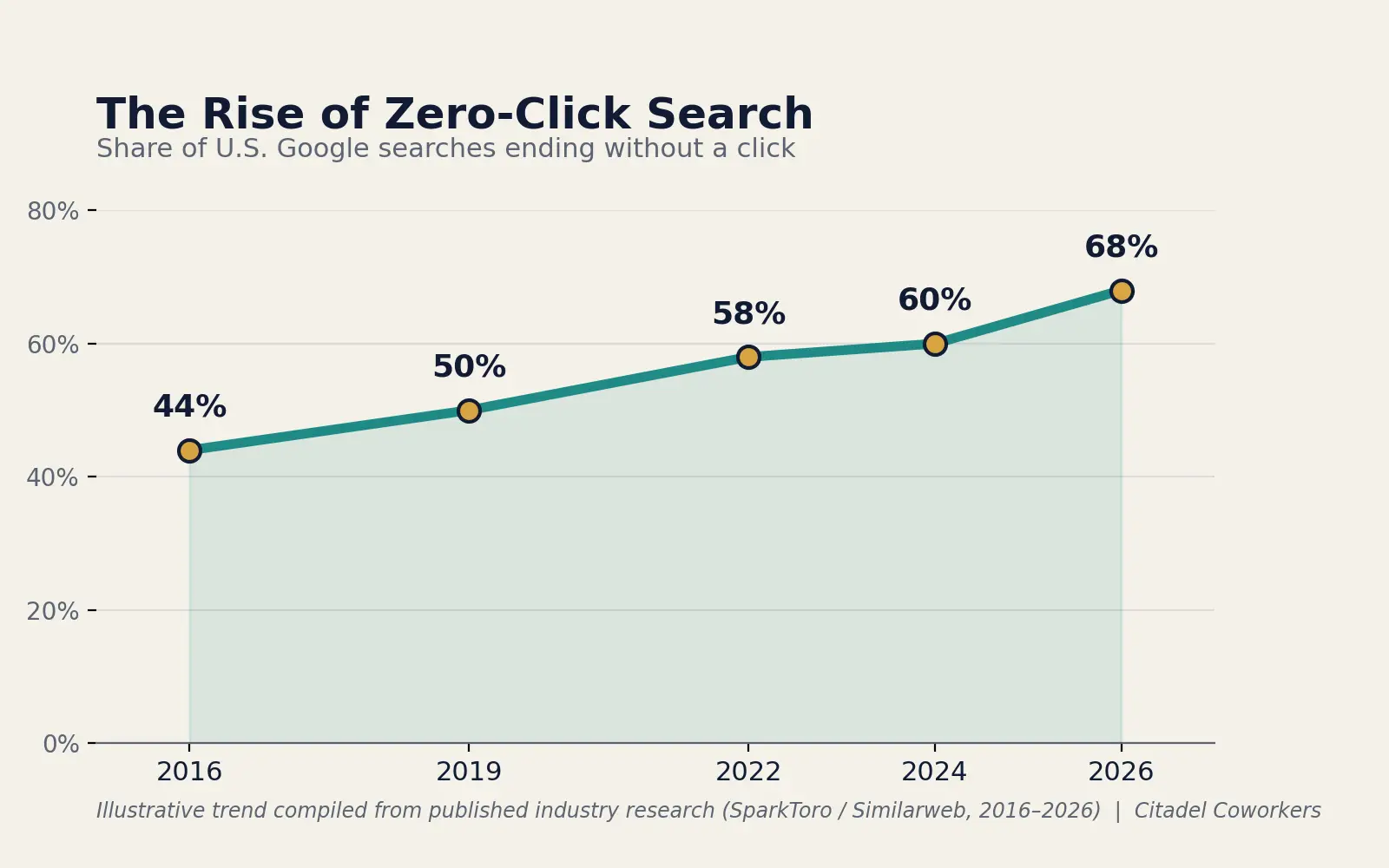
For a business owner, that means visibility now depends on being cited inside an answer, not just ranked below one. This is the exact tension that AI search optimization exists to solve and it’s why the question isn’t whether to pay attention to it, but when and how much.
What Is AI SEO
AI SEO is the practice of optimising a website’s content, structure and authority signals so that both traditional search engines and generative AI platforms can find, understand and recommend it. It sits alongside conventional SEO rather than replacing it. The technical groundwork-site speed, clean architecture, credible content-still matters, but the target has expanded from “rank well” to “get cited and recommended”.
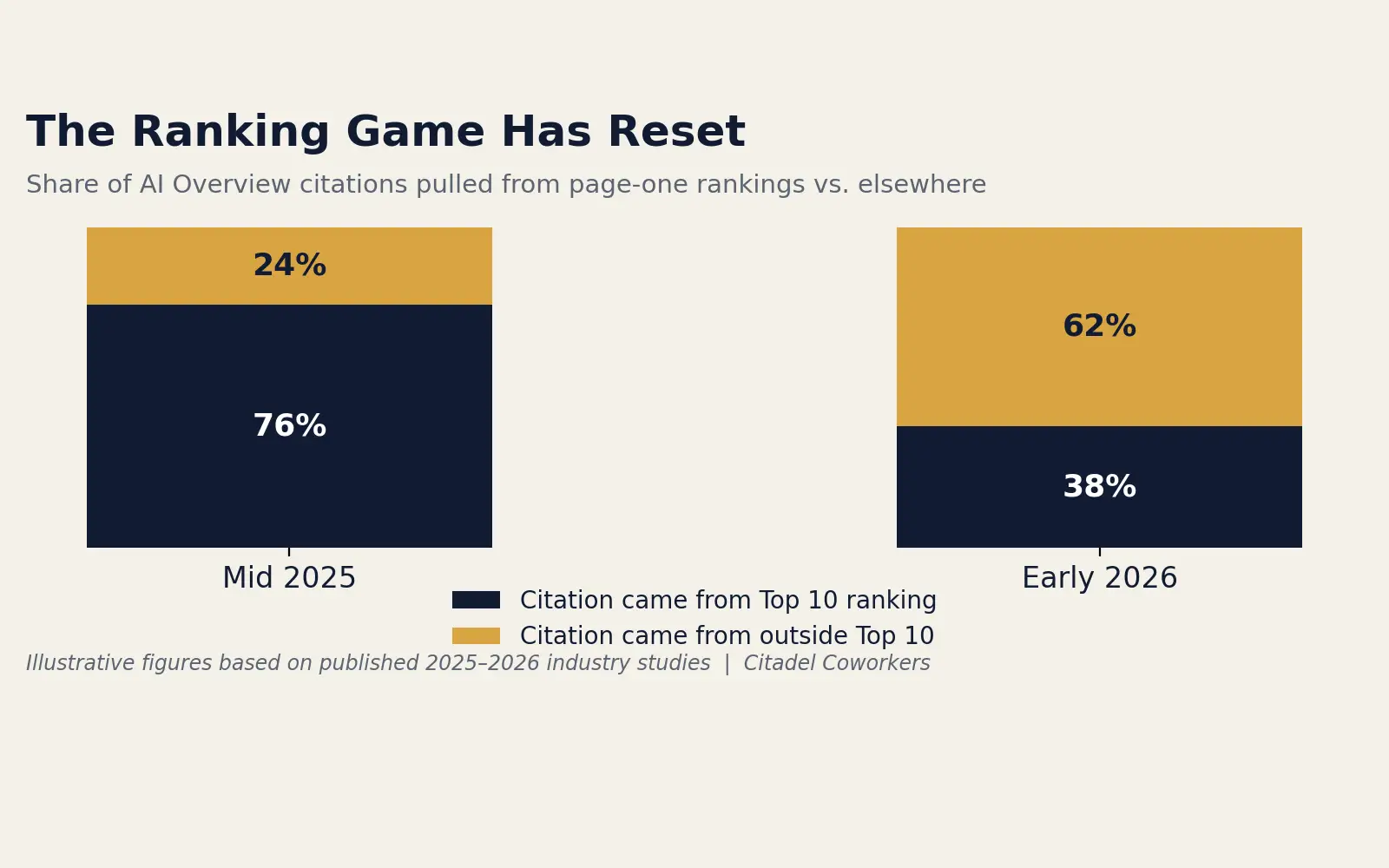
Within that umbrella sits generative engine optimization, a narrower discipline focused specifically on earning citations inside AI-generated answers on platforms like ChatGPT, Claude and Gemini. Think of the broader strategy as the house and this one of its load-bearing rooms: distinct enough to name, but useless without the rest of the structure around it.
How AI Is Already Reducing Errors and Sharpening Strategy
Here’s where the honesty test really begins. AI tools have made several parts of search optimisation faster and measurably more accurate and it would be dishonest to pretend otherwise:
Technical audits at scale. AI-assisted crawlers can flag broken schema, duplicate metadata or slow-loading pages across thousands of URLs in minutes-a worry that used to take a specialist days and still missed things.- Content gap detection. Natural-language models can compare a site’s existing content against real query patterns, surfacing missed topics or thin pages far faster than manual research ever could.
- Consistency checks. AI systems catch inconsistent name, address and phone data, mismatched product details or outdated claims across dozens of pages, a common source of the very errors that erode trust with both users and AI crawlers alike.
- Pattern recognition at speed. Spotting which competitor pages are earning citations and why is a task AI can compress from days of manual comparison into a single afternoon.
Used this way, AI isn’t replacing strategy. It’s removing the tedious, error-prone groundwork so human strategists can spend their time on judgment calls instead of spreadsheets.
Where AI Cannot Be Trusted And Why Human Judgement Still Wins
This is also exactly where confidence needs a ceiling. AI models can summarise a competitor’s positioning, but they cannot reliably judge tone, brand nuance or what will actually persuade a specific buyer in a specific industry. They can draft content quickly, but left unchecked, they also fabricate statistics, misattribute quotes and repeat outdated information with total confidence.
There’s a second, quieter risk worth naming. AI platforms often cite generic, easily summarised content over genuinely distinctive expertise, simply because it’s easier to compress into an answer. A business that lets AI generate everything without editorial oversight risks becoming indistinguishable from its competitors, which is the opposite of what good marketing is supposed to achieve.
That’s precisely why Citadel Coworkers treats AI as an accelerant for research and execution, never as a replacement for the strategist who understands a client’s market, voice and customers. The AI SEO services worth paying for are the ones where a human is still reviewing every claim, every tone choice and every fact before it goes live. Automation earns trust by being clicked, not by being unsupervised.
Is Paying For AI SEO Actually Worth It
The honest answer depends on where a business currently stands. A simple gut check helps:
It’s likely worth prioritising now if:
- Buyers already research the category conversationally, software, professional services, healthcare and other high-consideration purchases
- Competitors are already appearing in AI-generated answers for relevant terms
- The business has a decent content and authority base but isn’t showing up in AI citations yet
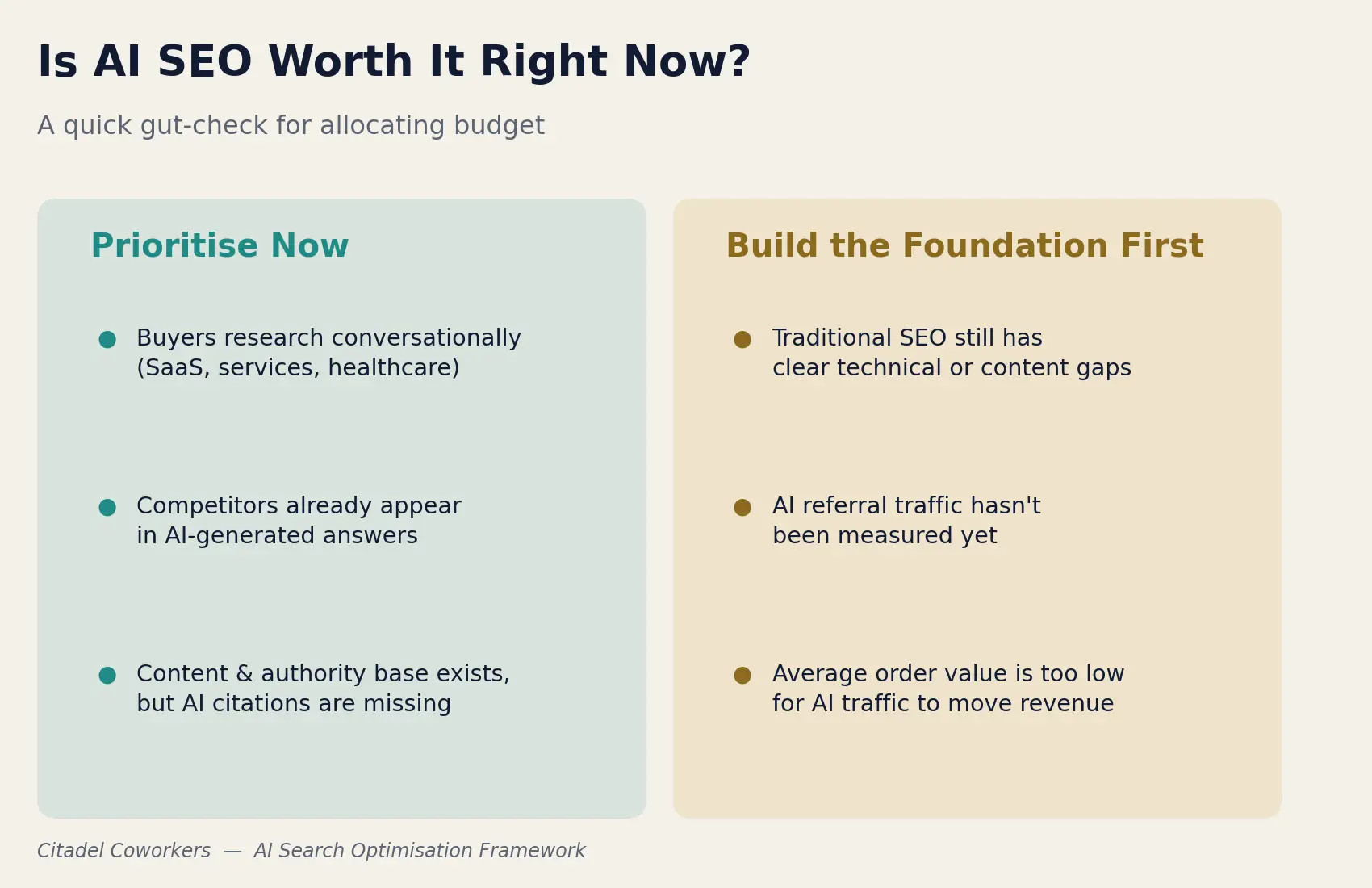
It’s more reasonable to build the foundation first if:
- Traditional SEO still has obvious gaps, such as thin content, technical issues or a weak backlink profile
- AI referral traffic is currently negligible and hasn’t even been measured yet
- Average order value is low enough that even strong AI traffic wouldn’t move revenue meaningfully
For more businesses, this isn’t an all-or-nothing decision. It earns its place in the budget when the fundamentals are already solid enough for AI-focused work to amplify them, not invent them from scratch. Citadel Coworkers would rather tell a client to wait three months and fix their foundation than take a retainer that won’t move the needle yet.
Why Growing Businesses Trust Citadel Coworkers With Their AI Search Strategy
What sets an engagement apart in this space isn’t the promise of guaranteed citations. No agency controls what a language model chooses to surface and any that claims otherwise should raise a flag immediately. What matters is a partner who treats AI visibility as an extension of sound strategy, not a separate, mysterious add-on bolted onto an existing retainer.
Citadel Coworkers approaches this by auditing where a brand currently stands across Google, ChatGPT and Perplexity before recommending a single change. That audit typically reveals quick wins, structured data gaps, missing FAQ content, and inconsistent entity signals that cost little to fix but meaningfully affect whether a brand gets mentioned at all. From there, the work blends AI-assisted research and drafting with hands-on editorial review, so content stays fast to produce and still sounds like an actual expert wrote it.
If you’re curious where your own brand currently stands in AI-generated answers, a short visibility check is often the clearest way to find out before committing to a larger programme.
Getting Started Without Wasting Budget
A sensible first step rarely requires a large retainer. In practice, it tends to look like this:
- Measure current AI referral traffic and citation appearances honestly, even if the number is small today.
- Fix the technical and structural gaps, schema, clear headings, and factual accuracy that block AI systems from understanding the site properly.
- Publish a small number of genuinely authoritative pieces rather than a large volume of thin, forgettable ones.
- Reassess after 60 to 90 days, since early citation signals tend to show up before revenue does.
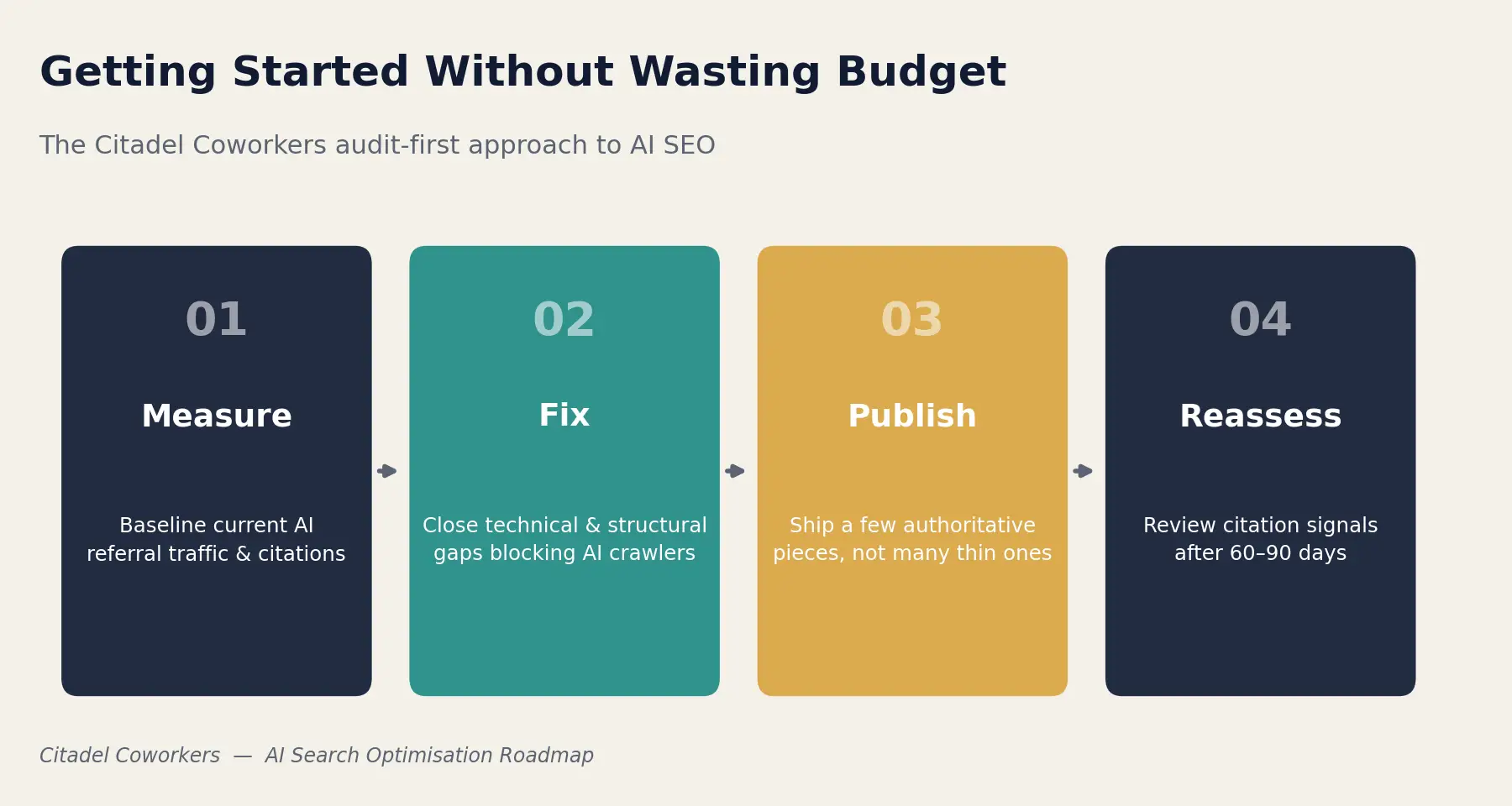
This sequencing keeps spend proportional to evidence rather than hype, whihc is the real difference between an investment and a gamble. Businesses exploring this path with Citadel Coworkers usually start with exactly this kind of audit rather than a full-scale campaign, precisely because it removes the guesswork before any meaningful budget is committed.
The Bottom Line
AI hasn’t replaced the fundamentals of good marketing. It has changed where those fundamentals need to show up and how quickly a business needs to adapt to stay visible. The businesses that will look back on this moment as a turning point are the ones treating AI as a research and efficiency partner today, while keeping a human hand firmly on strategy, voice and judgment.
That combination, more than any single tool or tactic, is what separates a brand that gets cited from one that quietly gets left out of the conversation. It’s worth deciding where you stand before the window narrows any further.
Leave a Reply