

First, you hire an employee to stop doing everything yourself. Then you hired a second, and a third and somewhere along the way, you became the bottleneck again. The inbox no one else manages. The calendar that only you can navigate. The vendor follow-ups sit at the bottom of a to-do list that never quite gets shorter.
This is not a time management problem. It is a delegation problem.
And in 2026, the businesses solving it most effectively are not the ones hiring more full-time staff; they are the ones being deliberate about which tasks belong in-house, and which ones are quietly stealing hours that should be spent on strategy, client relationships and growth.
Why Does The “Do It All” Approach Costs More Than You Think
There is a version of business leadership that equates busyness with productivity. It is a costly illusion.
When senior professionals spend hours scheduling meetings, chasing invoices or formatting reports, the real cost is not the time itself; it is the higher-value thinking that never happens because the calendar was too full. Research consistently points to the fact that knowledge workers lose a significant portion of their week to tasks that are important but not irreplaceable by them specifically.
Virtual assistant services exist precisely to address this gap. The model is straightforward: skilled remote professionals take on defined, repeatable or specialist tasks so that your internal team can focus on work that genuinely requires their presence and expertise. The business case is not complicated but the execution matters more than most people expect.
If you have been considering a more strategic approach to delegation but are unsure where to start, the answer usually lies in looking honestly at where your team’s time is actually going.
The Tasks That Make the Most Sense to Hand Over
Not every task is worth outsourcing and not every task that can be delegated should be. The right starting point is asking: does this task require my specific judgment, relationships or institutional knowledge or does it require skill, consistency and time? Here is where most businesses find the clearest wins:
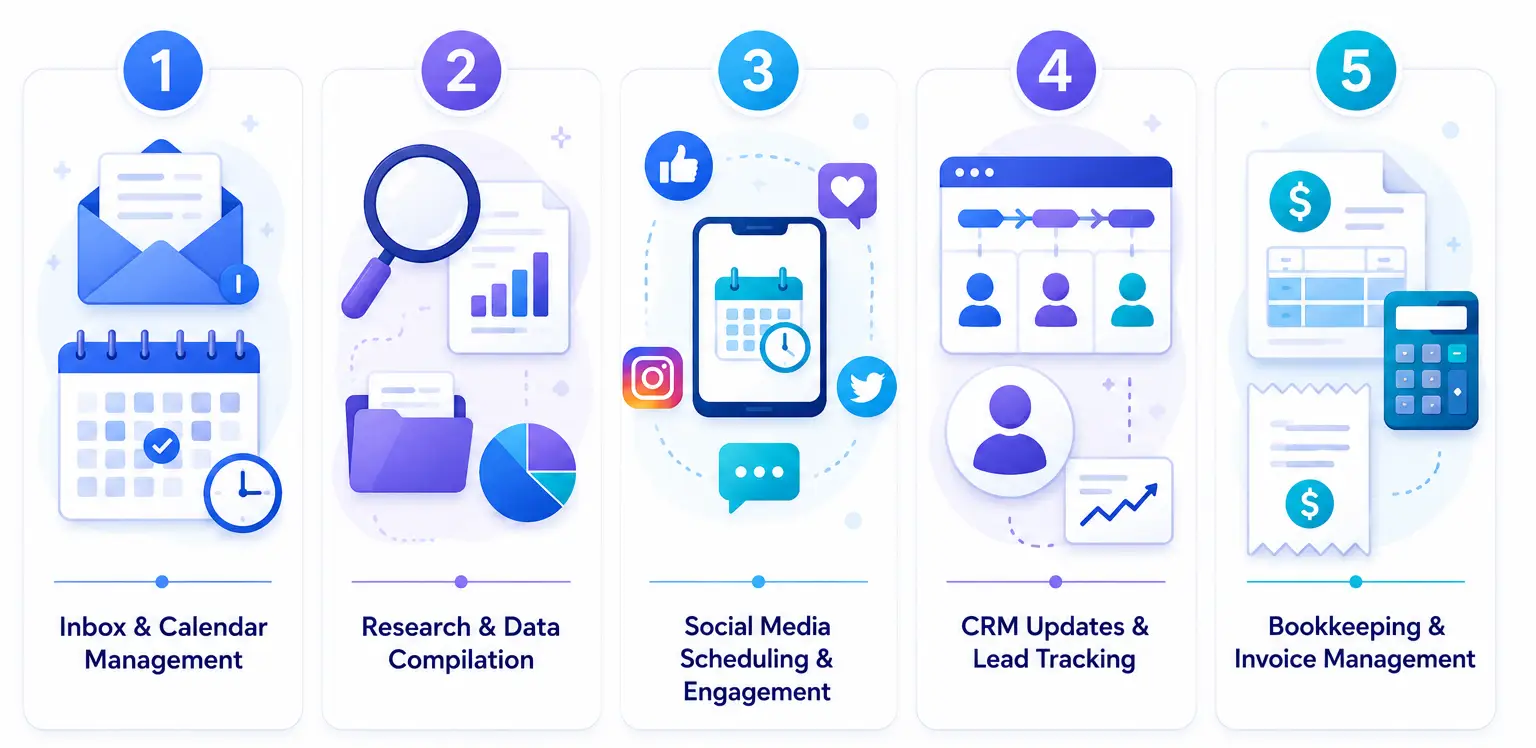
1. Inbox and Calendar Management
For business owners and senior managers, an unmanaged inbox is a slow drain on focus. A virtual assistant can triage correspondence, draft standard replies, flag priorities and maintain a clean calendar protecting the time of the people who need to be present where it counts.
2. Research and Data Compilation
Information collection and structuring from competitive analysis to supplier sourcing is procedure-driven but time-intensive. A competent VA can produce organised, actionable research briefs without the person who needs the insight spending hours producing it.
3. Social Media Scheduling and Engagement
Social presence is a currency of consistency. Virtual assistants can handle content calendars, posting schedules on different platforms, monitoring comments and more, keeping your brand visible without your marketing team having to reinvent the wheel each week.
4. CRM Updates and Lead Tracking
Outdated CRM records are a silent killer of sales momentum. Keeping pipelines current, logging interactions and ensuring follow-up tasks are scheduled are precisely the kind of structured, repeatable tasks a VA handles well.
5. Bookkeeping and Invoice Management
Many small businesses delay financial admin until it becomes urgent and the cost is always higher than it needed to be, whether measured in late fees, missed payments or a panicked catch-up before quarter-end. A Virtual assistant for a small business can manage routine bookkeeping tasks, raising invoices, reconciling expenses and chasing payments with far less friction than letting it pile up. If financial admin is currently sitting at the bottom of a shared to-do list, it is worth considering what a dedicated, consistent hand would change.
6. Travel and Logistics Coordination
Booking travel, arranging itineraries, coordinating accommodation and ground transport, this is administratively intensive and almost entirely transferable to a skilled virtual assistant who manages it as a dedicated function.
7. Content Drafting and Proofreading
From newsletters to internal documents to client proposals, a VA with writing capability can produce first drafts, format documents and proofread final versions, speeding up the editorial process without compromising quality.
Where AI Actually Fits In And Where It Falls Short
It would be incomplete to discuss virtual assistant support in 2026 without acknowledging what artificial intelligence tools have changed about the landscape.
AI has made certain tasks genuinely faster, such as drafting templates, summarising documents and formatting data. Some of what a VA did three years ago can now be initiated with a prompt. This is real, and any business choosing to outsource virtual assistant work should understand it.
But AI does not manage relationships. It does not read the subtext in a client’s email. It does not use judgment when a situation falls outside the parameters of the original brief. AI is not something that you can hold accountable for outcomes and it cannot adapt to the evolving, often unwritten, context of your specific business.
What it has done is raise the value of the human capabilities that remain irreplaceable: discernment, discretion, contextual communication and the kind of proactive thinking that anticipates what you need before you ask for it.
The best virtual assistant support in 2026 is not human but AI it is human augmented by AI, with a professional who knows which tool to use and when.
What To Look For In A Virtual Assistant Provider
What To Look For In A Virtual Assistant Provider
The quality of your experience with virtual assistant support depends significantly on where and how it is sourced. This is particularly relevant if you are working with offshore providers, where time zone differences, communication practices and supervision structures vary widely.
What are offshore virtual assistant services?
This strategy involves remote professional help from competent professionals outside your own country. Managed correctly, the quality of the product is the same as local-based help, frequently at a more affordable cost structure. The essential difference between a great offshore partnership and a bad one is how rigorously the supplier handles quality, communication and accountability for you. A good engagement vs a frustrating one usually comes down to three things:
- Clarity of scope: The more precisely you define the task, the better the output.
- Quality of the match: The VA’s experience needs to align with the specific domain you are delegating.
- Ongoing communication structure: The best results come from relationships, not transactions.
Providers who invest in selecting, training and managing their VAs rather than simply connecting you with a freelancer tend to produce more consistent results, particularly for business-critical functions.
Why Businesses Choose Citadel Coworkers
For businesses that have moved past the question of whether to outsource and are now focused on how to do it well, Citadel Coworkers offers a model built around operational reliability.
What distinguishes Citadel is not just the breadth of capabilities available but the deliberate way engagements are structured. Each client relationship begins with a thorough assessment of which tasks will deliver the most immediate value when delegated, followed by a matching process designed to align the right professional with the right brief.
Citadel Coworkers has worked with businesses across professional services, e-commerce, consulting, and B2B environments, developing an understanding of what good delegation looks like in practice, not just in theory. The focus is not on volume of hours delivered, but on the quality of the outcome.
If you are at the point where you know time is being lost but are not yet certain how to structure a virtual support arrangement, it is worth exploring what a structured conversation with their team looks like.
How To Make Your First Outsourced Task A Success
One of the most common reasons businesses pull back from virtual assistant support after an early attempt is a poor first experience, usually caused by an underdefined brief, an unclear communication channel or a task that was never quite right for delegation in the first place.
Before you hand anything over, take thirty minutes to document exactly how you currently do it: the steps, the tools, the standards, and the exceptions you handle. That documentation becomes the foundation of a productive brief and it often reveals whether the task is genuinely ready to be delegated.
Start with something bounded and repeatable. A win early builds confidence on both sides of the relationship. Remote assistant support works best when treated as a professional engagement, not a temporary fix. The businesses that get the most from it are the ones that invest the same clarity of communication they would give to any valued team member.
The Real Return On Delegation
The businesses that get delegation right do not talk about it as a cost-saving measure. They talk about it as a clarity measure.
When you stop filling your calendar with tasks that can be handled elsewhere, something shifts not just in your schedule, but in how you think about the business. You stop reacting and start directing. You stop being the person who keeps everything running and start being the person who decides where it should go.
That shift does not happen because you hired a virtual assistant. It happens because you were honest about where your time was actually going and made a deliberate choice to reclaim it.
The tasks on this list are not small. They are the ones who quietly consume the hours between your most important work. Handing them over is not a shortcut. It is a strategic decision made by leaders who understand that growth requires space and space has to be created intentionally.
If 2026 is the year you build that space, the question is not whether to delegate. It is what you will do with the time when you finally do.