

A decade ago, hiring a developer in India usually meant browsing a freelance marketplace, picking someone based on star ratings and hoping the time-zone gap wouldn’t cause too much friction. A lot went wrong back then and a lot of those stories are still being repeated as though nothing has changed since.
What’s actually changed is significant. Dedicated team models replaced one-off freelance gigs. Video calls and shared documentation replaced email chains that took two days to get a reply. The graduate talent pool grew far larger and more specialised than it was a decade ago.
The fear hasn’t caught up with the facts. Plenty of companies are still making hiring decisions using a mental model of remote work that belongs to an earlier era and that gap is quietly costing them developers they’d otherwise hire without a second thought.
Why the Hesitation Around Indian Developers Still Lingers
For most founders and CTOs, the doubt isn’t really about skill. It’s about control. Handing core product work to someone you can’t see across a desk feels risky, especially after one earlier attempt went sideways.
That fear isn’t irrational. But it’s usually built on an old, narrow version of events, one freelancer, one vague brief, one missed deadline stretched into a verdict about an entire country’s workforce.
The cost of holding onto that verdict is real, too. Companies that rule out remote talent on principle end up paying more for less availability and they compete for the same shrinking pool of local developers everyone else is chasing as well.
Companies that hire developers without a clear process are usually the ones still telling bad outsourcing stories a decade later. The process, not the location, is almost always the deciding factor.
Meanwhile, the cost of waiting keeps climbing quietly. Senior developer talent in most Western markets is harder to find and more expensive to retain each year, and roles sit open for months while competitors fill the same skill gaps faster, using a much wider talent map.
The Myths That Keep Holding Good Hiring Decisions Back
Most resistance to working with a remote developer team traces back to a handful of repeated claims. Here’s where they hold up, and where they don’t.
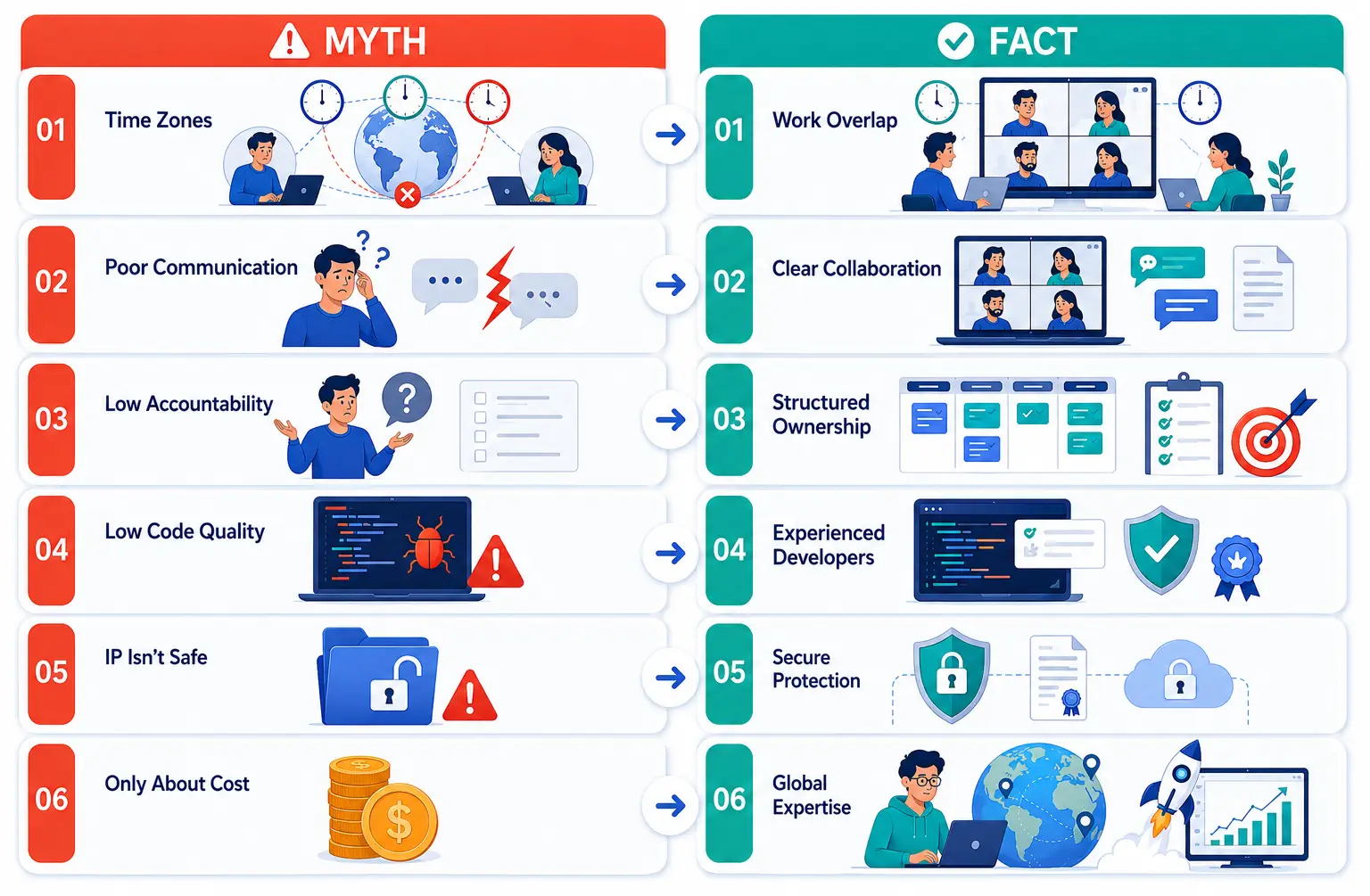
Myth: Time zones make real-time collaboration impossible.
Fact: A three- to four-hour overlap window comfortably covers daily stand-ups and reviews, and work often continues through the non-overlapping hours while your local team sleeps.
Myth: Communication will constantly break down.
Fact: India has one of the largest English-speaking professional workforces in the world, and experienced teams run the same agile rituals, stand-ups, sprint reviews and written documentation that local teams already use.
Myth: Remote means lower accountability.
Fact: A dedicated team model built around clear sprint goals and visible task boards often produces more accountability than informal local hiring, simply because the structure is built in from day one.
Myth: Code quality will suffer.
Fact: India produces one of the largest pools of graduates annually, and senior remote developers frequently bring experience across several stacks and industries.
Myth: Intellectual property is at risk.
Fact: That risk depends on the partner’s protocols, not the location. NDAs, access controls and secure infrastructure protect IP regardless of which city they works from.
Myth: It’s purely a cost play with no real expertise behind it.
Fact: While rates are typically lower than in the US, UK or Western Europe, many senior Indian developers have shipped products for global fintech, SaaS and healthtech companies, often across several time zones at once.
None of these myths are entirely baseless. They’re simply outdated, or only true when the hiring process itself is sloppy. The companies pulling ahead right now have stopped treating remote developers as a fallback option and started treating them as core team members.
Is It Actually Safe to Hire a Team You May Never Meet in Person?
Here’s the direct answer: yes, provided the engagement is structured properly. Risk in remote hiring rarely comes from geography. It comes from unclear contracts, vague scopes of work and no defined point of accountability on either side.
When those three things are handled with a written agreement, a specific deliverable and a named lead on both sides, you can hire developers remotely and see outcomes that look very similar to hiring locally, minus the salary premium and the narrow talent radius.
In practical terms, that means checking how a prospective partner vets developers, how disputes or underperformance are handled and whether you’ll have direct access to the person doing the work rather than a layer of account managers between you and the code.
What It Actually Takes to Hire Dedicated Developers Who Perform
Good outcomes aren’t accidental. A dedicated team model means assigning developers exclusively to your project and folding them into your existing workflow, rather than handing them isolated tickets through a marketplace.
Companies that consistently get strong, lasting results from a remote developer team tend to follow a similar pattern:
- Start with a short, paid trial sprint instead of jumping straight into a long-term contract.
- Define ownership clearly on who reviews code, who approves releases and who escalates blockers.
- Document architecture and decisions in writing, not only in chat threads that get buried.
- Set a recurring overlap window for live discussion, even when most of the work happens asynchronously.
- Treat the remote developer as a team member with full context, not as a ticket-taker.
- Review progress against outcomes, not hours logged; output is a far better signal than activity.
This is also where Citadel Coworkers tends to get involved early, not after something has gone wrong, but at the structuring stage, helping companies define the engagement properly before a single line of code gets written.
Where AI Fits and Where Human Judgement Still Wins
AI coding assistants have changed what a hiring decision should actually weigh. A remote developer who uses these tools well can ship first-draft documentation in minutes instead of hours, which means “can this person code fast” is no longer the right question to screen for. Most experienced candidates can, with the right tools.
What’s harder to automate, and worth hiring for specifically, is judgement: knowing which architecture holds up at your scale, reading a vague requirement correctly or catching a quick fix that will cause a production issue six months later. That depends on someone who understands your business, not just your codebase.
This changes what a strong hire looks like in practice. The most valuable remote developers right now aren’t the ones producing code fastest; they’re the ones who know when to trust an AI-generated suggestion and when to override it. That judgement, paired with AI-accelerated output, is what you’re actually paying for when you hire well.
Picture a generated function that technically passes its tests but quietly assumes data that will never look that clean in production. Catching that gap before it ships is judgement, not automation and it’s exactly the kind of thing worth screening for during hiring, not discovering after something breaks.
Why Growing Companies Choose Citadel Coworkers as Their Remote Developer Partner
Plenty of platforms can hand you a resume. Few can hand you a developer who already knows how to work inside someone else’s product, timeline and team culture from week one.
Citadel Coworkers builds every engagement around fit first, matching not just a tech stack, but communication style, working hours and project pace to how your team actually operates. Each developer is vetted for technical depth as well as the ability to work independently without constant supervision.
Clients consistently point to three things: a faster ramp-up period, transparent reporting instead of black-box billing and one dedicated point of contact who genuinely understands the project, instead of a rotating support queue.
There’s also room to grow without renegotiating everything from scratch. A team that starts with one developer on a single module can expand as the roadmap does, without the friction of rebuilding the relationship at every stage.
What Working With the Right Remote Team Actually Looks Like
In practice, it looks almost unremarkable, which is exactly the point. Stand-ups happen on schedule. Sprint goals get met. Code gets reviewed before it ships, not after something breaks in production.
There’s no drama in a well-run remote engagement and that’s precisely what makes it work. The fewer surprises a partnership produces, the more time your team spends building instead of firefighting.
If you’re currently weighing whether a remote developer team in India is right for your next project, the smartest first step isn’t a long commitment. It’s one small, well-scoped trial sprint, designed to show you the working rhythm before you scale anything further.
It’s worth considering what that trial could look like with Citadel Coworkers; a single sprint tends to answer more real questions than another comparison article ever will. The next good hire for your team might not be sitting in the next building or even the next time zone. The only real question is whether you’re judging that possibility on what’s true now or on a story that quietly stopped being accurate years ago.