
If you found this page through a search engine, there’s a decent chance you didn’t get here through ten blue links at all. An AI assistant may have pointed you our way instead and if that’s true, you’re already living inside the story we’re about to tell you.
A growing share of the people who might become your customers are no longer typing keywords into Google. They’re asking ChatGPT or Perplexity a direct question and acting on whatever answer comes back, sometimes without ever seeing a traditional list of links.
We wanted to walk you through what that actually means for your business, not in the abstract. It’s exactly why Citadel Coworkers builds its digital marketing services around this shift, rather than treating it as an afterthought.
Why This Shift Should Matter to You Right Now
For twenty years, ranking on page one of Google was the finish line. If your business built its strategy around that, you weren’t wrong; it worked and for a long time it was enough on its own.
But search has changed shape under you. Your customers aren’t just searching anymore; they’re asking, comparing and expecting a direct answer. AI tools synthesize information from dozens of sources and hand your prospective customer a conclusion, often before they ever visit your website.
This isn’t only a search engine story for you but rather a trust story about whether your business gets vouched for by a system your customers now rely on daily. That endorsement carries the weight an in-person referral used to carry: quiet, but decisive.
There’s a compounding cost to standing still, too. Every month you delay, your competitors are quietly building the citations, structured content and topical authority that AI systems learn to trust. By the time the shift shows up in your lead numbers, the gap is already hard to close.
How Is AI Search Different From What You Have Been Using For So Long
AI search refers to tools like ChatGPT, Perplexity and Google’s AI Overviews that generate one synthesized answer instead of a list of links. Instead of ten blue links, these tools read across multiple sources and give your prospective customer one direct response, often naming only a handful of businesses.
Ask any voice assistant for a marketing agency nearby and pay attention to what happens next. It doesn’t read out ten options. It names one or two, based on signals most businesses, maybe including yours, have never audited: consistency of information, credibility and how clearly your expertise is documented online.
The difference is subtle but significant. Traditional search rewards ranking. AI search rewards being cited. Your business can be ranking on page one and still be invisible in an AI-generated answer if your content isn’t structured so that these systems can easily extract and trust.
GEO and AEO: Two Terms You’ll Want to Understand
Two acronyms are becoming unavoidable in this conversation: GEO and AEO.
Generative Engine Optimization or GEO, is the practice of structuring your content so generative AI tools can find it, understand it, and use it to construct an answer. Answer Engine Optimization or AEO, focuses specifically on winning the direct answer slot, whether that’s a featured snippet, a voice result or a single AI-generated recommendation.
Neither replaces search fundamentals. They sit on top of what you’re likely already doing, rewarding clarity and structure over volume and keyword repetition.
How This Should Reshape Your Digital Marketing Strategy
If your marketing plan is still built solely around keyword rankings, it’s already working from outdated assumptions. AI-driven discovery has introduced a new layer above traditional search, and it plays by different rules.
The good news: none of this requires reinventing your brand from scratch. It requires re-prioritizing what already works, with more precision than before.
Here’s what’s actually changing for businesses like yours:
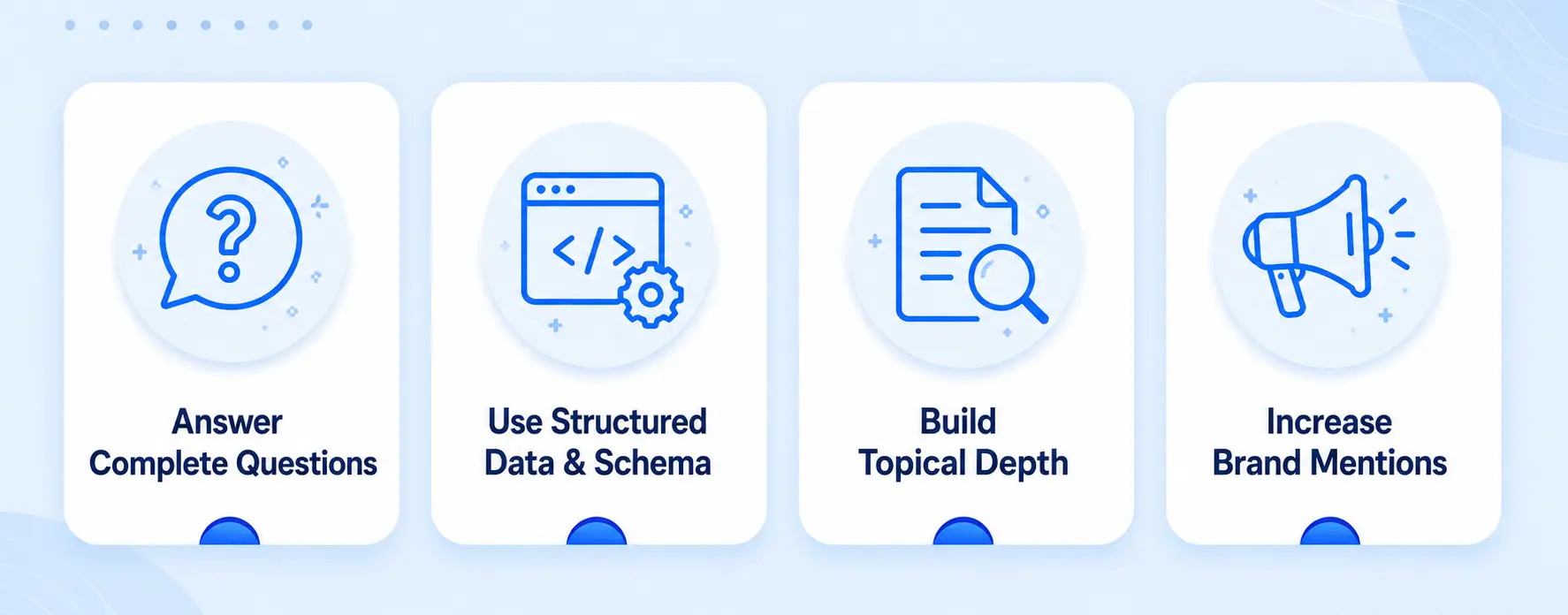
- Your content needs to answer complete questions and not just target keywords.
- Structured data and schema markup help AI systems understand and extract your company’s information accurately.
- Topical depth across your website matters more than isolated, high-ranking pages.
- Mentions of your brand across the web, not just backlinks, now influence AI-generated recommendations.
None of this replaces good marketing fundamentals. It builds on them. A sound approach today accounts for both the human reader in front of your website and the AI system reading on their behalf.
Where Your SEO Services Still Matter (and Where They Don’t Anymore)
Search engine optimization services aren’t obsolete for your business; it’s incomplete on its own. Technical health, site speed and clean architecture still matter, because AI tools still crawl and index the web before they synthesize an answer.
What’s changed is the finish line. Ranking well used to be the goal. Now it’s a prerequisite for something bigger: being trusted enough by an AI system to be named in your customer’s answer.
If you’re only measuring success by rankings, you might be missing where your actual customers are now discovering you. It’s worth exploring whether your current approach accounts for this shift at all.
Mistakes We See Businesses Make With AI Search
Watching businesses attempt this shift reveals a pattern. A few mistakes show up again and again:
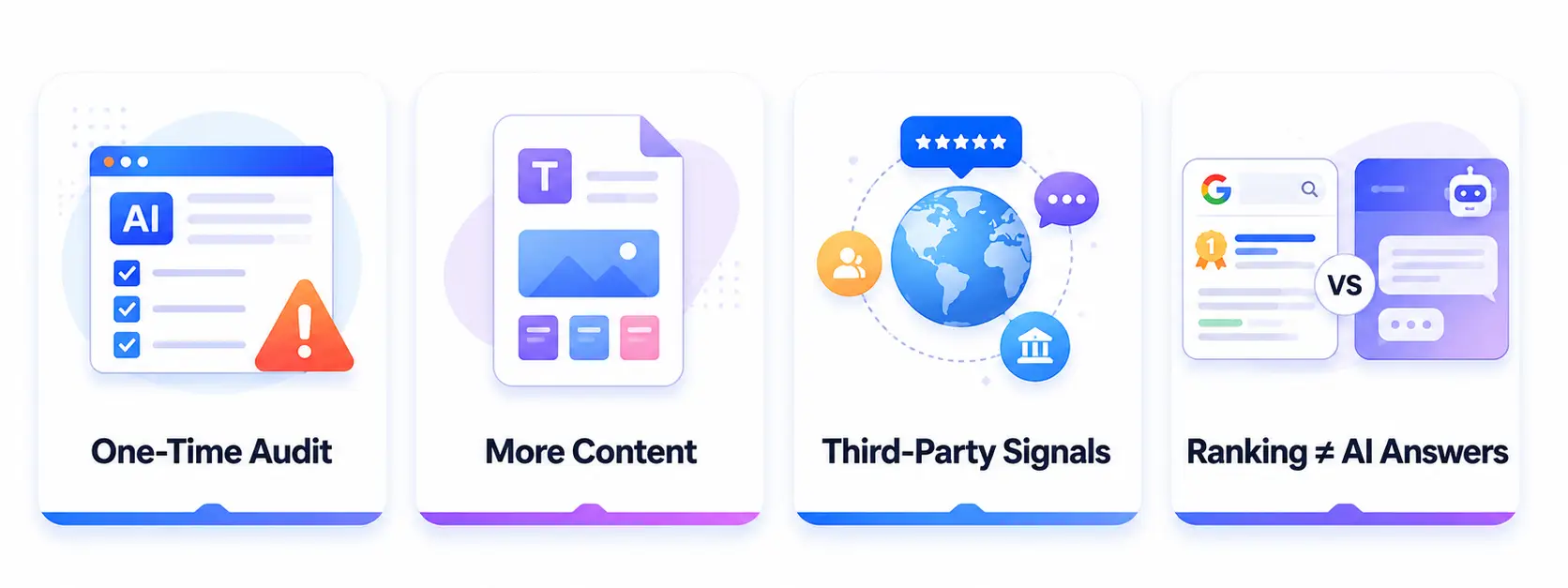
- Treating AI visibility as a one-time audit instead of an ongoing practice.
- Producing more content instead of clearer, better-structured content.
- Ignoring how your brand is described across third-party sites, forums, and directories.
- Assuming a strong Google ranking automatically transfers into AI-generated answers.
Avoiding these mistakes matters more than chasing the newest tactic. Consistency and clarity tend to outperform novelty here.
What Good Content Marketing Services Look Like Now
This is where content marketing services earns its keep in a genuinely new way. AI systems don’t reward more content. They reward content built to be understood, clear, specific and structured around the real questions your customers are asking.
That means writing with intent: answering a question fully in the first few lines, backing it with specifics and avoiding vague, filler-heavy paragraphs that AI tools tend to skip over entirely.
Vague claims and recycled statistics get ignored by both your readers and AI systems alike. Specific detail, named examples and direct answers get remembered and cited.
At Citadel Coworkers , this is exactly what we’ve rebuilt our own process around: fewer, sharper pieces of content that actually get cited, instead of volume for its own sake.
Why Human Judgment Still Wins in an AI-Driven Search Landscape
None of this means AI is doing the thinking for you and that’s precisely the point worth sitting with. AI systems are exceptional at pattern recognition and synthesis. They’re far weaker at nuance, brand voice and judgment calls that depend on context only a person can weigh.
A machine can tell you what’s ranking. It can’t tell you what your business should stand for or how your message will land with your specific audience on a specific day. That’s still your decision and it’s one worth protecting rather than automating away.
This is also where a lot of AI-generated marketing content quietly fails. It reads correctly, but it says nothing specific. Your prospective clients notice the difference, even if they can’t always name it.
Treating AI as a tool rather than a replacement is, frankly, a competitive advantage for you. Businesses that pair AI-aware content with real strategic thinking are the ones actually getting cited, not the ones producing content on autopilot.
Why Businesses Like Yours Choose to Work With Citadel Coworkers
Plenty of agencies talk about AI search. We’ve actually restructured how we build our digital marketing services around it.
We approach this shift the way it should be approached for you, not as a trend to chase, but as a genuine change in how your customers find and evaluate businesses. That starts with auditing where your brand currently stands in AI-generated answers, not just traditional rankings.
That approach shows up in the details: how your website answers a real question in its first two sentences, how consistently your brand is described across the web and how deliberately your content calendar is built around what your customers are actually asking, not just what’s easy to produce.
It also means building content, structure and strategy that serve both the AI systems reading your website and the people making the final decision on your services. That combination of technical precision paired with real judgment is harder to find than it should be.
If you’re curious where your business currently stands in this new landscape, it might be worth having that conversation with us sooner rather than later.
Where This Leaves You
AI search isn’t a passing shift for your business; it’s a permanent recalibration of how discovery works. If you adapt early, you won’t just survive the transition; you could be one of the businesses AI systems recommend by name.
The question worth asking isn’t whether this change is coming for you. It’s already here. The real question is whether your brand is being read, understood and cited, or quietly left out of the conversation entirely.
For now, you have a real head start if you’re paying attention. The rest will notice the shift eventually, just later and from further behind. Momentum here tends to compound quietly, the same way it once did for businesses that dismissed mobile search a decade ago.
That’s a decision worth making deliberately, not by default. And we’re glad you’re already here, thinking about it.