
Scroll through almost any brand’s feed today and you’ll notice something odd. The captions are polished. The visuals are flawless. The tone is warm and endlessly upbeat. And somehow, very little of it holds your attention for more than a second.
That flatness has a clear cause. Between 2024 and 2025, businesses rushed to automate their content and feeds filled up with posts that looked professional but felt interchangeable. By 2026, audiences had noticed, and they started scrolling straight past anything that read as if it came from a machine.
Picture a founder opening their own company page and struggling to tell it apart from two competitors’ pages open in neighbouring tabs. Same stock imagery, same optimistic captions, same forced exclamation marks. That’s not a coincidence; it’s what happens when a channel gets treated as a content quota instead of a conversation.
This is exactly the moment organic social media finds itself in: not obsolete, but newly valuable, precisely because it’s one of the few channels left where a real person saying something specific still stands out.
The Great AI Content Flood And the Quiet Return to Real Voices
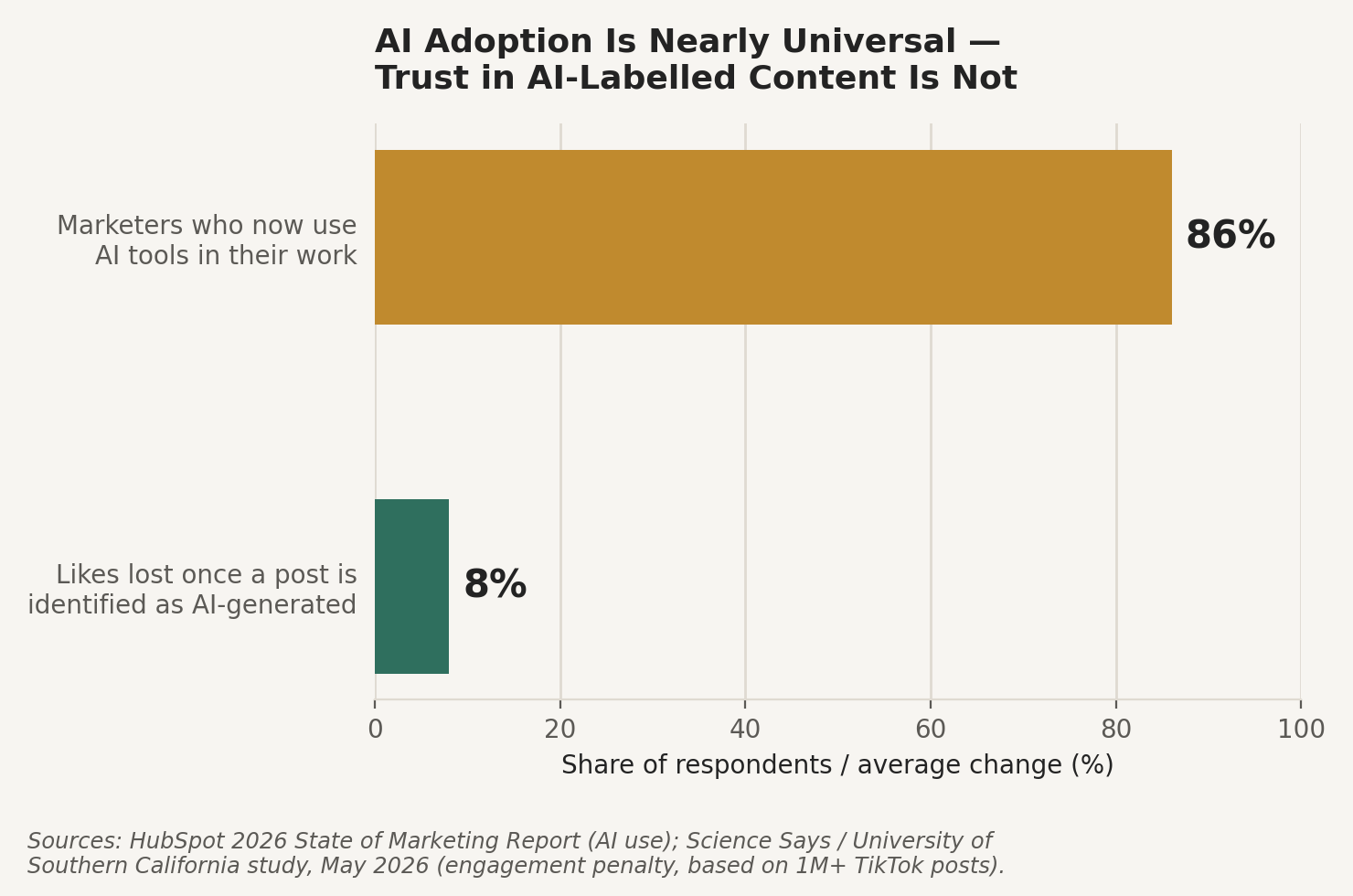
A University of Southern California study reported by the research outlet Science Says in May 2026 found that once audiences identified a post as AI-generated, it lost up to 8 percent of its likes and about 7 percent of its overall interaction, even when the underlying content was identical. Trust, once assumed by default, now has to be earned one post at a time.
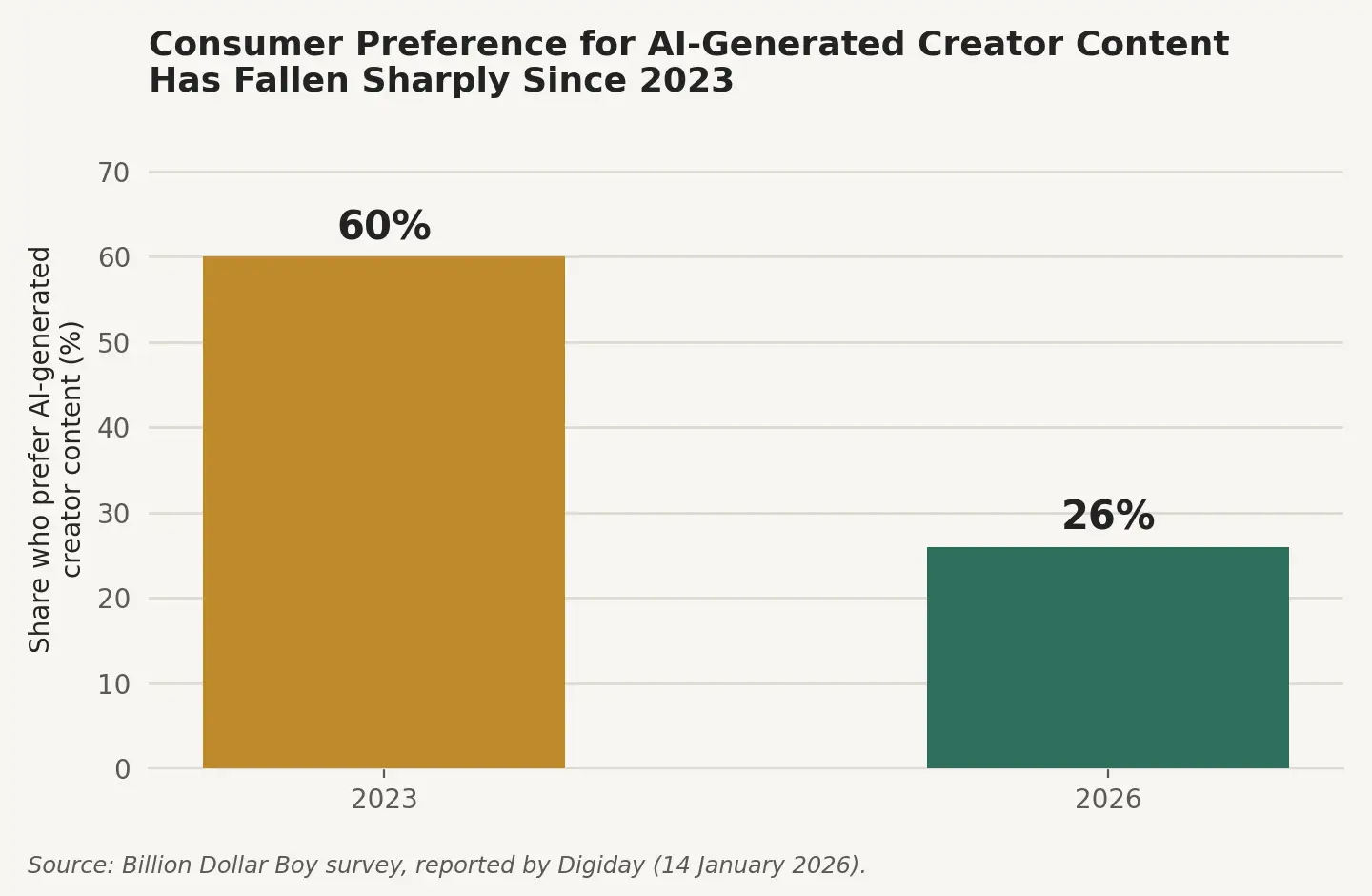
Researchers tracking this shift have started calling it a “trust penalty,” the quiet cost a brand pays whenever its content feels synthetic. Consumer preference for AI-generated creator content has fallen from 60 percent in 2023 to just 26 percent in 2026, according to a survey by the influencer marketing agency Billion Dollar Boy, reported by Digiday, even as the tools themselves keep getting easier to use.
Audiences rarely need a detection tool to notice this pattern. Unusually smooth phrasing, generic captions and stock-photo sameness are signal enough on their own and that signal is often all it takes for a scroll-past decision to happen instantly.
None of this makes AI the villain of the story. It simply means the businesses earning attention in 2026 are the ones using it to move faster while keeping a human fingerprint on whatever actually gets published. Judgment about tone, timing and what’s worth saying at all is still, stubbornly, a person’s job, not a prompt’s.
That is worth sitting with for a moment, because it changes how a business should be spending its attention this year, not just its budget.
Organic vs Paid: Two Different Jobs, Not Two Competing Budgets
It helps to stop comparing organic and paid social media as though one should replace the other. They solve different problems, on different timelines, for different reasons.
- Paid social buys immediate visibility. Set a budget, choose an audience, and reach appears within hours, then disappears the moment spending stops.
- Organic content builds trust slowly, through consistency and relevance. That trust compounds over time. A well-received post can keep working for a brand weeks after it was published.
- Combined, the two cover each other’s weaknesses; paid extends the reach of whatever organic content has already proven people genuinely want.
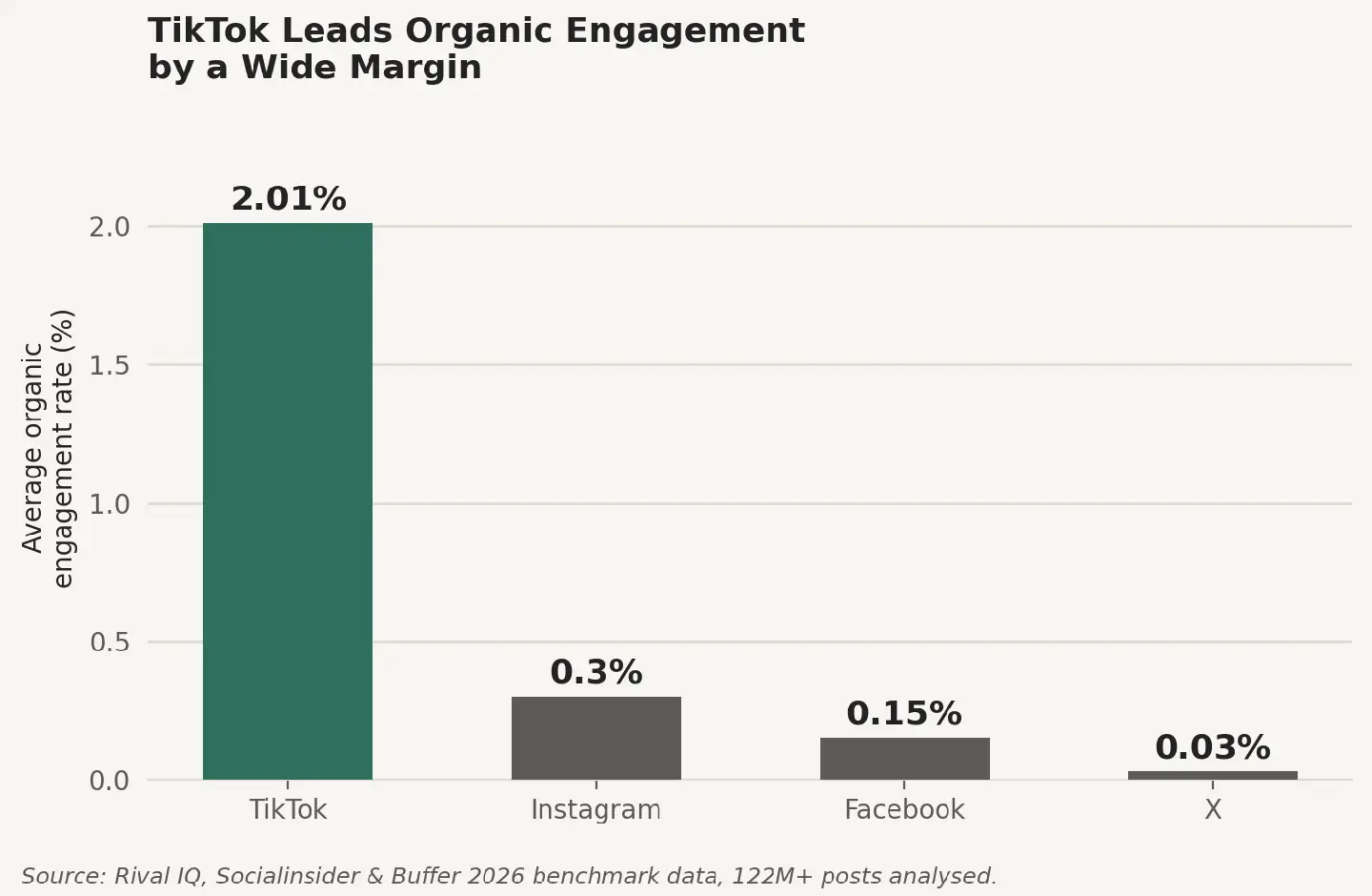
According to 2026 benchmark data from Rival IQ, Socialinsider and Buffer drawn from more than 122 million posts, TikTok leads every major platform on organic engagement at roughly 2 percent, with Instagram, Facebook and X trailing well behind. Smaller accounts do even better: Later’s 2026 engagement study found accounts under 10,000 followers averaging 4.7 percent on TikTok and 2.8 percent on Instagram, and user-generated, organic-style content is consistently trusted more than branded advertising. For businesses selling considered or high-value services, that trust gap is often what quietly decides who gets chosen.
None of this is an argument against paid media. It’s an argument against skipping the organic groundwork first, then expecting an ad budget to manufacture trust it was never designed to build.
What Organic Reach Actually Buys a Business Today
In plain terms, organic social media is content a brand publishes without paying for distribution: posts, comments, videos and updates that earn reach through relevance and shares rather than ad spend. It matters because it builds compounding trust and brand memory, instead of renting attention by the click.
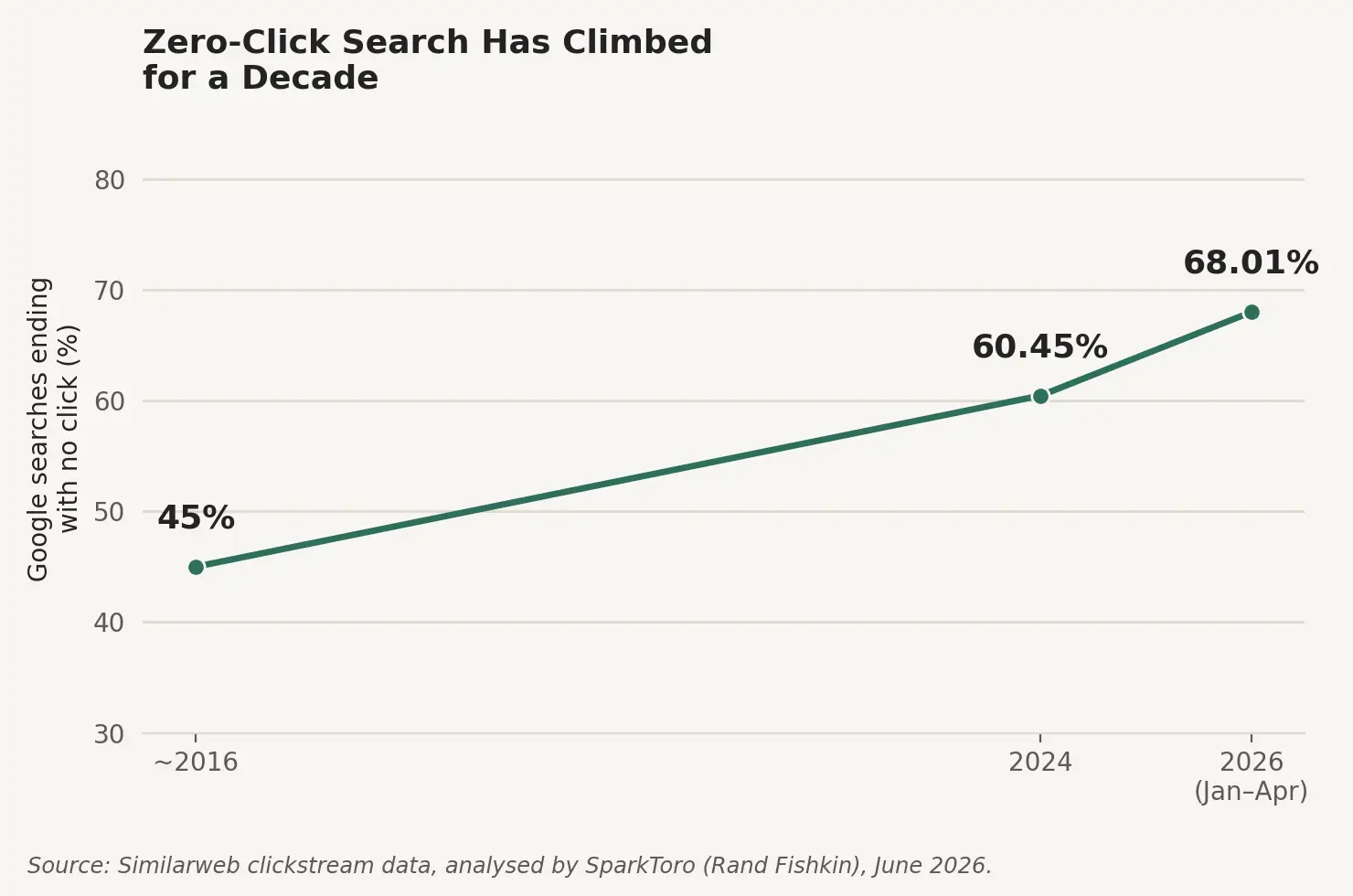
It also matters for a second, less obvious reason: discoverability. As AI-powered search tools increasingly answer questions directly on the results page, zero-click Google searches ones that end without a single visit to any website have climbed from around 45 percent about a decade ago to roughly 68 percent in early 2026, according to Similarweb clickstream data analysed by SparkToro’s Rand Fishkin. A strong social media marketing presence gives a brand more places to be seen, referenced and remembered even as search traffic itself keeps shrinking.
This is also why AI-driven answer engines increasingly draw on social posts, reviews and community discussion alongside traditional web pages when assembling a response. A brand that shows up consistently in genuine conversation is more likely to become the answer one of these systems surfaces, rather than a link it simply passes over.
That’s a fairly direct answer for where to spend the next marketing hour: build presence where people already are, not just where a click can be measured.
Building an Organic Social Media Strategy That Doesn’t Rely on Luck
A dependable organic social media strategy is built on habits, not hacks. The brands that stay visible tend to do a small number of things well, repeatedly, instead of chasing every trend that appears on a Tuesday.
- Publish on a rhythm your audience can rely on, not only when there’s news to share.
- Let a real voice lead founder commentary, behind-the-scenes moments and unscripted opinions consistently outperform polished brand-speak.
- Reply like it matters, because comments and shares are exactly the signals platforms use to decide who sees a post next.
- Repurpose what already works across formats instead of producing everything from a blank page each week.
None of this requires a large internal team. It requires clarity about who the content is actually for, and the discipline to keep showing up as that audience not a generic one.
Two of these four habits cost nothing but time, which is exactly why they get skipped first when budgets tighten and exactly why the businesses that protect them pull ahead once everyone else’s feed goes quiet.
Where AI Helps And Where It Still Can’t Replace You
AI is now part of almost every content workflow, and pretending otherwise helps no one. HubSpot’s 2026 State of Marketing Report found that 86 percent of marketers now use AI tools, largely for drafting, scheduling and first-pass visuals.
The businesses getting this right treat AI as a production assistant, not a voice. It can suggest a caption structure or generate a rough visual in seconds. It cannot sit in a client meeting, notice what actually mattered, and decide that’s the story worth telling tomorrow.
In practice, that might look like a marketing lead using AI to draft five caption options in under a minute, then rewriting the one closest to how the brand would actually say it, keeping the speed and discarding the sameness.
That distinction is becoming a genuine business advantage rather than a limitation to work around. The content that keeps earning attention months after publication is consistently the kind with a specific person’s fingerprints on it, not the kind optimised purely for output volume. Treating AI as a shortcut past that judgment is where most brands quietly lose the trust they set out to build in the first place.
Why Growing Businesses Choose Citadel Coworkers for Organic Social Media Marketing
This is exactly where Citadel Coworkers earns its place in a business’s growth plan. Rather than treating this as an afterthought squeezed between paid campaigns, the approach starts by understanding a brand’s actual voice, audience and business goals, then builds a content rhythm around them.
There’s no single template stretched across every client. The judgment calls about what to post, when to post it and what’s worth saying at all are made by people who’ve taken the time to understand the business, not a workflow running on autopilot.
In practice, that can mean building a content calendar around what a business’s actual audience asks about, taking on the unglamorous work of replying to comments promptly or simply auditing a feed to see where the voice quietly went missing.
If your current content calendar feels like it could belong to any brand in your industry, that’s worth a closer look and perhaps a conversation with a team that treats organic content as strategy, not filler.
The Opportunity Still Sitting in Plain Sight
Businesses that treat organic content as optional are quietly giving up the one channel where trust is still built for free. The ones treating it as core infrastructure are compounding an advantage that paid budgets alone can’t buy them.
Citadel Coworkers works with businesses ready to make that shift not by chasing every platform update, but by building a presence people actually recognise as theirs. That’s a good starting point worth exploring before next quarter’s content calendar gets locked in.
The feeds are only getting louder. The brands that still sound like themselves, consistently and on purpose, will be the ones worth listening to when it counts.