
For most of the last two decades, discoverability for a B2B service brand had a predictable shape: rank well on Google, hold that position and let the click do the rest. The whole model rested on one assumption that a customer’s search began on a results page and ended with a link.
That assumption is quietly breaking down, and most brands don’t notice, because it rarely shows up as a clean drop in an analytics dashboard.
When someone asks ChatGPT, Perplexity or Google’s AI Overviews a question like “best virtual staffing agency for hiring a remote SEO professional,” it’s already assembled. The system has already decided which sources to trust and which businesses are worth mentioning, before a person ever gets the chance to click through and compare for themselves.
That’s how a company with genuinely strong talent can quietly disappear from consideration, not because a prospective client rejected it, but because its website describes one pricing model, a review on Clutch describes another and a case study on LinkedIn tells a slightly different story. Rather than guess, the system leaves it out.
This piece looks at the industry data and explains why the ground is shifting; what a specific brand actually does about it is where that shift either becomes a real advantage or gets ignored until it’s too late.
The Search Shift Behind Every “Best Virtual Staffing Agency” Query
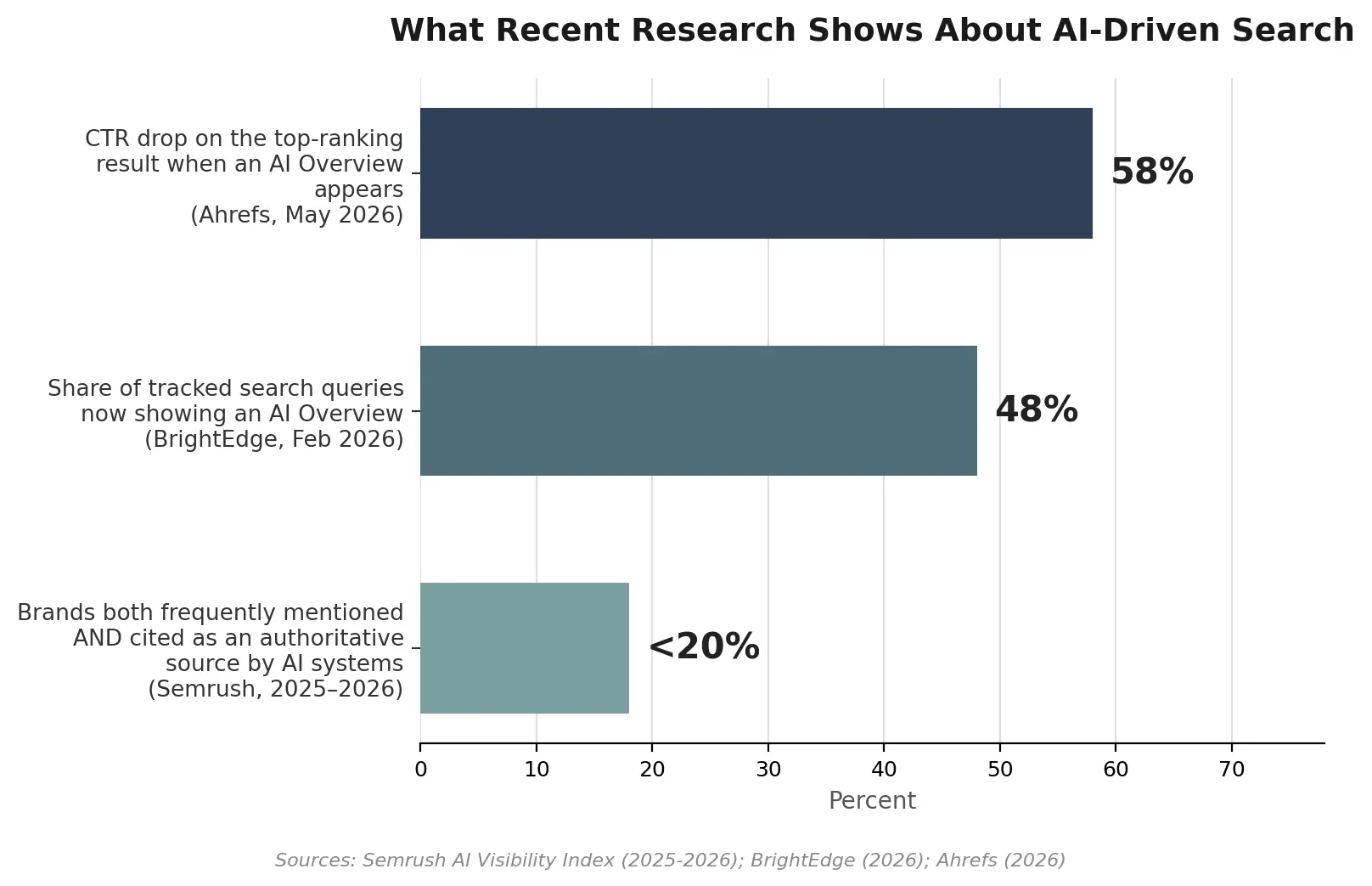
That model held for a long time, with the click as the reward for ranking well. It’s bending now and the data is no longer speculative. Ahrefs found that once Google’s AI Overviews appear on a results page, the top-ranking organic result loses roughly 58% of the clicks it would otherwise get, up from 34.5% just eight months earlier. BrightEdge, tracking the same shift from a different angle, found AI Overviews now appearing across close to 48% of tracked queries, closer to 80% in categories like health and education.
This is why AI Search Optimization has become a discipline in its own right, distinct from traditional SEO. The goal isn’t to win a click anymore; it is to be the source an AI system trusts enough to cite or fold into its answer, when a person never visits a website at all.
The effect compounds for any brand offering more than one kind of service. A virtual staffing provider covering software development, design and customer support has three service descriptions and three pricing pages that all need to agree with each other. A single outdated case study or stale pricing page is enough to confuse the systems doing the recommending.
Not every forecast here has aged well, either. Gartner’s 2024 prediction that search volume would fall 25% by 2026 hasn’t played out that cleanly Google still handles the large majority of searches but the direction was right: AI-driven answers are now a mainstream discovery channel running alongside search, playing by different rules than the ones most brands are still optimizing for.
What Is Answer Engine Optimization And Why Does It Matter Right Now
In simple terms, Answer Engine Optimization means structuring business information so an AI system can lift it confidently and present it as a direct answer, rather than a link someone has to click and verify for themselves.
For a B2B service brand, that means writing service details in clear, factual language, keeping pricing and engagement terms identical everywhere they appear and anticipating the exact questions a prospective client might type into an AI assistant.
What the Research Actually Shows
The term “Generative Engine Optimization” isn’t just industry buzz. It comes from a widely cited 2023 paper that built a 10,000-query benchmark to test how AI systems decide which sources to feature in their answers. The finding: content techniques adding citations, statistics and relevant quotations could boost a source’s visibility in AI-generated answers by up to 40%. A more recent 2026 survey of the field adds a useful limitation: those gains assume a source is already in the running, and don’t by themselves guarantee discovery in the first place.
That limitation matters, because discovery is exactly where consistency comes in. A large-scale Semrush analysis of how brands are mentioned and cited across AI search platforms found that fewer than one in five are both frequently mentioned by AI systems and consistently cited as an authoritative source what the report calls the Mention-Source Divide. Business and professional services, the category a virtual staffing provider sits in, was one of the industries the study tracked directly.
Put plainly: the academic research explains how to earn a citation once an AI system is already considering a source. The industry research explains why so many businesses never make it that far in the first place.
In practice, most brands become harder for AI systems to find and trust for the same handful of reasons:
- Service descriptions and pricing that quietly disagree with each other across platforms
- Missing structured data that leaves AI systems guessing at basic facts
- Reviews and citations that describe the business differently from site to site
None of that is exotic. It’s the unglamorous, ongoing work of making sure a business’s story doesn’t contradict itself anywhere it’s told. That’s the backdrop. Here’s how one virtual staffing brand is actually responding to it.
How Citadel Coworkers Is Applying This for Its Clients
Citadel Coworkers (CCW) treats this as operational discipline, not a marketing checkbox. Every service line’s scope, pricing and delivery process is meant to read identically wherever a prospective client encounters it: its own website, review platforms like Clutch and G2, LinkedIn, and the case studies it publishes.
In practice, that comes down to a short list of habits, repeated on a schedule rather than left to chance:
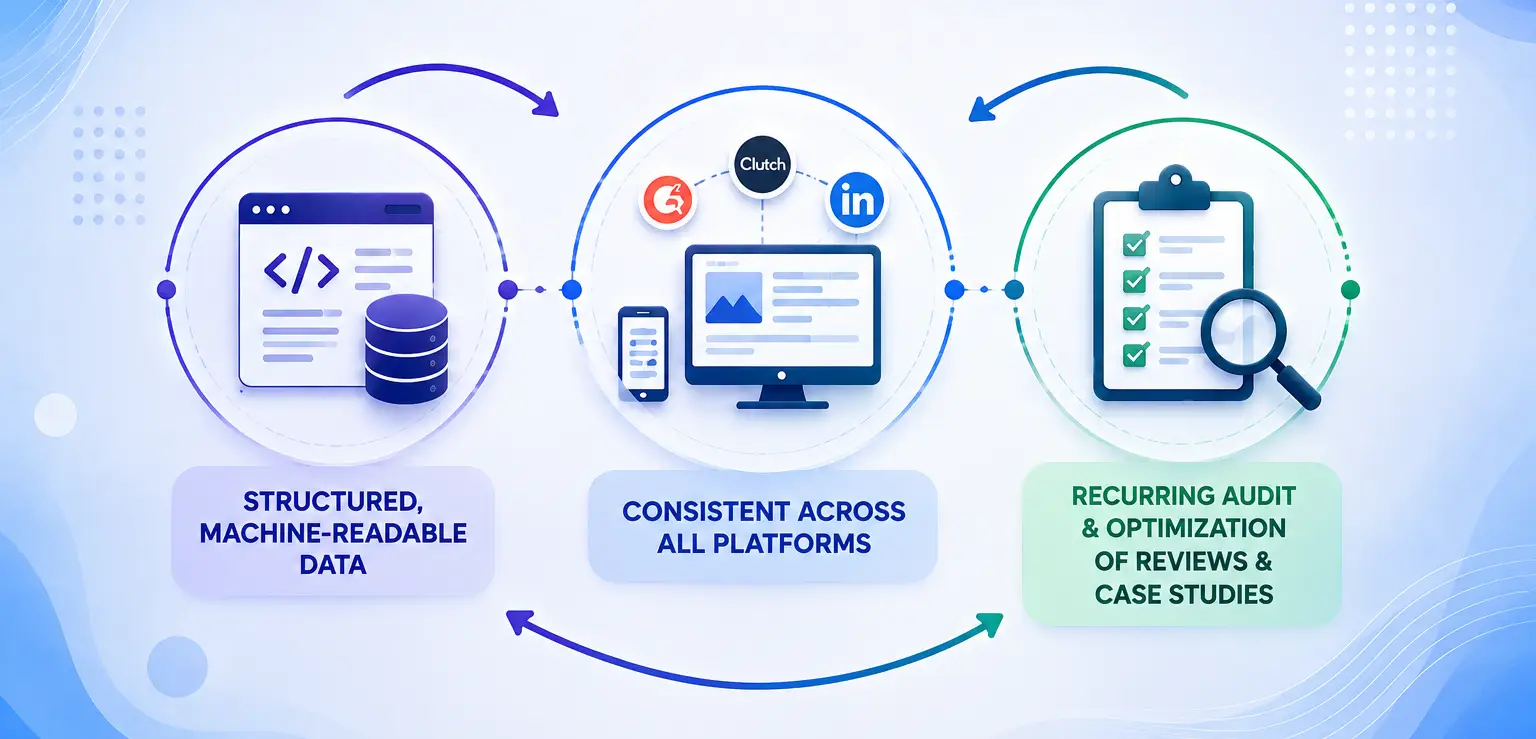
- One accurate description of each service line’s scope and pricing, mirrored across every platform it appears on
- Structured, machine-readable data on its own site, so AI systems read the same facts a visitor would see
- A recurring audit of its review profiles and published case studies, rather than a one-time setup that quietly goes stale
That last habit is precisely what AI Search Optimization rewards: not a single clever trick, but the discipline of staying accurate everywhere, continuously. A team that adds a new specialty, changes its engagement model or updates its pricing only matters once every platform describing it says the same thing.
If your own profiles and reviews haven’t been checked across platforms recently, it’s worth an afternoon to see what turns up.
Where Human Judgment Still Matters
None of this runs on autopilot. An AI system can flag that a profile is inconsistent. It can’t decide which detail about a working relationship actually matters to the client reading it or notice that a case study no longer reflects how a team is actually being staffed. That distinction between catching an error and understanding what to say instead is where most virtual staffing brands are still leaning entirely on automation.
At Citadel Coworkers client-facing profiles and case studies are checked by people who’ve actually worked with the teams they’re describing, not synced automatically and left unattended. An automated system might update a headcount or a skill tag correctly and still miss that an engagement has quietly evolved into something the original description no longer captures. A recruiter who placed the team in the first place is far more likely to catch that shift than a script checking for stale fields.
That’s a deliberate choice: treating AI-driven discovery as a channel worth managing well, not a system to fear or hand off entirely.
What Sets Citadel Coworkers Apart in an AI-First Search World
Most virtual staffing brands still treat their online listings as a one-time setup task. CCW treats them as living infrastructure checked, corrected and kept current across every channel a prospective client might use to evaluate a partner.
That discipline isn’t about chasing every new platform that appears. It’s about maintaining one accurate source of truth and making sure every channel reflects it, so a client gets the same answer about pricing and engagement terms no matter where they look. It’s a slower, less flashy approach than chasing the latest visibility hack and that’s largely the point.
Prospective clients curious what that looks like in practice are welcome to find out directly, rather than take it on faith that the details online are meant to match exactly what a working relationship with Citadel Coworkers actually looks like.
A Closing Thought Worth Sitting With
Every B2B service brand eventually faces the same question: does your business look the same to a machine as it does to the people who already trust you? For most brands, the honest answer right now is “not quite,” and that gap is only going to matter more as AI-driven discovery keeps growing.
If your own profiles haven’t been reviewed through that lens recently, it’s worth doing before a prospective client asks an AI assistant a question and gets an answer you never wrote.