

Ask an AI assistant which project management tool fits a 20-person team and watch what happens. It won’t hand back ten blue links to click through; it will name two or three tools directly, weigh the trade-offs and stop there. No website visit required, no ad seen, no form filled out.
That’s the shift reshaping search right now. A brand can get named inside that answer and never register in a traffic dashboard, because the decision happened inside the conversation instead of on a results page.
For a marketing team, that’s disorienting. Every dashboard was built to measure clicks and sessions, not mentions inside someone else’s chat window. Yet the buyer on the other end of that conversation is making the exact same decision they always made- they’re just making it earlier and out of sight.
This piece breaks down what’s actually changing in how people search, why it matters more than a single traffic dip and how our team at Citadel Coworkers helps clients plan content that still gets found and credited when the search happens inside a conversation instead of a results page.
The Quiet Shift Nobody Put on the Roadmap
Search used to run in a straight line: type a question, scan ten blue links, click the one that looks most useful. That line has bent into a loop of questions, follow-ups and comparisons, all answered inside the same chat window.
Semrush’s research on Google’s AI Overviews found the feature now appears alongside roughly 88% of informational search queries. Most everyday “how” and “what” questions may never reach a traditional results page at all.
HubSpot’s 2026 research adds another layer: 58% of marketers already say their teams are actively optimizing content for answer engines. This is no longer an early-mover advantage – it’s catching up fast.
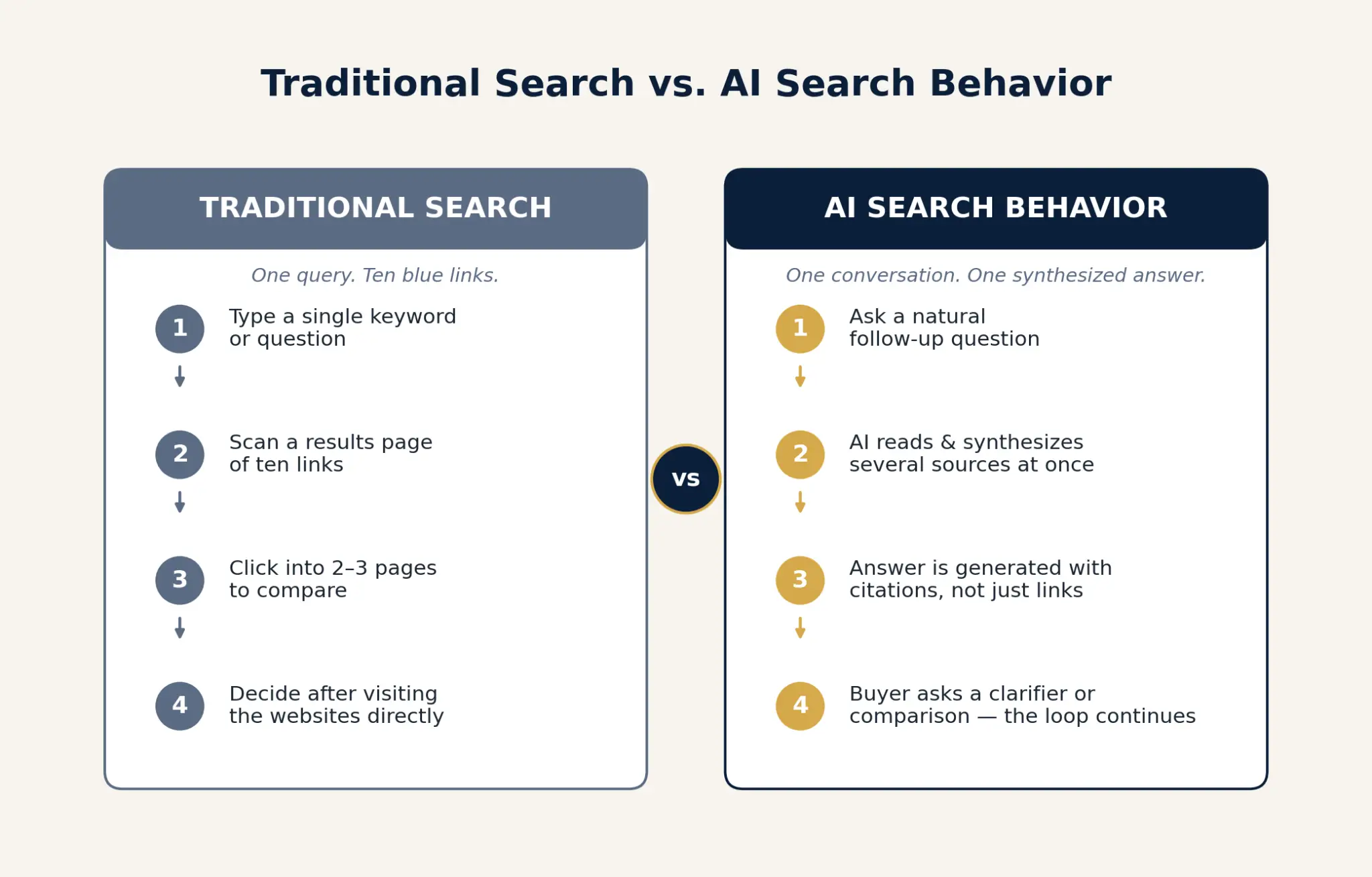
Part of what makes this tricky is that the questions rarely stop at one. A buyer might ask an AI assistant what the best plan is for a 20-person team, then whether it integrates with a tool they already use, then how support compares to a specific competitor. Each answer builds on the one before it and a page written to satisfy only the first question quietly drops out of the rest of that conversation.
None of this shows up as a dramatic crash in your analytics. It shows up quietly as a slow fade from the conversations your buyers are having with ChatGPT, Gemini and Perplexity where the competitors get named and you simply don’t.
What Is AI Search Engine Optimization
AI search engine optimization is the practice of structuring content so AI systems can find it, understand it correctly and cite it inside a generated answer, rather than simply ranking it on a results page.
It shares roots with traditional SEO-crawlability, authority and topical relevance still matter. But one detail changes the whole game: independent research has found that only a small fraction of ChatGPT’s citations actually match a page’s top-10 Google ranking. Ranking well and getting quoted have become two different jobs.
Where Generative Engine Optimization Fits Into a Real Content Marketing Strategy
Generative engine optimization often gets treated as its own separate discipline. In practice, it works best as a layer on top of an existing content marketing strategy, not a replacement for one.
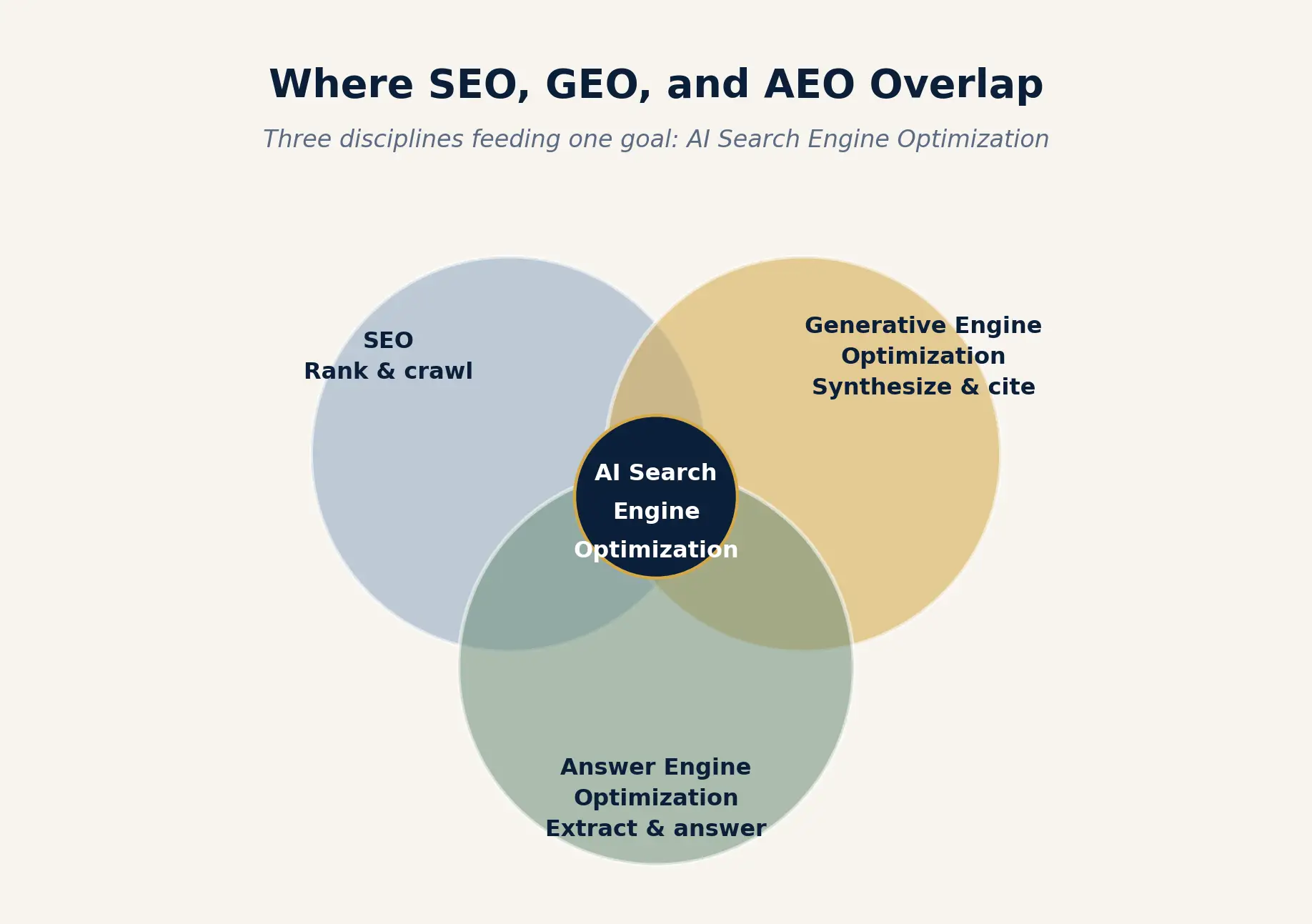
The overlap is bigger than most teams assume. Strong topical depth, clear structure and credible sourcing help a page rank and get cited at the same time. GEO simply adds one more filter to the writing process: could this passage be lifted out and quoted accurately, on its own?
Five Signals That Decide Whether AI Cites You or Skips You
Across the platforms we monitor for clients, a handful of factors keep resurfacing:
- Clear, question-based headings that mirror how people actually phrase a query
- A direct answer near the top of each section, ahead of the supporting detail
- Original data, examples or expert commentary a model can’t find anywhere else
- Recent publish or update dates, especially in fast-moving categories
- Mentions and citations elsewhere on the web that reinforce topical authority
None of these are exotic. They’re disciplined execution of things good content teams already know- applied consistently enough that a model starts to notice the pattern.
Turning Content Optimization Into an Answer Engine Optimization Habit
Most content optimization checklists stop at readability scores and keyword placement. Answer engine optimization asks one more question of every section: if a model had to summarize this in two sentences, would that summary still be accurate and complete on its own?
That single test changes how a page was written. Definitions move to the top. Dense paragraphs become short lists. Every section is drafted to stand alone, because that’s often exactly how it will be used.
Where the Algorithms Stop and Human Judgment Has to Start
AI can draft an outline, tighten a sentence or flag a missing FAQ in seconds. What it can’t do is know which trade-off actually matters to your specific buyer or recognize when a technically accurate answer would still mislead someone in context.
That gap is where an experienced strategist earns their keep. Judgment about tone, timing and what not to say isn’t something a model reliably supplies and getting it right is a real competitive advantage rather than a hedge against the technology.
Brands that pair AI-assisted drafting with seasoned editorial judgment tend to publish faster without sounding interchangeable with every other AI-optimized page on the internet. That combination, more than any single tactic, is what keeps content trustworthy enough to be cited again and again.
Take pricing pages, warranty terms or anything in a regulated industry. A model can summarize the numbers accurately and still miss the context a human editor would flag instantly: a seasonal exception, a regional rule, a nuance that changes the advice entirely.
That’s not a reason to avoid AI in the workflow. It’s a reason to keep a person accountable for what finally gets published.
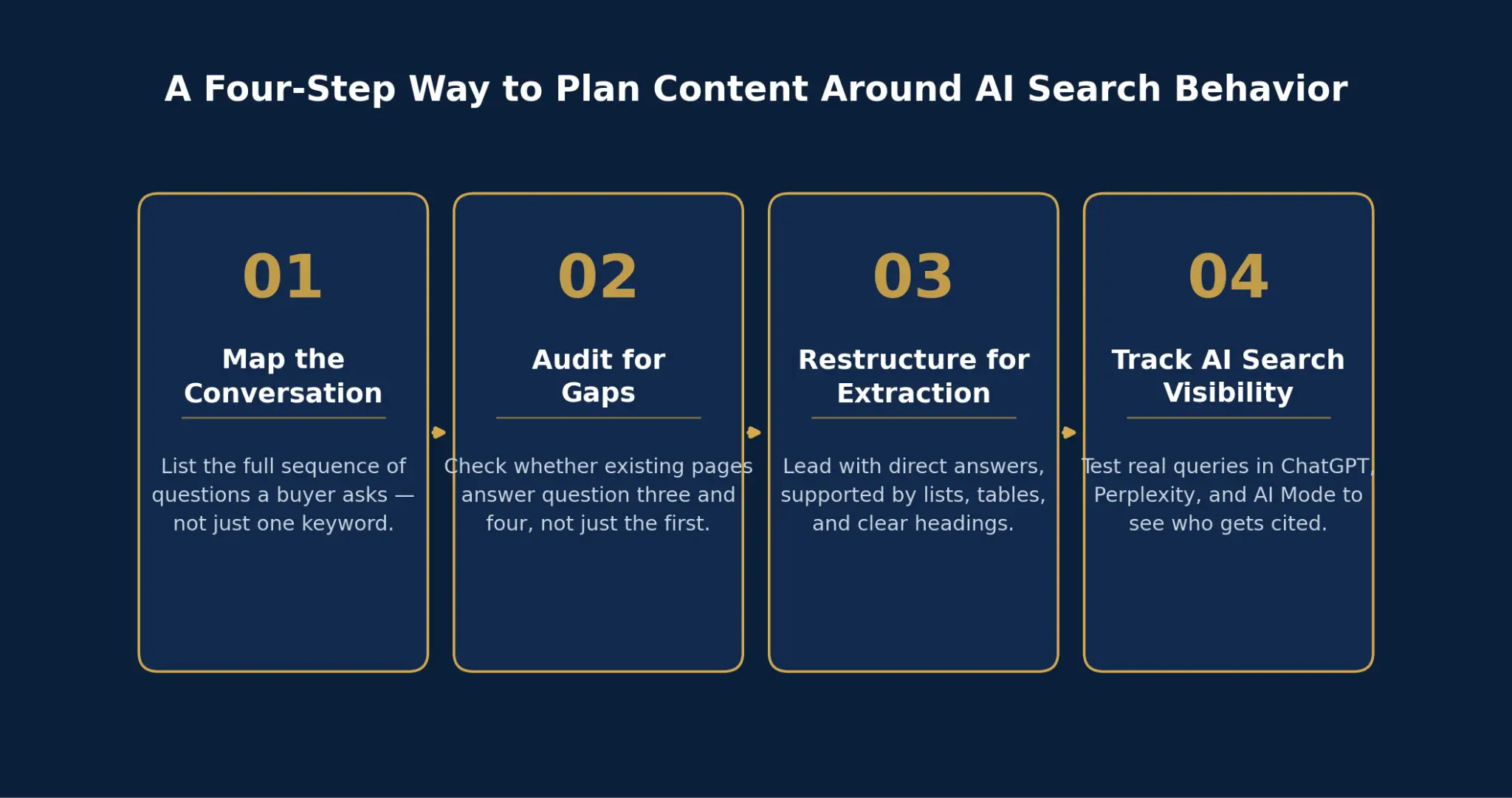
A Four-Step Way to Plan Content Around How People Actually Search
If this feels like a lot to rebuild at once, it isn’t. Most teams can start with four manageable steps
- Map the conversation. List the full sequence of questions a buyer actually asks, not just the single keyword you’d normally target.
- Audit for gaps. Check whether current pages answer the third and fourth question in that sequence, not only the first one.
- Restructure for extraction. Rewrite key sections with the direct answer up top, supported by lists, short tables and clear headings.
- Track your AI search visibility. Periodically test your own queries in ChatGPT, Perplexity and Google’s AI mode to see who gets cited and whether it’s you.
Why More Businesses Are Handing This Work to Citadel Coworkers
Most agencies bolted “AI search” onto an existing SEO service line and called it a new offering. Citadel Coworkers built the process the other way around: starting from how a language model actually reads and selects a passage, then working backward to what a page needs to contain.
In practice, that means less generic advice about sprinkling in more schema markup and more specific, page-by-page decisions about what to cut, what to clarify and what to cite. Clients keep strategic control over their brand voice; the team handles the research and structural work that makes AI-era visibility repeatable instead of accidental.
The engagements that work best pair a strategist who understands the buyer journey with an editor who understands exactly how a passage needs to be shaped to survive being summarized. Add a habit of checking real AI platforms on a regular schedule and a brand stops guessing whether its content is landing; it starts knowing.
What This Means for Your Next Content Calendar
None of this requires abandoning a plan that’s already working. It means adding one filter to every brief before it goes to a writer: could an AI system quote this section accurately, on its own, without extra context?
Try it on the next article already on your calendar. If the honest answer is no, small restructure an earlier answer, a tighter section, one supporting stat – usually closes the gap without a full rewrite. It’s a useful five-minute exercise even before any bigger strategy conversation.
The Search Box Changed. The Opportunity Didn’t.
The brands that get named inside AI-generated answers over the next few years are being decided now, in the pages published this quarter. Waiting for more certainty just hands that ground to whoever moves first.
That’s the entire premise behind AI search engine optimization: not chasing a ranking for its own sake, but earning a place inside the answer itself.
Start smaller than feels necessary. Map one conversation, restructure one page and see what happens the next time someone asks an AI the exact question that page was built to answer.