Key Takeaways
- AI assistants like ChatGPT, Gemini and Perplexity have no “edit” button. Fixing what they say about your business means fixing the sources they pull from: your website, listings and directories.
- Pricing, hours and service details are among the pieces of business information AI gets wrong most often because they change frequently and live in scattered places online.
- Correcting the record is a source-level exercise: audit, trace, fix, refresh and monitor, not a one-time cleanup.
- AI can process financial and business data far faster than any team, but it still cannot make judgment calls on tax treatment, compliance or what a transaction actually means.
- Citadel Coworkers pairs proactive AI search optimization with hands-on human review, so both your records and your public business information stay accurate.
Your pricing changes. Your service list changes. Even your hours shift from season to season. AI assistants rarely keep pace and long after you’ve updated your own records, ChatGPT, Gemini and Perplexity may still repeat the version that was true two years ago.
Not appearing in an AI answer is a visibility problem. Giving a prospect the wrong one is a revenue problem. Independent research into AI-generated brand facts found that roughly 9 in every 100 statements AI makes about a business are simply false.
Picture what that looks like for a firm where the founder asks ChatGPT for “generative engine optimization near me” and gets a retired price, a service you dropped last year and a number nobody answers. They don’t call to check; they just move to whoever AI trusted more.
For a business built on getting the numbers right, letting AI get your own facts wrong is a credibility problem you can’t afford. Correcting outdated business information in AI is no longer optional; it’s part of protecting your pipeline.
Why an AI’s Wrong Answer Is a Revenue Problem, Not a PR One
When an AI assistant misstates your hours, pricing or service area, it does not just look sloppy. It quietly redirects a paying customer toward someone else and you never see the lead you lost.
Independent research backs this up. A 2025 study by the European Broadcasting Union and the BBC, which reviewed thousands of AI-generated answers, found assistants misrepresented source content in close to 45% of cases, a pattern researchers linked partly to outdated or poorly sourced material. Business information faces the same structural problem: AI is only ever as current as the pages it can find.
This matters more now that AI has become a genuine discovery channel. ChatGPT alone processes roughly two billion queries a day and AI Overviews now appear on a meaningful share of local searches, often answering the question before a user ever clicks through to a website. If your listed information is stale, you may be losing leads you never knew existed.
What Kind of Business Information Does AI Get Wrong Most Often
Pricing, hours and current service offerings top the list. These details change the most often, live across the most platforms and are the easiest for an old directory listing to contradict.
Company history and general “about” information tend to be more stable, but even these carry error rates worth watching, especially when a business has rebranded, relocated or changed its ownership structure. If two sources disagree, AI has no reliable way to know which one is current; it simply picks the most confident or most frequently repeated version.
Where AI Actually Gets Its Facts About You
AI is not inventing what it says about your business. It is reflecting a mix of sources, some you control and some you do not:
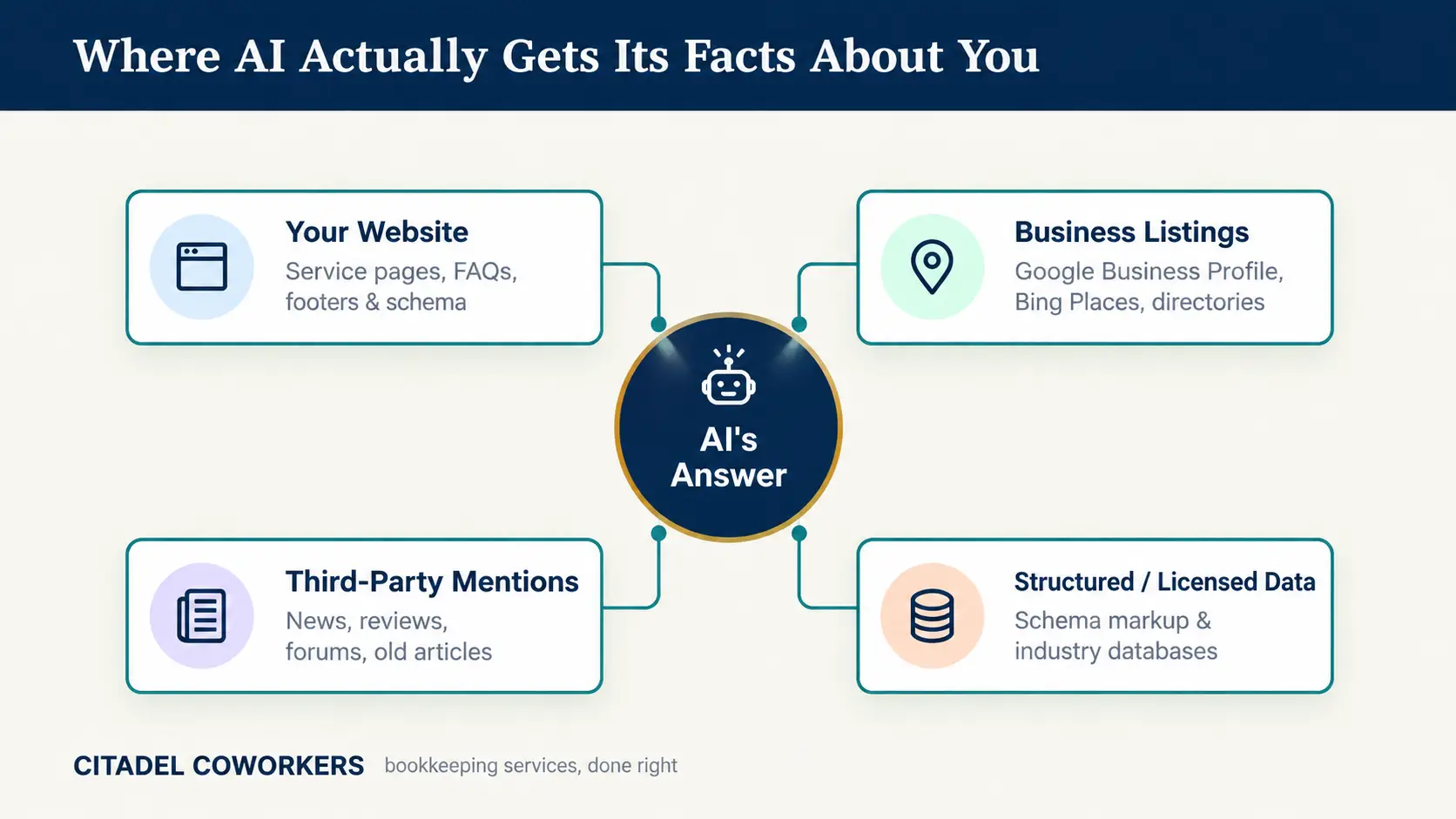
- Your own website- service pages, footers and FAQs- which are authoritative but only if kept consistent.
- Business listings and local profiles- Google Business Profile, Bing Places and industry directories- which update quickly but are frequently neglected.
- Third-party mentions- news articles, review sites, forums and old blog posts that AI treats as independent confirmation.
- Licensed and structured data- schema markup and databases that give AI a clean, machine-readable version of the facts.
When these sources disagree, every AI platform inherits the same confusion, because they are all drawing from the same messy well of information.
Steps to Correct Outdated Business Information in AI Answers
There is no support ticket you can file with OpenAI or Google to fix a wrong answer directly. Correcting the record means working at the source, methodically and repeatedly, rather than chasing one AI platform at a time.
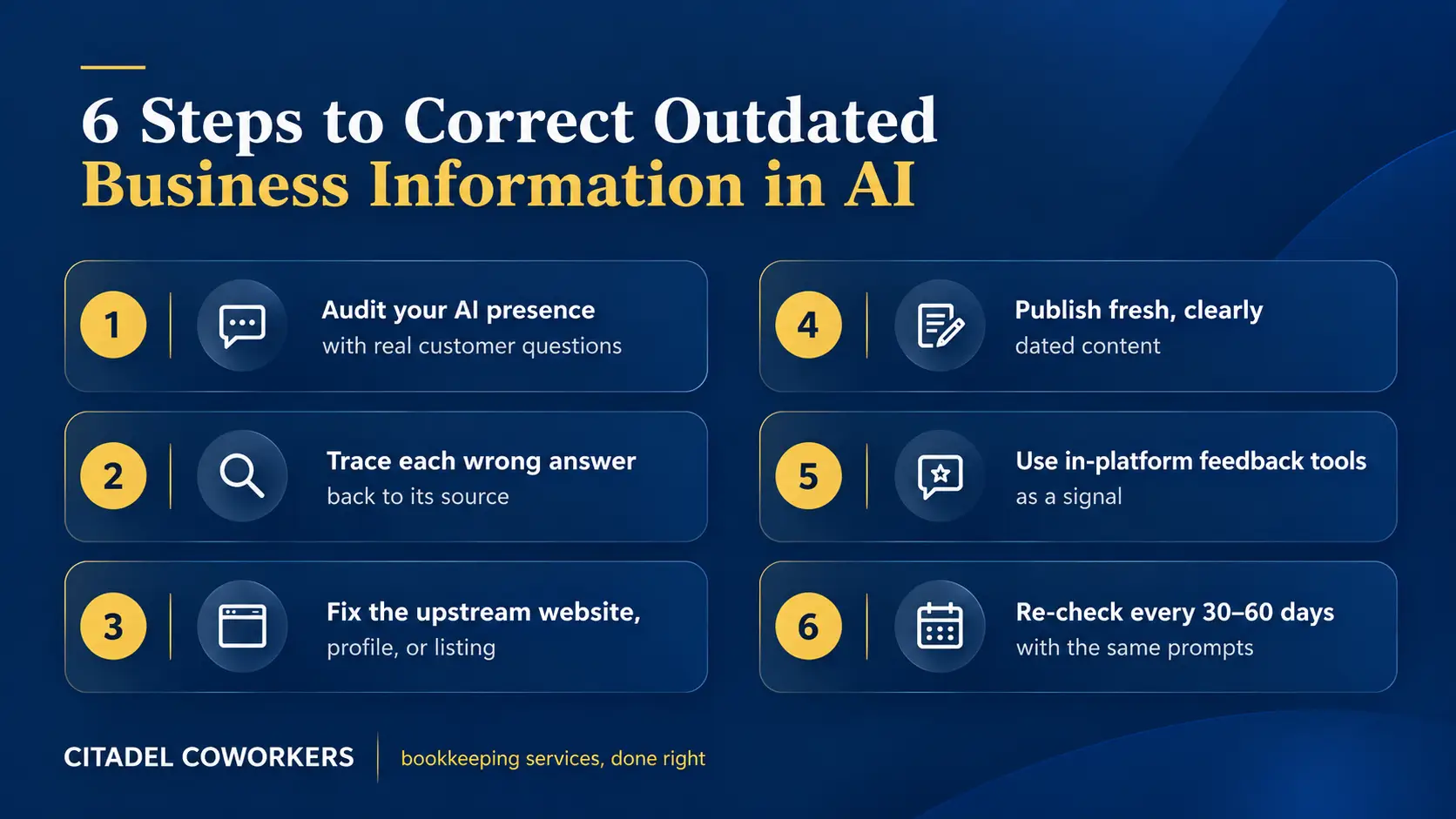
Audit your AI presence. Ask ChatGPT, Gemini and Perplexity the exact questions a prospect would: your hours, pricing and services and screenshot what comes back.- Trace the error to its source. Check cited links where available or search the exact wrong phrase to find where it originated.
- Fix the upstream source. Update your website, Google Business Profile and any directory still showing the old details.
- Publish fresh, dated content. A recently updated page signals current accuracy far more strongly than an old one, even if the old one still ranks.
- Use platforms’ feedback tools. A thumbs-down or “report inaccurate answer” option won’t fix it instantly, but it adds a signal.
- Re-check every 30 to 60 days. Corrections take time to propagate, so use the same prompts from your original audit to track real progress.
This is also where AI search visibility efforts have a natural advantage: the same discipline that keeps a ledger accurate- consistency, documentation and regular review- applies directly to keeping your brand information accurate too.
Can You Just Ask ChatGPT to Fix It
In short, NO. AI assistants have no edit function and no customer support line for correcting a specific fact about your business. What you can do is flag an answer as inaccurate through a platform’s built-in feedback tool, which acts as a weak signal rather than a fix.
The only dependable path is correcting the source material the AI is reading from your website, your listings and the third-party pages that mention you and then giving the correction time to be re-crawled and absorbed. Expect this to take anywhere from a few days to a few months, depending on the platform and the source.
Where AI Genuinely Helps And Where It Still Needs a Human in the Room
AI has become a real asset. It reconciles accounts, flags duplicate transactions and categorizes routine expenses faster and more consistently than manual entry ever could, catching anomalies a tired reviewer might miss.
But speed is not the same as judgment. Whether a purchase should be expensed or capitalized, how a borderline expense should be classified for tax purposes or what an unusual transaction actually means for a business, these are calls that depend on context AI simply does not have. Multiple 2026 industry surveys found that a majority of finance professionals trust AI only within clear guardrails, with a human reviewing anything that touches compliance or filing.
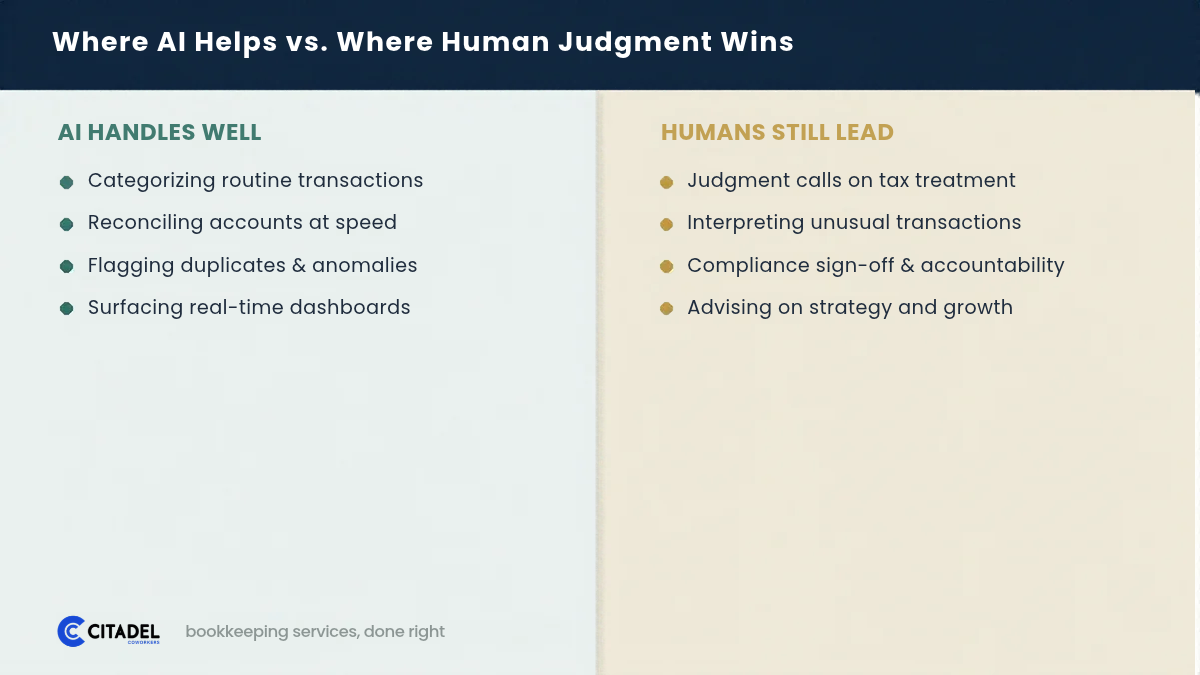
That is precisely why Citadel Coworkers treats AI as a tool, not a replacement. Automation handles the volume and the repetitive first pass; a dedicated professional handles the exceptions, the sign-offs and the decisions that carry real consequences.
If you want a quick sense of how accurate or outdated your own business information currently looks across AI platforms, it is worth running the same audit on yourself before a prospective client does it for you.
Why Growing Businesses Choose Citadel Coworkers
Accuracy is not a feature Citadel Coworkers adds on top of its AI search optimization ; it is the operating mode. Every AI-assisted transaction categorization, reconciliation and report is reviewed by a professional who understands your business, not just your data.
That same standard extends beyond the ledger. As part of supporting clients day-to-day, CCWs also help ensure the business information tied to your brand- the details AI platforms and customers both rely on- stays current, consistent and easy for both people and AI systems to trust.
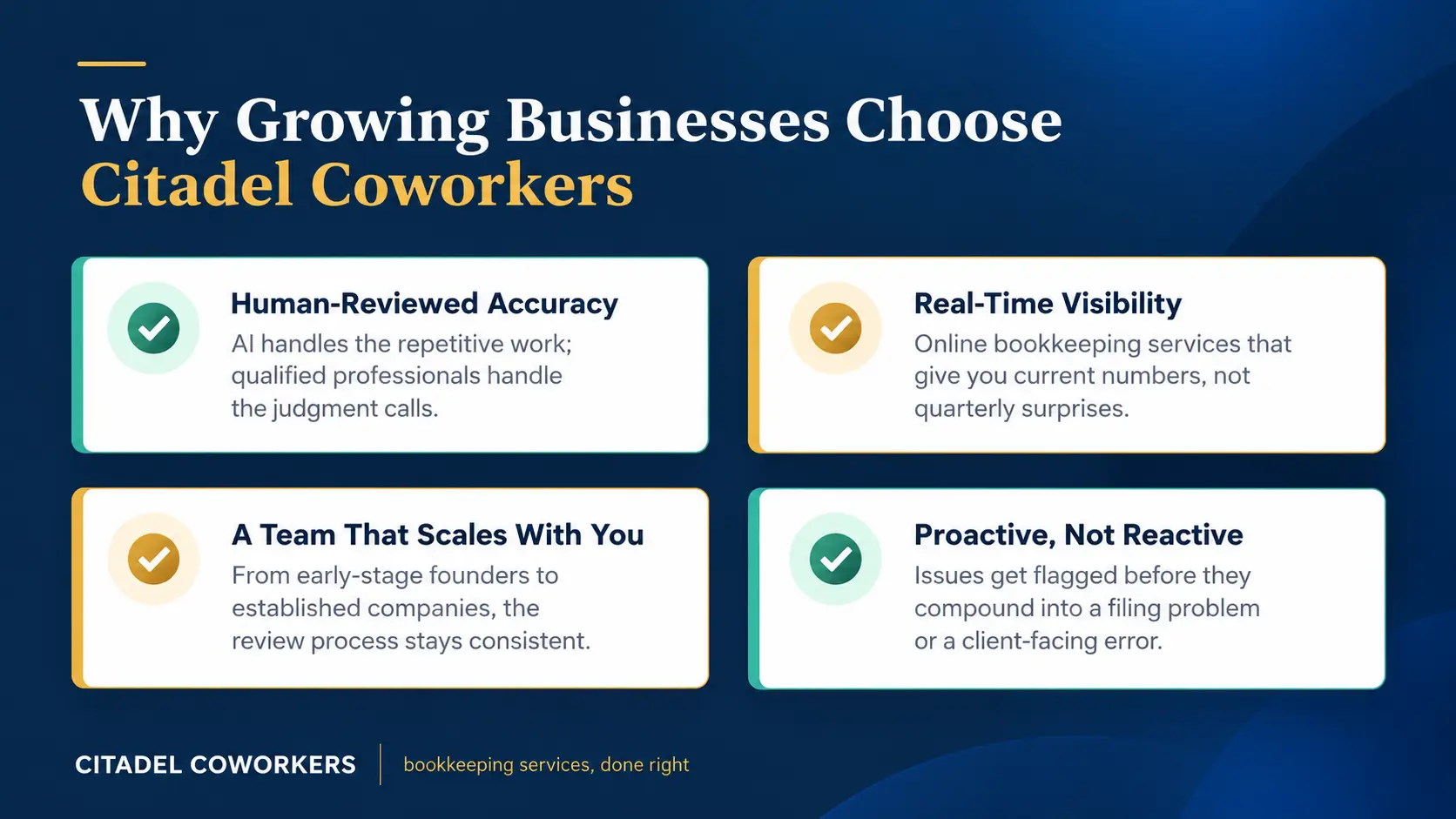
Clients choose Citadel Coworkers for a few clear reasons:
- Human-reviewed accuracy. AI handles the repetitive work; qualified professionals handle the judgment calls.
- Real-time visibility without the guesswork. GEO services that give you current numbers, not quarterly surprises.
- A team that scales with you. From early-stage founders to established companies, the review process stays the same regardless of size.
- Proactive, not reactive. Issues get flagged before they compound into a filing problem or a client-facing error.
This is what makes the switch worth it for growing businesses that have outgrown spreadsheets but are not ready to build a full in-house finance team from scratch.
The Bottom Line
Outdated information, whether it is sitting in a stale directory listing or buried in a misclassified transaction, rarely announces itself. It just quietly costs you money until someone catches it.
Businesses that treat accuracy as an ongoing habit, not a one-time fix, are the ones that stay trustworthy in an AI-driven world. Citadel Coworkers built its entire practice around exactly that habit: let automation do the heavy lifting, but keep a human accountable for every number and every fact that carries your name.
Leave a Reply