
Key Takeaways
- Neither approach wins alone. Automation delivers speed and coverage; people deliver judgment, empathy and accountability.
- Roughly half of consumers say generic or templated replies put them off, according to BrightLocal’s 2026 survey, so unsupervised automation carries a real cost.
- Since April 2026, Google screens owner replies as pending, approved or rejected. Copy-paste replies may never go live.
- The safest model is tiered: automate monitoring and drafting and keep people on anything negative, sensitive or regulated.
- Use AI to draft and people to decide. That single rule protects both speed and trust.
Two businesses receive the same one-star review, about a refund that never arrived and a support call that went badly.
The first answers within seconds: “Thank you for your valuable feedback!” The second replies the next morning, mentions the refund and the delay and offers a direct line to a manager who can fix it.
Same complaint, but very different signals.
Which one would you call? That question sits at the heart of automated versus manual review responses. It is not about technology. It is about what your reply tells a stranger who is deciding whether to trust you.
Why Every Reply Is Read By Someone About to Decide
Think about how you read reviews yourself. You scan the star rating, skim the newest comments, then look at how the owner answered the angriest one. That last step often tells you more about the business than the rating does.
BrightLocal’s Local Consumer Review Survey 2026, which polled 1,002 US adults, found that roughly 89% of consumers expect businesses to respond to reviews. About 80% say they are more likely to choose a business that replies to all of them.
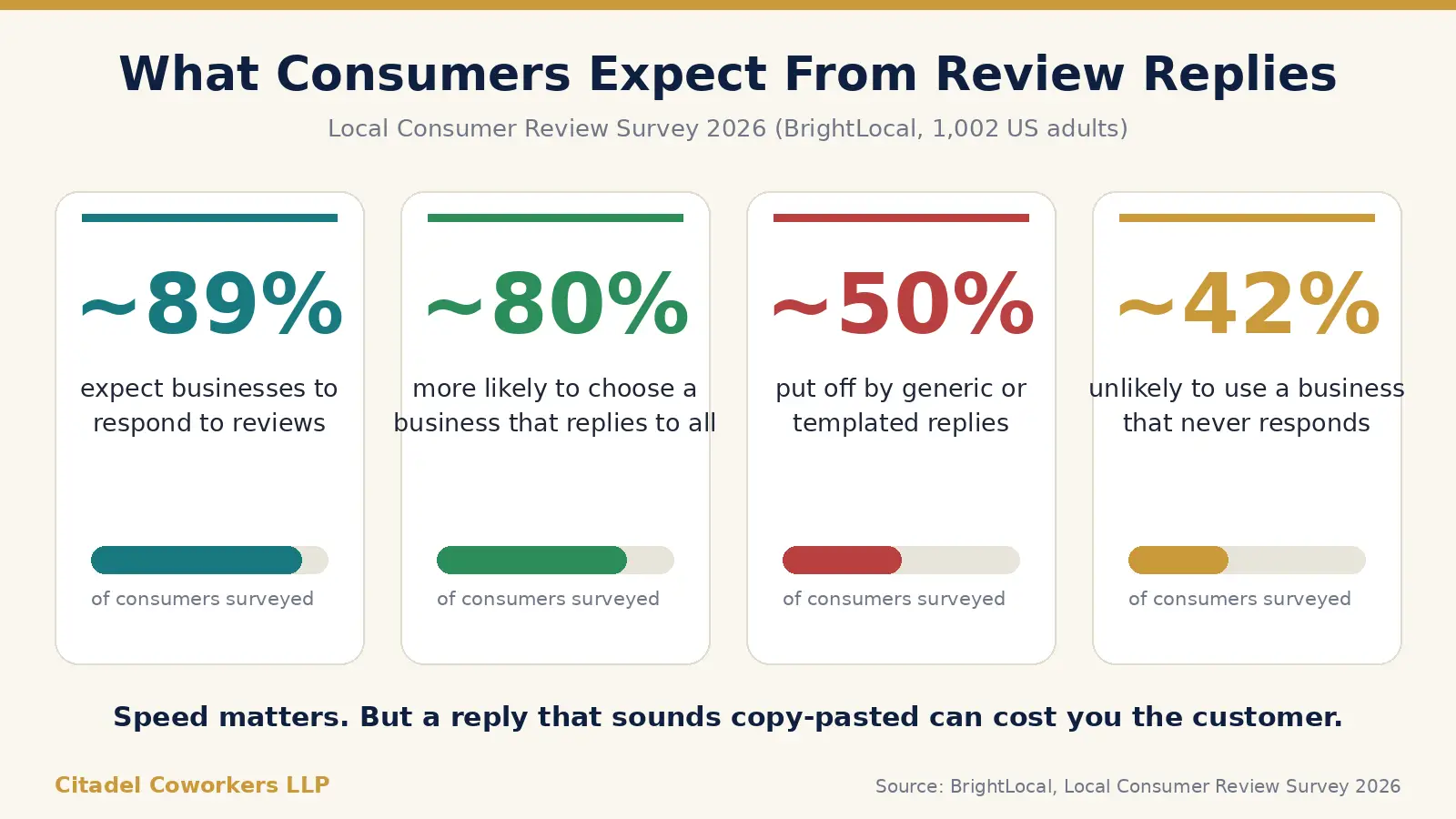
Speed alone does not win, though. Around 50% say generic or templated replies make them unlikely to choose a business. A reply is no longer a courtesy. It is part of the review and prospects read it that way.
That is why online reputation management now depends on reply quality, not just reply volume. A silent profile looks neglected. A robotic one can look worse.
Google Now Screens Replies: What Changes in 2026
Since April 2026, replies on Google Business Profile carry a moderation status: pending, approved or rejected. Before that, replies sent through the API went live automatically. Google’s checks are usually quick, but some reports describe delays far longer.
Industry analysis of roughly 12,700 rejected replies points to familiar culprits: repetitive wording, links, hashtags, promotional language and keyword stuffing. Some rejections reportedly fail quietly, so a team that assumes “sent” means “live” may never notice.
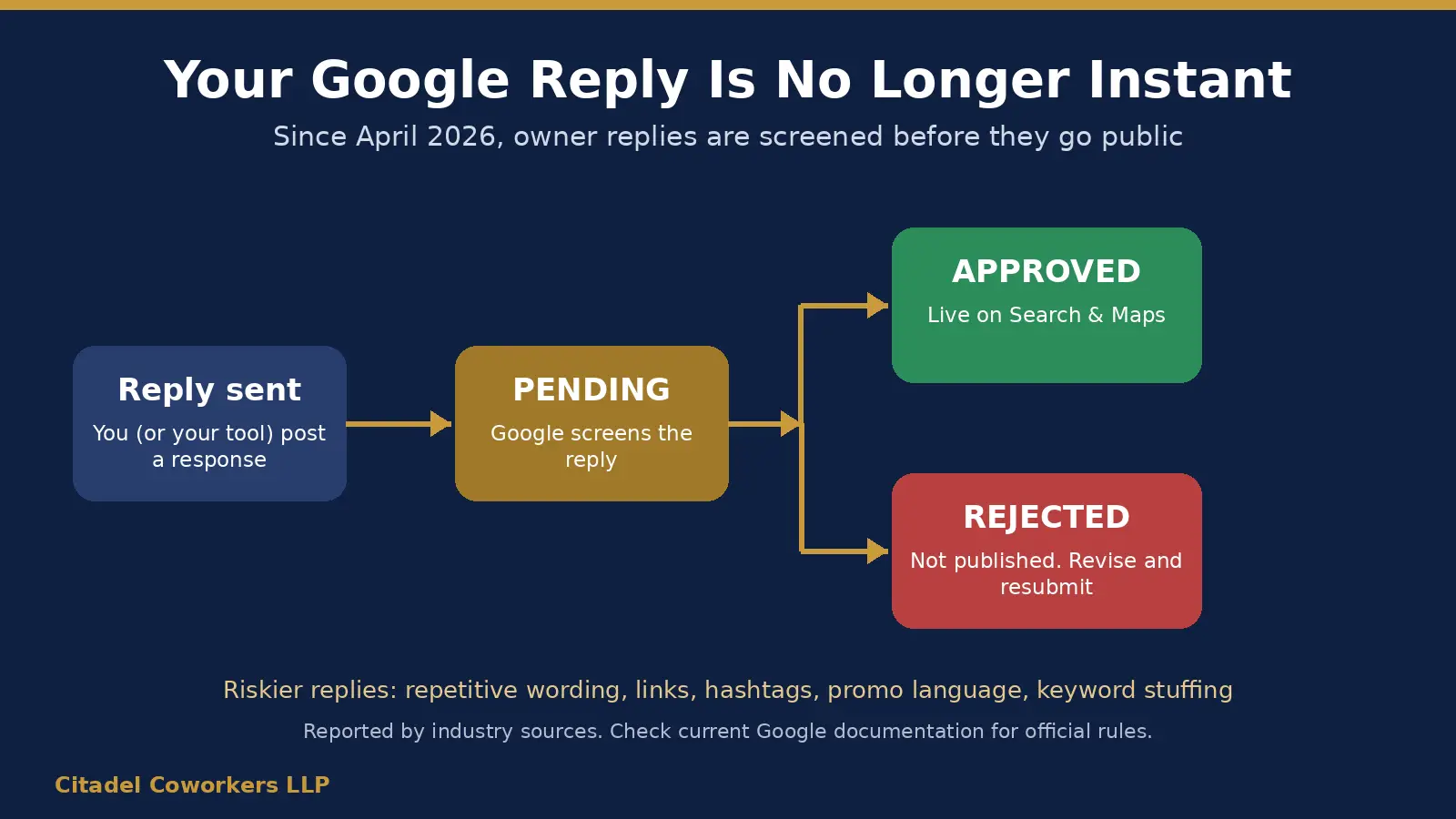
This is where Google review management gets more demanding. A reply that never publishes helps no one and a template that once looked efficient can now look suspicious.
The practical fix is simple. Reference the customer’s actual words, skip links and hashtags, vary your phrasing and check each reply’s status after posting.
If Google rejects one, revise it rather than resubmitting the same text. Treat approval status as a metric, not an afterthought.
Automated vs. Manual Replies: What is the Difference
Automated review responses are replies drafted or published by software, using rules, templates or AI, usually triggered by a star rating or keyword. Manual review responses are written by a person who has read the review, checked the facts and chosen the words.
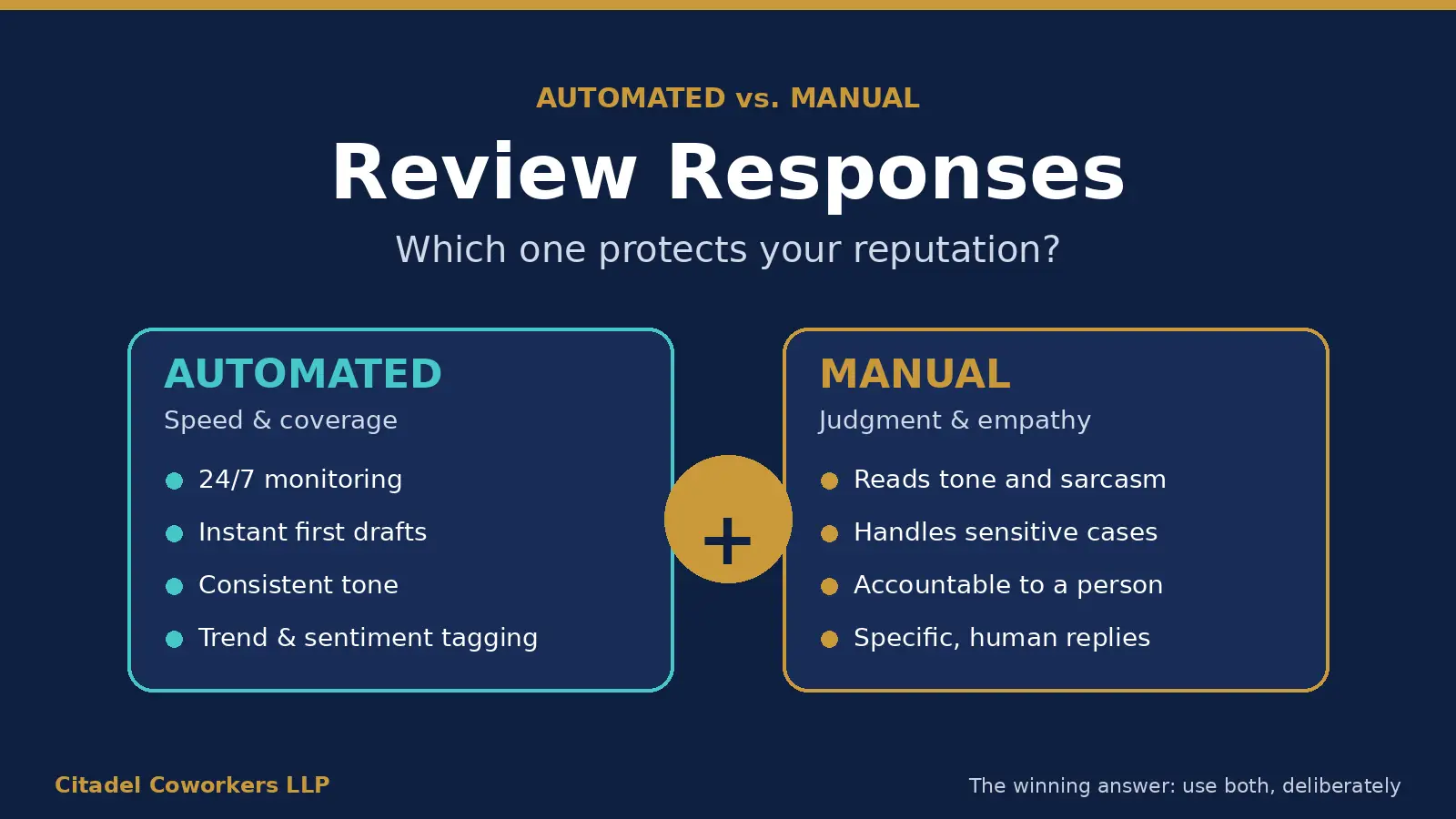
Automation optimises for speed and coverage. Manual replies optimise for accuracy and empathy. The strongest online review management programmes use both, deliberately.
The Hidden Cost of Manual-Only Replies
Manual replies have a real strength: nothing beats a person who knows the customer, the context and the stakes. The trouble is scale.
As reviews spread across Google, Facebook, Yelp and industry directories, checking each platform becomes a chore that slips when the team is busy. Replies get shorter. Some reviews are missed entirely. Tone drifts depending on who is typing.
The cost is not just time. Around 42% of consumers, per BrightLocal’s 2026 survey, say they are unlikely to use a business that never responds. Silence is also a reply and manual-only teams tend to send it during their busiest weeks.
How AI Reduces Errors in Review Replies
Most reply mistakes are ordinary human ones: a review missed over a weekend, a typo, the wrong name in the sign-off, a defensive answer typed while annoyed. AI is good at exactly this unglamorous work.
Used well, it pulls every platform into one queue, alerts you around the clock, drafts in a consistent brand voice, translates foreign-language feedback and tags sentiment and recurring themes. Patterns surface before they become a crisis.
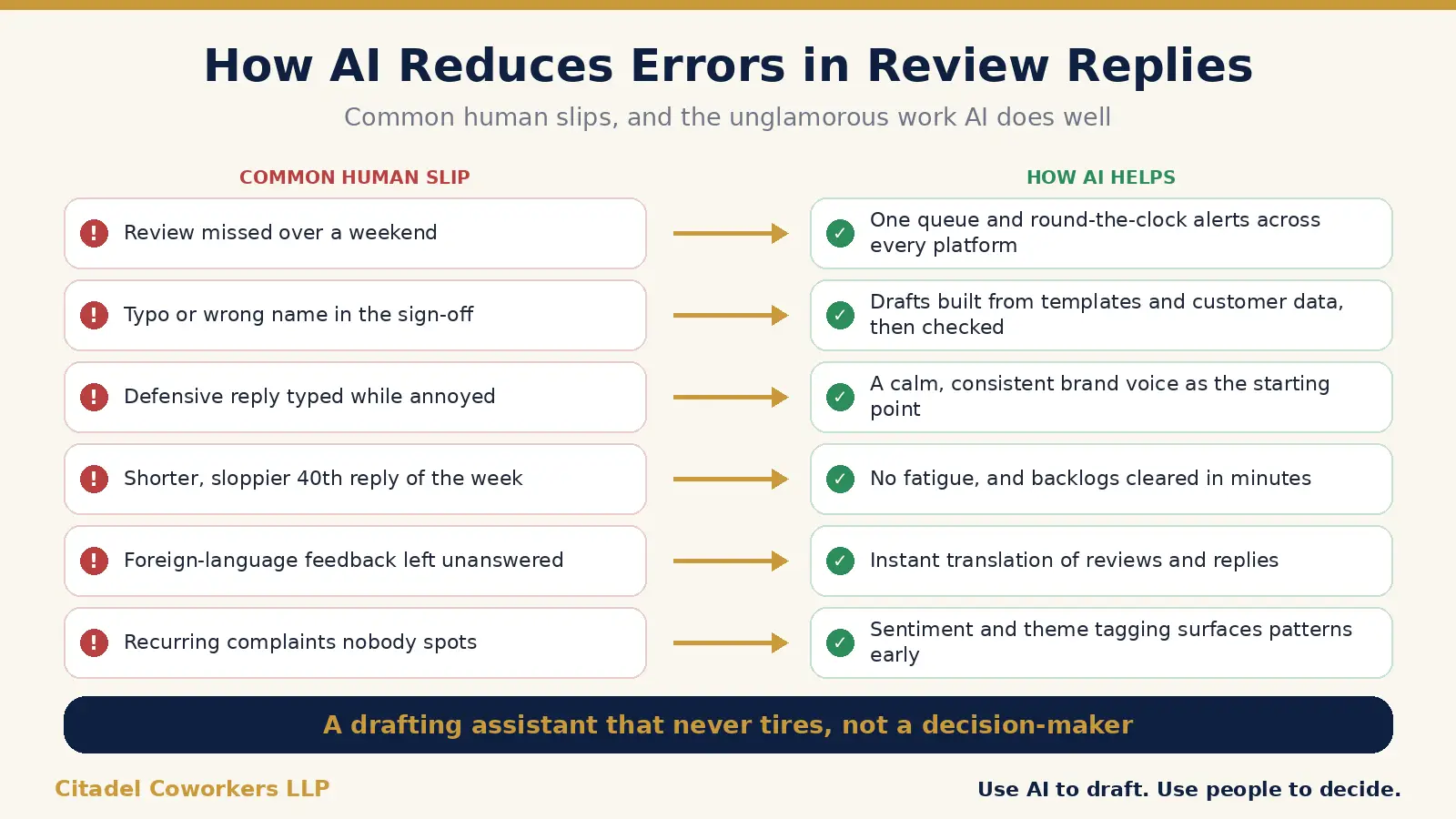
It also removes fatigue. A person writing their fortieth reply of the week grows shorter and sloppier. Software does not.
Consistency matters more than it sounds: when every location and every team member answers in the same courteous register, customers stop noticing the process and start noticing the care. It can also clear a backlog in minutes, so a business recovering from a burst of feedback can catch up without pulling people off customer-facing work.
Think of it as a drafting assistant that never tires, not a decision-maker.
Where AI Cannot Be Trusted
AI reads words. It does not always read intent. “Great, another delay” can look positive to a system and is plainly a complaint to any person. Sarcasm, mixed feelings and cultural nuance are common failure points.
Generative tools can also state things that are simply untrue, a problem often called hallucination. An invented refund policy, a promised call-back nobody will make, an apology that admits liability: in a public reply, each becomes a written commitment.
Privacy is another blind spot. In healthcare, legal and financial services, even confirming that someone is a client can breach confidentiality obligations. Software cannot tell when it is crossing that line.
Human Judgment: Your Advantage, Not a Bottleneck
AI is now part of daily operations and review replies are no exception. Confident businesses neither reject it nor hand it the keys. They decide in advance which decisions belong to people.
Human judgment is essential when a review mentions legal action, injury or safety, names a staff member, comes from a high-value client, looks fraudulent or requires a call on refunds. A person also carries accountability. Someone’s name stands behind the reply.
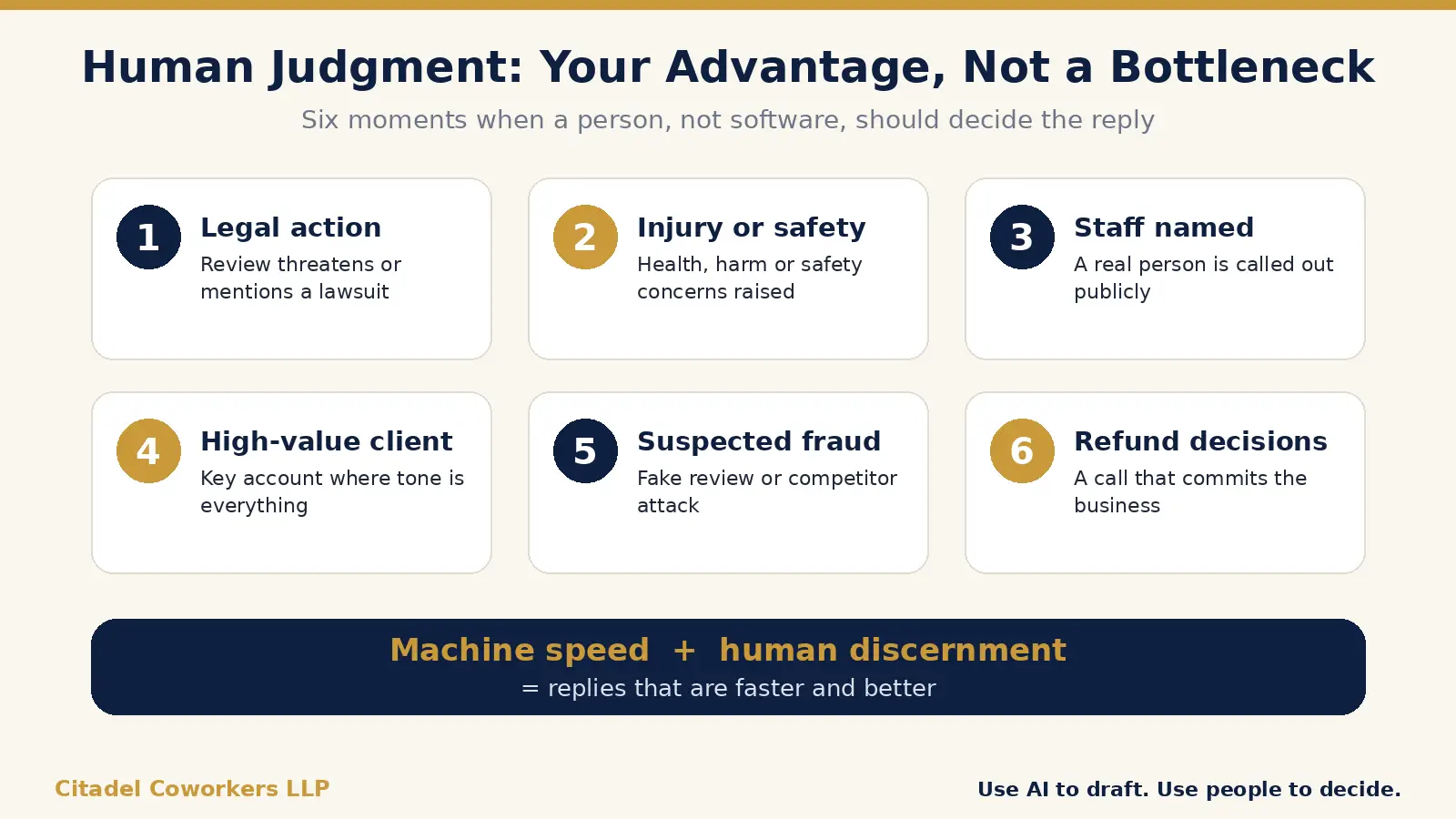
In regulated sectors and high-stakes B2B relationships, one poorly judged public sentence can cost more than a month of saved time.
There is a wider reason to care. BrightLocal’s 2026 research shows consumers increasingly ask AI tools for local recommendations and among those who use AI-generated review summaries, roughly 59% still open the review profile to check. Your replies are part of what they find there.
That is an advantage, not a limitation. Customers cannot tell whether a warm reply took twenty seconds, but they can tell whether it understood them. Pairing machine speed with human discernment gives you answers that are faster and better.
What a Reply Is Worth Reading Contains
Whether a person or a tool writes it, a strong reply does four things. It thanks the reviewer by referencing something they actually said. It acknowledges what went wrong without arguing. It shows empathy without admitting legal fault or promising compensation in public. And it moves detailed problems to a private channel.
Notice that none of these is about length. A three-sentence reply that names the delayed refund beats a polished paragraph that could sit under any review. Specificity is the quality software finds hardest to fake and people find easiest to supply.
A Tiered Model For What to Automate
Good review management sorts reviews by risk, not by volume. Here is a workable structure:
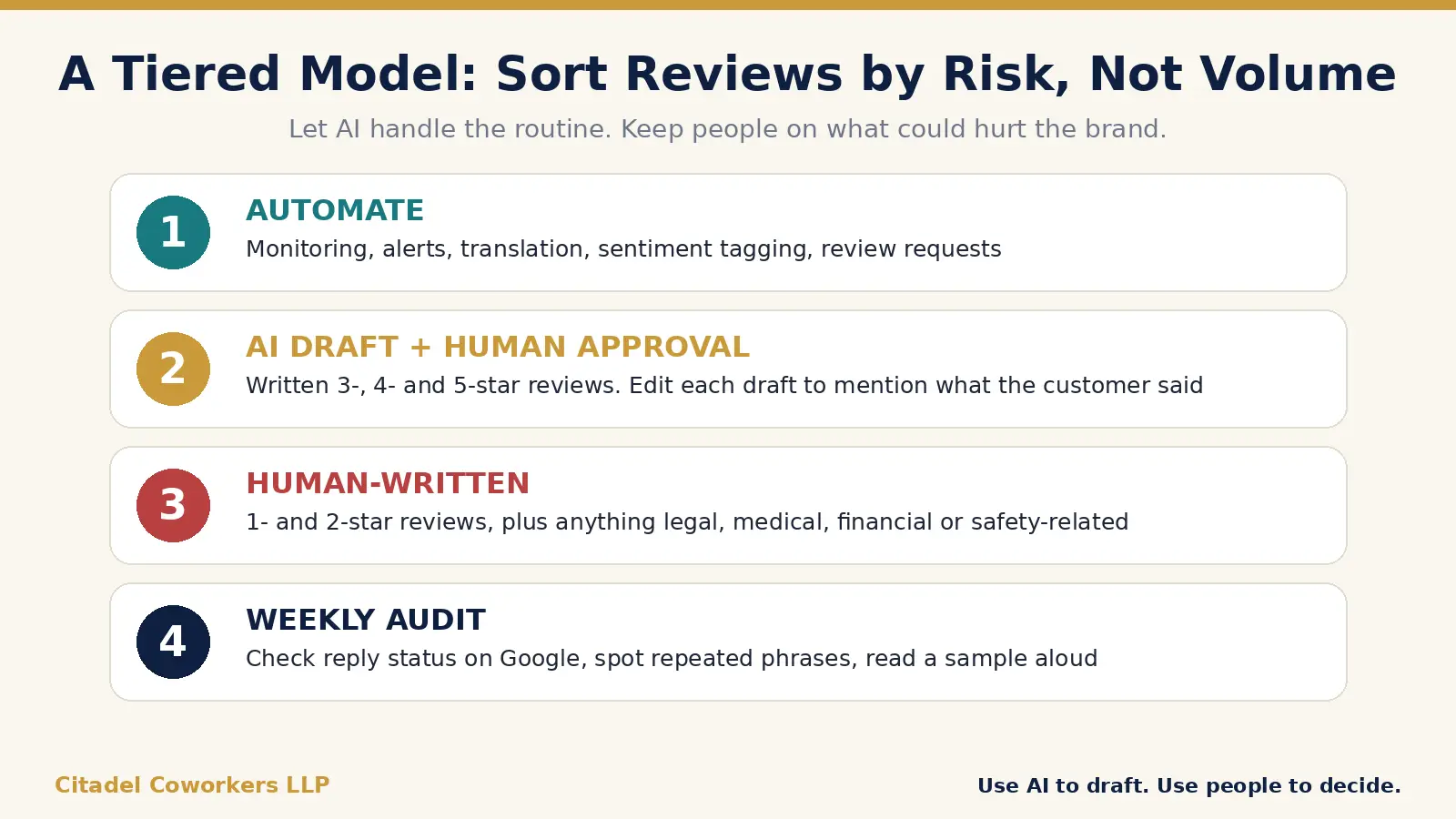
- Automatic: monitoring, alerts, translation, sentiment tagging and review requests.
- AI draft, human approval: written 3-, 4- and 5-star reviews. Edit each draft to mention something specific the customer said.
- Human-written: 1- and 2-star reviews, plus anything legal, medical, financial or safety-related.
- Weekly audit: check reply status in Google, hunt for repeated phrases and read a sample aloud.
Even a bare five-star rating with no comment deserves a short reply, but vary the wording so it never reads like a stamp.
Try the read-aloud test this week, the kind of quick check Citadel Coworkers would suggest first. Pull your last ten replies. If two could be swapped between customers without anyone noticing, they are probably too generic.
Why Businesses Trust Citadel Coworkers With Replies That Matter
Citadel Coworkers approaches online reputation management as a discipline built on judgment, not just tooling. Software handles the watching and the first draft. People handle the decisions.
Three principles shape that approach. Every sensitive reply is reviewed by someone who understands your business. Every response is edited to sound like you, not like a template.
And clear guardrails, from escalation rules to approval steps, mean nothing goes live unchecked. You always know what was automated, what was approved and why.
None of this is glamorous. It is the quiet discipline that keeps a reputation steady when volume spikes or a difficult review lands at midnight. If you would like to see how a tiered workflow could fit your business, explore how Citadel Coworkers can help you build one.
The Reply Is the Moment That Matters
The complaint was never the real problem. The reply was the moment that counted. Let your software watch the clock and draft the first line. Let a person decide what your business stands for. Start with your last ten replies and ask one honest question: would a stranger believe someone read this?
Leave a Reply