
Key Takeaways
- Review velocity, the pace of new reviews, not the total count, has become one of the fastest-moving ranking signals in local search and AI-driven recommendations.
- A business with a handful of recent reviews can now outrank a competitor sitting on hundreds of reviews that have gone quiet.
- Search engines and AI assistants apply something close to “recency decay”, where older reviews gradually lose their influence on visibility.
- AI can monitor, flag and draft responses at scale, but judgment calls on tone, escalation and risk still belong to a person.
- A deliberate, structured approach to review velocity turns it into a repeatable growth channel instead of an occasional scramble.
- Citadel Coworkers builds that rhythm for client brands through structured systems paired with hands-on human oversight.
Your business has 250 Google reviews and a 4.7-star average. Your competitor has 90 reviews and holds a 4.5-star average. When searching for what you sell, your competitor’s profile is sitting first in the map pack and the one ChatGPT mentions when someone nearby asks for a recommendation.
The gap isn’t the star rating. It’s how recently and how consistently new reviews are landing on each profile.
According to BrightLocal’s 2026 Local Consumer Review Survey, 97% of consumers now read reviews before choosing a local business and the platforms feeding them that information are getting sharper about weighing which reviews reflect what a business is like right now, not what it was like five years ago.
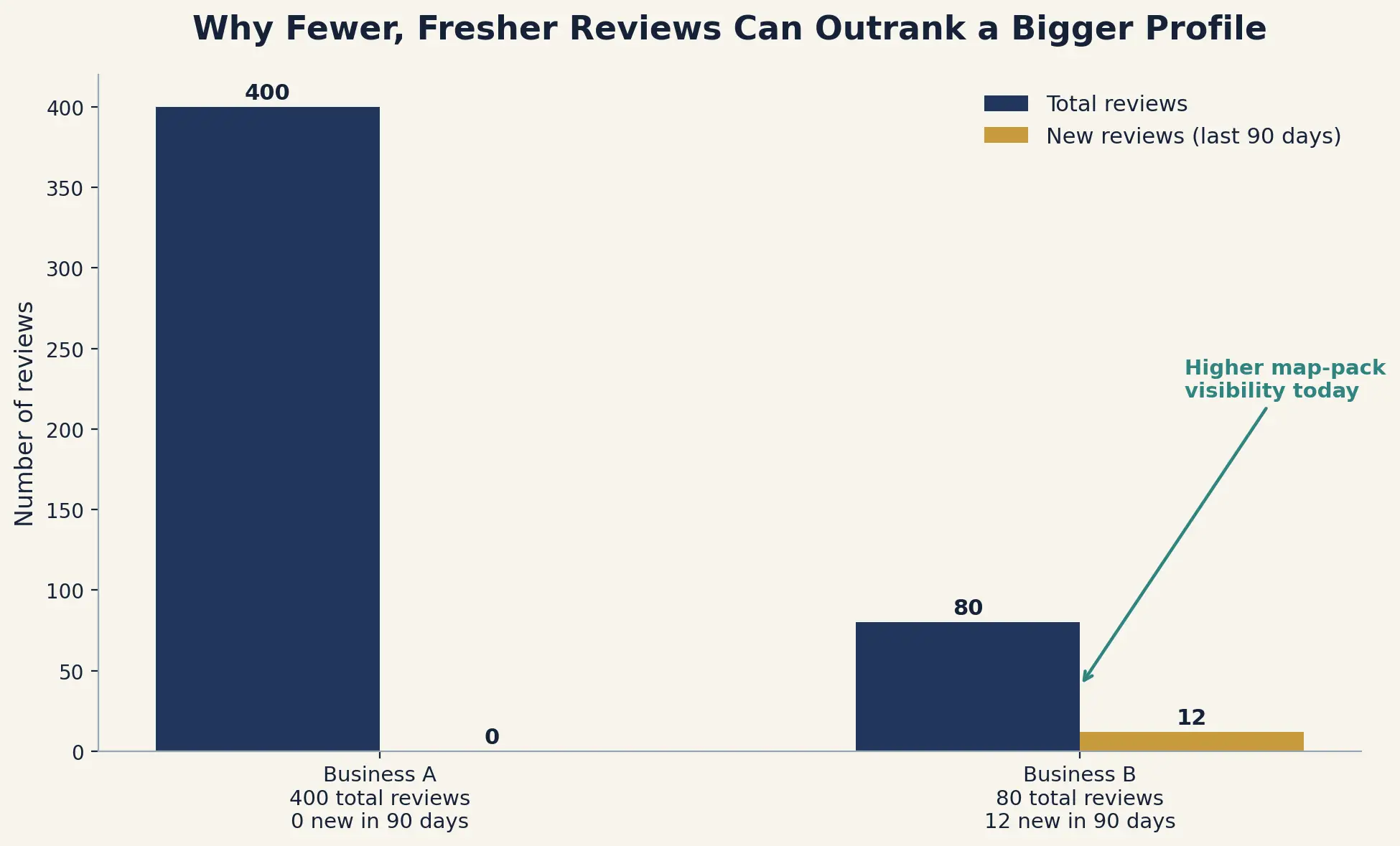
That shift has a name: review velocity. Here’s what it means for your brand and how AI is reshaping both the threats and the defenses inside your review profile and where Citadel Coworkers sees this working best for the brands we manage it for.
What Is Review Velocity
Review velocity is the rate at which a business earns new reviews over a defined period, typically the most recent 30, 60 or 90 days. It measures rhythm, not size.
That is different from review volume, which is simply the running total of every review a business has ever collected. A ten-year-old business can hold hundreds of reviews and still show weak velocity if almost none of them are recent. A two-year-old business can show strong velocity with a fraction of that total.
Local search platforms and the newer AI-powered search tools layered on top of them increasingly treat velocity as a proxy for whether a business is still active, still delivering and still worth recommending today, not simply five years ago. Answer engines built on generative AI pull from this same pool of reviews when they summarize a business or compare it with nearby alternatives, so a stagnant profile can lose ground in AI-generated answers even before it loses ground in a traditional search results page.
Why a Quiet Review Profile Is Costing You Customers
Reviews used to function like a resume: collect enough of them and the case was closed. That assumption no longer holds. Both people and the algorithms recommending businesses now read a review profile as a live status update, not a finished archive.
A single poor review can turn away a meaningful share of prospective customers before they ever make contact and a business that goes quiet for months sends a similar signal, even when every past review was glowing. Silence reads as uncertainty about whether the business is still paying attention.
Industry research on this topic consistently points in the same direction: businesses that respond to reviews and keep new ones flowing tend to convert more of the traffic they already have, while profiles that go stagnant lose ground even when their historical rating stays high.
This is exactly why online reputation management has shifted from an occasional cleanup task into an ongoing discipline that sits close to revenue. Brands that treat their review profile as a living system, rather than a project with an end date, are the ones still showing up when it counts.
How Search Platforms and AI Assistants Actually Read Your Review Timeline
Picture every review as carrying a freshness weight the moment it is posted. That weight does not vanish overnight, but it fades the longer a profile goes without a new one arriving, a pattern close to what analysts now describe as recency decay.
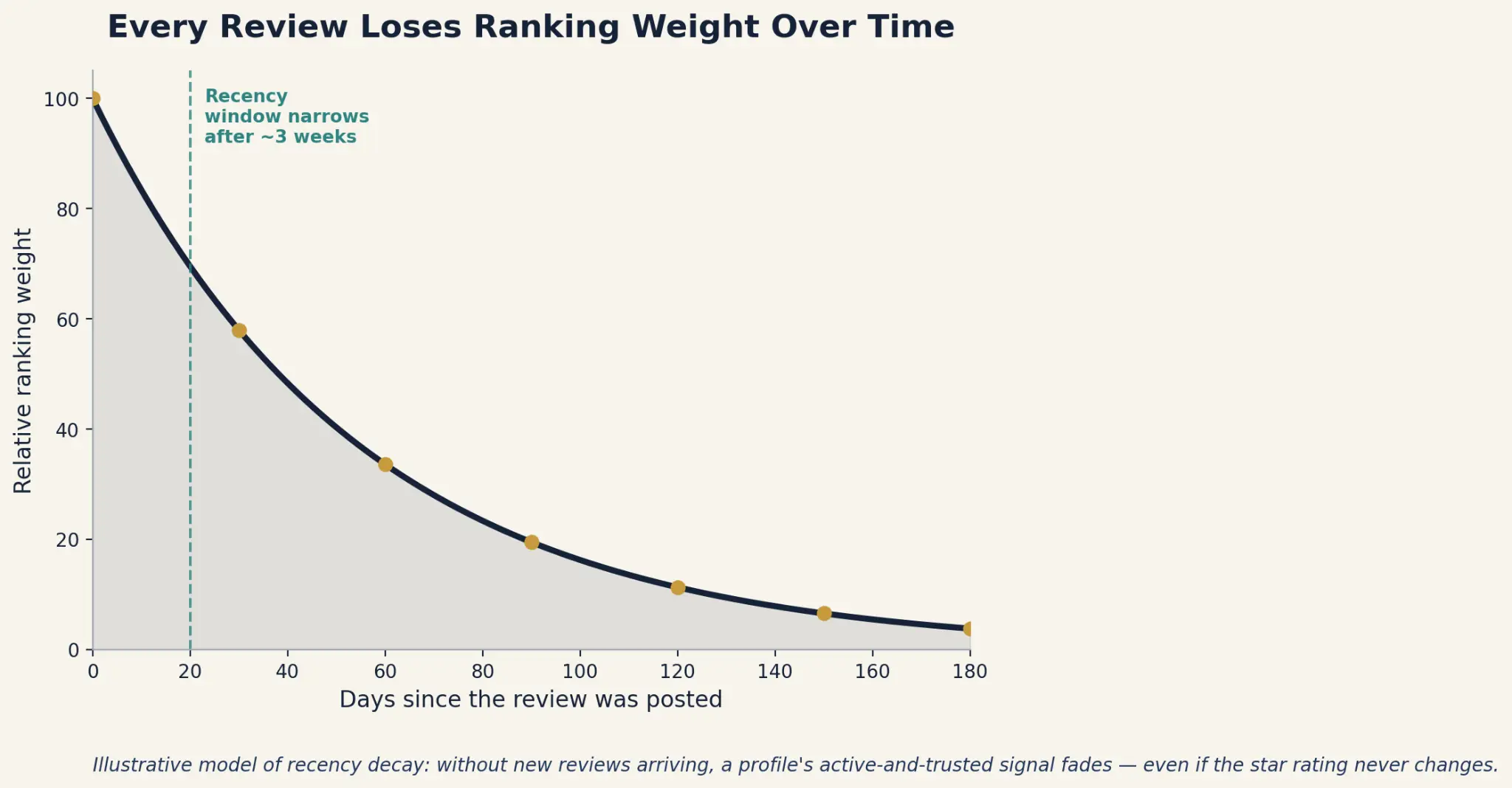
A handful of factors shape how a review profile gets read as a whole:
-
- Recency: how long it has been since the last review arrived
- Frequency: how consistently new reviews arrive over months, not just in short bursts
- Response rate: how often and how quickly the business replies
- Sentiment and detail: whether reviews read as specific and genuine rather than generic
- Cross-platform consistency: whether the pattern looks similar on Google, industry-specific sites and social platforms
None of these factors work alone. A business with an excellent star rating but no movement on any of them starts to resemble, statistically, a business that has quietly stopped operating.
Before assuming a visibility dip is about star rating, it is worth checking something simpler first: how long it has actually been since a new review came in.
Building Review Velocity Without Gaming the System
The instinct, once a business notices this, is to run a single campaign and ask every past customer for a review at once. That approach tends to backfire. A sudden cluster of reviews followed by months of silence looks less like momentum and more like a manufactured spike.
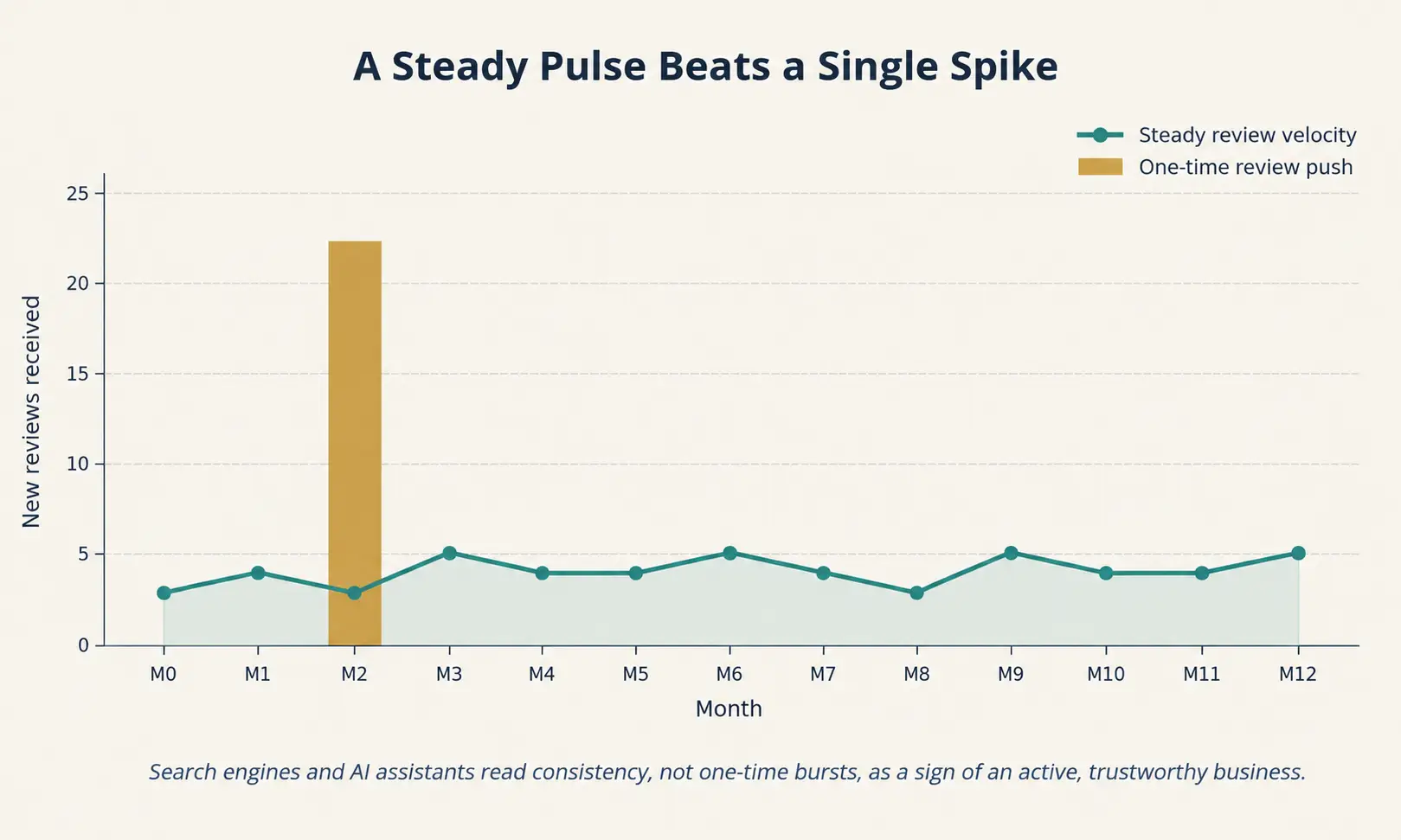
A steadier approach holds up better over time:
- Ask at the moment of service completion, not weeks later, while the experience is still fresh.
- Use short SMS or email prompts rather than long forms; the easier the ask, the higher the response.
- Spread requests across the customer base instead of batching them into occasional pushes.
- Respond to every new review within a day or two, positive or negative.
- Review the cadence monthly, not just the star rating.
This is the operational core of review management done well: not chasing a bigger number, but keeping a steady, believable rhythm that customers and algorithms both recognize as real.
Where AI Earns Its Keep in Reputation Work And Where It Doesn’t
AI has changed both sides of this picture. It can scan thousands of reviews for sentiment, flag unusual clusters and draft a reasonable first response in seconds- work that used to consume hours every week for larger brands.
At the same time, that same technology has made convincing fake reviews easier to produce. Researchers tracking this problem have found that AI-generated reviews are a fast-growing share of what platforms now remove as spam and that human readers alone catch them barely better than guessing.
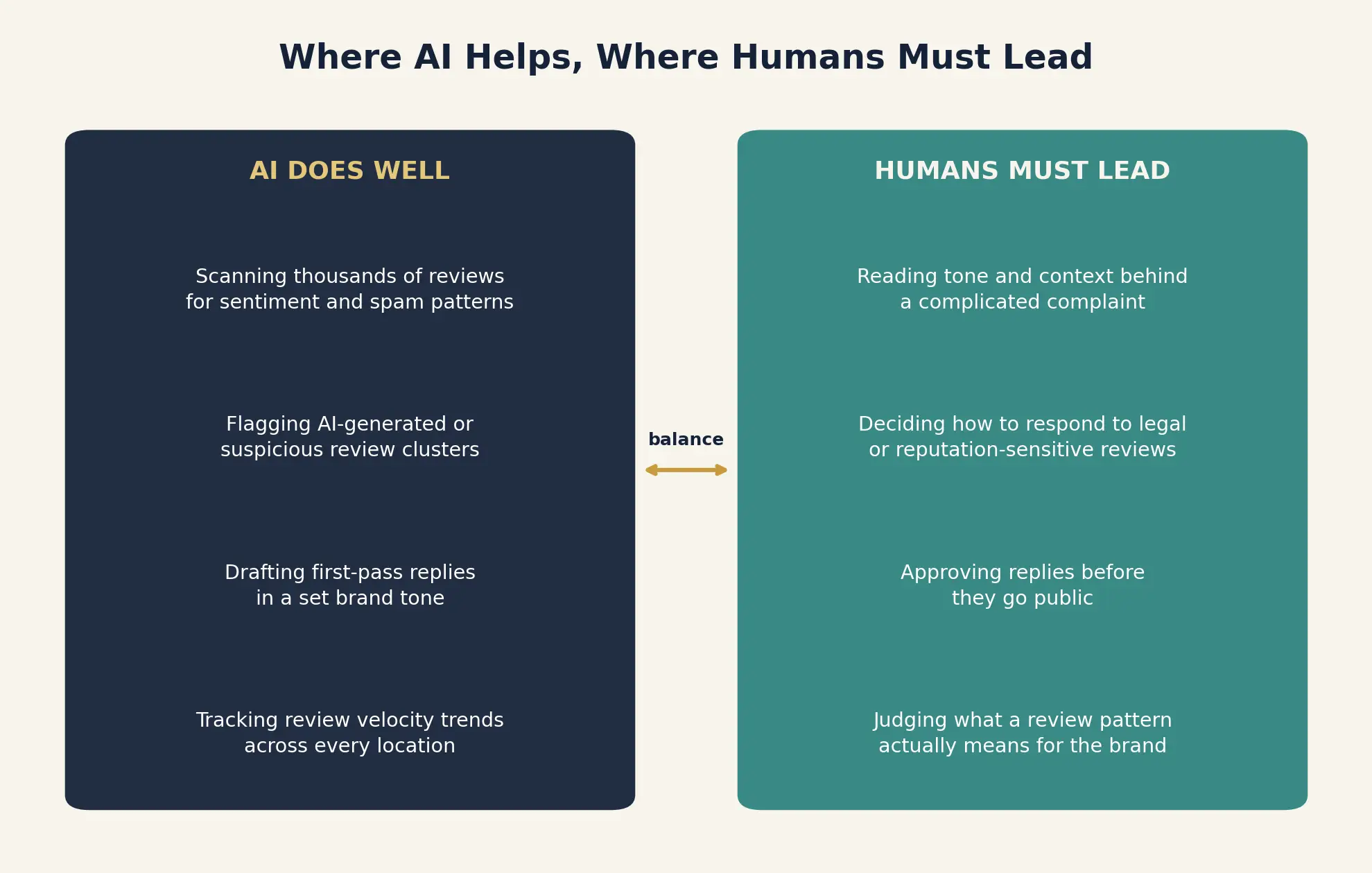
That combination, AI drafting at scale on one side and AI-generated content polluting the review pool on the other, is exactly why human judgement has not become optional. A generic complaint about slow service can be handled by a well-trained AI draft. A complaint involving a billing dispute, a safety concern or a legal gray area cannot; it needs a person weighing tone, risk and relationship before anything goes public.
At Citadel Coworkers, AI is treated as a first-pass filter rather than a final decision-maker. It handles the scanning and the drafting, while a person still signs off on anything that could shape how a brand is perceived. That combination is where thoughtful online reputation management actually earns its results.
Why Growing Brands Choose Citadel Coworkers
Most agencies treat reviews as a side task bolted onto broader marketing work. Citadel Coworkers treats review velocity as its own discipline, with its own cadence, reporting and accountability. That distinction tends to matter most for multi-location brands, where one slow quarter at a single site can quietly drag down performance everywhere else.
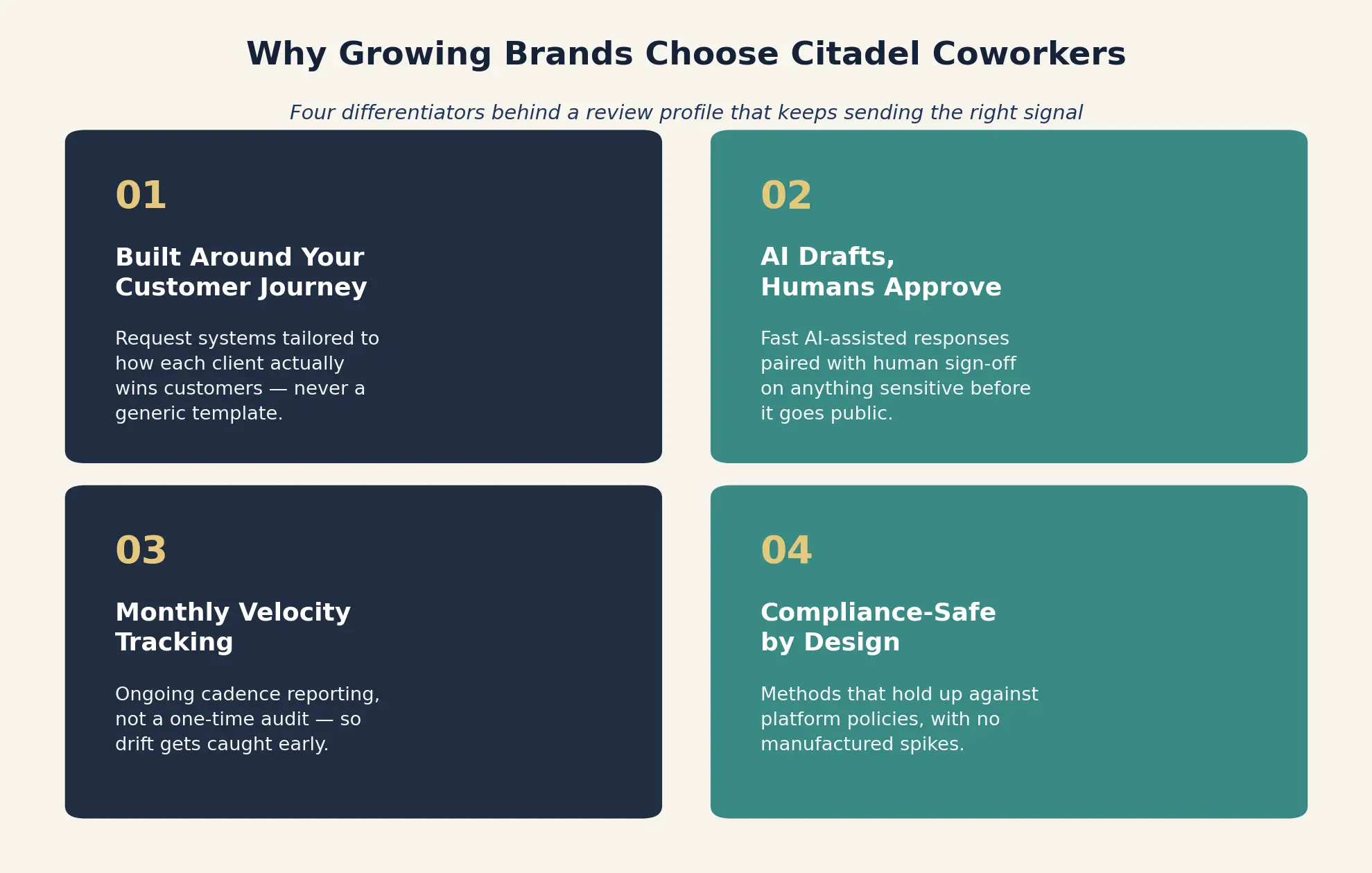
In practice, that looks like a few specific things:
- Request systems built around each client’s actual customer journey, not a generic template
Response workflows that pair fast AI drafting with human approval on anything sensitive
Monthly velocity tracking, not a one-time audit
Compliance-safe methods that hold up against platform policies, with no manufactured spikes
The result is not simply a bigger number on a dashboard. It is a review profile that keeps sending the right signal, month after month, to the people and the platforms deciding who gets chosen.
If a review profile has barely moved in the last quarter, it is worth a conversation about what a structured cadence could look like across every location.
Turning Online Reviews Into a Predictable Growth Channel
Handled properly, online reviews stop behaving like an unpredictable byproduct of customer service and start behaving like any other growth channel, with inputs, a cadence and measurable output.
That shift matters because it removes the guesswork. Instead of wondering why visibility dipped, a brand can look at exactly how many reviews arrived last month and how that compares with three months earlier. Marketing budgets get easier to justify once a reputation program produces numbers that behave this predictably month after month.
A strong review history was never wasted effort, but on its own, it no longer carries a profile the way it used to. The brands pulling ahead this year are not necessarily the ones with the longest history or the largest total. They are the ones still showing up, one recent review at a time, proving they are worth choosing today. That is the pulse worth protecting, quarter after quarter, long after the first campaign ends.
Leave a Reply