

A prospective client typed a question into an AI assistant last week, not into Google. The assistant answered in four sentences, named two competitors and never linked back to a single website. Nobody clicked through. Nobody scrolled a results page. The buying decision moved forward anyway.
Traffic used to be the whole scoreboard. Now a page can do its job perfectly and still show zero visits, because the visit happened inside someone else’s chat window. If a blog post never gets a click but still shapes the answer a machine gives your next customer, did it work or didn’t it?
It worked only if it was built for this moment-written to be reused, re-quoted and reorganized on short notice, instead of filed away the day it was published.
That is why content agility right now matters more than content volume. Brands that can turn one well-researched idea into whatever format the moment calls for, in days, not quarters, are the ones still showing up when someone asks. Brands still running on a monthly content calendar are quietly going invisible, one unanswered question at a time.
What Does Discoverability Actually Mean Now
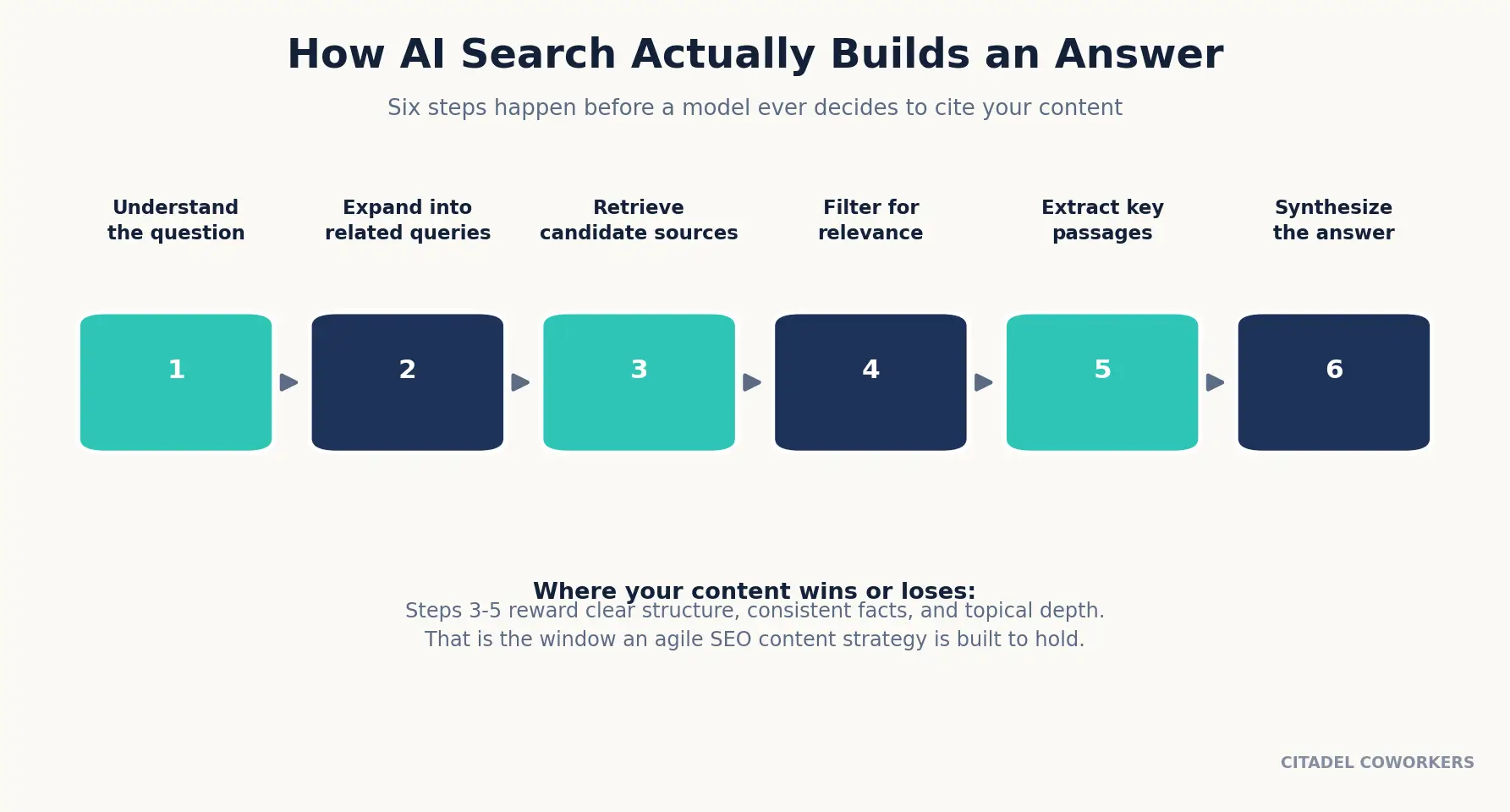
Discoverability once meant ranking on page one. Today it means something closer to being trusted enough to be repeated. Search engines, AI Overviews and answer engines such as Perplexity or ChatGPT do not just index a page anymore. They read it, judge it, and decide whether it is reliable enough to quote back to someone who never visits the site at all.
In practical terms, that shift changes what “good content” even looks like. A page can rank well and still get skipped in an AI-generated answer if it is not structured clearly, backed by consistent facts or written by someone with real authority on the subject.
Visibility today is earned in two arenas at once: the results page itself and the machine’s internal judgment of whether a source is worth citing.
The Hidden Cost of a Content Calendar That Cannot Bend
Most content teams still run on a rhythm built for a slower internet: plan a topic, draft for weeks, gather approvals, publish once, move on. That rhythm made sense when discoverability mostly meant matching keywords to search queries.
It breaks down the moment an algorithm update or a shift in how people phrase questions to an AI tool changes what “relevant” looks like. A rigid editorial calendar cannot respond in the same week, so brands lose the exact window when their expertise would have mattered most.
The fix is not publishing more. It is publishing in a way that lets a team rework and redistribute its best ideas the moment the ground shifts beneath them, without starting from a blank page every time.
What Content Agility Actually Looks Like Inside a Working SEO Content Strategy
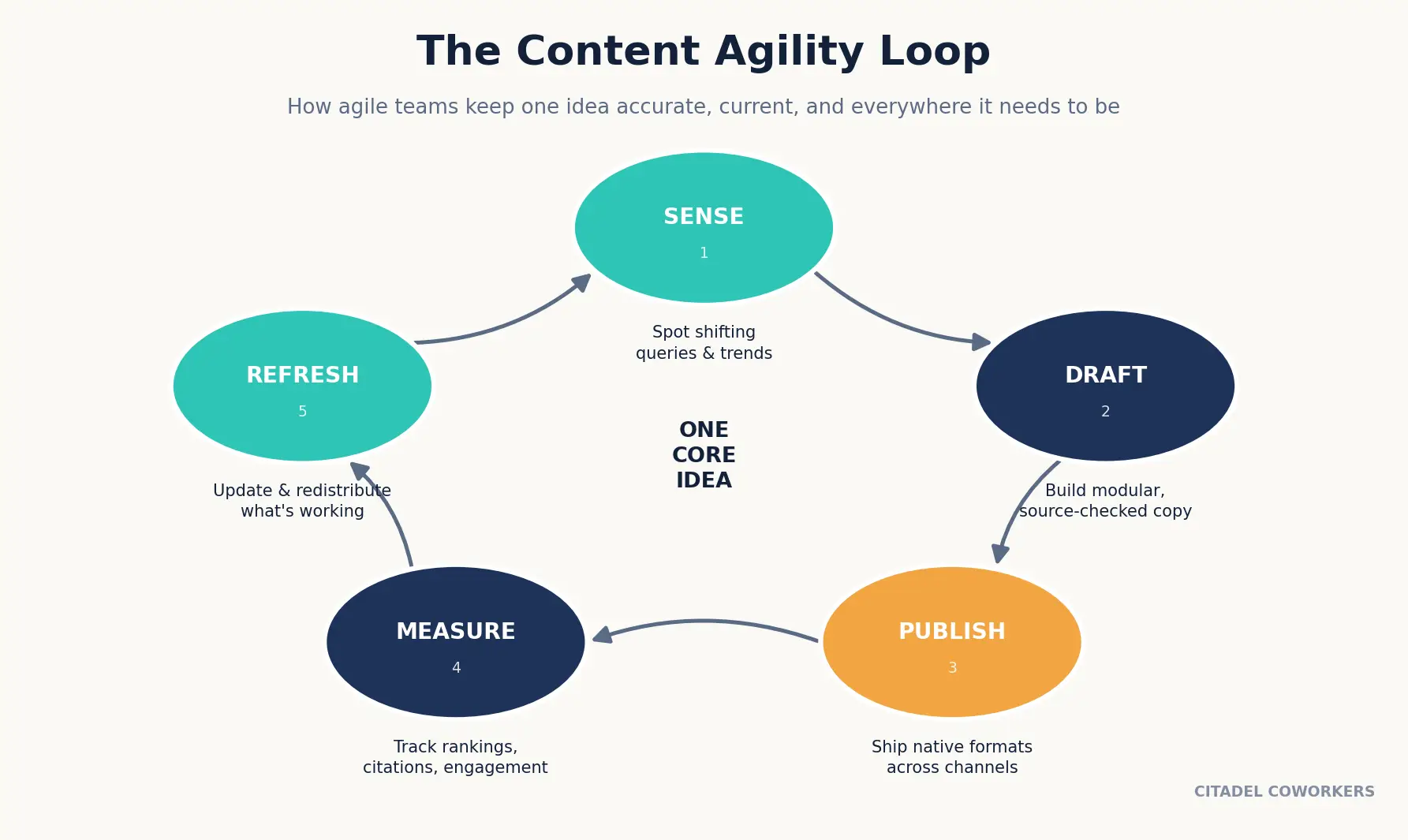
Content agility is the operational ability to adapt a core idea into multiple formats and update it quickly, without losing accuracy or brand voice along the way. Put simply, it is less a content type and more a habit built into how a team plans, writes and maintains its work.
A genuinely agile SEO content strategy treats every asset as something that will be revisited, not filed away once it is published. That single mindset shift changes how a team briefs writers, how it structures documents and how often it returns to older pages.
Four habits separate agile teams from reactive ones, and none of them require a bigger headcount:
- Build modular from the start. Break long reports and guides into standalone sections before publishing, so each one can be pulled out, updated or repurposed as its own asset.
- Keep one source of truth. Store core statistics, product claims and expert quotes in a single reference document so every writer pulls the same accurate facts.
- Set guardrails, not approval chains. Agree on tone, positioning and non-negotiables once, then let contributors publish inside those lines without a fresh round of sign-offs every time.
- Put refreshing on the calendar. Treat top-performing pages as living documents and schedule updates the same way new work gets scheduled.
The Five Signals That Decide Whether AI Assistants Trust Your Content
Once a team accepts that machines are reading and judging content before a human ever sees it, it helps to know what they are actually checking for. Across the major AI search tools, the underlying signals are not mysterious. They are an evolution of things SEO has rewarded for years.
- Structured, well-tagged content that clearly labels what a page is about, from headings down to schema markup.
- A credible backlink and mention profile that signals other trusted sources vouch for the brand.
- Genuine topical depth, meaning the content covers a subject thoroughly rather than skimming it for keywords.
- Clean site architecture that lets both crawlers and AI systems find and index the strongest pages without friction.
- Consistent freshness, since outdated pages are usually the first thing models filter out when assembling an answer.
None of these signals reward speed alone or quality alone. They reward the combination, which is exactly what a well-run, adaptable content operation delivers once it is actually running the way it should.
How Citadel Coworkers Turns One Idea Into a Discoverability Engine
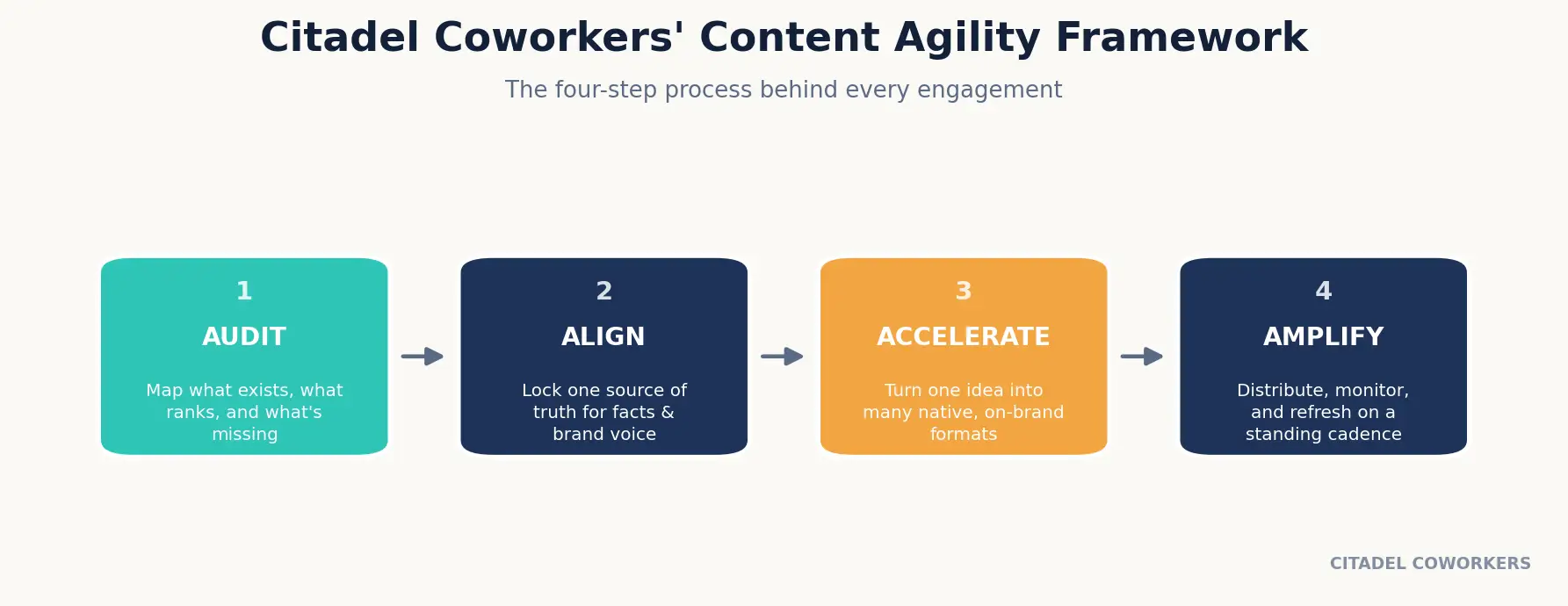
This is the exact gap Citadel Coworkers was built to close. Instead of handing clients a stack of blog drafts once a month, our content teams start with one well-researched idea and engineer it to travel.
That single idea becomes a core article, a short explainer, a set of FAQ blocks phrased the way people actually talk to AI assistants and a distribution plan that puts each version where the right audience already spends time.
The work does not stop at publish. Citadel Coworkers pairs every content marketing strategy with a standing review cadence, so pages that start slipping in rankings or losing relevance get rewritten with current data instead of quietly fading on page four or in search results.
If you are curious what one of your best-performing pages could become when it is engineered this way, it is worth mapping out its potential formats before your next content sprint, rather than after the topic has already gone cold.
Where AI Speeds Up Content Optimization And Where It Cannot Replace You
AI tools have undeniably changed the pace of content work. Drafting outlines, summarizing research, generating meta descriptions and testing headline variations all happen faster now, with little reason left to do them by hand.
But content optimization built entirely by machines tends to read like everyone else’s machine-built content: technically correct, structurally sound and forgettable. Models trained on largely the same public information tend to converge on the same phrasing, the same examples and the same safe conclusions.
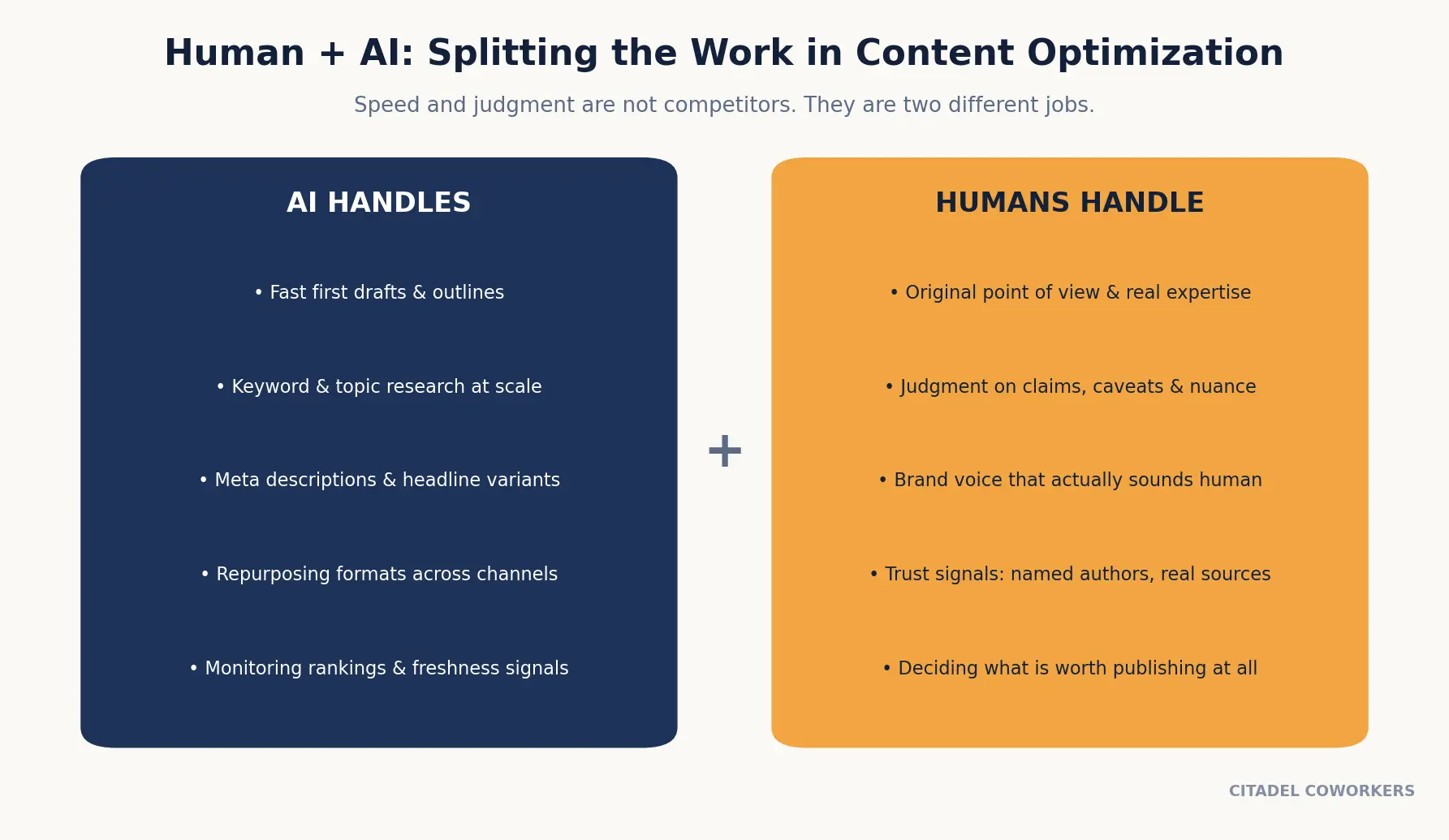
What still requires a person is judgment: knowing which client story is worth telling, which claim needs a caveat, which statistic is misleading without context and which sentence actually sounds like the brand instead of a template. Original expertise still beats recycled competence and that is the real currency of SEO content marketing today.
This is why an agile workflow and human oversight work together rather than in competition. Speed lets a team publish and update quickly. Human review makes sure what gets published quickly is still worth someone’s trust, machine or otherwise.
What Growing Brands Actually Get When They Bring In Citadel Coworkers
Businesses do not come to Citadel Coworkers looking for more content. They come because their current content is not moving fast enough to matter or it is moving fast and losing accuracy and voice along the way. Solving both problems at the same time is the differentiator.
Citadel Coworkers structures every engagement around three things that are hard to fake: senior strategists who stay on the account instead of rotating out after onboarding, a shared source-of-truth system so facts stay consistent across every format and channel and a standing cadence for revisiting and refreshing content instead of treating publish day as the finish line.
None of this requires the client to overhaul its internal team or its tools. It requires a partner who treats a solid SEO content strategy as an ongoing practice, not a one-time project that gets handed off and forgotten once the invoice is paid.
Staying Visible Starts With One Decision
The brands that stay discoverable over the next few years will not be the ones who publish the most. They will be the ones whose ideas are structured well enough and updated often enough to keep showing up wherever their audience is actually asking questions.
Somewhere, right now, someone is asking an AI assistant a question a business could answer better than almost anyone else. Whether that expertise ends up in the answer depends less on how much gets published and more on how ready the content is to move the moment the question arrives.
If it is not clear how your current content would hold up under that test, a short audit is usually enough to show where the gaps sit and what fixing them would involve. Exploring that starting point with a team like Citadel Coworkers costs far less than finding out the hard way, months from now, that the content stopped working somewhere along the way.