Blog

  • Google Reviews or Yelp: Where Should Your Local Business Focus First

    Google Reviews or Yelp: Where Should Your Local Business Focus First

    Key Takeaways

    • For most local businesses, Google reviews matter more because they feed Search, Maps and AI-generated answers.
    • Yelp still carries weight in categories such as restaurants and home services, so check where your own customers look.
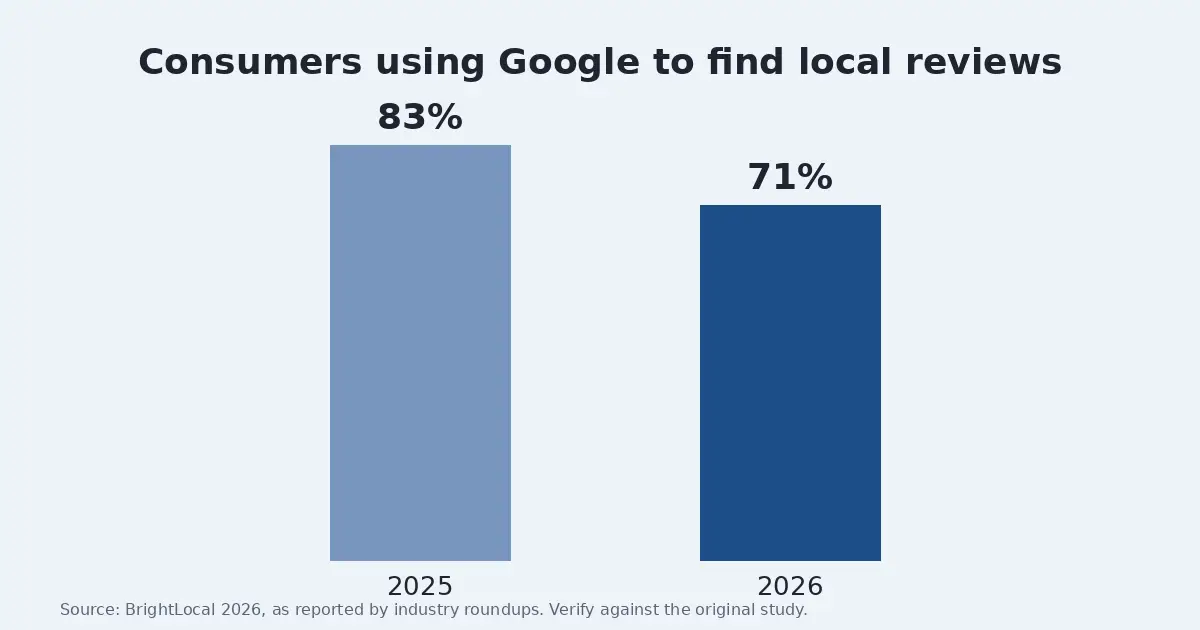
    • BrightLocal’s 2026 survey reports that 71% of consumers use Google to find local reviews, down from 83% a year earlier. Reviews are spreading across more places.
    • AI speeds up monitoring and sorting, but fake reviews, tone and disputes need human judgment.

    Every local business owner eventually faces the same question: should reviews be earned on Google, on Yelp or on both? Customers read reviews before they ever call, visit or book, so the choice shapes who finds you and who trusts you. Google and Yelp both promise visibility. They do not deliver it in the same way or to the same audience.

    This guide compares the two, shows where AI helps and where it misleads and offers a routine you can actually follow.
    Tust Citadel Coworkers

    Google Reviews or Yelp: Which Matters More for Local Businesses

    For most local businesses, Google reviews matter more. They appear directly in Google Search and Maps, influence local visibility and account for the largest share of consumer review activity. Yelp matters most for restaurants, home services and similar categories where its audience is active.

    “Matters more” depends on your customer, not a universal ranking. A boutique accountancy in a small town may never see a Yelp visitor. A city restaurant may draw a large share of its walk-ins from it. Ask new customers how they found you and let that answer set your priorities.

    Why Do Reviews Decide the Sale Before You Say a Word

    BrightLocal’s 2026 Local Consumer Review Survey, as reported by several industry roundups, found that 41% of consumers now always read reviews before visiting a local business. A year earlier, it was 29%. Reviews are no longer a bonus. They are the first conversation.

    Discovery is shifting too. One report cited in those roundups says 52% of consumers used AI to find a local business in 2026, up from 9% in 2025. We would verify that jump against the original study, but the direction is clear: AI tools now summarise your reviews for people who never visit your profile.
    Tust Citadel Coworkers

    Owners often feel this as a quiet unease: a competitor with fewer years in business suddenly looks more trustworthy online. Rarely is the product worse. More often , the reviews are fresher, the replies warmer and the profile complete.

    That is why the platform question matters. Every review you earn is read by a person and, increasingly, by a machine deciding whether to recommend you.

    What Does Google Reward That Yelp Does Not

    Google has said that review count and score factor into local ranking, alongside relevance and distance. More recent, detailed reviews therefore give you a double benefit: they persuade readers and strengthen your visibility.

    Replies matter as well. One 2026 compilation reports that around 89% of consumers expect owners to respond to reviews. Treat that figure as indicative and check the primary source, but the expectation is well documented across the industry.

    Google also polices its platform. It states that it removed or blocked 170 million policy-violating reviews in 2023, which means flagged fakes can be reported and sometimes removed.

    Where Does Yelp Still Earn Its Place

    Yelp runs recommendation software that filters out reviews it considers less reliable. A glowing note from a first-time reviewer may sit in a “not recommended” section and not count towards your rating. That frustrates owners, but it also makes a strong Yelp rating harder to fake.

    Yelp has also long advised businesses not to ask customers for reviews. Check its current guidelines before running any campaign, because the rules differ from Google’s relaxed approach.

    If you run a restaurant, salon or repair trade in a dense city, Yelp deserves real attention. If your customers rarely mention it, give it a complete, accurate profile and keep your energy on Google.

    How Many Reviews and What Rating Do You Need to Compete

    There is no magic number, but benchmarks help. One 2026 local SEO compilation reports that profiles with 40 or more reviews and a 4.5-star average reach the local three-pack far more often than those with fewer than ten. We have not traced that to a primary study, so treat it as directional.

    Shoppers also distrust weak ratings. A widely repeated BrightLocal-derived figure says about 71% of consumers avoid businesses rated three stars or lower. Yet a perfect 5.0 can look suspicious. Real businesses collect the occasional imperfect review and a few honest critical ones make the praise believable.

    Aim for steady, recent and specific. Ten detailed reviews this quarter can do more than a hundred vague ones from last year, because readers and AI summaries both favour fresh, concrete detail.

    Where Can AI Help With Reviews and Where Should You Not Trust It

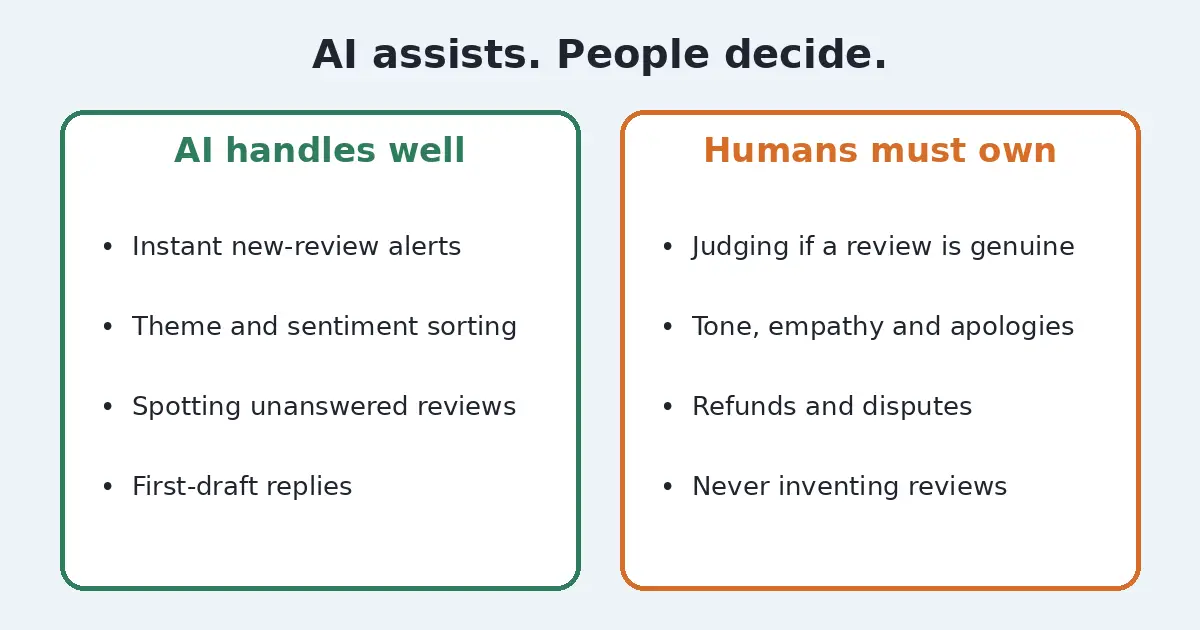
    AI has become the quiet assistant of the review desk. It excels at volume work, which is exactly where human error creeps in. It is reliably useful for three jobs:
    Tust Citadel Coworkers

    • Alerts:
      flagging a new one-star review within minutes instead of days.
    • Sorting: grouping hundreds of reviews into themes such as wait times or staff attitude.
    • Consistency: catching unanswered reviews across several locations, so nothing slips through.

    The limits are just as important. AI-generated fake reviews are explicitly covered by the FTC’s consumer review rule, which took effect on 21 October 2024 and carries civil penalties above $50,000 per violation. Confirm the current figure with the FTC, but the message is simple: never use AI to invent praise.

    AI-drafted replies can also sound confident and be wrong. They may promise refunds that do not exist, misread sarcasm, or answer a complaint about safety or privacy with a template.

    Human judgement decides what a machine cannot: whether a review is genuine, whether to offer compensation, how to apologise, and when to escalate. Customers can tell when a real person replied. Treat that as a business advantage, not a limitation. Let AI draft and sort; let people decide and sign.

    How Should You Respond to a Negative or Suspicious Review

    Not every bad review is fake, and not every fake is obvious. Start with two questions: does this person appear in your records, and is the event they describe plausible?

    If the review looks genuine, reply publicly, briefly and with empathy. Offer to continue the conversation offline, and never reveal private details. Handled calmly, one critical review becomes a small chapter in your online reputation management story rather than the headline.

    If it looks suspicious, report it through the platform’s own tools and keep screenshots. Do not retaliate, and do not pay anyone for removal. The FTC rule also targets review suppression, so avoid threatening reviewers or gating who may post.

    What Does a Simple Review Routine Look Like on Both Platforms

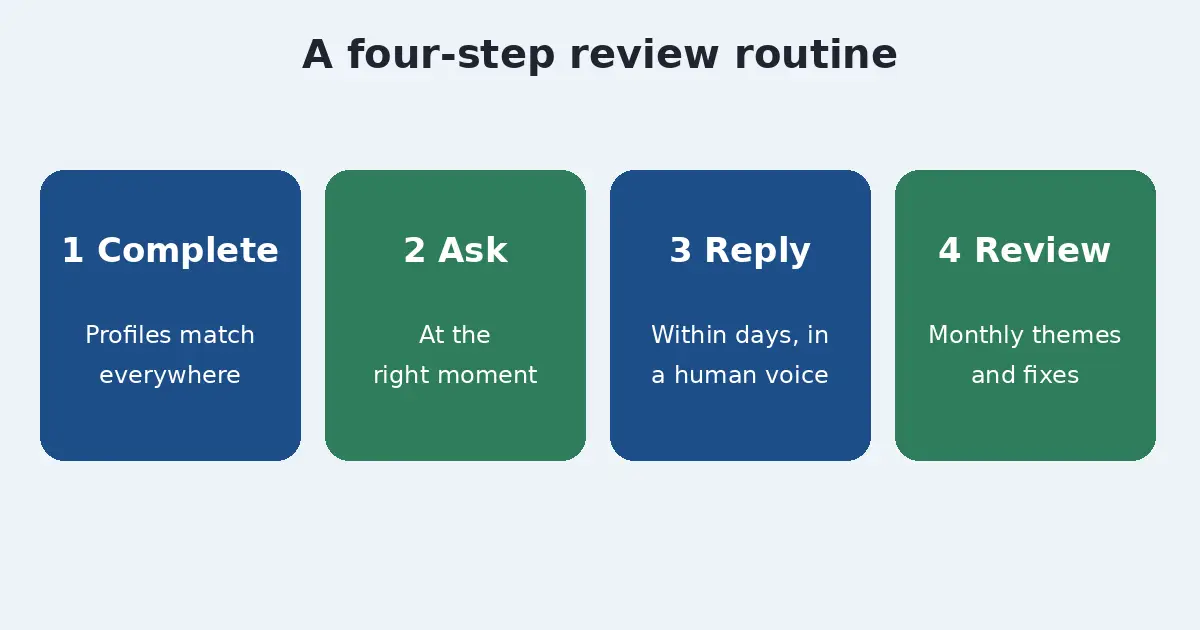
    Good online reviews management is less about tools than habit. Four steps cover most of it:
    Tust Citadel Coworkers
    • Complete your profiles. Keep name, address, hours and categories identical on Google and, where relevant, Yelp.
    • Ask at the right moment. On Google, invite happy customers right after good service. On Yelp, stay within its guidelines.
    • Reply within days. Use a human voice. Thank, acknowledge, resolve. Never argue in public.
    • Review monthly. Look for repeated themes and fix the operational cause, not only the comment.

    Try one small experiment tonight. Search your own business on a phone, as a stranger would. What the first screen shows is your real storefront. Then note what you would want to know before booking, and fix any gap you find this very week.

    What Sets Citadel Coworkers Apart When Your Reputation Is on the Line

    Owners rarely need more dashboards. They need someone who connects what customers say to what the business does next. Citadel Coworkers approaches reputation work as a practical discipline: understand where your customers actually look, then build a steady rhythm around it.

    That approach rests on three commitments. Advice follows your customers, not a favourite platform. Technology handles the repetitive work while people handle tone, disputes and strategy. And nothing relies on shortcuts that put your standing at legal or reputational risk.

    Businesses exploring ORM services tend to value clarity over jargon, and reports they can read in minutes. If that sounds like the partnership you want, you are welcome to explore how we would map your platforms.

    We also believe in teaching as we go. Each engagement should leave your team better able to read its own feedback, spot patterns early and respond with confidence, whether or not AI tools are part of the workflow.

    Your Next Customer Is Already Reading. What Will They Find

    Every owner faces that Google-or-Yelp question sooner or later, and the answer lives with your customers, not with the platforms. Decide this week where yours actually look, give that profile your best effort, and let people guide the AI rather than the reverse.

    Strong online reputation management is built from small, repeated habits, not one-off campaigns. A reply written this morning, a theme spotted this month and a profile corrected this quarter add up to trust that no advert can buy. Customers will keep reading before they visit, and AI tools will keep summarising what they read. The owners who thrive will stay present, honest and human while technology handles the repetitive work in the background.

    When you are ready to talk it through, Citadel Coworkers is a conversation away.
  • How To Get More Google Reviews for Your Business: A Guide from Citadel Coworkers

    How To Get More Google Reviews for Your Business: A Guide from Citadel Coworkers

    Key Takeaways

    • Ask every satisfied customer. Having more recent reviews now carries as much weight as star ratings.
    • Never offer rewards, filter who you ask or pressure anyone on your premises. Google enforces these rules.
    • When replying to every review, make sure to maintain a specific, human voice and ideally within days.
    • Let AI monitor and draft, while your resource is in charge of what gets published.

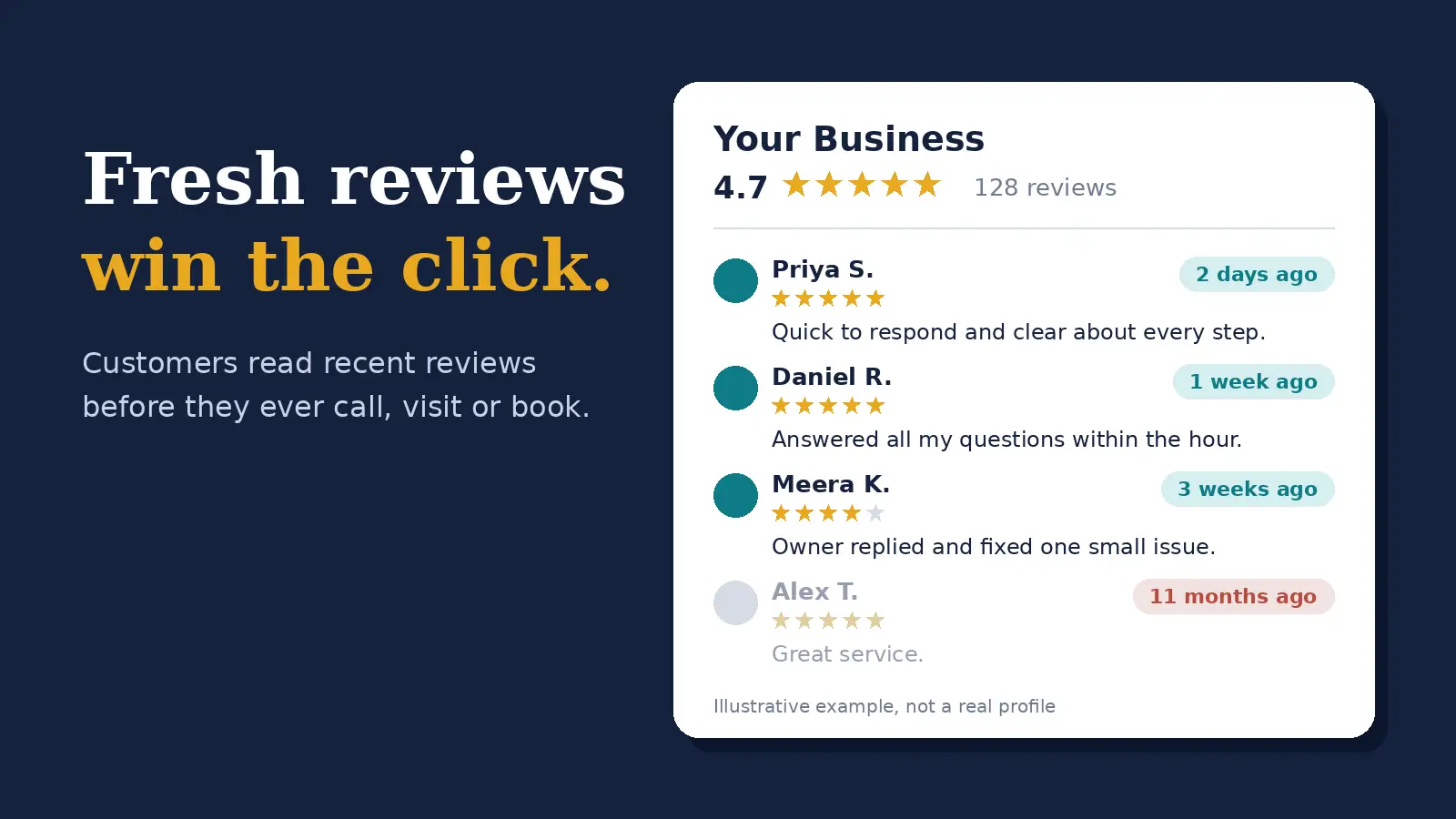
    A customer has your number half-typed. Then she taps your Google profile, scrolls to the reviews and finds that the newest one is eleven months old. She doesn’t call and you never get the answer to why. The loss appears in no report, yet it repeats every week wherever trust is decided before the first conversation.

    This guide answers the questions owners ask most: how to get more Google reviews, what Google allows, how many you need, how to reply and where AI helps or misleads.

    Tust Citadel Coworkers

    Why Do Recent Reviews Decide Who Gets the Call

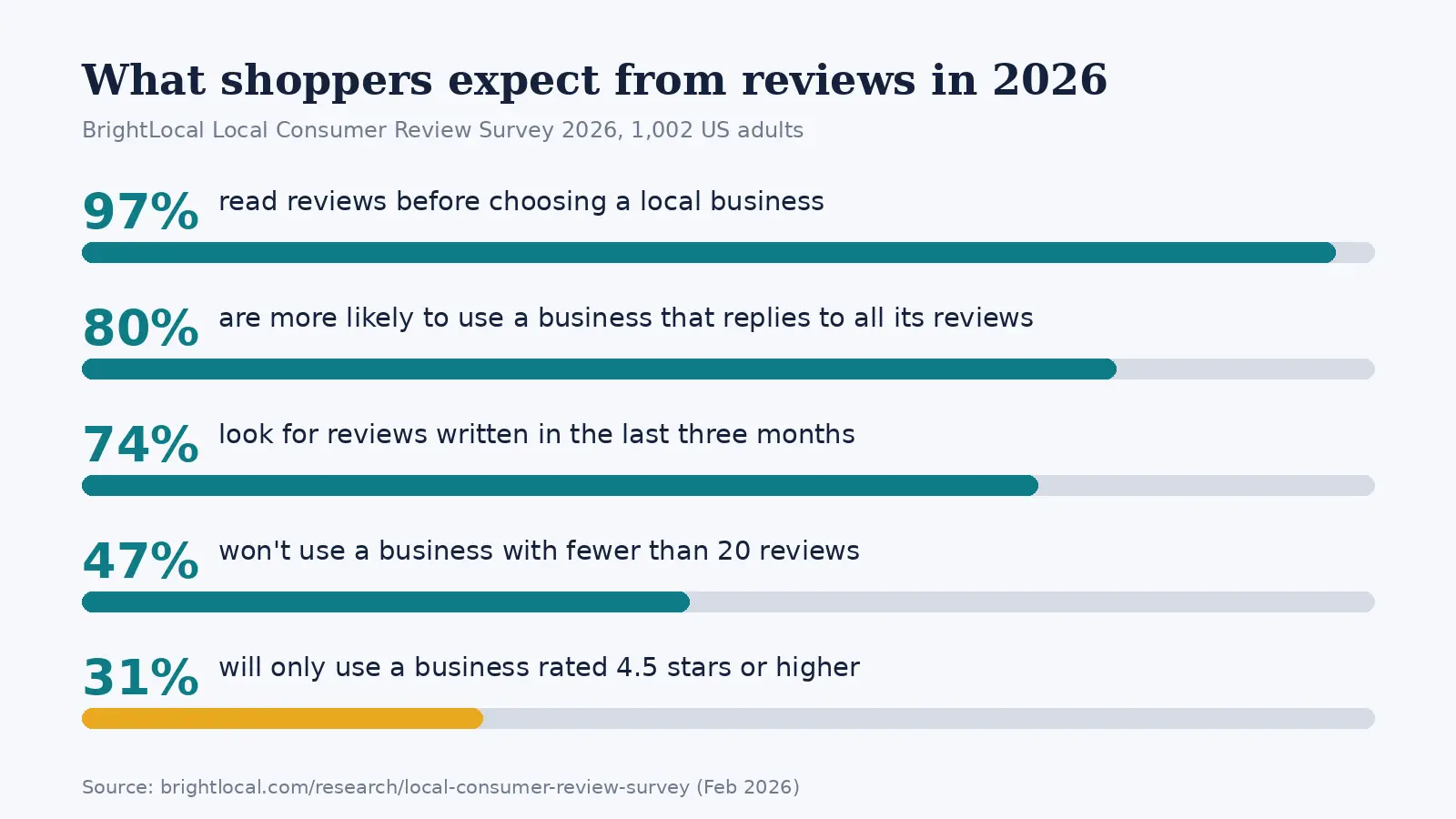
    Because shoppers have raised the bar, BrightLocal’s 2026 survey of 1,002 US adults found that 97% read reviews for local businesses and 41% now always do, up from 29% a year earlier.

    But recency and rating count too. About 74% of prospects will seek reviews from the last three months and 31% will only utilize the evaluations rated by firms rated 4.5 stars or better, compared to 17% the year before.

    Discovery is evolving too. BrightLocal claims that 45% of consumers now utilize AI solutions such as chatbots to receive local suggestions. That’s why online reputation management begins long before a crisis hits, with a steady stream of new and real reviews.

    Tust Citadel Coworkers

    You do not need perfection. Only 10% of consumers insist on a flawless 5.0, while 68% want at least four stars.

    Google is not your only stage, either. The average consumer now uses six review sites and Google’s share of review reading dipped from 83% to 71% while Apple Maps rose from 14% to 27%. Start on Google, then spread requests to the sites your customers use.

    Five Habits That Turn Happy Customers Into Google Reviews

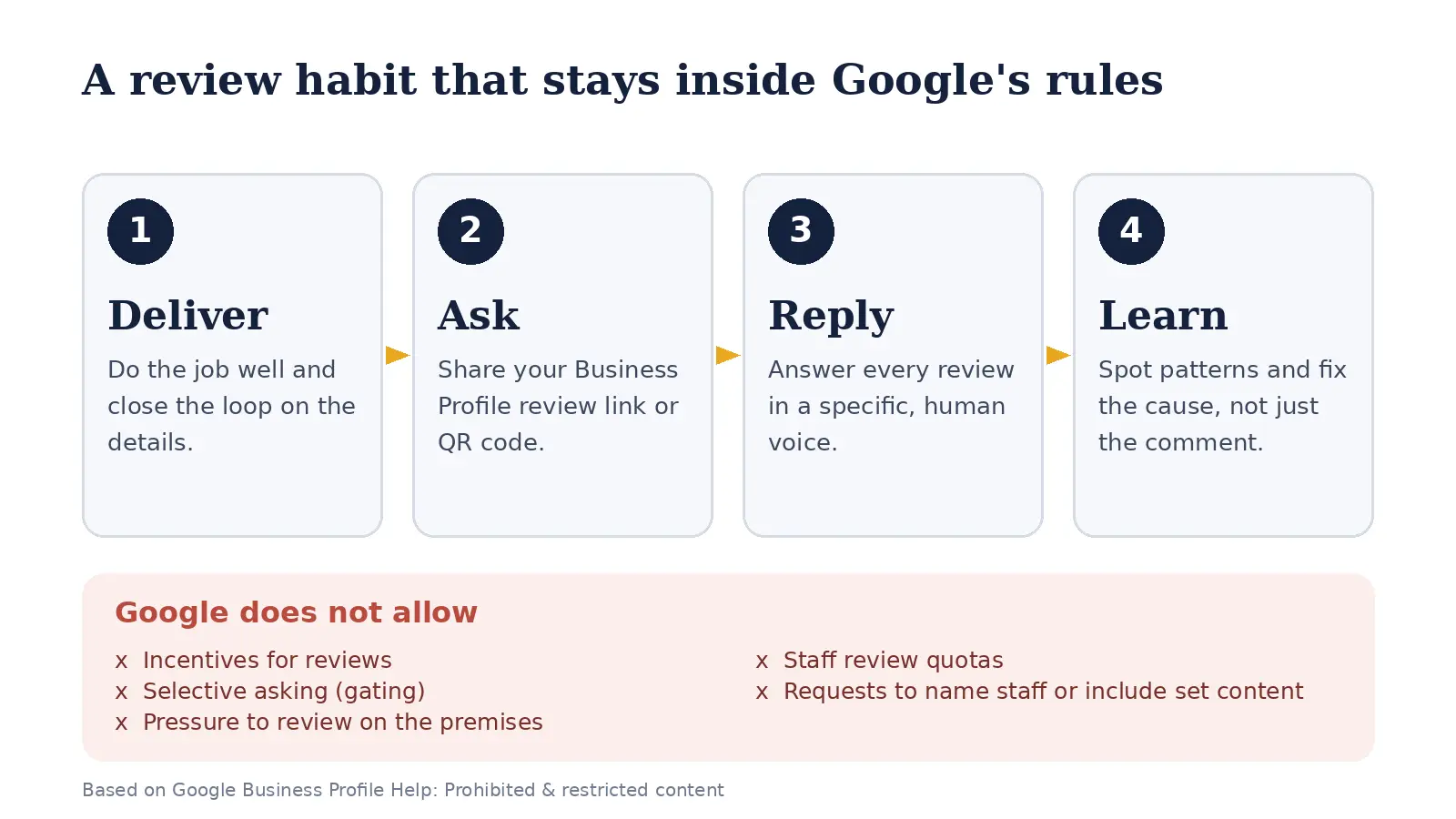
    Google review management works best as a weekly habit rather than a one-off campaign. These five steps keep it simple:

    • Grab your link. Copy the link or QR code from your profile. See reviews. Open Get more reviews. Note that the QR code is only created on a computer.
    • Ask at the perfect time. Ask for feedback after a delivery, a completed project or a closed support question while the experience is still new.
    • And place the link where the clients are. Link to receipts, thank you emails, the end of a talk and a printed QR code in your shop.
    • Ask for honesty, not praise. Inviting feedback is allowed; requesting five stars is not.
    • Make it routine. Book a weekly slot for requests instead of a quiet month. Steady asking keeps your newest review recent, week after week.

    Open your profile and copy that link. The rest follows from there. A tidy profile helps every request land. Google Business Profile optimization (precise hours, services, photographs, and contact details) reassures reviewers they’re in the right spot and offers AI technologies the right data to sum up.

    Tust Citadel Coworkers

    Which Review Tactics Will Get You Penalised

    Google’s policy is direct. Merchants may not incentivize customers with cash, discounts or free goods, discourage bad reviews or request only favorable ratings. They also may not pressure customers to review on the premises, set staff review quotas or request specific content, including a staff member’s name.

    Enforcement runs at scale. Google has blocked or removed over 292 million policy-violating reviews in 2025. Whenever it detects a sudden spike of spam reviews on a profile, it removes them, pauses new reviews, alerts the owner and shows consumers a banner.

    The law is watching too. In the US, the FTC’s 2024 rule bans fake reviews, including AI-generated ones and allows civil penalties above $50,000 per violation.

    Why Did Some of Your Google Reviews Disappear

    When Google removes comments that are breaking its policies, you might often see that your reviews vanish overnight. This covers paid reviews, reviews posted through several accounts by one person, any reviews that show a conflict of interest like from current or former employees or even through family members

    If a drop surprises you, audit how your reviews were collected. Did staff post their own? Did an old agency buy any? Did anyone offer a discount? Fix the habit, not only the symptom. If Google Business Profile support accidentally deleted any of your real reviews, reach out to them.

    How Quickly and How Personally Should You Reply to Google Reviews

    Quickly and preferably by name. BrightLocal showed that 80% of consumers are more likely to patronize a firm that responds to all its reviews. Some 81% expect a response within a week, while 19% expect a response the same day.

    Generic beats specific. Templated replies put off half of consumers. Call out the detail the reviewer noted, thank them explicitly and for the critique, admit the issue and suggest a real next step.

    A strong reply sounds like a person: “Thank you, Priya. We’re glad the handover felt clear. If anything slips next quarter, message me directly.” Only verified businesses can reply, so verify first. If any review turns out to be fake or breaks the posting guidelines, report it to Google instead of arguing it yourself in public.

    Where AI Helps Google Review Management and Where It Quietly Fails

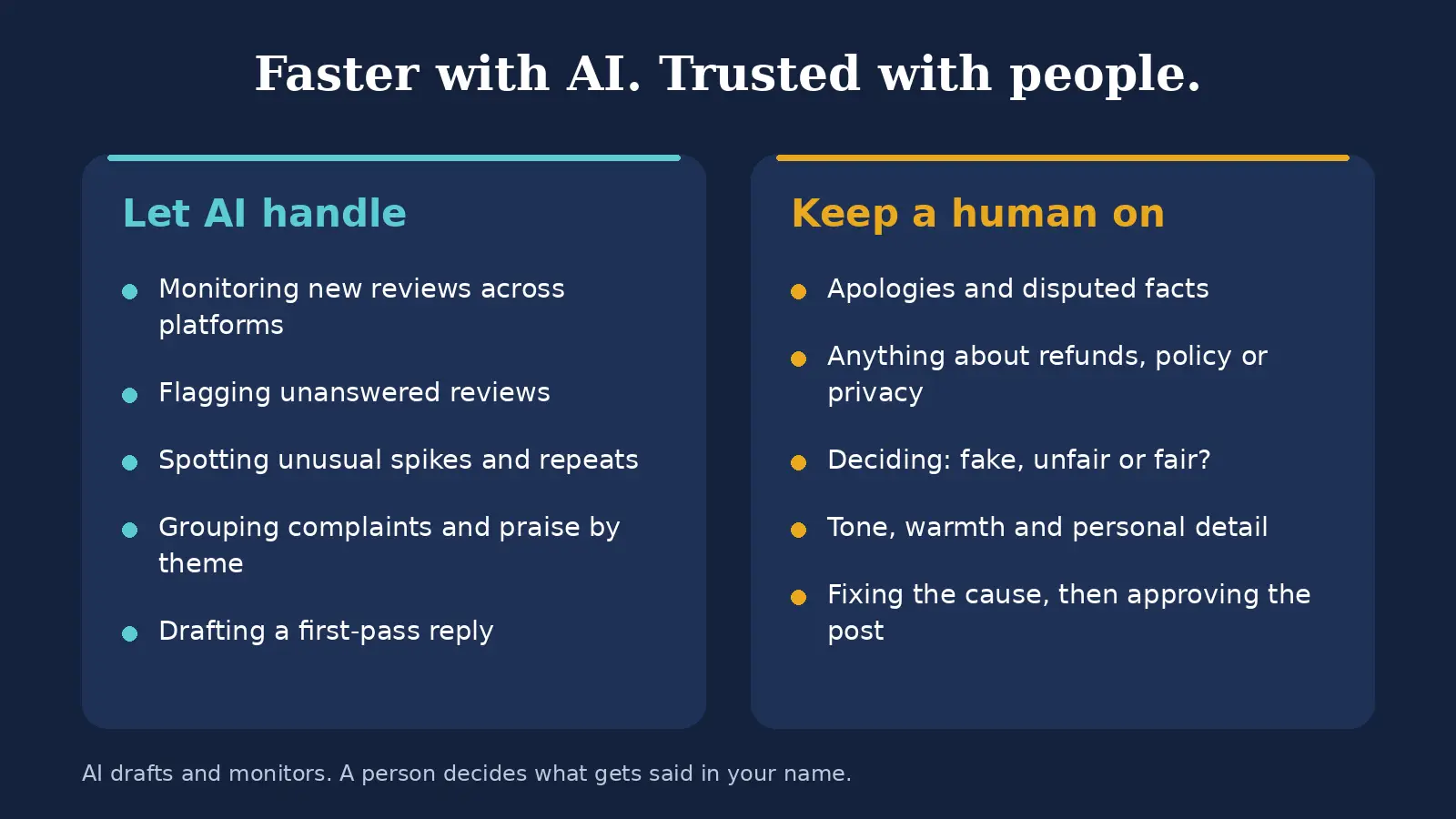
    AI has earned a place here. Google itself uses Gemini to catch manipulated edits and scam patterns before they go live. The same strengths help any business with the routine: monitoring several platforms, flagging unanswered reviews, spotting an odd spike, grouping complaints by theme and drafting a first reply.

    That cuts the errors that cost trust, such as the review missed for weeks, the pattern noticed too late or hours that differ across listings. In Google review management , AI is a tireless watcher and a sharp proofreader.

    It cannot be trusted with the final step. AI can invent a refund policy that does not exist, apologise for the wrong thing or reveal details that should stay private. Generic output also backfires, as half of consumers dislike it.

    AI-written reviews are off limits entirely. Reviews must reflect a genuine experience and the FTC treats AI-generated fakes as fakes.

    Tust Citadel Coworkers

    Human judgement decides the moments that carry weight: whether a complaint is fair, whether a review is fake or merely unflattering, what a sincere apology sounds like and what to fix so the complaint never returns.

    Treat AI as the draft and a person as the signature. That is an advantage, because you reply faster than rivals and still sound like yourself. Because AI tools draw on listings and web sources, check what they say about you and ask for corrections when something is wrong.

    How Citadel Coworkers Helps Clients Earn More Google Reviews

    Most businesses already know how to get Google reviews. What they lack is someone whose job it is to do it every week. Requests go out late, replies wait in a queue and the newest review ages quietly. Citadel Coworkers fixes that by placing a dedicated virtual professional inside your team to own the routine, so asking for reviews stops depending on a free afternoon.

    Here is what that looks like in practice. A customer support professional sends your Google review link after each resolved ticket, delivery or closed project, while the experience is fresh. Requests ask for honest feedback only. They offer no rewards, filter out no customers and never ask for five stars, so every review stays within Google’s rules.

    An SEO specialist keeps your Business Profile accurate and watches for new reviews and unanswered ones, so customers who click through find correct details and prompt replies. A graphic and web designer puts your review link and QR code on your website, emails and printed materials, which are the places Google suggests. Replies are drafted in a specific, human voice and you keep the final say on anything published.

    Your Next Review Is One Honest Question Away

    Return to the customer with your number half-typed. Whether she calls depends on what she finds: recent reviews, a steady rating and owner replies that sound like real people. None of that needs a campaign. It needs a link, a habit and a human in charge of your name.

    Start with one customer this week. Ask honestly, reply warmly and let the pattern build. Six months from now, the first thing she sees could be last week’s review. And if you would rather not carry the routine alone, Citadel Coworkers can help you build the team around it.

  • How to Improve Your Website’s Visibility in Google AI Overviews

    How to Improve Your Website’s Visibility in Google AI Overviews

    Key Takeaways

    • Google says its AI features rest on its core Search systems, so sound SEO still underpins visibility.
    • A top-ten ranking is not required: about 38% of cited URLs in Ahrefs’ March 2026 study ranked there.
    • Transfer-first sections, first-hand experience and named sources make a passage easy to quote and trust.
    • AI is excellent at repetitive accuracy but not at judgment, so a person should verify every claim.
    • Track progress in Search Console’s Generative AI performance report and plan for steady work, not overnight results.

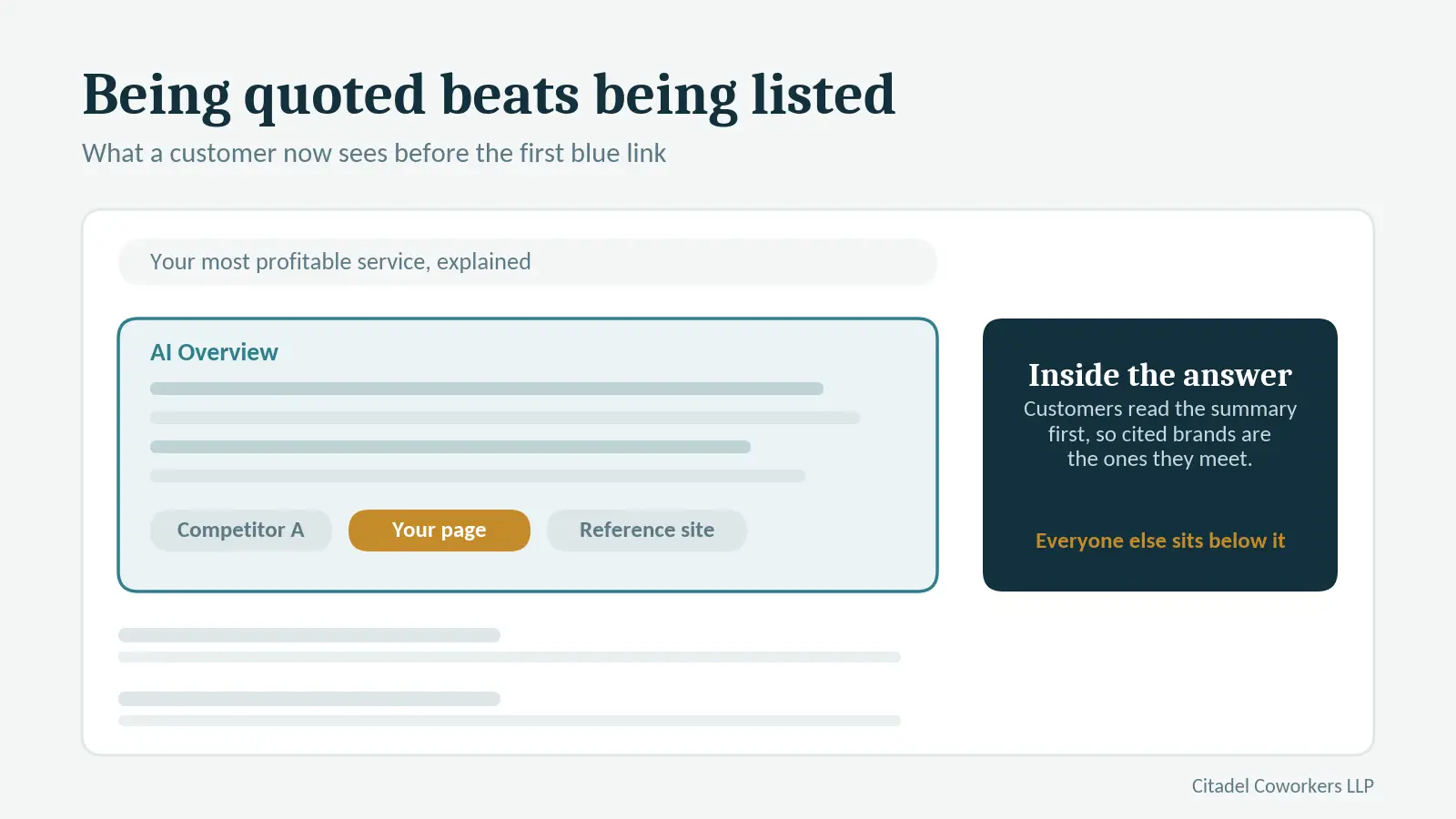
    Type your most profitable service into Google and stop at the first blue link. Now look above it. A tidy paragraph has already answered your customer’s question and small source cards sit beside it.

    A competitor’s name may be on one. Yours may be on none. That quiet gap decides who gets the phone call and no ranking report will flag it.

    This guide explains what those source cards are, how Google chooses who earns them and what a business can realistically do about it. It also tackles a question every team is asking right now: how far should we trust AI itself?

    Tust Citadel Coworkers

    What Does It Mean to Be Cited in an AI Overview

    An AI Overview citation is a clickable source link that Google shows beside its AI-generated summary, pointing to a page that supports part of the answer. Think of it as a footnote readers can actually follow. Being cited puts your brand inside the answer rather than beneath it.

    Why a Citation Now Outweighs a Ranking

    AI summaries absorb clicks that rankings once earned. Seer Interactive’s 2026 update, covering roughly 5.47 million queries, found that brands cited inside an AI Overview earned approximately 120% more generic clicks per impression than uncited brands on the same query. Cited brands still trailed queries with no summary at all.

    Google itself notes that people increasingly gravitate to generative AI experiences to find information. When the answer arrives before the click, the brands named in that answer inherit the trust that comes with it.

    Visibility is not about ranking higher on search results. It is about being quoted. That is why this topic matters to any business whose customers begin with a search.

    Can a Smaller Business Really Earn a Citation

    Yes, and the evidence supports it. Google says its AI features create opportunities for more types of sites to appear.

    Citation depends on whether a passage answers a question clearly, not on how large your domain is. A specialist with a clear, honest explanation of one problem offers Google something a vaguer, bigger page may not.

    Do You Need a Top-Ten Ranking to Be Cited

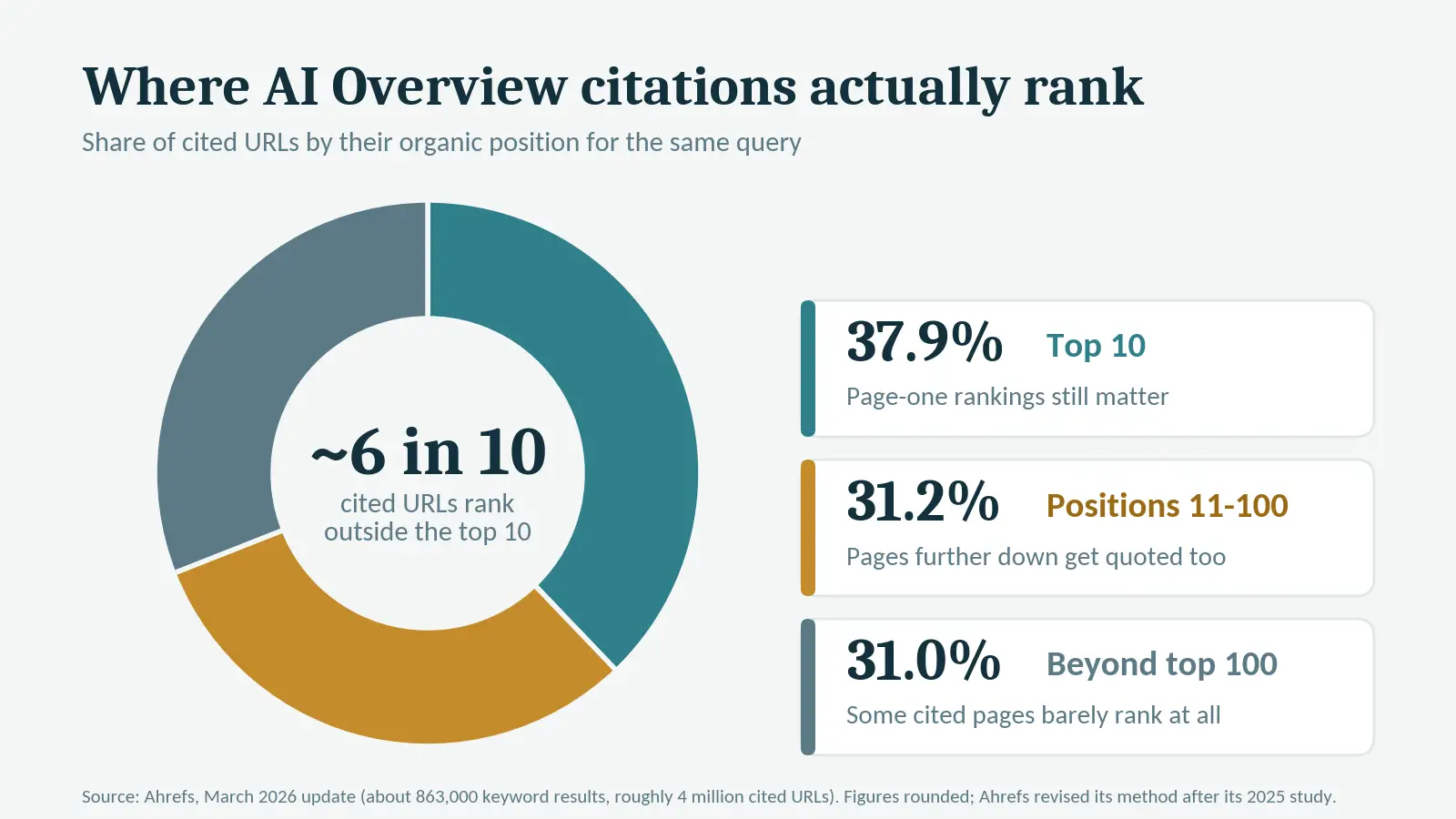
    No. In March 2026, Ahrefs analysed about 863,000 keyword results and four million cited URLs. Roughly 38% ranked in the top ten for the same query, about 31% sat between positions 11 and 100 and about 31% were outside the top 100 entirely.

    Tust Citadel Coworkers

    Ahrefs changed its methodology after its 2025 study, which found 76% so the two figures are not a clean trend line. Rankings still help, because eligibility still starts with Google’s own search index. They simply are not the gate.

    How Google Decides Which Pages to Quote

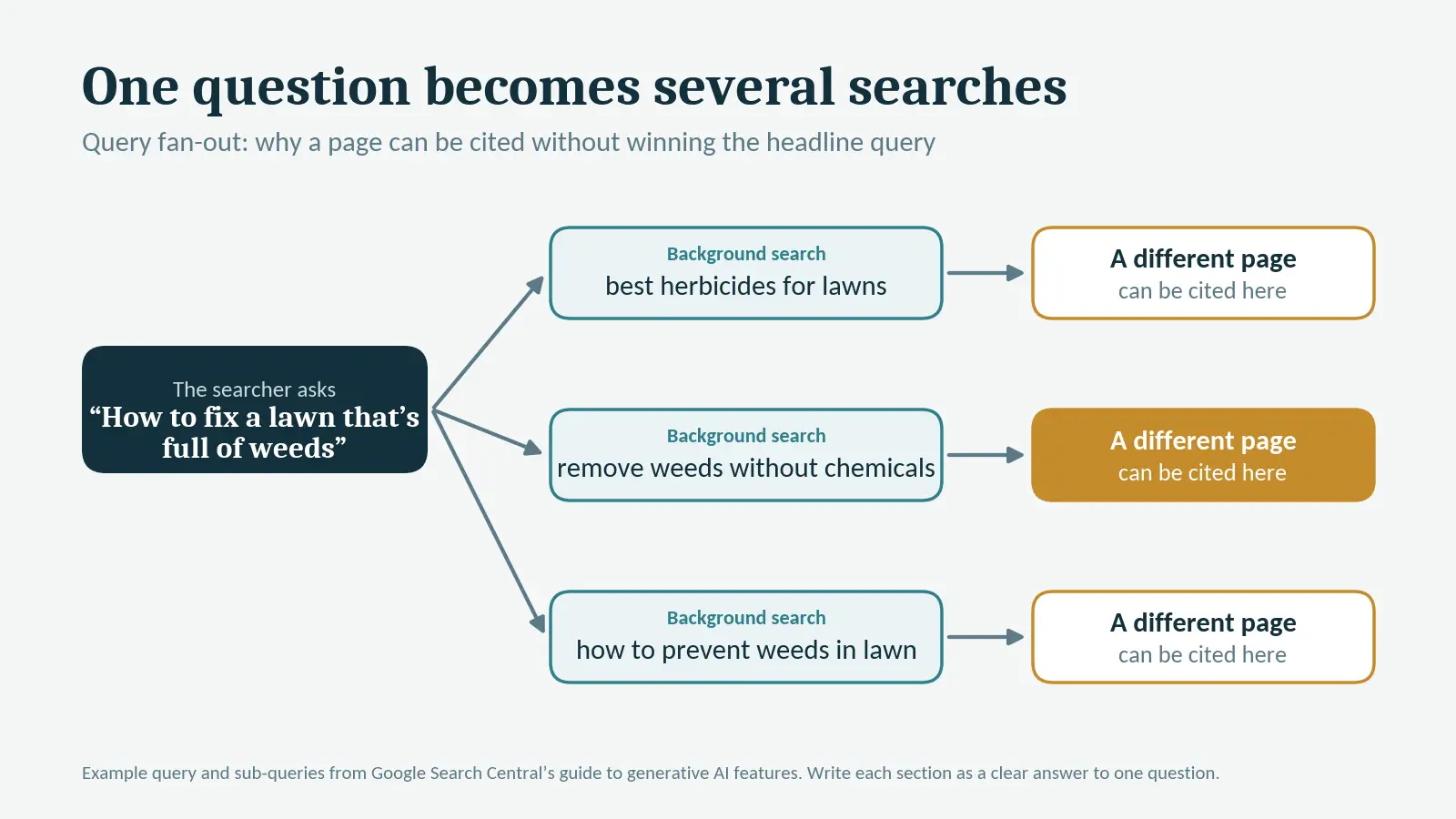
    Google describes two techniques. Retrieval-augmented generation pulls relevant pages from Search’s index so the answer rests on real documents. Query fan-out then splits one question into several related searches. Google’s own example: a question about fixing a weedy lawn can spawn searches on herbicides, chemical-free removal and prevention.

    Tust Citadel Coworkers

    The consequence is practical. A page can be cited for a sub-question it answers well, even if it never wins the headline query. Write each section so it stands alone as a clear answer to one question.

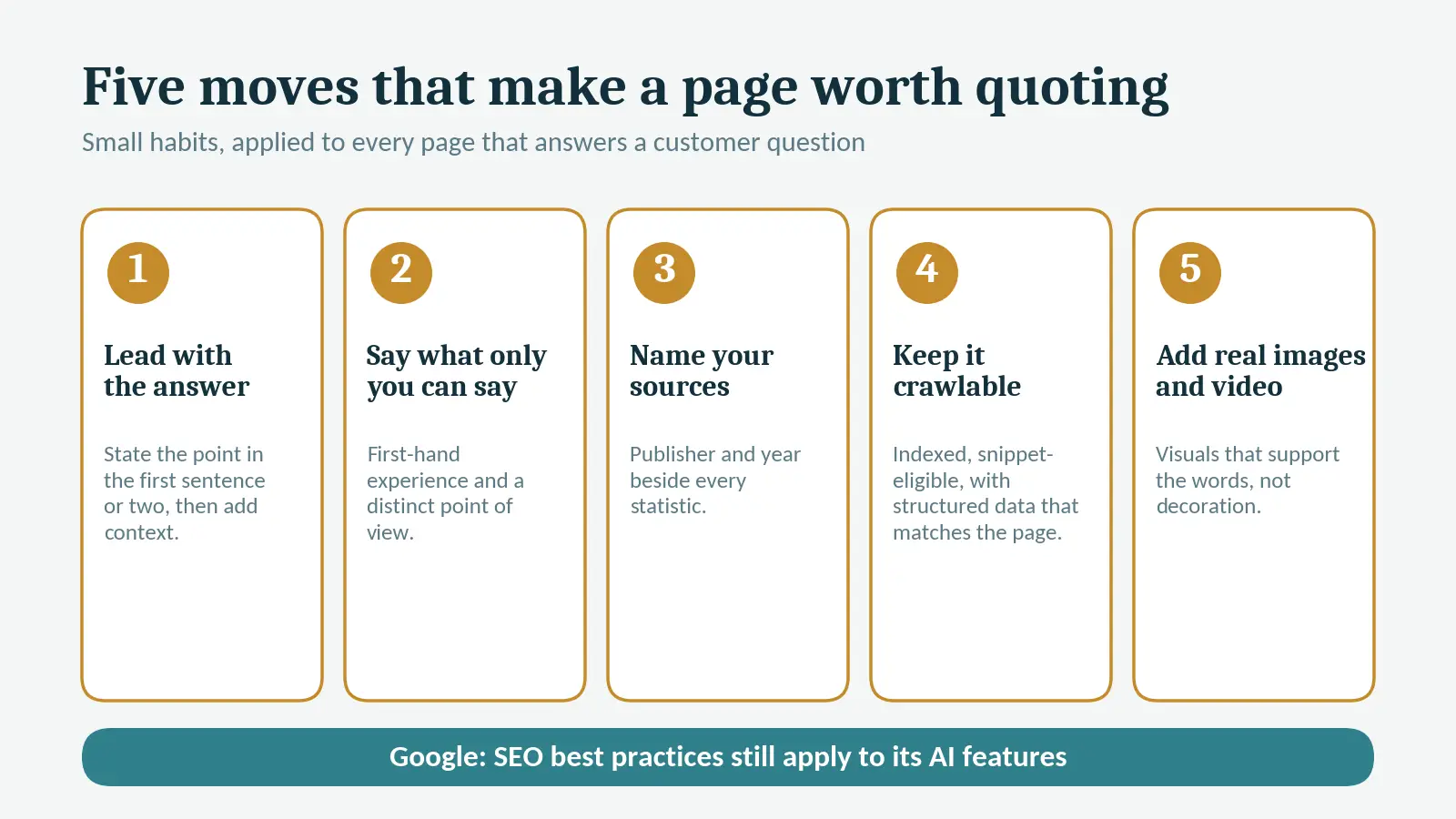
    Five Moves That Make a Page Worth Quoting

    Google AI Overviews optimization starts with an unglamorous truth: Google says SEO best practices still apply, because its AI features rest on its core ranking and quality systems.

    Marketers label the work generative engine optimization (GEO) or answer engine optimization. Google’s view is that it remains SEO. Within that frame, five habits stand out.

    Tust Citadel Coworkers

    • Lead each section with the answer.
      State the point in the first sentence or two, then add context. People and machines both find it faster.
    • Say something only you can say. Google asks for non-commodity content: first-hand experience and a distinct point of view, not a restatement of what already exists.
    • Name your sources. Attribute statistics to a publisher and a year, so every claim can be checked.
    • Keep the page crawlable. It must be indexed and eligible to appear with a snippet. Structured data helps, but it is not required and it must match the visible text.
    • Support the words with real images and video. YouTube made up nearly 6% of AI Overview citations in Ahrefs’ dataset.

    Here is the first habit in practice. A citation titled “Our Process” that opens with a paragraph about your mission gives a summary with nothing to quote.

    The same section opening with “We work in four stages: discovery, plan, build and review” hands over a sentence that stands on its own, with detail following underneath.

    Google’s guide is equally blunt about myths. For Google Search, you do not need text files, content chopped into tiny chunks, copy rewritten purely for machines or manufactured brand mentions. Other AI platforms may behave differently, so treat that advice as specific to Google.

    Which Pages Should You Fix First

    Start where customers decide. Service pages, process explainers, pricing guidance and the questions your sales team hears every week come first, because those are the queries where a citation turns into an enquiry.

    Blog posts that restate common knowledge come last. Google calls that commodity content and it is the kind a generative model could easily produce without you. Ask one question of every page: would a customer repeat this sentence to a colleague?

    Pick one service page this week and rewrite the opening of every section so it answers its own question outright. If you would like a second opinion on what to change first, Citadel Coworkers is glad to look it over with you.

    Where AI Genuinely Helps And Where It Cannot Be Trusted

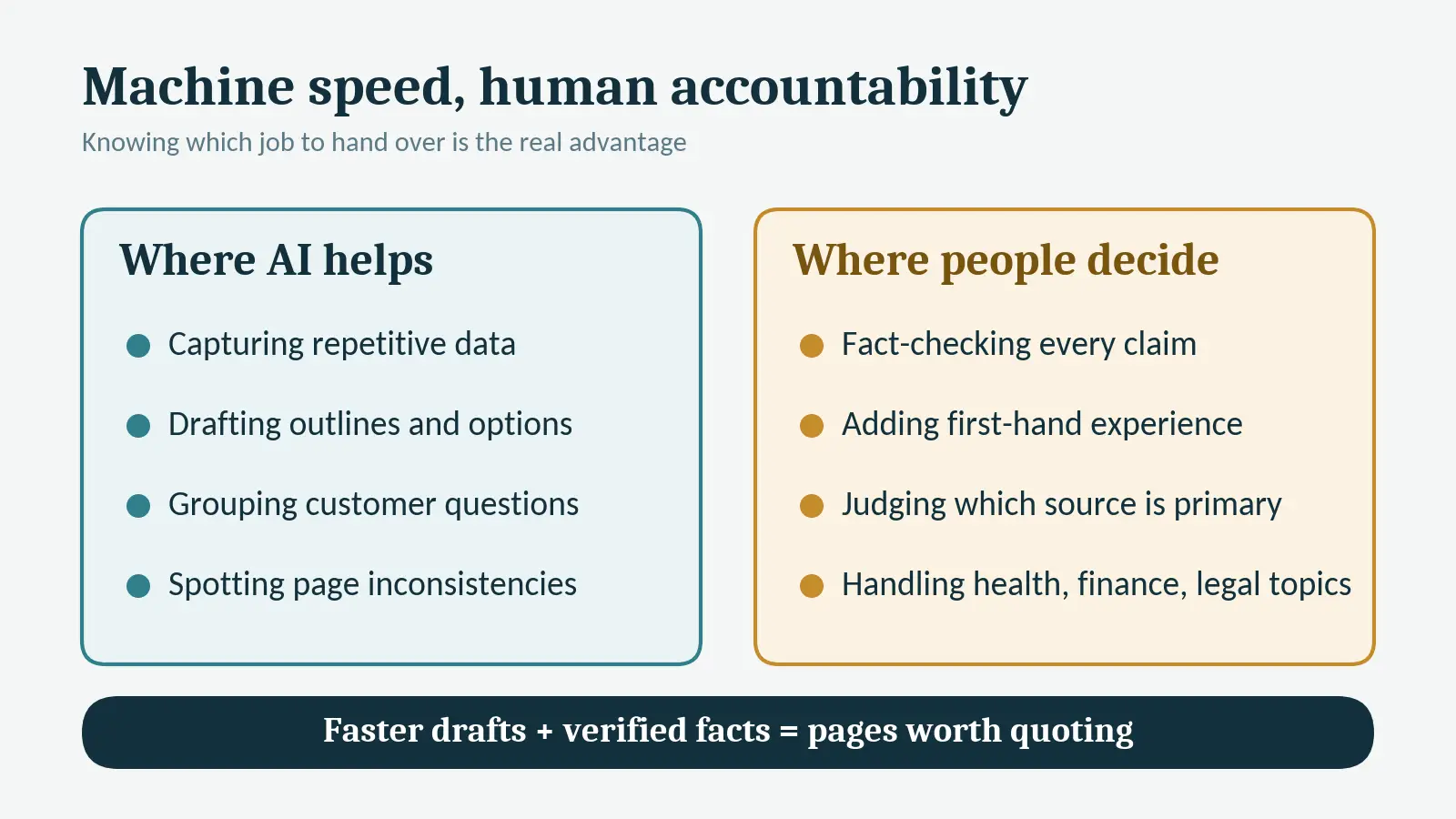
    None of this is an argument against AI. It is a capable colleague for repetitive work. APQC research, cited in a recent Precoro guide, puts invoice error rates at roughly 2% under manual processing and below 0.8% with automation.

    Drafting outlines, grouping customer questions and spotting inconsistencies across pages are similar jobs where speed and patience beat fatigue.

    Trust is a separate question. In April 2026, the New York Times, working with AI startup Oumi, tested 4,326 queries and found AI Overviews answered correctly about 91% of the time with Gemini 3.

    That still leaves roughly one answer in ten wrong, including mistakes on health topics. Google disputed the method, saying it does not reflect real searches. Separately, McKinsey’s 2026 survey of 1,719 respondents reports inaccuracy as the most commonly cited negative outcome of AI use.

    Tust Citadel Coworkers

    Google’s own guidance warns that AI-generated content can contain inaccuracies and should be fact-checked before it is published. That is where human judgment earns its place: deciding whether a statistic is current, whether a source is primary, what your experience adds and what a client needs to hear.

    In health, finance and legal topics, a confident error carries real cost. A model cannot sit across the table from a client and sense which answer they are actually afraid to ask for.

    AI Overviews reward exactly that kind of non-commodity thinking. So the advantage belongs to teams who pair machine speed with human accountability. Confidence about AI is not suspicion of it. It is knowing which job to hand over.

    How Long Does It Take to Get Cited

    Nobody can promise a timeline. Google states that meeting the technical requirements and following best practices does not guarantee a page will be crawled, indexed or served. Treat any fixed deadline offered by an agency as a warning sign and plan for steady work rather than an overnight result.

    How to Tell Whether Your Efforts Are Working

    Start with the Generative AI performance report in Google Search Console, which shows how your content performs in AI features on Search and Discover.

    Then, for questions your customers truly ask, track three things: how often an AI Overview appears, how often it cites you and which pages earn the citation. Then compare the pages that earn citations with the ones you expected to.

    Be wary of tools claiming access to Google’s internal metrics. Google says no third-party tool has it and any promise of guaranteed AI search optimization results deserves the same caution. Treat Google AI Overviews optimization as a monthly habit, not a one-off campaign.

    Why Businesses Choose Citadel Coworkers When They Want to Be the Answer

    Plenty of teams can define an AI Overview. Fewer will tell you what to leave alone. Citadel Coworkers approaches visibility the way this guide does: begin with what Google itself says, test it against evidence and keep a person accountable for every claim that goes live. That includes saying so plainly when a popular tactic is more hype than help.

    Businesses tend to value three things in that approach:

    • Clarity over hype: plain advice on what matters and what does not.
    • Judgment over automation: AI speeds the drafting, while people own the facts and the point of view.
    • Fit over formula: recommendations shaped around your services, audience and capacity.

    If that is the kind of partner you have been looking for, explore how Citadel Coworkers can help your team plan its next step. A conversation costs little and often clarifies a lot.

    Start With the Page Your Customers Reach First

    Go back to that search. The source cards are small, yet they are where customers now begin to decide whom to trust. You will not earn that place with a trick. You earn it by being the page that answers clearly, backs its claims and shows real experience. Begin with one page this week. The brands people meet inside tomorrow’s answers are the ones doing this work patiently today.

  • How the LinkedIn Algorithm Works in 2026 And What Actually Drives Reach

    How the LinkedIn Algorithm Works in 2026 And What Actually Drives Reach

    Key Takeaways

    • LinkedIn rebuilt its feed so posts are now matched by meaning rather than keywords.
    • Saves, dwell time and intelligent comments matter more than likes or post volume.
    • Engagement pods, comment automation, one-word comment prompts and recycled thought leadership are being pushed down.
    • AI is an excellent tool for drafting, formatting and error-checking, but judgment and accountability still decide whether a post earns trust.
    • Choose two or three themes, publish original insight and answer every genuine comment.

    Falling reach is one of the most common complaints on LinkedIn this year. Founders, executives and company pages publish steadily, keep the same rhythm and still watch their posts stall.

    The difference in 2026 is not your effort. LinkedIn has rebuilt how the feed finds and ranks posts in March. What this means for your posts is that the reach depends less on how many people follow you and more on whether the system believes a post matters to the person reading it.

    LinkedIn also began pushing down the shortcuts that once inflated numbers: engagement pods, comment automation and recycled thought leadership. This guide explains what changed, what the feed now rewards and where AI helps or quietly hurts, with practical steps you can use this week.

    Tust Citadel Coworkers

    What Is the LinkedIn Algorithm

    The LinkedIn algorithm is the ranking system that decides which posts appear in a member’s feed, and in what order. In 2026, it retrieves posts matching that person’s interests, predicts which ones they will read, save or discuss, then orders them accordingly. Quality filters run first; relevance and attention decide the rest.

    How do you increase reach on LinkedIn? Publish specific, experience-based posts on two or three themes, earn saves and thoughtful comments and keep links out of the post body when reach is the goal.

    What Changed on LinkedIn in 2026 and Why Your Reach Felt It

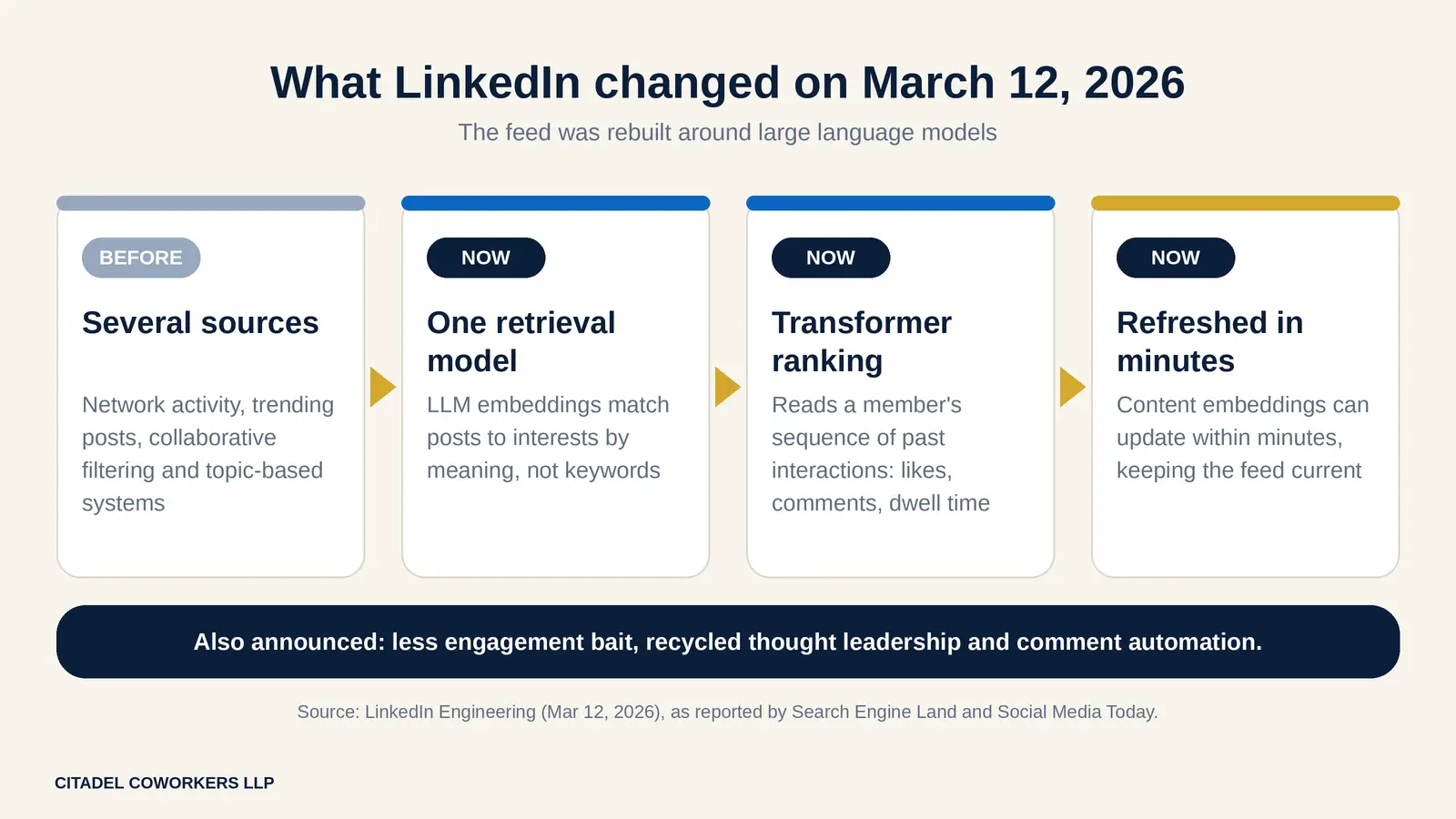
    LinkedIn Engineering published details of a rebuilt feed in March. As Search Engine Land reported, LinkedIn replaced several separate discovery systems with one retrieval model powered by large language models. A transformer-based ranker then studies patterns across each member’s past interactions, including likes, comments and dwell time.

    The result is precision, not punishment. LinkedIn can now link related topics even when the wording differs, so your post competes inside each reader’s interests rather than across a network of roughly 1.3 billion members. Reach feels lower because it is aimed better.

    Tust Citadel Coworkers

    An authenticity push came with the rebuild. LinkedIn said it is acting against comment-automation tools, browser extensions and engagement pods and showing less of what games the system: prompts begging for a one-word comment, unrelated videos paired with text and recycled thought leadership posts with little to no substance.

    Meaning now beats mechanics. Hoootsuite’s 2026 update notes that hashtag stuffing matters less than clarity: name the audience, state the problem and make the takeaway obvious. Saves and thoughtful comments signal that a post was worth the reader’s time.

    Relevance has also overtaken recency. LinkedIn confirmed in mid-2025 that it would show older posts when they matched a member’s interests, weighing past engagement, the relationship with the author and the author’s expertise on the topic.

    New members are covered too. LinkedIn is testing an Interest Picker at sign-up, so clearly themed content can reach them from day one.

    How a Post Travels From Draft to Feed

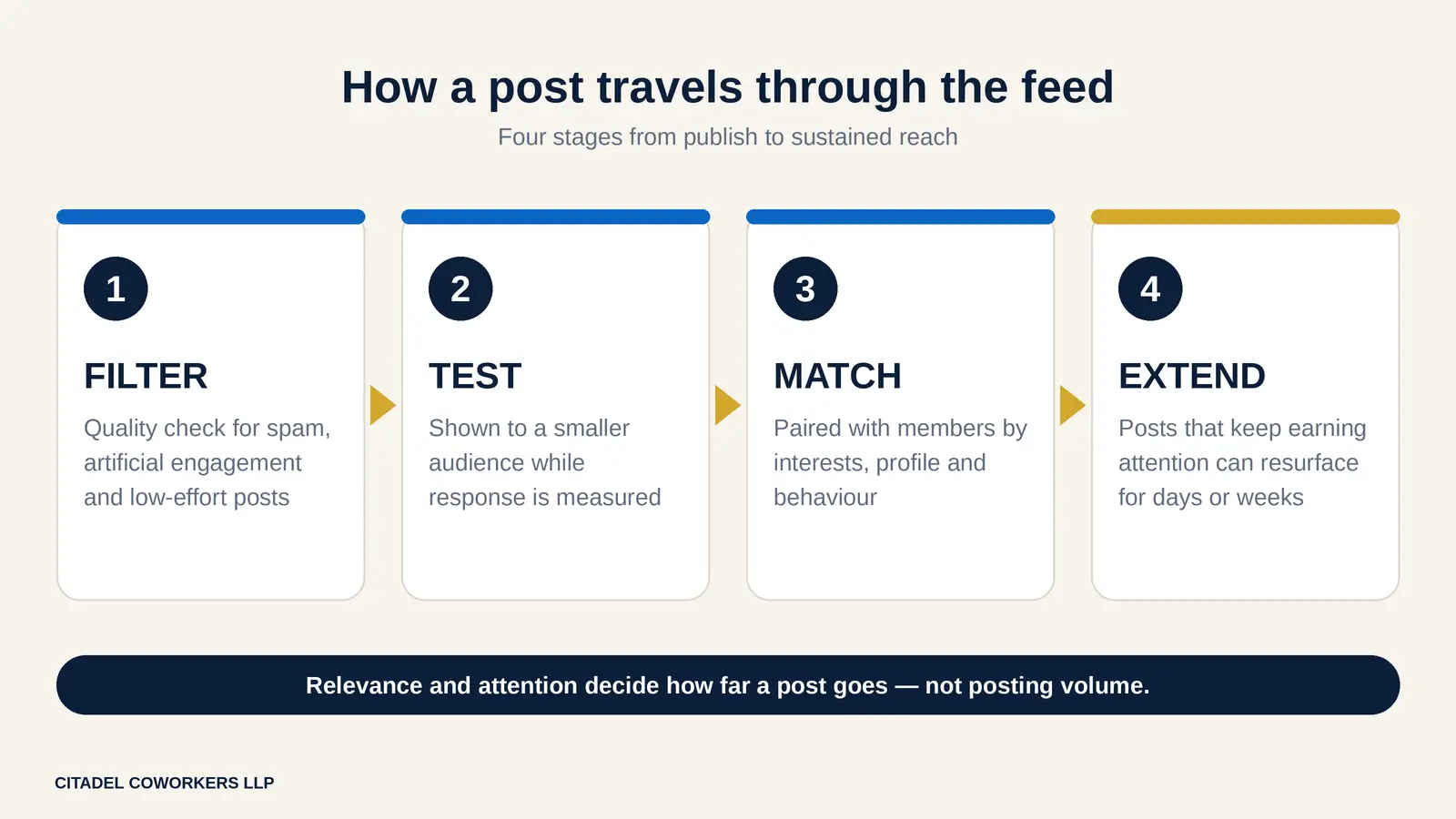
    Here is the short version of the LinkedIn algorithm 2026 teams need to plan around.

    Tust Citadel Coworkers
    • Filter. A quality check screens for spam, artificial engagement and low-effect posts before anything else happens. Tagging unrelated people or excessively adding hashtags can trip it.
    • Test. Distribution of your post starts with a smaller audience while LinkedIn watches how those readers respond.
    • Match. Retrieval pairs the post with members whose profile and behaviour suggest it will be useful, which is why two followers of one page can see different feeds. Your own profile counts too: a headline that contradicts your content sends mixed signals.
    • Extend. Posts that keep earning attention can resurface days or even weeks later.

    The Signals That Earn Reach Now

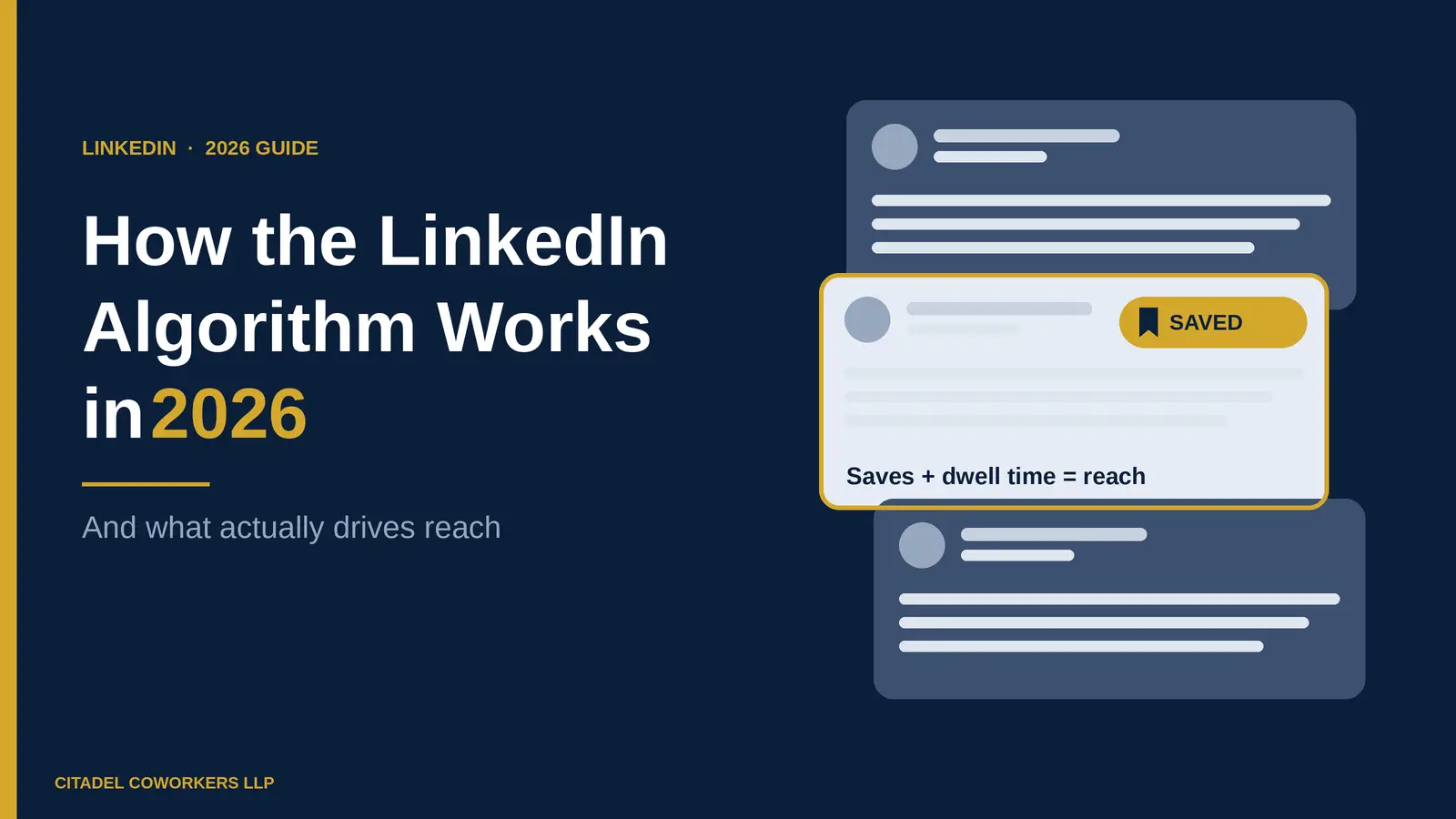
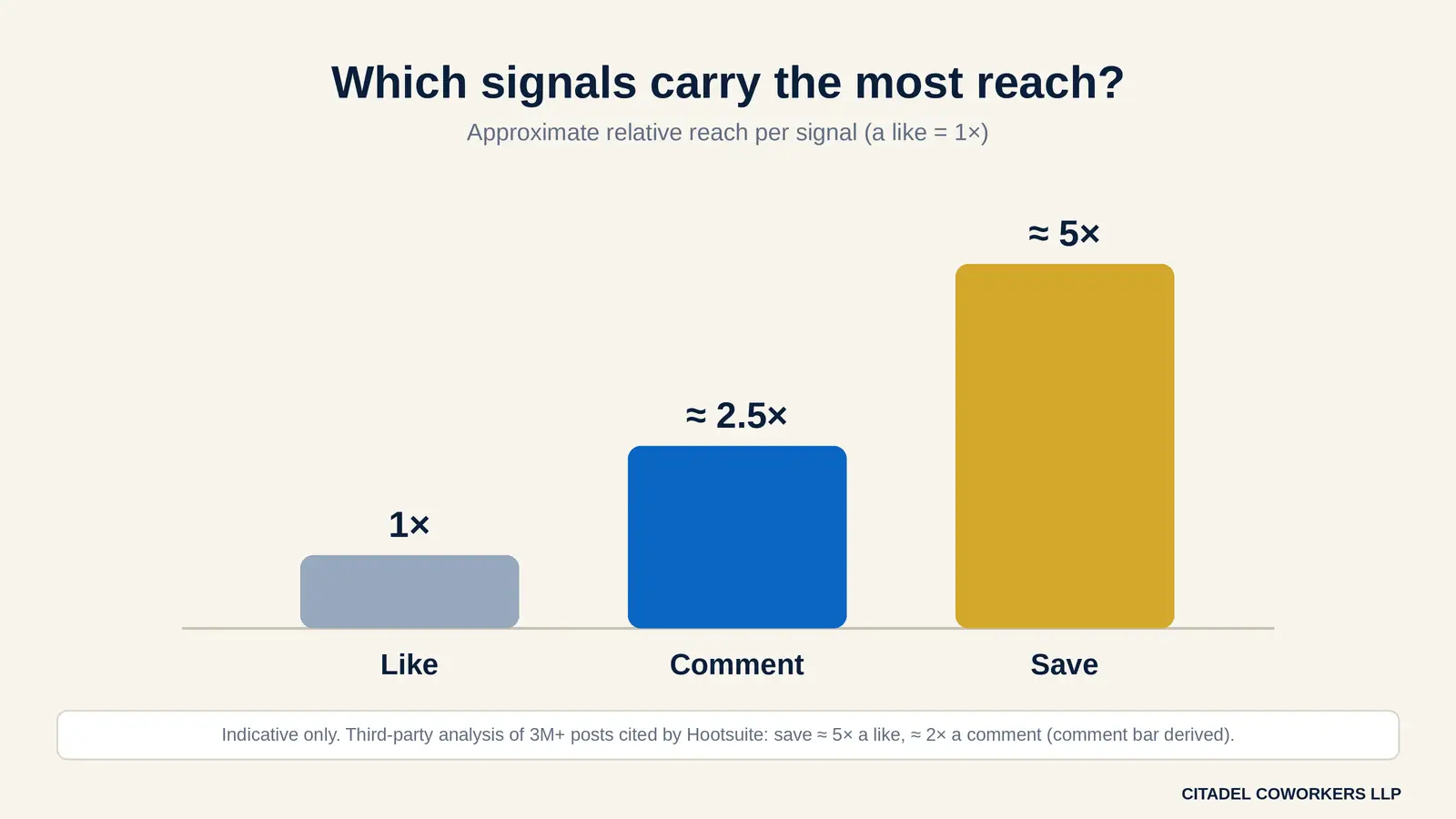
    Attention beats applause. Dwell time, “see more” expansions, saves and comment depth tell the system a post was genuinely useful. One third-party analysis of more than 3 million posts, cited by Hootsuite, found a save can drive around five times the reach of a like. Treat that figure as approximate; the direction is what matters.

    Comments count, but quality counts more. A thread where the author replies with substance signals real dialogue; a pile of one-word replies signals the opposite. Ask questions that invite experience, such as what broke first or what you would do differently, then show up to answer.

    Tust Citadel Coworkers

    Format follows attention. Documents and carousels earn saves, native video is growing and posts that keep readers on the platform generally travel further than posts built to send them away. If traffic is the goal, accept narrower reach and judge the post by clicks and lead quality.

    Build a LinkedIn Content Strategy Around Two or Three Themes

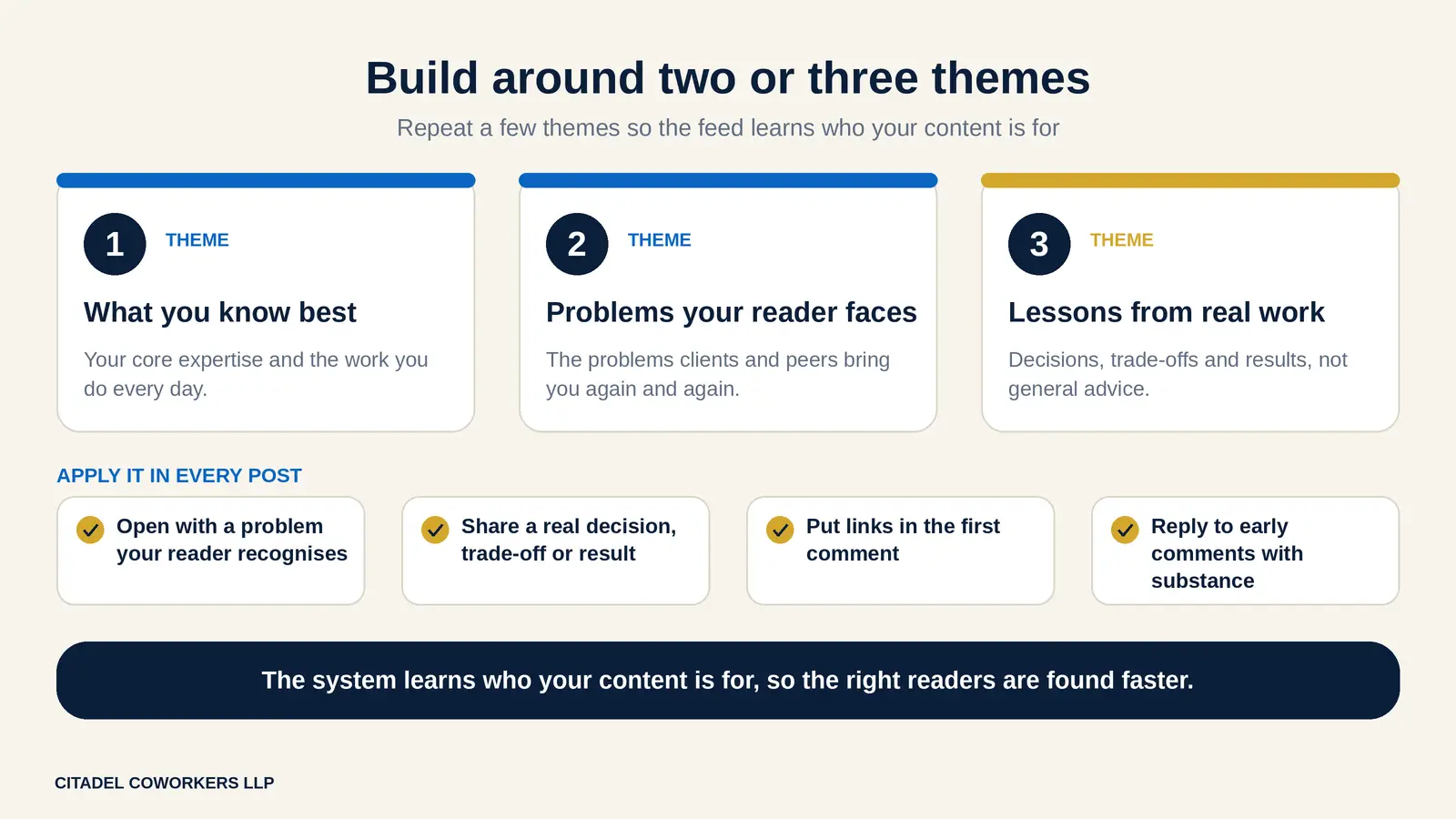
    A workable LinkedIn content strategy starts narrow. When a page and its leaders keep returning to the same two or three themes, the system learns who the content is for and the right readers are found faster. Then apply a simple checklist:

    Tust Citadel Coworkers
    • Open with a problem your reader recognises, within the first two lines.
    • Give a specific conclusion, trade-off or consequence, not broad guidance.
    • For reach, keep the content native, and place links in the initial comment.
    • Respond to early remarks with substance to deepen the thread.
    • Align your headline and About section with the themes of your posts.

    Then measure what the system measures. Keep track of the depth of comments, visits and inquiries to profiles, impressions, and repeat the formats that create these results. When a post performs, find out why before writing the next one.

    Page or profile? Both follow the same rules, but company pages tend to win with proof and brand perspective, while executives win with stories and lessons. The strongest teams use both.

    Your people are part of the system, too. When colleagues add their own perspective to company posts, they extend reach through their networks and add credibility no page can claim alone.

    Not sure where you stand? Pull your last ten posts and ask which one a reader would actually save. If you would like a second opinion, the team at Citadel Coworkers is happy to talk it through.

    Where AI Helps Your LinkedIn Reach And Where It Quietly Hurts

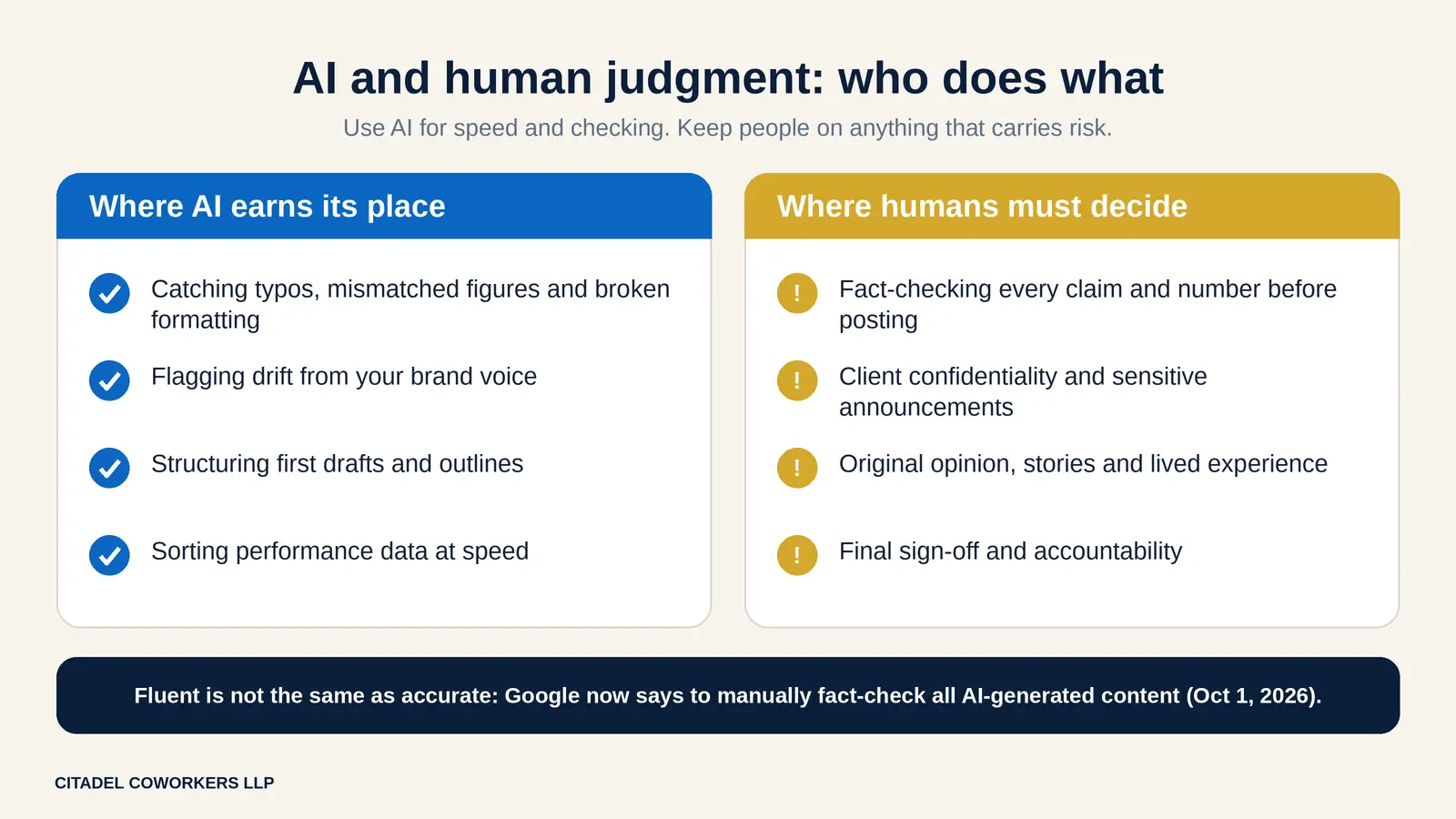
    AI now sits inside almost every marketing workflow and used well, it cuts errors. It catches typos, mismatched figures and broken formatting, flags drift from brand voice and sorts performance data faster than any person could. Repetitive work is where small human slips pile up and that is where machines earn their place.

    Tust Citadel Coworkers

    Trust has limits. On October 1, 2026, Google updated its Search guidance to call manual fact-checking of all AI-generated content critical, explaining that generative models predict likely words rather than retrieve facts. Fluent text can still be wrong.

    Workplaces feel this too. A January 2026 Connext Global survey found only 17% of US adults using AI at work believed it could run with minimal human involvement, while 70% said reliability comes from AI plus review or oversight. It is a vendor survey, so treat the percentages as indicative.

    On LinkedIn, the bigger risk is sameness. AI-assisted drafting is not the problem; generic output is, because templated posts produce shallow dwell time and few saves. Let AI structure drafts and check details; let people supply the story, the opinion and the numbers they have measured themselves.

    Some decisions should never be delegated. Client confidentiality, regulated claims, sensitive announcements and public opinions carry consequences a model cannot weigh, because it does not know your relationships, risks or history. A person who does must sign off.

    Remember who is reading. The system now reads for meaning and the person behind it reads for proof. That is not fear of AI. It is a business advantage: speed from the machine, credibility from the person.

    Why Businesses Trust Citadel Coworkers to Turn Posts Into Authority

    What separates a post people save from one they scroll past is rarely tooling. It is judgment. Citadel Coworkers treats LinkedIn marketing as a long game of earned attention rather than a posting schedule.

    Three principles shape that approach. Expertise comes first, so posts begin with what your people actually know. AI is used for speed and error-checking, never as a substitute for a point of view. Success is measured in saves, conversations and qualified enquiries, not impressions alone.

    Keeping people in the loop is part of that. Someone who understands your market reviews every claim, figure and tone choice before anything goes live, so speed never costs accuracy.

    Before Your Next Post, Write For the Reader

    Return to the complaint that started this guide: the same effort, less reach. The feed has not turned against you. It has become better at telling a post written for a reader from one written for a number.

    The brands that do well from here will not be the ones that post most or even automate best. They will be the ones whose people still have something worth saying and the discipline to say it clearly. Open your last post, read it as a stranger would and ask whether you would save it.

  • ChatGPT vs. Google Search: Where Should Your Brand Optimize, A Guide By Citadel Coworkers

    ChatGPT vs. Google Search: Where Should Your Brand Optimize, A Guide By Citadel Coworkers

    Key Takeaways

    • Optimize for both. Google remains your foundation, while ChatGPT increasingly shapes the shortlist.
    • Crawlability comes first. AI tools cannot recommend what they cannot read.
    • Write answer-first. Open every section with a clear, quotable answer.
    • Earn mentions beyond your website.. AI systems lean heavily on trusted third-party sources.
    • Pair AI with people. Use AI for speed and error-checking while humans take charge of facts, claims and strategy.

    When we talked about being visible online, it used to be connected with ranking on Google. Now it means two. Google is still widely reported to hold over 90% of global search share, yet OpenAI has reported roughly 900 million weekly ChatGPT users, many of whom ask for recommendations, not a list of links.

    Ranking well no longer guarantees being named. A brand can be ranking at the top on Google but still be invisible when an AI tool is asked. The real question is not which platform wins, but where to optimize first.

    Tust Citadel Coworkers

    In this guide, Citadel Coworkers explains how each platform chooses content, which steps earn visibility on both and where AI helps your team versus where human judgment must stay in charge.

    Why Does a Top Google Ranking Not Guarantee a ChatGPT Recommendation

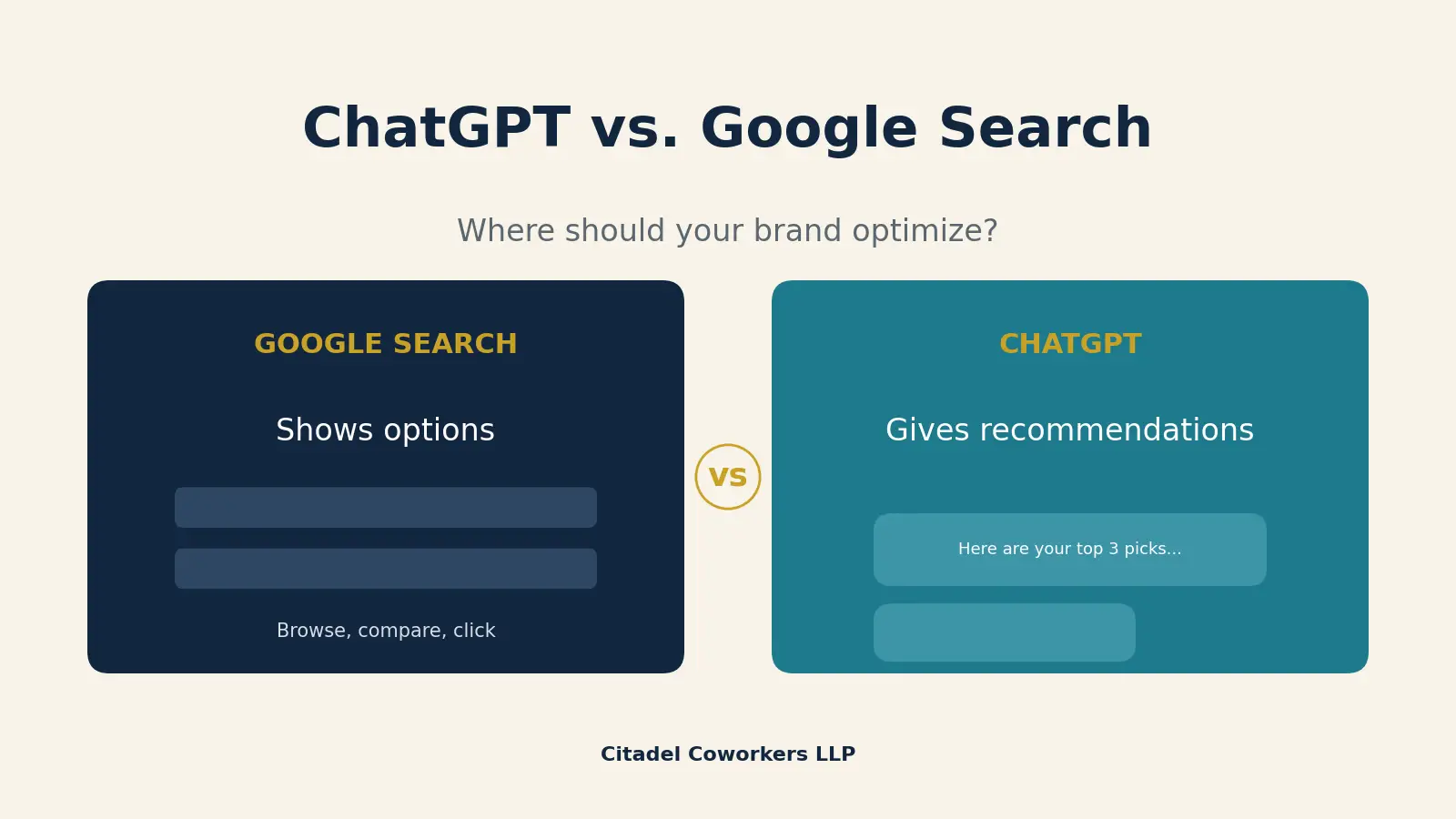
    Because the two tools do different jobs. Google lists options. ChatGPT narrows them. On Google, a buyer opens tabs and compares, but when on ChatGPT, they just ask the tool to give the comparison and believe the answers that come up.

    Those audiences overlap. The same buyer may search Google at launch and question ChatGPT that night, so absence from either channel leaves a gap in the journey.

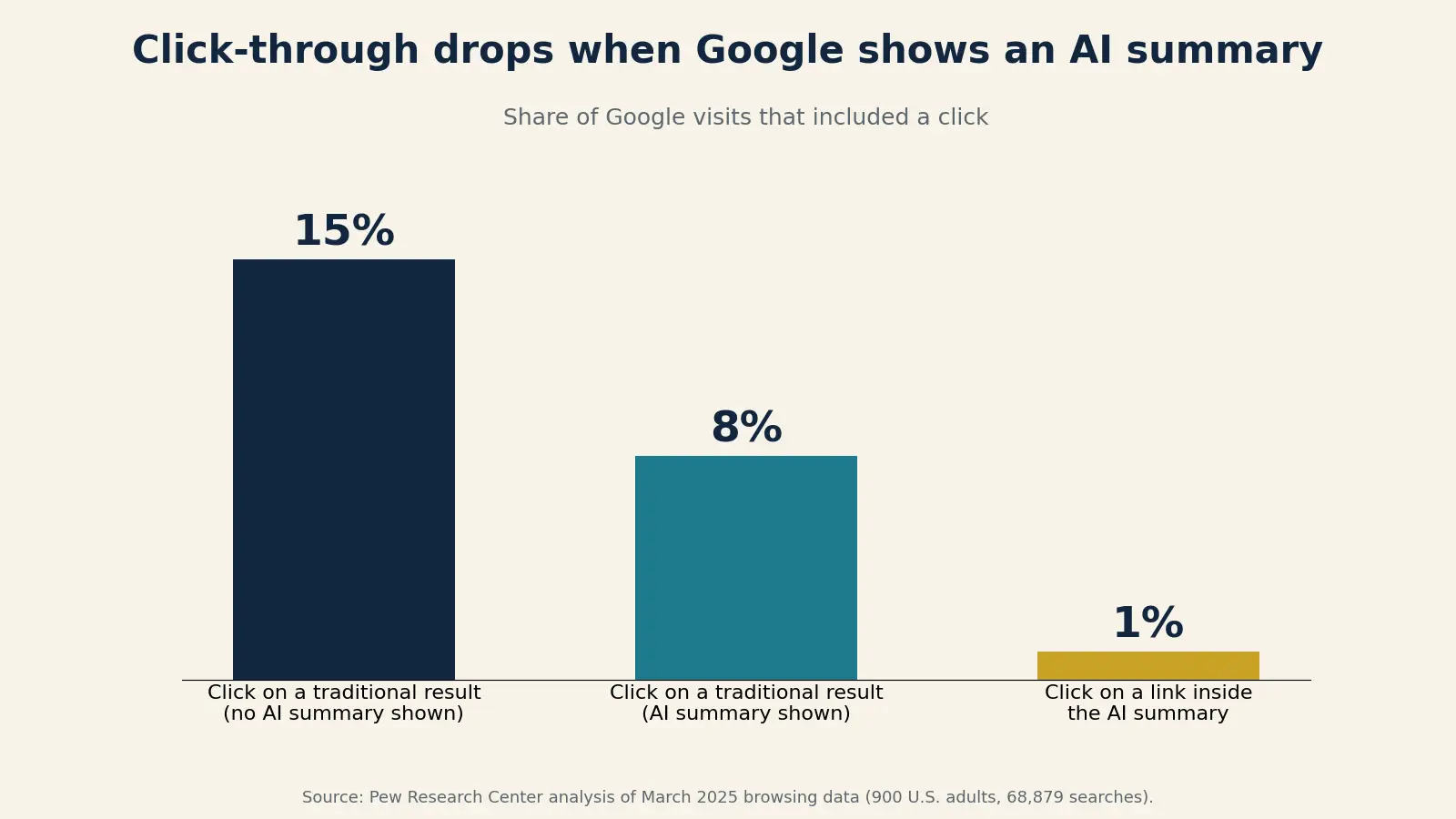
    Behavior is shifting inside Google too. Pew Research Center studied 68,800+ searches from 900 U.S. adults in March 2025. When an AI summary appears for a search, people clicked a traditional result in 8% of visits, compared with 15% when it did not. Just 1% clicked a link inside the summary.

    Tust Citadel Coworkers

    Rankings and recommendations also draw on different sources. An eMarketer report found that fewer than 10% of the sources cited by ChatGPT, Gemini and Copilot appear in Google’s top ten results for the same query. Visibility now has two layers and you need both.

    How Do Google and ChatGPT Each Decide What to Show

    Google ranks pages it can crawl and index. It rewards people-first content, clear internal linking, fast mobile-friendly pages and structured data that explains what a page is about.

    ChatGPT Search works differently. According to OpenAI, it queries search providers and live web content, then builds an answer with citations and links. OpenAI also cautions that citations can be outdated and results are not deterministic, so the same question may not return the same brands twice.

    Side by side, the strategy gets clearer. Google checks your page to ensure whether or not it deserves a ranking; on the other hand, ChatGPT checks whether you brand deserves to be mentioned.

    Google checks whether your page deserves a ranking; meanwhile, ChatGPT checks whether your brand deserves a mention.

    Why Do Strong Brands Still Go Missing in AI Answers

    Usually for one of three reasons. Their authority lives only on their own website, so AI systems find little outside proof. Their pages are informative but poorly structured, so there is no clean answer to lift. Or they land on the wrong side of an unpredictable system, which is why consistency, not perfection, is the goal.

    Should You Optimize for ChatGPT or Google First

    Both, in sequence. Build the Google foundation first, then add an answer-ready layer for AI tools. AI features on Google are drawn from pages that are already indexed and eligible to appear with a snippet, so crawlable, useful content is the entry ticket to either channel.

    Tust Citadel Coworkers

    In practice, that comes down to three questions. Can machines read your site? Can they lift a clear answer from it? Do trusted sources vouch for you?

    What Does an Answer-First Page Look Like in Practice

    Tust Citadel Coworkers

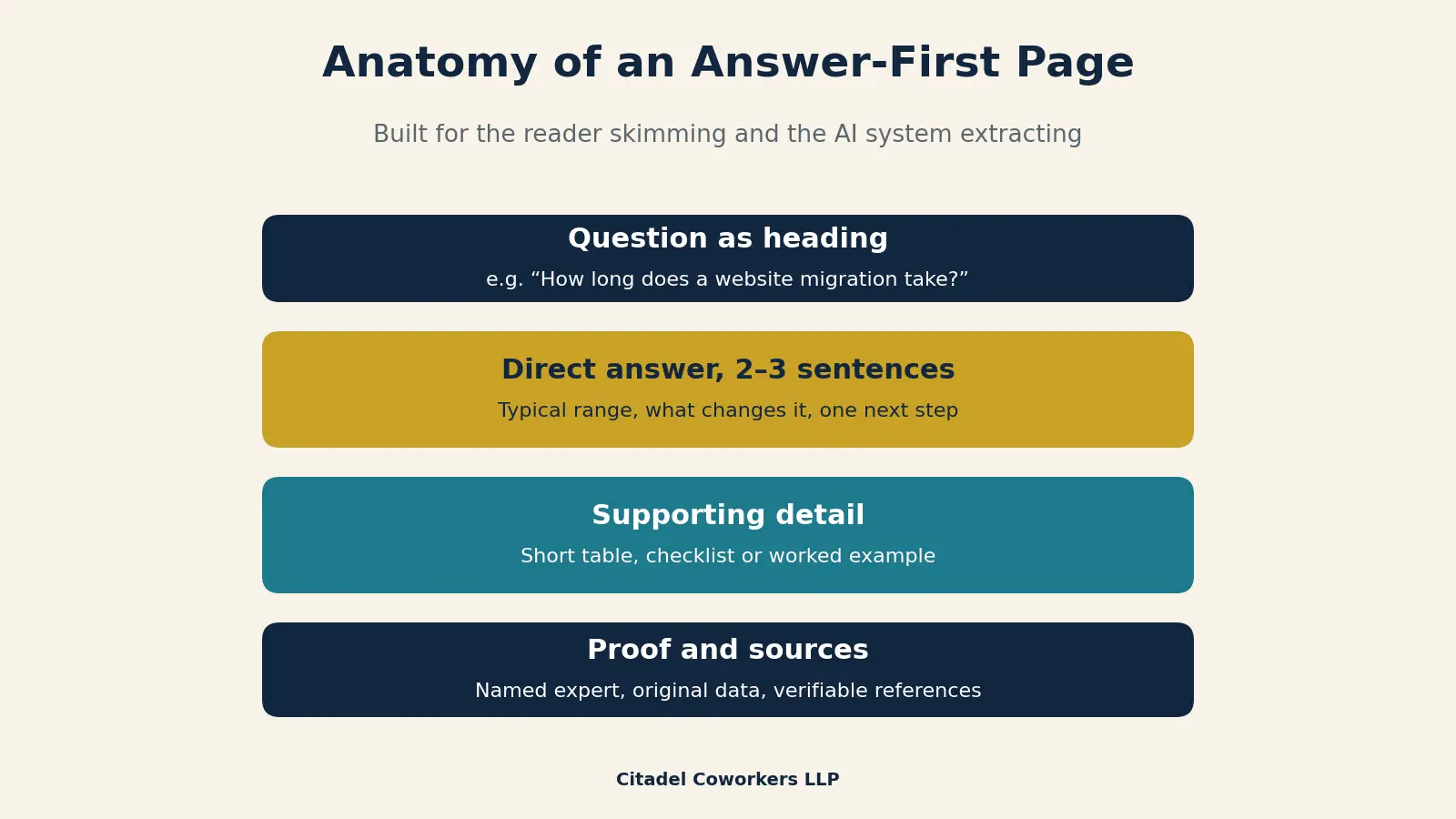
    Take a heading such as “How long does a website migration take?” Directly beneath it, give the answer in two or three sentences: a typical range, the factors that change it and one next step. Then add the detail: a short table or a checklist. A person skimming and an AI system extracting should both find the answer within seconds.

    What Is the Difference Between GEO and AEO

    Answer engine optimization is the practice of structuring content so AI-driven interfaces can extract it and present it as a direct answer. Generative engine optimization goes further. It shapes your wider digital presence, so AI platforms cite, mention or recommend your brand. Together, they form AI search engine optimization: the discipline of being found inside answers, not just beside them.

    Do You Really Have to Choose Between Rankings and Recommendations

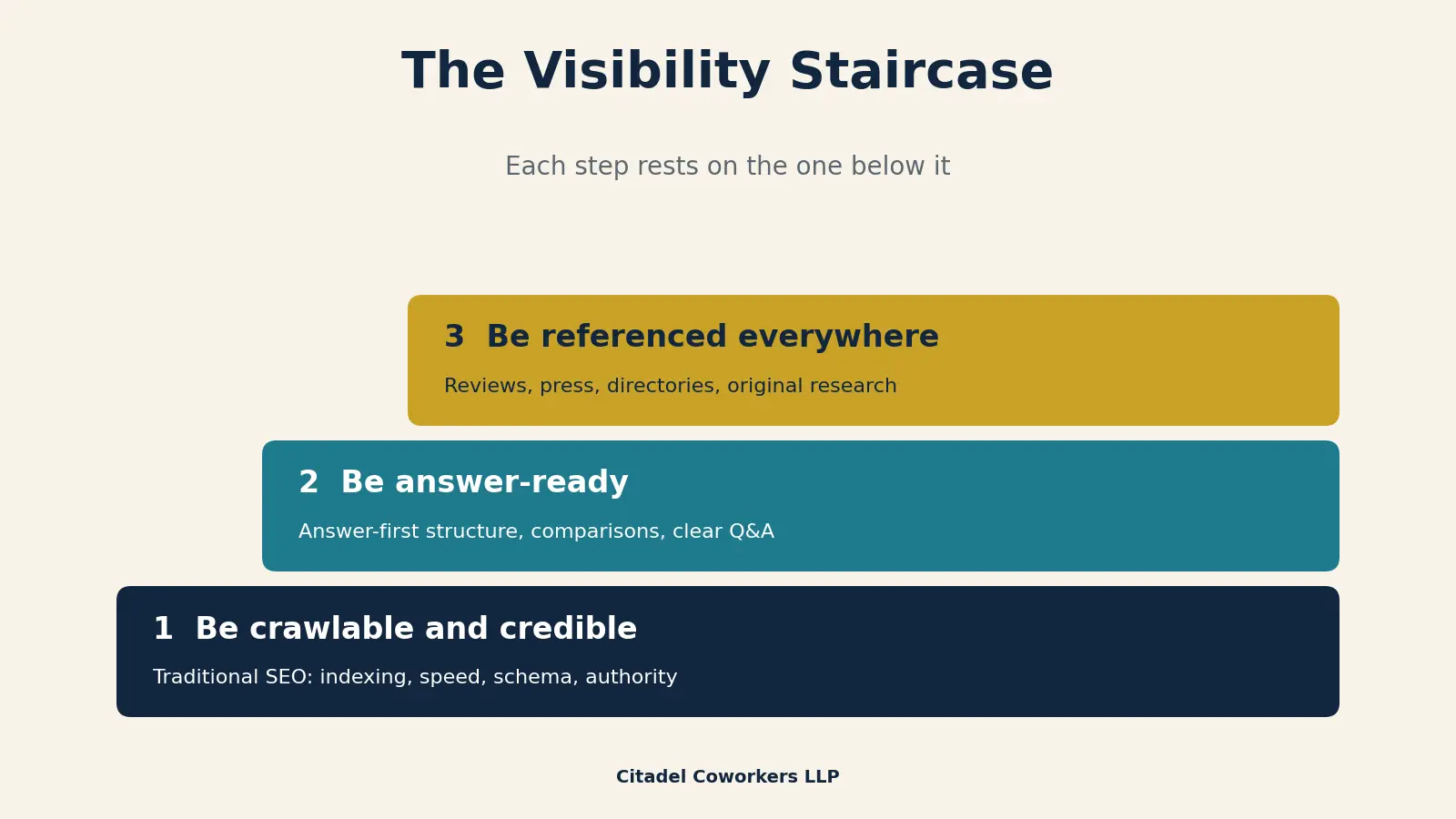
    The GEO vs SEO debate sounds like a fork in the road. It is closer to a staircase. Traditional SEO makes you crawlable and credible. GEO makes you quotable and widely referenced. The second step rests on the first, so abandoning one to chase the other weakens both.

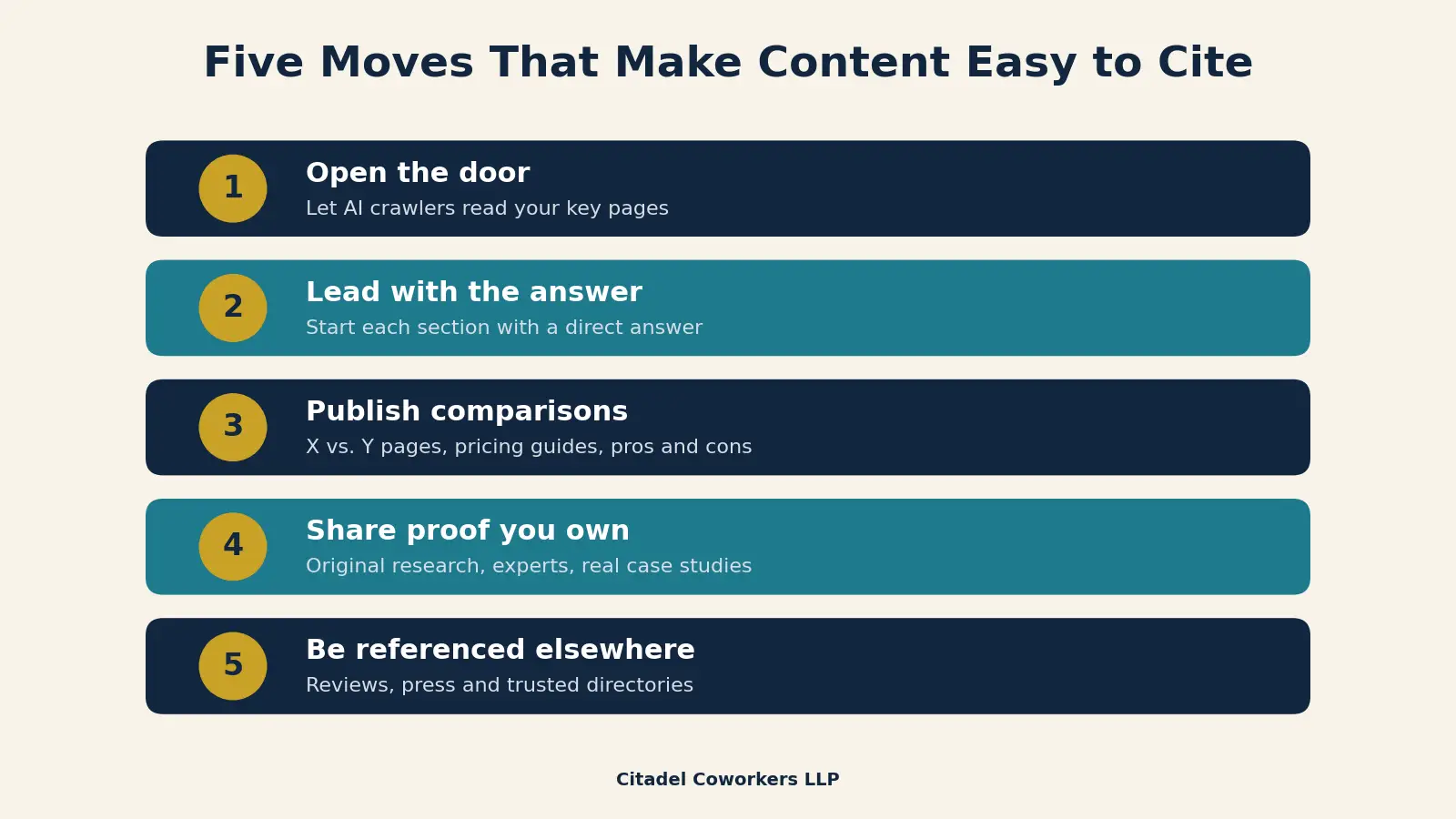
    Five Practical Moves That Make Your Content Get Cited

    These moves are not tricks. They are habits that make your expertise easy to find, easy to verify and easy to quote, which is exactly what both readers and AI tools look for.

    Tust Citadel Coworkers

    • Open the door.
      Allow crawlers such as OpenAI’s OAI-SearchBot in your robots.txt file and avoid hiding key content behind heavy scripts or paywalls.
    • Lead with the answer. Start each section with a two-to-three-sentence answer, then add the supporting detail.
    • Publish the comparisons buyers ask for. Think “X vs. Y” pages, pricing guides and honest pros-and-cons breakdowns.
    • Share proof only you own. Original research, named experts and case studies with real numbers carry weight.
    • Be referenced elsewhere. University of Toronto researchers found AI search leans heavily toward earned, third-party media over brand-owned content, so reviews, press and directories matter.

    A simple place to begin: ask ChatGPT the five questions your buyers ask most and note who gets named.

    Where Does AI Sharpen Your Work And Where Does It Need a Human

    AI now sits inside everyday business workflows. One June 2026 industry report put regular use at 88% of organisations. Used well, it reduces errors. It audits thousands of pages for broken schema or inconsistent details, flags analytics anomalies and drafts first versions in minutes.

    Its limits are just as real. AI can be confidently wrong. A 2026 legal analysis notes that many AI vendor agreements disclaim accuracy, leaving the business to carry the risk. An academic study of small consulting firms found hallucinations hardest to catch in tasks involving interpretation, prioritisation and narrative.

    The danger is not that AI makes mistakes. People do too. The danger is that AI mistakes arrive polished, fluent and easy to approve at a glance. A reviewer who knows your market, your client and your regulations will catch what a confident paragraph hides.

    Tust Citadel Coworkers

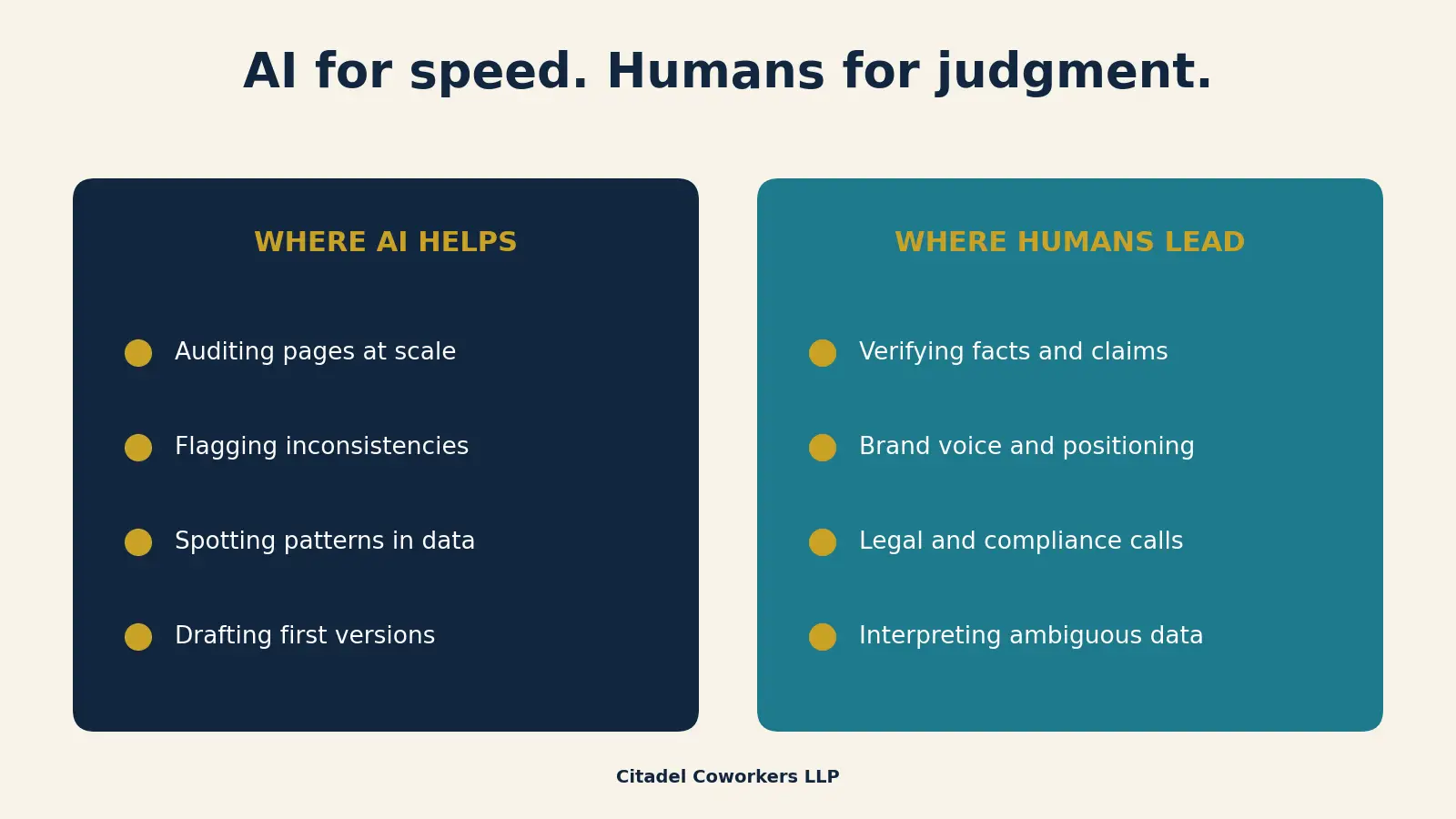
    AI is dependable for:

    • Auditing large sites at scale
    • Catching inconsistencies and formatting errors
    • Spotting patterns in rankings and citations
    • Producing first drafts for review

    Keep a person in charge of:

    • Verifying facts, statistics and claims
    • Brand voice and positioning
    • Legal and compliance review
    • Interpreting ambiguous data and setting priorities

    None of this is a reason to hold back. It is a reason to stand firm. Brands that pair machine speed with human accountability publish content that AI tools can cite and customers can trust. That is a genuine competitive advantage.

    How Will You Know It Is Working: Count Mentions, Not Just Clicks

    Track brand mentions, citations and AI referral traffic alongside rankings. AI answers vary from one run to the next, so judge patterns across many prompts, not a single result. Measuring AI search engine optimization takes patience, but the signals are clear once you know where to look.

    Start by recording a baseline today: the prompts you tested, the brands named and the pages cited. Repeat monthly. Without a baseline, every improvement is a guess.

    Why Businesses Choose Citadel Coworkers to Be Found, Cited and Chosen

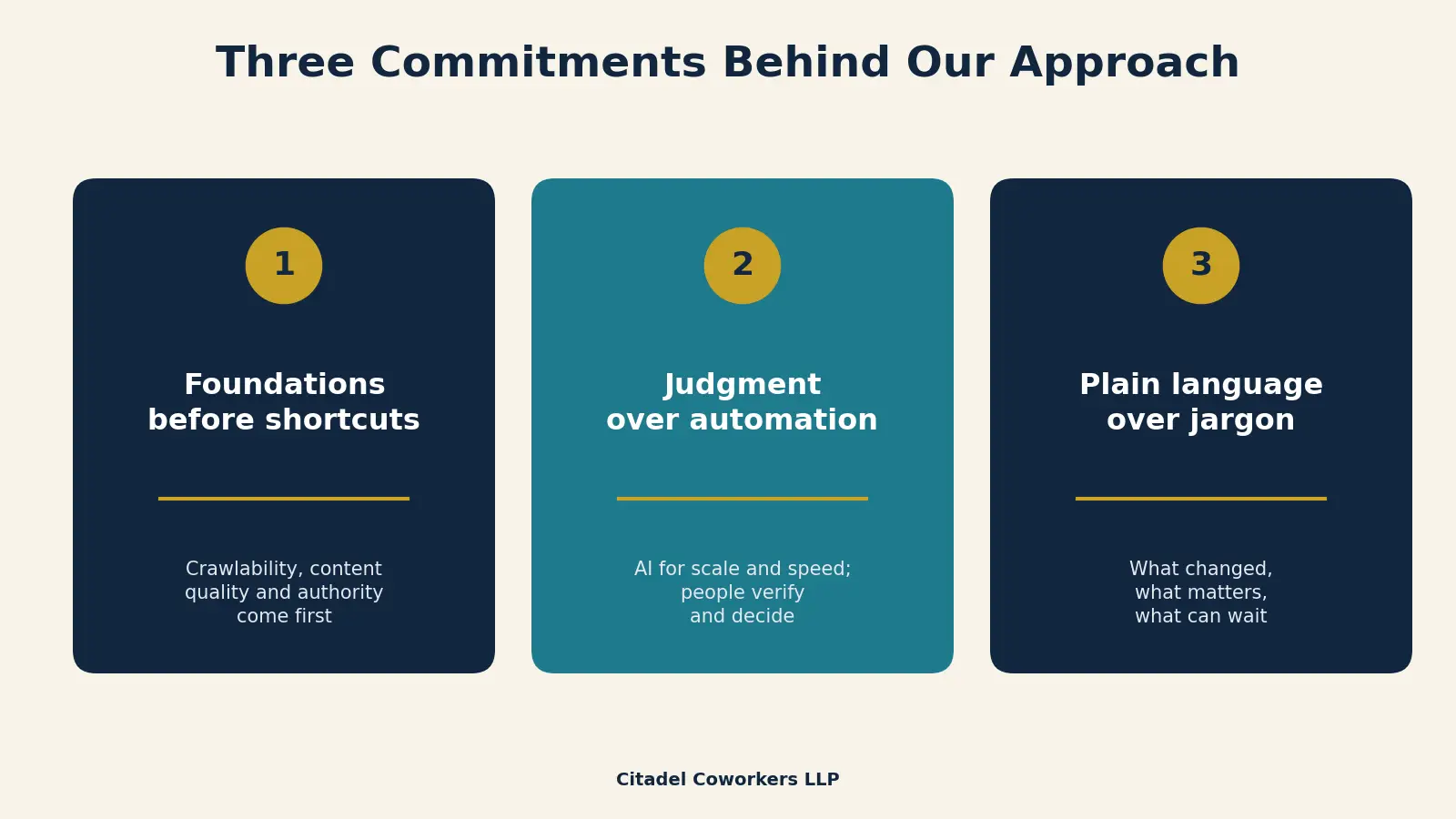
    Citadel Coworkers work from one belief: visibility is earned by being useful and usefulness needs people. Three commitments shape how we work.

    Tust Citadel Coworkers
    • Foundations before shortcuts. Every AI layer rests on crawlability, content quality and authority, so we start there.
    • Judgment over automation. We use AI for scale and speed. Experienced people verify the facts, shape the positioning and own the final call.
    • Plain language over jargon. We explain what has changed, what matters for your goals and what can wait.

    published, a person checks it against primary sources, because a recommendation built on a wrong claim does more harm than no recommendation at all.

    If you would like to see how your brand reads to both Google and AI tools today, we would be glad to explore it with you.

    Two Platforms, One Strategy: Where to Start This Week

    Visibility now runs through two doors: Google, where buyers compare and AI tools, where they ask for a verdict. Brands that treat them as rivals will spend years choosing. Brands that build on one foundation will be found at both.

    Start this week with one buyer question. Make your answer the clearest on the web, back it with proof others can verify and have a person check every claim before it goes live. Search will keep changing. The need to be clear, credible and checked will not.

  • Citadel Coworkers’ Verdict on Automated vs. Manual Review Responses: Which Works Better

    Citadel Coworkers’ Verdict on Automated vs. Manual Review Responses: Which Works Better

    Key Takeaways

    • Neither approach wins alone. Automation delivers speed and coverage; people deliver judgment, empathy and accountability.
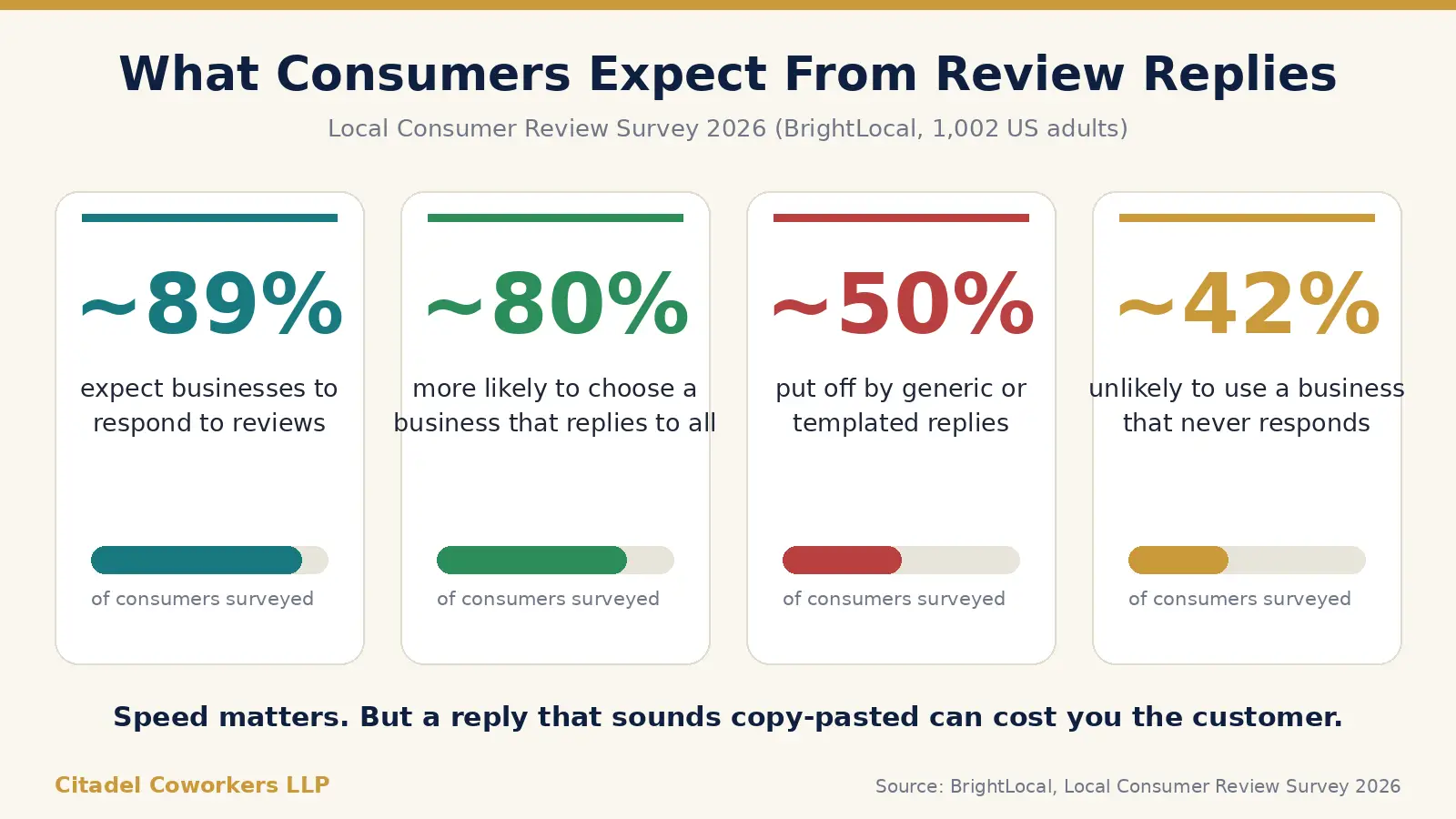
    • Roughly half of consumers say generic or templated replies put them off, according to BrightLocal’s 2026 survey, so unsupervised automation carries a real cost.
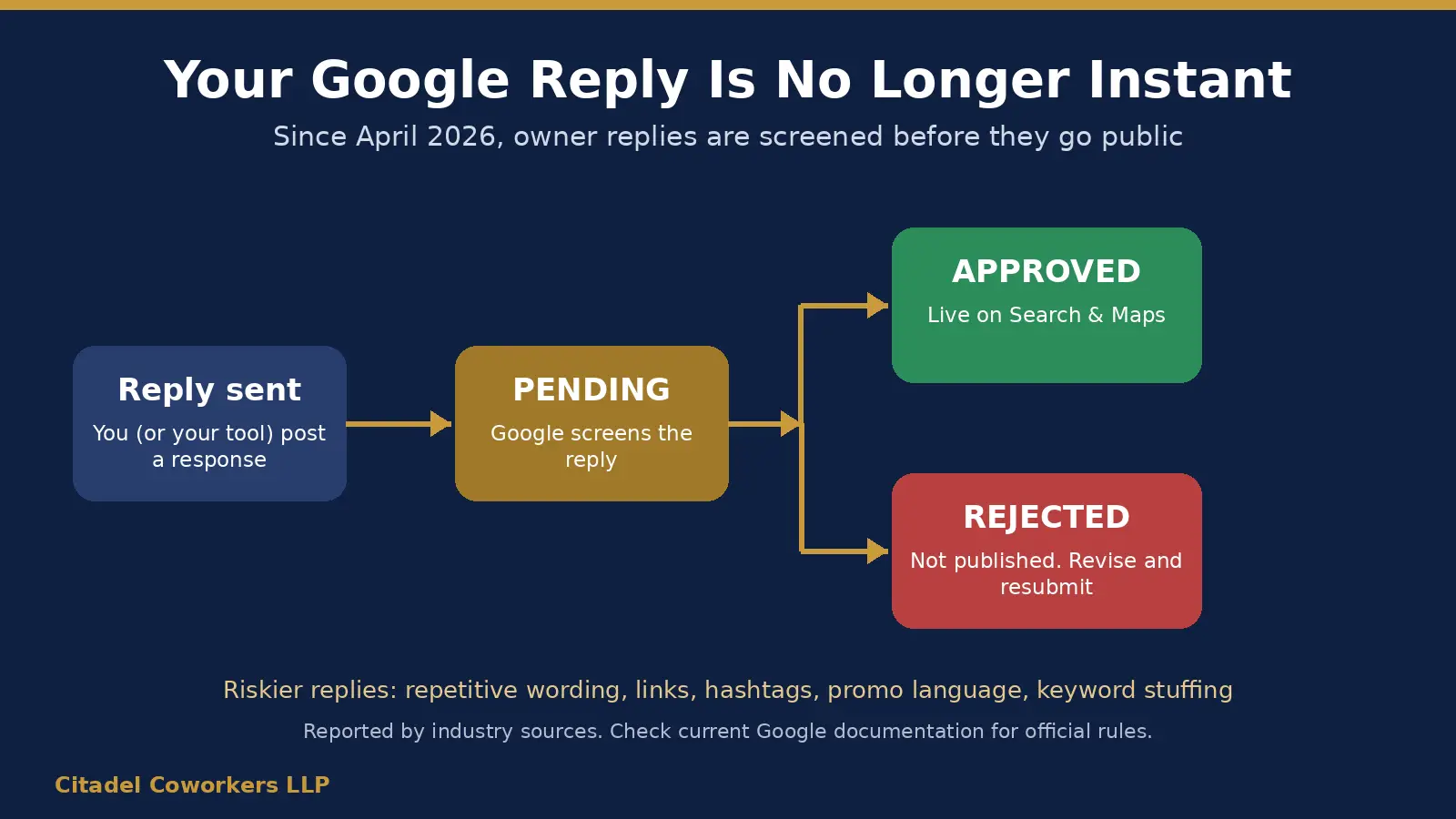
    • Since April 2026, Google screens owner replies as pending, approved or rejected. Copy-paste replies may never go live.
    • The safest model is tiered: automate monitoring and drafting and keep people on anything negative, sensitive or regulated.
    • Use AI to draft and people to decide. That single rule protects both speed and trust.

    Two businesses receive the same one-star review, about a refund that never arrived and a support call that went badly.

    The first answers within seconds: “Thank you for your valuable feedback!” The second replies the next morning, mentions the refund and the delay and offers a direct line to a manager who can fix it.

    Same complaint, but very different signals.

    Which one would you call? That question sits at the heart of automated versus manual review responses. It is not about technology. It is about what your reply tells a stranger who is deciding whether to trust you.

    Why Every Reply Is Read By Someone About to Decide

    Think about how you read reviews yourself. You scan the star rating, skim the newest comments, then look at how the owner answered the angriest one. That last step often tells you more about the business than the rating does.

    BrightLocal’s Local Consumer Review Survey 2026, which polled 1,002 US adults, found that roughly 89% of consumers expect businesses to respond to reviews. About 80% say they are more likely to choose a business that replies to all of them.

    Tust Citadel Coworkers

    Speed alone does not win, though. Around 50% say generic or templated replies make them unlikely to choose a business. A reply is no longer a courtesy. It is part of the review and prospects read it that way.

    That is why online reputation management now depends on reply quality, not just reply volume. A silent profile looks neglected. A robotic one can look worse.

    Google Now Screens Replies: What Changes in 2026

    Since April 2026, replies on Google Business Profile carry a moderation status: pending, approved or rejected. Before that, replies sent through the API went live automatically. Google’s checks are usually quick, but some reports describe delays far longer.

    Industry analysis of roughly 12,700 rejected replies points to familiar culprits: repetitive wording, links, hashtags, promotional language and keyword stuffing. Some rejections reportedly fail quietly, so a team that assumes “sent” means “live” may never notice.

    Tust Citadel Coworkers

    This is where Google review management gets more demanding. A reply that never publishes helps no one and a template that once looked efficient can now look suspicious.

    The practical fix is simple. Reference the customer’s actual words, skip links and hashtags, vary your phrasing and check each reply’s status after posting.

    If Google rejects one, revise it rather than resubmitting the same text. Treat approval status as a metric, not an afterthought.

    Automated vs. Manual Replies: What is the Difference

    Automated review responses are replies drafted or published by software, using rules, templates or AI, usually triggered by a star rating or keyword. Manual review responses are written by a person who has read the review, checked the facts and chosen the words.

    Tust Citadel Coworkers

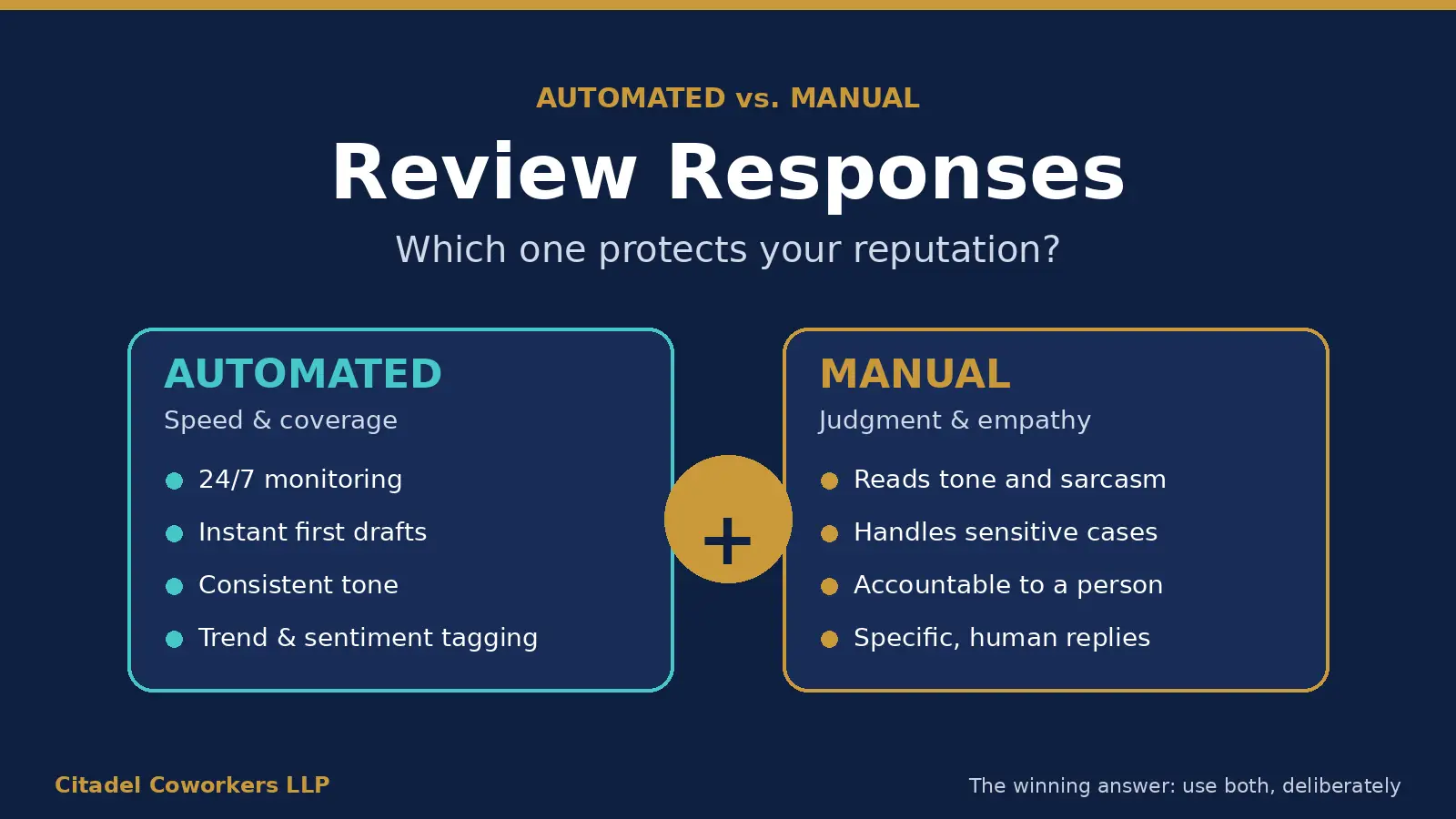
    Automation optimises for speed and coverage. Manual replies optimise for accuracy and empathy. The strongest online review management programmes use both, deliberately.

    The Hidden Cost of Manual-Only Replies

    Manual replies have a real strength: nothing beats a person who knows the customer, the context and the stakes. The trouble is scale.

    As reviews spread across Google, Facebook, Yelp and industry directories, checking each platform becomes a chore that slips when the team is busy. Replies get shorter. Some reviews are missed entirely. Tone drifts depending on who is typing.

    The cost is not just time. Around 42% of consumers, per BrightLocal’s 2026 survey, say they are unlikely to use a business that never responds. Silence is also a reply and manual-only teams tend to send it during their busiest weeks.

    How AI Reduces Errors in Review Replies

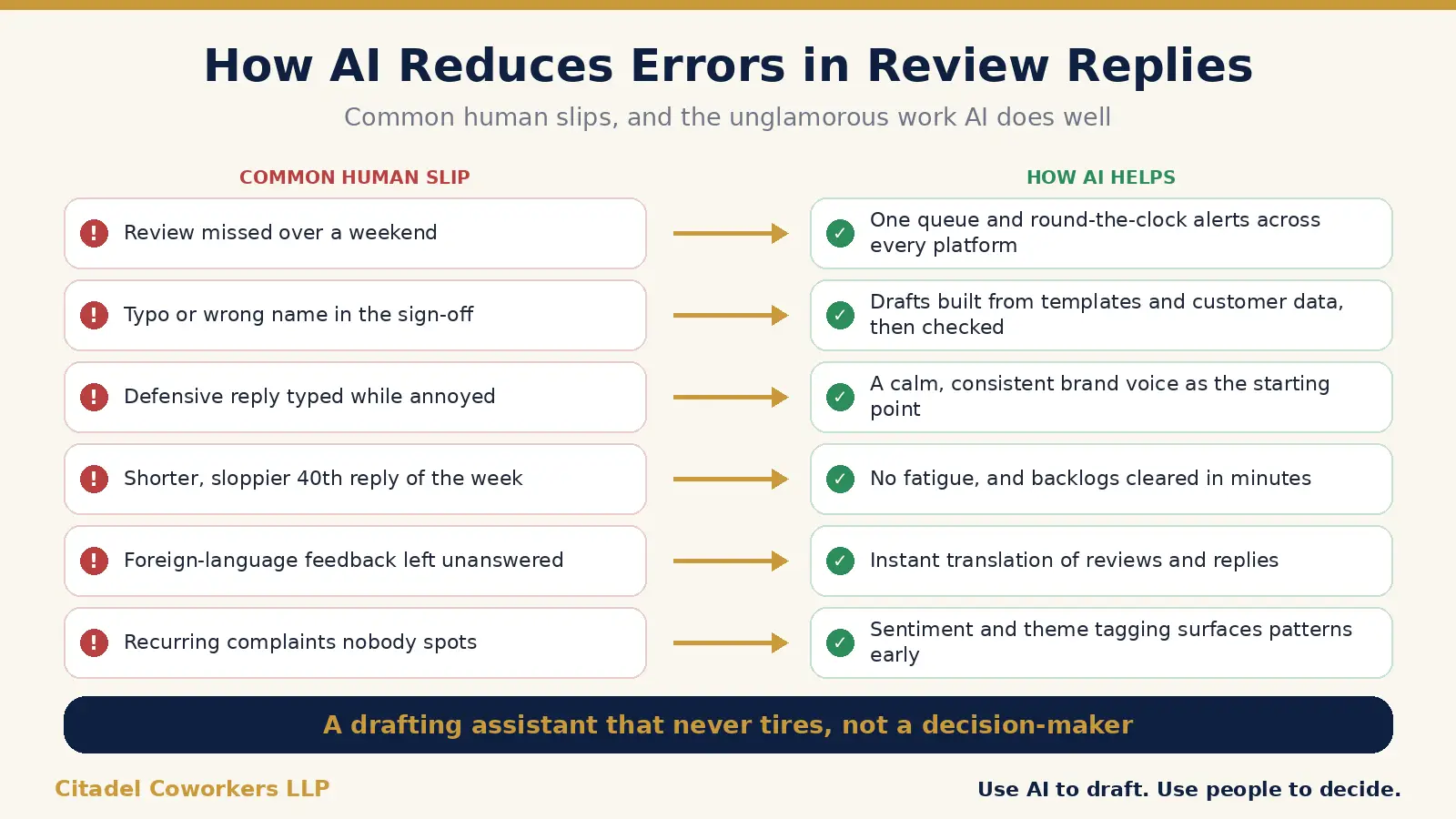
    Most reply mistakes are ordinary human ones: a review missed over a weekend, a typo, the wrong name in the sign-off, a defensive answer typed while annoyed. AI is good at exactly this unglamorous work.

    Used well, it pulls every platform into one queue, alerts you around the clock, drafts in a consistent brand voice, translates foreign-language feedback and tags sentiment and recurring themes. Patterns surface before they become a crisis.

    Tust Citadel Coworkers

    It also removes fatigue. A person writing their fortieth reply of the week grows shorter and sloppier. Software does not.

    Consistency matters more than it sounds: when every location and every team member answers in the same courteous register, customers stop noticing the process and start noticing the care. It can also clear a backlog in minutes, so a business recovering from a burst of feedback can catch up without pulling people off customer-facing work.

    Think of it as a drafting assistant that never tires, not a decision-maker.

    Where AI Cannot Be Trusted

    AI reads words. It does not always read intent. “Great, another delay” can look positive to a system and is plainly a complaint to any person. Sarcasm, mixed feelings and cultural nuance are common failure points.

    Generative tools can also state things that are simply untrue, a problem often called hallucination. An invented refund policy, a promised call-back nobody will make, an apology that admits liability: in a public reply, each becomes a written commitment.

    Privacy is another blind spot. In healthcare, legal and financial services, even confirming that someone is a client can breach confidentiality obligations. Software cannot tell when it is crossing that line.

    Human Judgment: Your Advantage, Not a Bottleneck

    AI is now part of daily operations and review replies are no exception. Confident businesses neither reject it nor hand it the keys. They decide in advance which decisions belong to people.

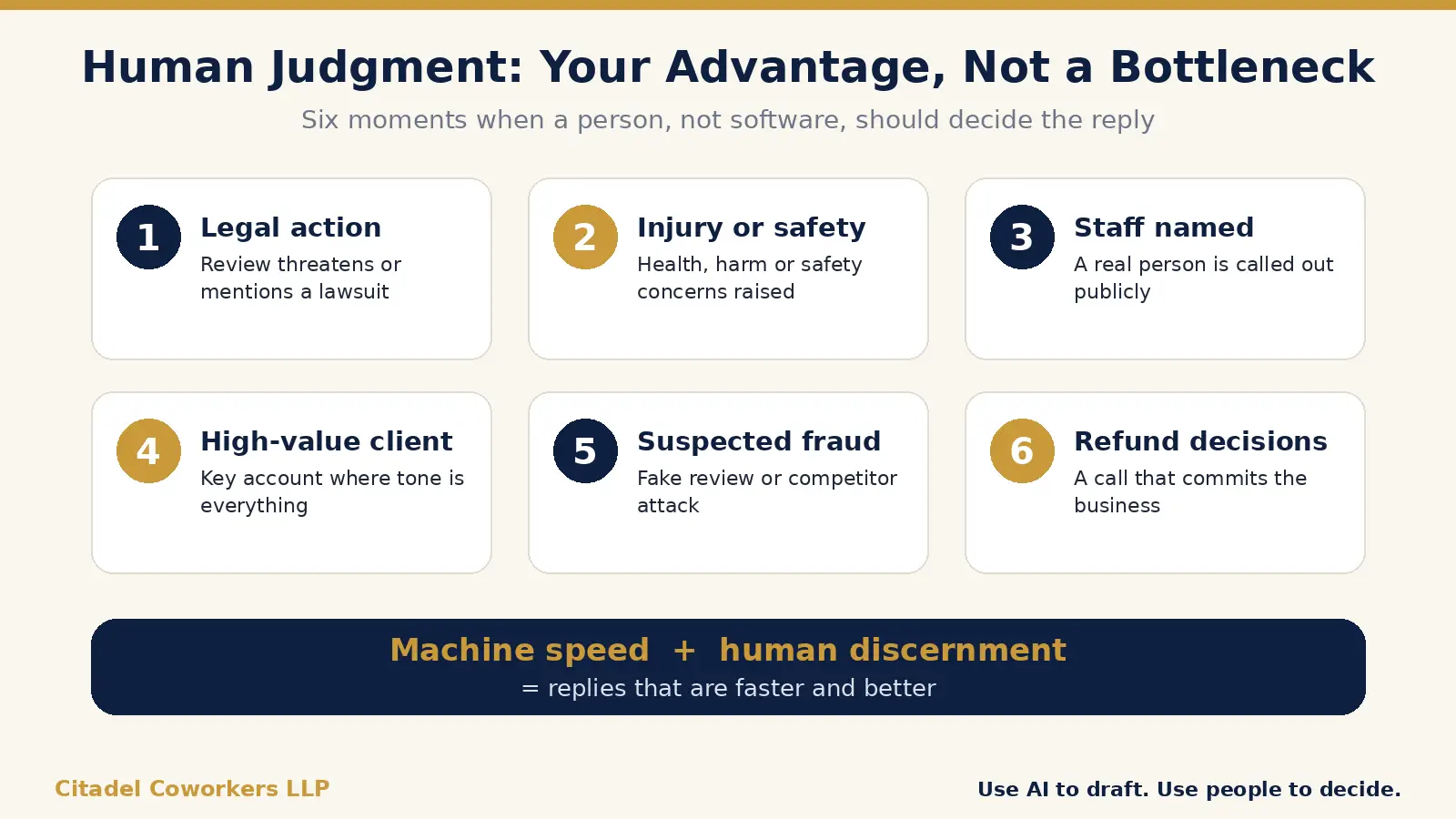
    Human judgment is essential when a review mentions legal action, injury or safety, names a staff member, comes from a high-value client, looks fraudulent or requires a call on refunds. A person also carries accountability. Someone’s name stands behind the reply.

    Tust Citadel Coworkers

    In regulated sectors and high-stakes B2B relationships, one poorly judged public sentence can cost more than a month of saved time.

    There is a wider reason to care. BrightLocal’s 2026 research shows consumers increasingly ask AI tools for local recommendations and among those who use AI-generated review summaries, roughly 59% still open the review profile to check. Your replies are part of what they find there.

    That is an advantage, not a limitation. Customers cannot tell whether a warm reply took twenty seconds, but they can tell whether it understood them. Pairing machine speed with human discernment gives you answers that are faster and better.

    What a Reply Is Worth Reading Contains

    Whether a person or a tool writes it, a strong reply does four things. It thanks the reviewer by referencing something they actually said. It acknowledges what went wrong without arguing. It shows empathy without admitting legal fault or promising compensation in public. And it moves detailed problems to a private channel.

    Notice that none of these is about length. A three-sentence reply that names the delayed refund beats a polished paragraph that could sit under any review. Specificity is the quality software finds hardest to fake and people find easiest to supply.

    A Tiered Model For What to Automate

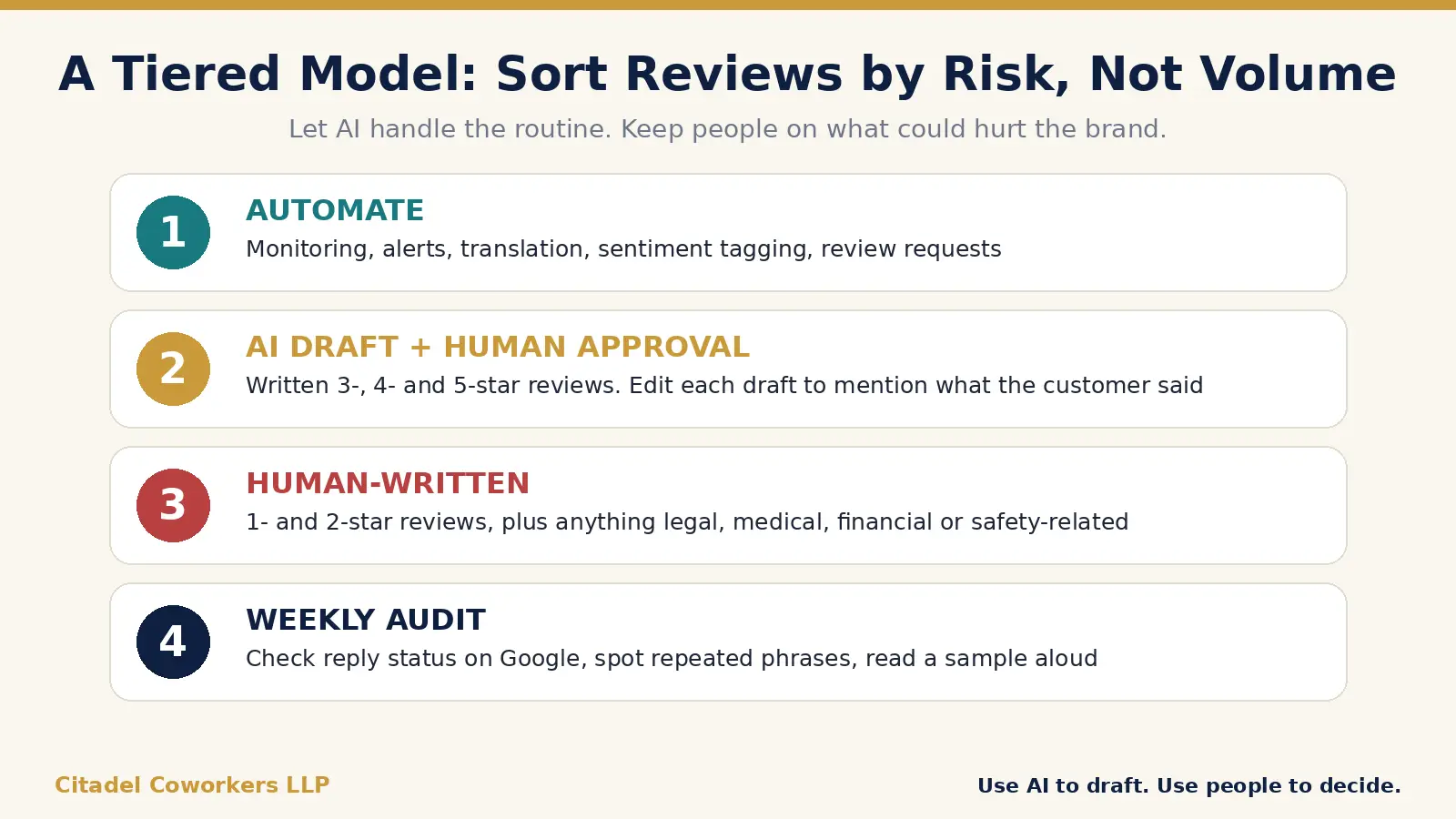
    Good review management sorts reviews by risk, not by volume. Here is a workable structure:

    Tust Citadel Coworkers
    • Automatic: monitoring, alerts, translation, sentiment tagging and review requests.
    • AI draft, human approval: written 3-, 4- and 5-star reviews. Edit each draft to mention something specific the customer said.
    • Human-written: 1- and 2-star reviews, plus anything legal, medical, financial or safety-related.
    • Weekly audit: check reply status in Google, hunt for repeated phrases and read a sample aloud.

    Even a bare five-star rating with no comment deserves a short reply, but vary the wording so it never reads like a stamp.

    Try the read-aloud test this week, the kind of quick check Citadel Coworkers would suggest first. Pull your last ten replies. If two could be swapped between customers without anyone noticing, they are probably too generic.

    Why Businesses Trust Citadel Coworkers With Replies That Matter

    Citadel Coworkers approaches online reputation management as a discipline built on judgment, not just tooling. Software handles the watching and the first draft. People handle the decisions.

    Three principles shape that approach. Every sensitive reply is reviewed by someone who understands your business. Every response is edited to sound like you, not like a template.

    And clear guardrails, from escalation rules to approval steps, mean nothing goes live unchecked. You always know what was automated, what was approved and why.

    None of this is glamorous. It is the quiet discipline that keeps a reputation steady when volume spikes or a difficult review lands at midnight. If you would like to see how a tiered workflow could fit your business, explore how Citadel Coworkers can help you build one.

    The Reply Is the Moment That Matters

    The complaint was never the real problem. The reply was the moment that counted. Let your software watch the clock and draft the first line. Let a person decide what your business stands for. Start with your last ten replies and ask one honest question: would a stranger believe someone read this?

  • What Is Review Velocity And Why Does It Matter For Your Brand

    What Is Review Velocity And Why Does It Matter For Your Brand

    Key Takeaways

    • Review velocity, the pace of new reviews, not the total count, has become one of the fastest-moving ranking signals in local search and AI-driven recommendations.
    • A business with a handful of recent reviews can now outrank a competitor sitting on hundreds of reviews that have gone quiet.
    • Search engines and AI assistants apply something close to “recency decay”, where older reviews gradually lose their influence on visibility.
    • AI can monitor, flag and draft responses at scale, but judgment calls on tone, escalation and risk still belong to a person.
    • A deliberate, structured approach to review velocity turns it into a repeatable growth channel instead of an occasional scramble.
    • Citadel Coworkers builds that rhythm for client brands through structured systems paired with hands-on human oversight.

    Your business has 250 Google reviews and a 4.7-star average. Your competitor has 90 reviews and holds a 4.5-star average. When searching for what you sell, your competitor’s profile is sitting first in the map pack and the one ChatGPT mentions when someone nearby asks for a recommendation.

    The gap isn’t the star rating. It’s how recently and how consistently new reviews are landing on each profile.

    According to BrightLocal’s 2026 Local Consumer Review Survey, 97% of consumers now read reviews before choosing a local business and the platforms feeding them that information are getting sharper about weighing which reviews reflect what a business is like right now, not what it was like five years ago.

    Tust Citadel Coworkers

    That shift has a name: review velocity. Here’s what it means for your brand and how AI is reshaping both the threats and the defenses inside your review profile and where Citadel Coworkers sees this working best for the brands we manage it for.

    What Is Review Velocity

    Review velocity is the rate at which a business earns new reviews over a defined period, typically the most recent 30, 60 or 90 days. It measures rhythm, not size.

    That is different from review volume, which is simply the running total of every review a business has ever collected. A ten-year-old business can hold hundreds of reviews and still show weak velocity if almost none of them are recent. A two-year-old business can show strong velocity with a fraction of that total.

    Local search platforms and the newer AI-powered search tools layered on top of them increasingly treat velocity as a proxy for whether a business is still active, still delivering and still worth recommending today, not simply five years ago. Answer engines built on generative AI pull from this same pool of reviews when they summarize a business or compare it with nearby alternatives, so a stagnant profile can lose ground in AI-generated answers even before it loses ground in a traditional search results page.

    Why a Quiet Review Profile Is Costing You Customers

    Reviews used to function like a resume: collect enough of them and the case was closed. That assumption no longer holds. Both people and the algorithms recommending businesses now read a review profile as a live status update, not a finished archive.

    A single poor review can turn away a meaningful share of prospective customers before they ever make contact and a business that goes quiet for months sends a similar signal, even when every past review was glowing. Silence reads as uncertainty about whether the business is still paying attention.

    Industry research on this topic consistently points in the same direction: businesses that respond to reviews and keep new ones flowing tend to convert more of the traffic they already have, while profiles that go stagnant lose ground even when their historical rating stays high.

    This is exactly why online reputation management has shifted from an occasional cleanup task into an ongoing discipline that sits close to revenue. Brands that treat their review profile as a living system, rather than a project with an end date, are the ones still showing up when it counts.

    How Search Platforms and AI Assistants Actually Read Your Review Timeline

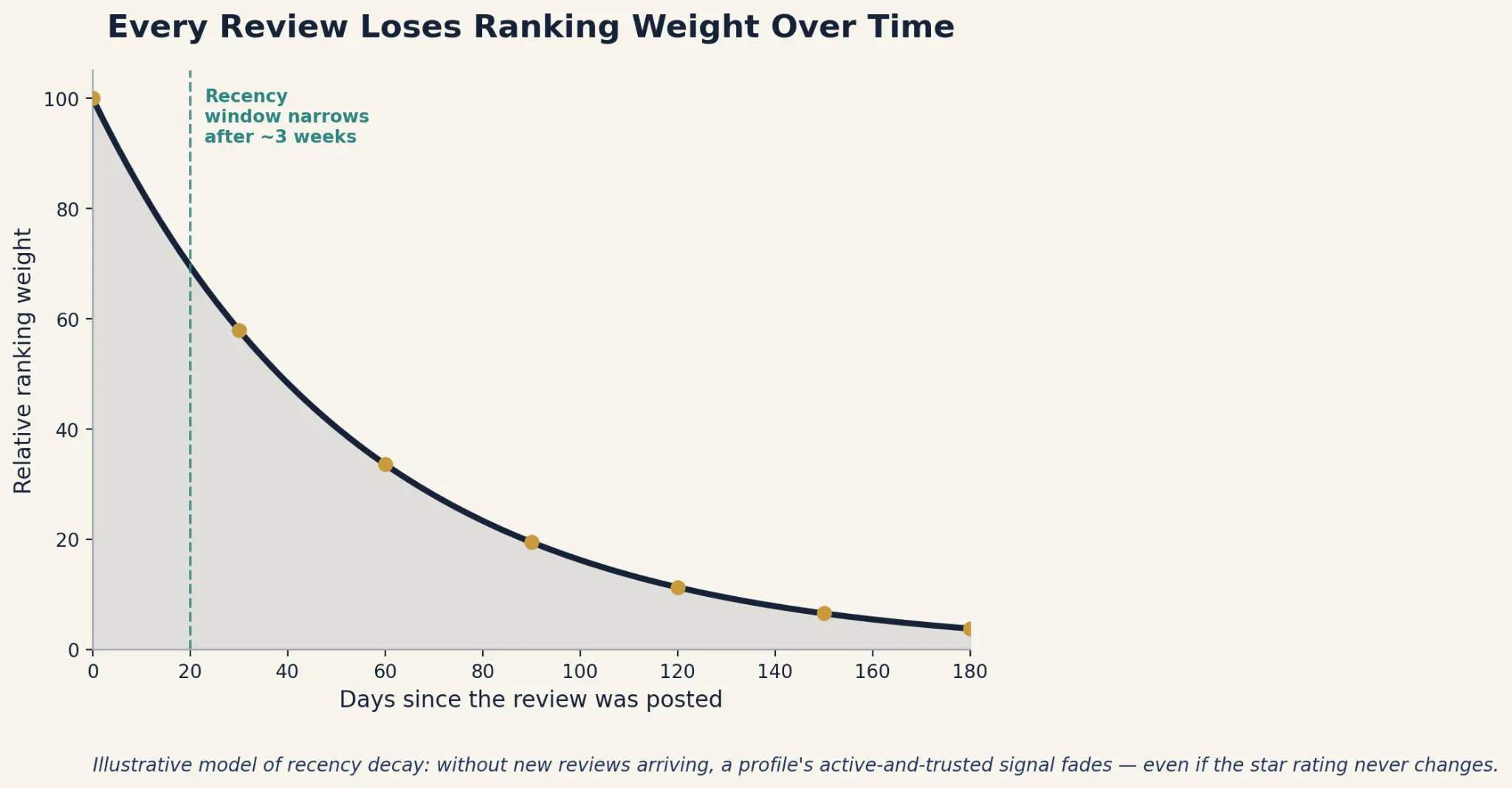
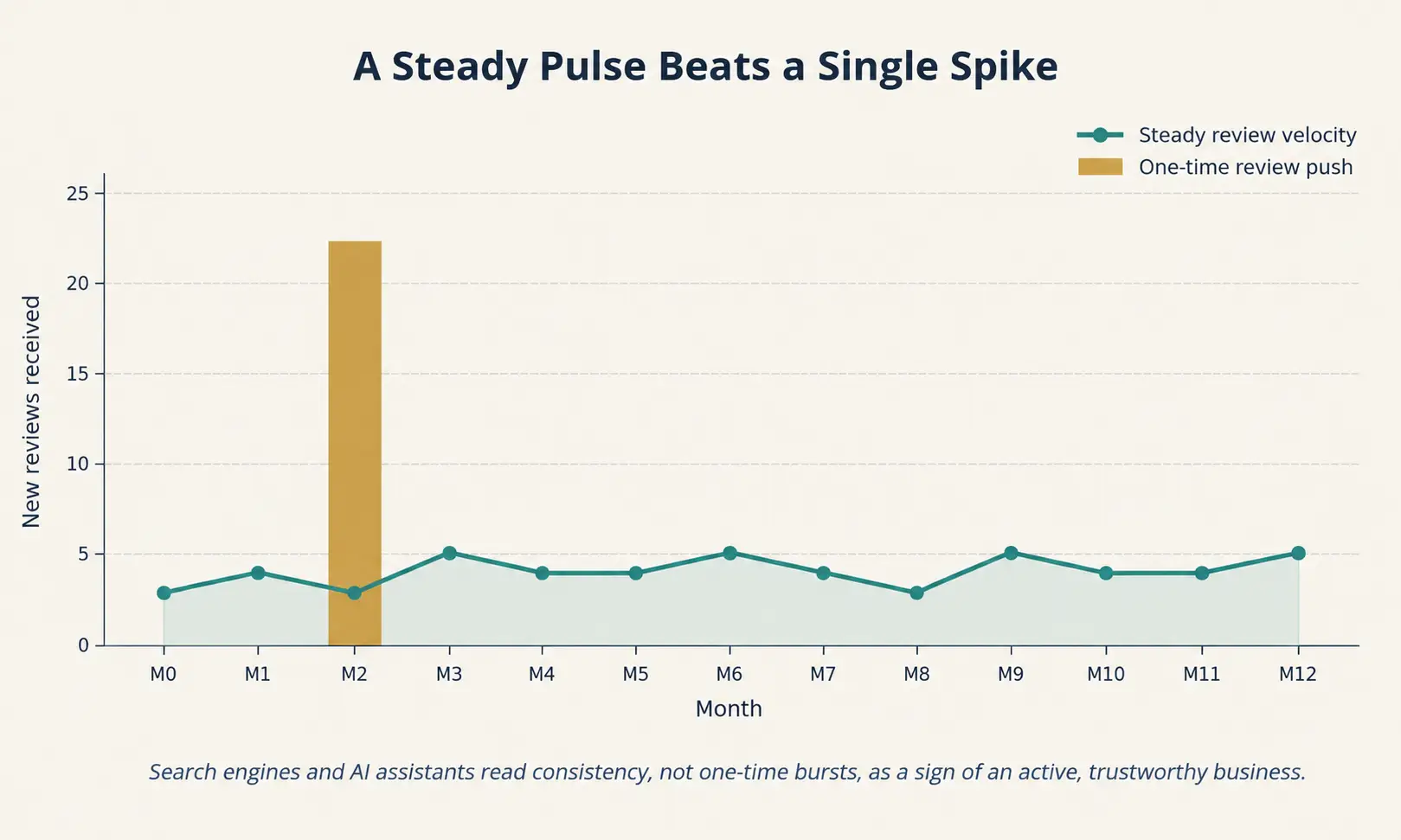
    Picture every review as carrying a freshness weight the moment it is posted. That weight does not vanish overnight, but it fades the longer a profile goes without a new one arriving, a pattern close to what analysts now describe as recency decay.

    Tust Citadel Coworkers

    A handful of factors shape how a review profile gets read as a whole:

    • Recency: how long it has been since the last review arrived
    • Frequency: how consistently new reviews arrive over months, not just in short bursts
    • Response rate: how often and how quickly the business replies
    • Sentiment and detail: whether reviews read as specific and genuine rather than generic
    • Cross-platform consistency: whether the pattern looks similar on Google, industry-specific sites and social platforms

    None of these factors work alone. A business with an excellent star rating but no movement on any of them starts to resemble, statistically, a business that has quietly stopped operating.


    Before assuming a visibility dip is about star rating, it is worth checking something simpler first: how long it has actually been since a new review came in.

    Building Review Velocity Without Gaming the System

    The instinct, once a business notices this, is to run a single campaign and ask every past customer for a review at once. That approach tends to backfire. A sudden cluster of reviews followed by months of silence looks less like momentum and more like a manufactured spike.

    Tust Citadel Coworkers

    A steadier approach holds up better over time:

    • Ask at the moment of service completion, not weeks later, while the experience is still fresh.
    • Use short SMS or email prompts rather than long forms; the easier the ask, the higher the response.
    • Spread requests across the customer base instead of batching them into occasional pushes.
    • Respond to every new review within a day or two, positive or negative.
    • Review the cadence monthly, not just the star rating.

    This is the operational core of review management done well: not chasing a bigger number, but keeping a steady, believable rhythm that customers and algorithms both recognize as real.

    Where AI Earns Its Keep in Reputation Work And Where It Doesn’t

    AI has changed both sides of this picture. It can scan thousands of reviews for sentiment, flag unusual clusters and draft a reasonable first response in seconds- work that used to consume hours every week for larger brands.

    At the same time, that same technology has made convincing fake reviews easier to produce. Researchers tracking this problem have found that AI-generated reviews are a fast-growing share of what platforms now remove as spam and that human readers alone catch them barely better than guessing.

    Tust Citadel Coworkers

    That combination, AI drafting at scale on one side and AI-generated content polluting the review pool on the other, is exactly why human judgement has not become optional. A generic complaint about slow service can be handled by a well-trained AI draft. A complaint involving a billing dispute, a safety concern or a legal gray area cannot; it needs a person weighing tone, risk and relationship before anything goes public.

    At Citadel Coworkers, AI is treated as a first-pass filter rather than a final decision-maker. It handles the scanning and the drafting, while a person still signs off on anything that could shape how a brand is perceived. That combination is where thoughtful online reputation management actually earns its results.

    Why Growing Brands Choose Citadel Coworkers

    Most agencies treat reviews as a side task bolted onto broader marketing work. Citadel Coworkers treats review velocity as its own discipline, with its own cadence, reporting and accountability. That distinction tends to matter most for multi-location brands, where one slow quarter at a single site can quietly drag down performance everywhere else.

    Tust Citadel Coworkers

    In practice, that looks like a few specific things:

    • Request systems built around each client’s actual customer journey, not a generic template
    • Response workflows that pair fast AI drafting with human approval on anything sensitive
    • Monthly velocity tracking, not a one-time audit
    • Compliance-safe methods that hold up against platform policies, with no manufactured spikes

    The result is not simply a bigger number on a dashboard. It is a review profile that keeps sending the right signal, month after month, to the people and the platforms deciding who gets chosen.


    If a review profile has barely moved in the last quarter, it is worth a conversation about what a structured cadence could look like across every location.

    Turning Online Reviews Into a Predictable Growth Channel

    Handled properly, online reviews stop behaving like an unpredictable byproduct of customer service and start behaving like any other growth channel, with inputs, a cadence and measurable output.

    That shift matters because it removes the guesswork. Instead of wondering why visibility dipped, a brand can look at exactly how many reviews arrived last month and how that compares with three months earlier. Marketing budgets get easier to justify once a reputation program produces numbers that behave this predictably month after month.

    A strong review history was never wasted effort, but on its own, it no longer carries a profile the way it used to. The brands pulling ahead this year are not necessarily the ones with the longest history or the largest total. They are the ones still showing up, one recent review at a time, proving they are worth choosing today. That is the pulse worth protecting, quarter after quarter, long after the first campaign ends.

  • Google Local Services Ads to Performance Max Migration: What Citadel Coworkers Want Local Service Businesses to Know

    Google Local Services Ads to Performance Max Migration: What Citadel Coworkers Want Local Service Businesses to Know

    Key Takeaways

    • Local Services Ads is being folded into Google Ads as a specialized Performance Max campaign built for pay-per-lead goals and Phase 1 is already live for select U.S. home service categories.
    • The migration is mandatory. There is no opt-out and once the notice arrives, the account moves automatically within a set window.
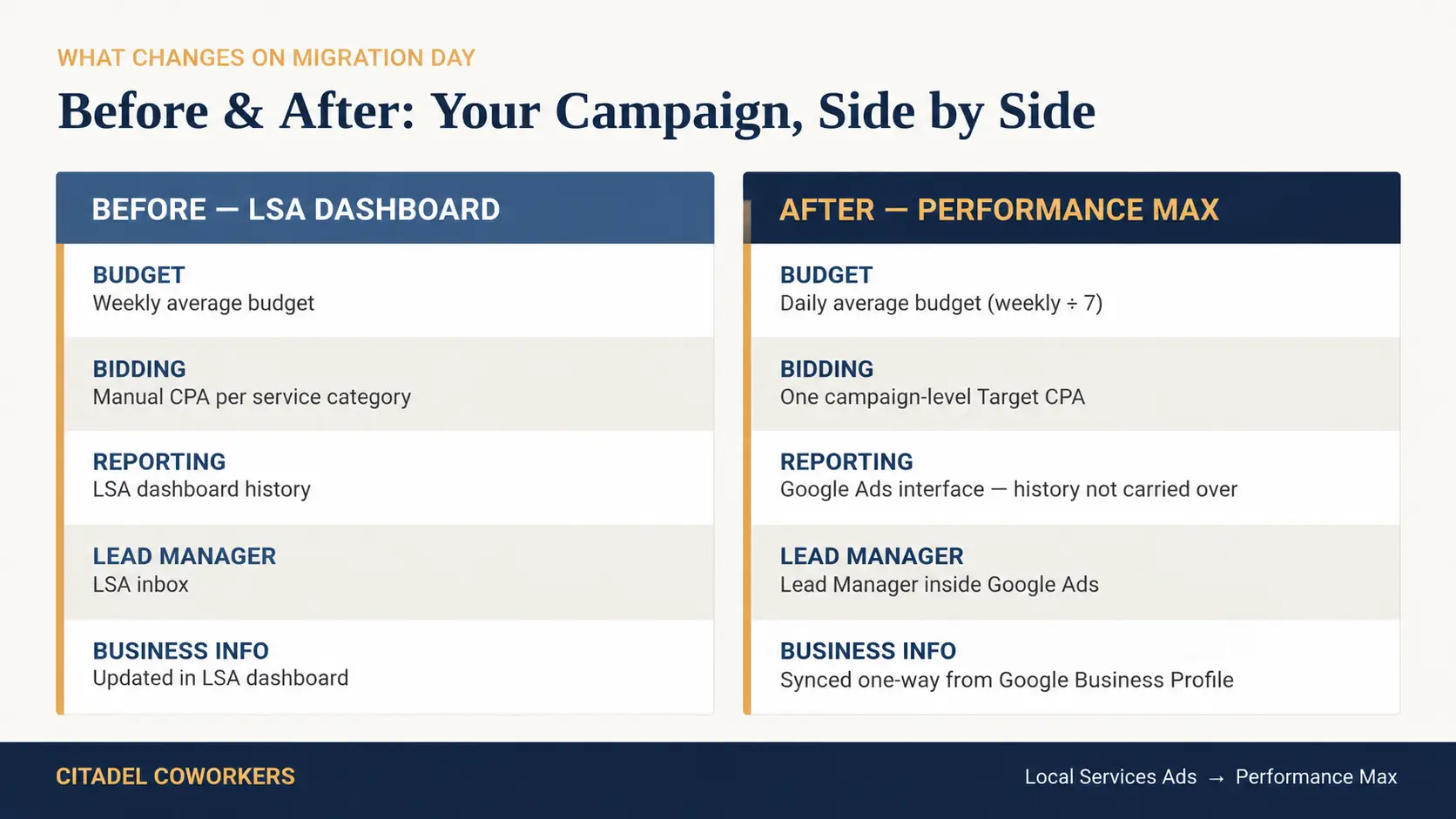
    • Historical performance reports do not carry over. Businesses need to archive their data before the account transitions.
    • Multi-service businesses face a bidding structure change: a single Target CPA now governs every service category unless the account is deliberately restructured beforehand.
    • Citadel Coworkers is guiding local businesses through account audits, campaign restructuring and post-migration monitoring so lead flow doesn’t stall during the shift.

    Google Local Services Ads are moving into Google Ads or Google Performance Max campaigns and Phase 1 is already live. As of August 2026, home and storefront service businesses across plumbing, HVAC, electrical, roofing, pest control and moving are receiving migration notices with just a 14-day window before their account moves automatically. There’s no opt-out and no extended preview period, only a countdown attached to the leads that keep a business running.

    This blog breaks down what the migration actually changes, what stays the same, where the automation genuinely helps versus where it can quietly cost you money and the exact steps Citadel Coworkers recommends taking before your notice arrives.

    Why This Shake-Up Deserves More Than a Passing Glance

    For years, local Services Ads gave local service businesses something rare in digital advertising: simplicity. One dashboard, one login and payment only for leads that actually called or messaged. A plumber or electrician didn’t need a media buyer to show up at the top of a local search.

    That simplicity is being retired. Google is folding those accounts into its broader advertising platform and the businesses treating this as routine software maintenance are the ones most likely to watch cost per lead climb while call volume quietly drops.

    The stakes here aren’t abstract. Lead flow for a roofing crew or an HVAC company isn’t a number on a dashboard somewhere. It’s next week’s job schedule and this month’s payroll. A mishandled transition doesn’t just dent a metric. It dents income.

    What’s Actually Changing And What Google Is Leaving Alone

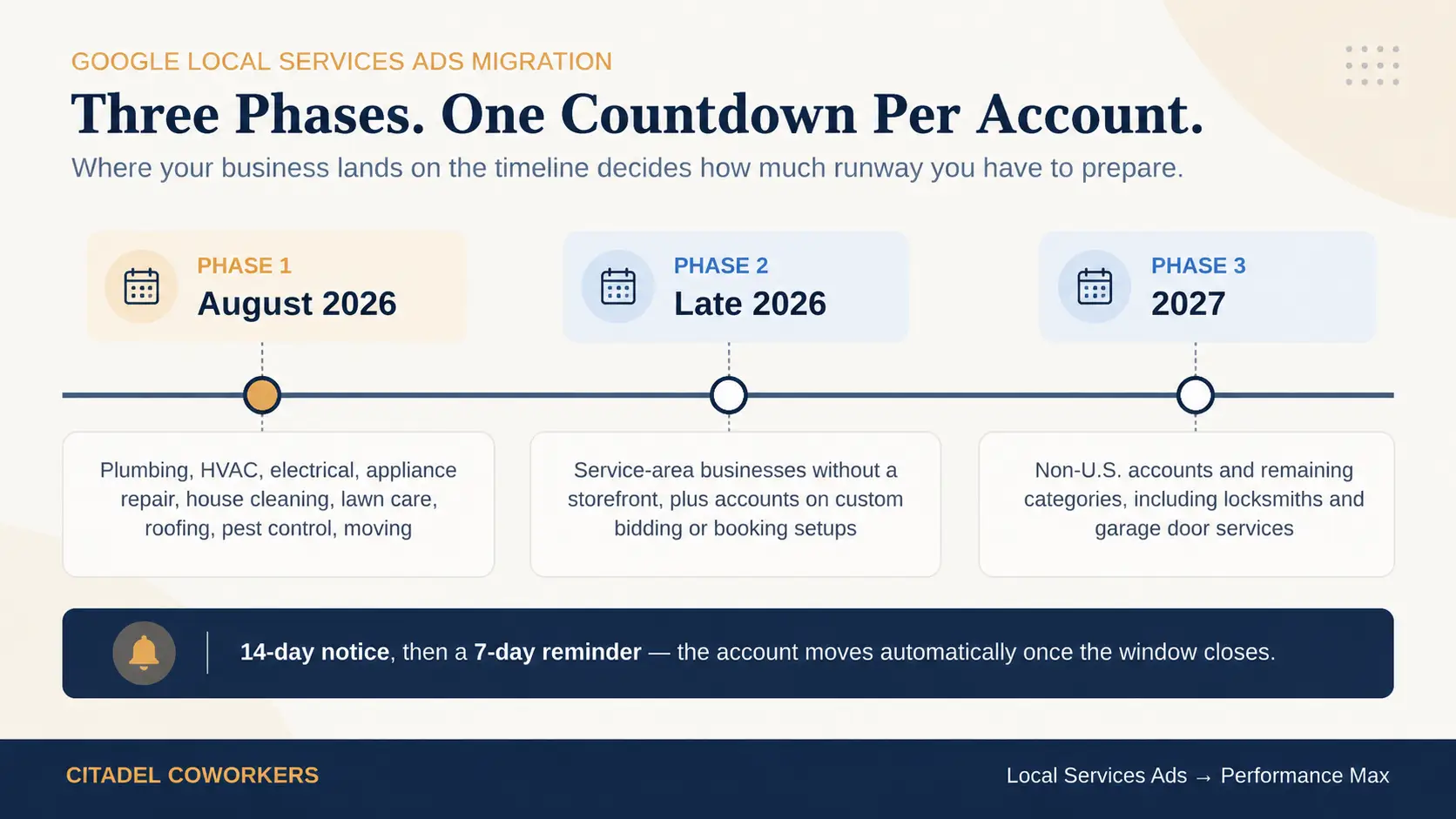
    Google is rolling this out in three phases rather than flipping a single switch. Knowing where your business sits in that timeline determines how much runway you have to prepare.

    Tust Citadel Coworkers
    • Phase 1 (August 2026): Select U.S. home and storefront service advertisers, including plumbing, HVAC, electrical, appliance repair, house cleaning, lawn care, roofing, pest control and moving.
    • Phase 2 (Late 2026): Service-area businesses without a physical storefront, plus accounts running custom bidding or booking setups.
    • Phase 3 (2027): Non-U.S. accounts and remaining categories, including advanced-verification trades such as locksmiths and garage door services.

    Once a business receives its notice, Google gives 14 days, followed by a seven-day reminder, before the account moves automatically into a specialized Performance Max campaign built around pay-per-lead goals.

    Not everything changes, though. Ads still appear exclusively on Google Search and Google Maps, not the wider network of YouTube, Display and Gmail placements that a standard Performance Max account reaches. Billing stays pay-per-lead and no keyword lists are required. The core product experience customers see hasn’t moved. What’s moved is everything behind it.

    Tust Citadel Coworkers

    The Bidding Trap Multi-Service Businesses Can’t Afford to Miss

    Here’s where the migration gets genuinely tricky for businesses that offer more than one service line. Under the current system, a plumbing company can set a different cost-per-lead target for emergency calls than for routine maintenance visits, because those leads simply aren’t worth the same amount.

    After migration, a single campaign-level Target CPA applies across every service category bundled into that account. A high-value emergency job and a lower-margin routine visit start competing for the same bid target, which can quietly inflate costs on the services that were never meant to carry that price.

    Google’s own guidance points to a workaround: build separate campaigns for each service line to preserve independent bidding control. It works, but it adds real management overhead for businesses used to a single, simplified dashboard.

    This is exactly the kind of decision that needs to be made before the 14-day window opens, not during it. Mapping out whether your account needs that restructuring now, while there’s still time to plan rather than react, is worth a conversation before that notice ever arrives.

    Where AI Genuinely Helps And Where It Still Needs a Human in the Room

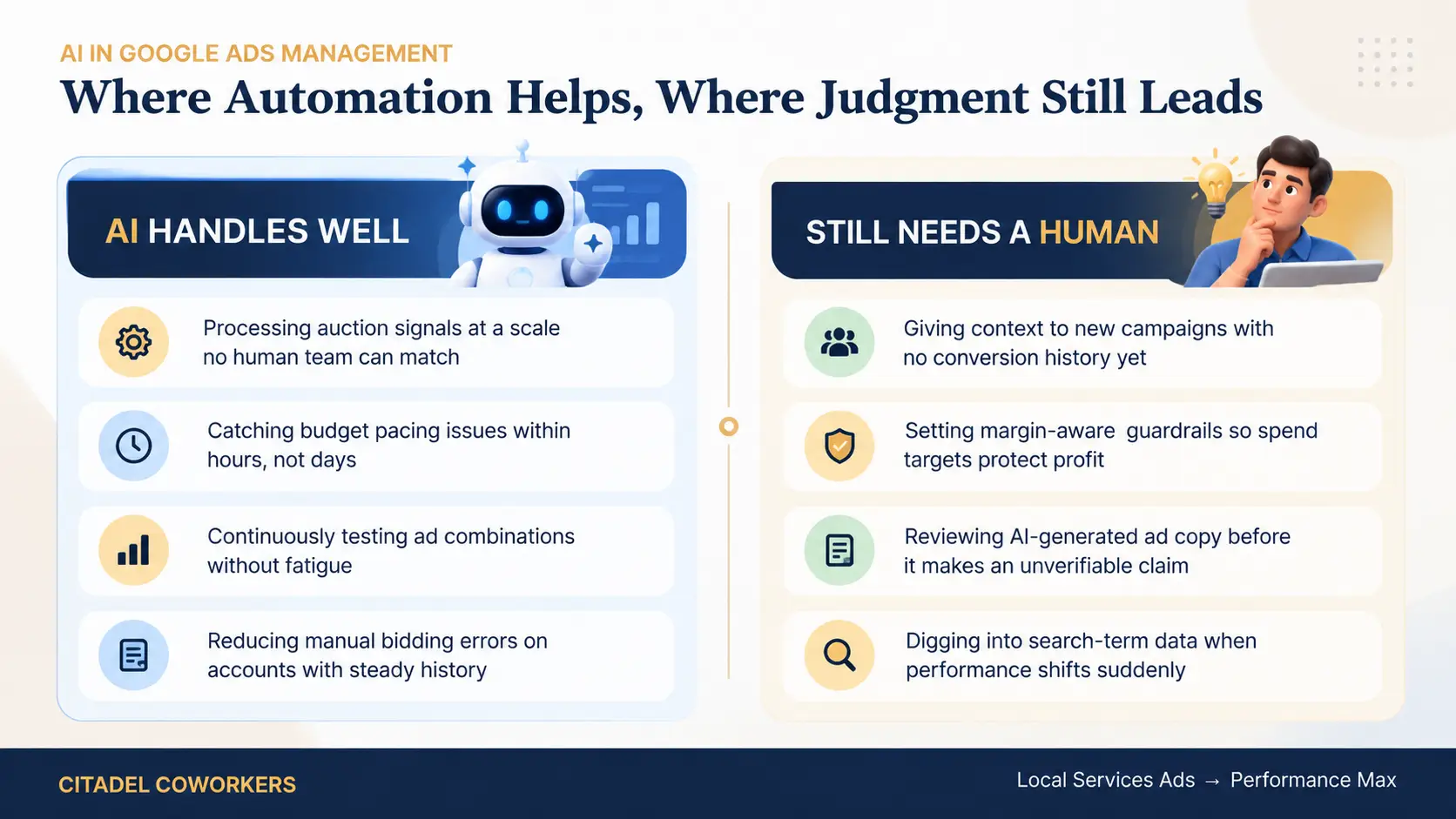
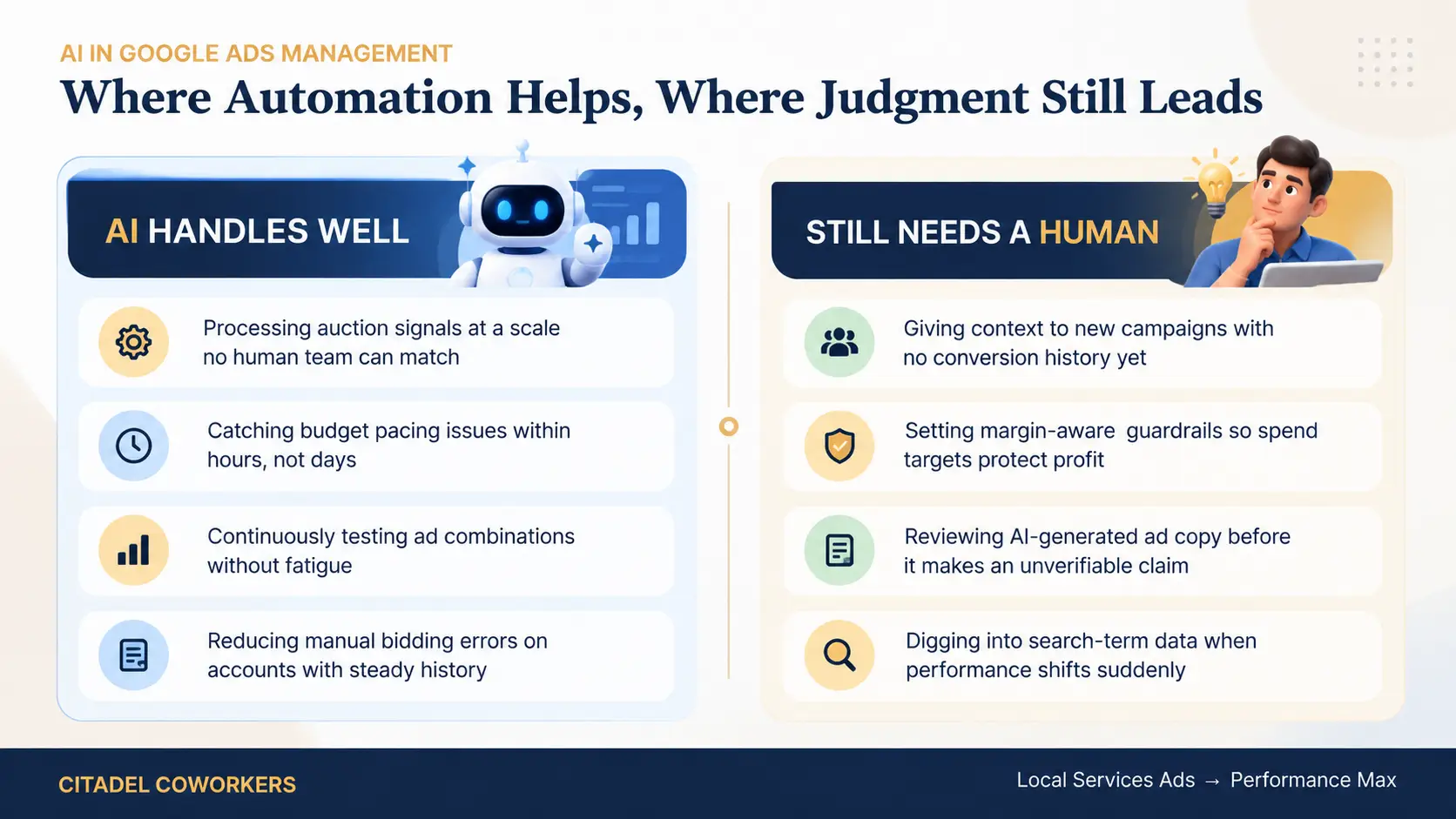
    Automation now handles most of the moment-to-moment decisions inside modern Google Ads management and it’s worth being honest about what that means. Smart bidding can process auction signals at a scale no human team could match, catching pacing issues within hours and testing ad combinations continuously without fatigue. For established accounts with steady conversion history, that reduces the kind of manual bidding errors that used to eat budgets.

    Tust Citadel Coworkers

    But automation has real blind spots and pretending otherwise costs money. A few worth knowing:


    • New campaigns lack context.
      Algorithms lean on historical data. A freshly migrated account or a seasonal launch doesn’t have enough of it yet, so early decisions often need a human filling in what the machine can’t see.
    • Overspend risk is real without guardrails. Industry estimates suggest automated bidding left unsupervised can’t actually back up, which creates policy and reputational risk if nobody reviews it before it goes live.
    • Smart bidding doesn’t explain itself. When performance shifts suddenly, the system rarely shows its reasoning, so someone still has to dig through segment and search-term data to understand why.

    None of this is an argument against automation. It’s an argument for pairing it with judgment. The businesses coming out ahead in this shift aren’t the ones avoiding AI; they’re the ones directing it with the business context, margin data and category knowledge the algorithm was never given in the first place.

    What Is the Real Difference Between Local Services Ads and Performance Max

    It’s a fair question and one worth answering plainly. Local Service Ads was a standalone, pay-per-lead product built specifically for service businesses, with its own dashboard and no keyword bidding involved. Google Performance Max is an automated campaign type that lives inside the main Google Ads platform and typically spans multiple channels.

    The migrated version is a hybrid: it keeps the pay-per-lead pricing and Search-and-Maps-only placement that made the original work, but now runs through the same Google Ads interface as every other campaign type, complexity included.

    A Readiness Checklist Before Your Migration Notice Lands

    The preparation window is short, so it helps to know exactly what to do with it:

    Tust Citadel Coworkers

    • Export every Local Service Ads performance report
      you might need for benchmarking, client reporting or year-over-year comparisons. This data disappears once the account moves.
    • Audit your Google Business Profile for accuracy. It becomes the source of truth for your business name, address, hours and photos after migration.
    • Confirm your Google Business Profile is properly linked to your Google Ads account before the transition begins.
    • Hold off on major profile changes, like a name or address update, until the two-week stabilization period after migration is complete.
    • Decide in advance whether multi-service categories need separate campaigns to preserve bidding control.

    This is exactly the kind of groundwork Citadel Coworkers walks local businesses through before a notice ever reaches their inbox, because the businesses that prepare tend to come out of the stabilization period in a stronger position than the ones scrambling after the fact.

    Why Local Businesses Are Trusting Citadel Coworkers With This Transition

    Migration like this rewards a specific kind of partner: one that understands both the mechanics of automated bidding and the operational reality of running a service business. That combination is where Citadel Coworkers has built its approach.

    Rather than letting a client’s account drift through migration on autopilot, the team maps out campaign structure ahead of time, decides where separate campaigns genuinely earn their overhead and sets clear guardrails around what the automation should and shouldn’t be allowed to optimize on its own.

    Reporting is archived before it disappears. Google Business Profiles are audited for the accuracy the new system depends on. And once an account transitions, a defined stabilization protocol keeps bid and budget changes from happening too early, while still watching closely enough to catch genuine anomalies. If you’d rather hand this checklist to someone else, Citadel Coworkers’ team is set up to review your account before your notice ever lands and build the plan for what comes next.

    Moving Forward Without Losing the Leads You’ve Already Earned

    This migration isn’t optional and treating it as a minor platform update is the fastest way to lose ground you’ve spent years building. But businesses that prepare, archive their data, clean up their profiles and decide their campaign structure ahead of time have a real chance to come out the other side stronger than before.

    The phone still needs to ring. The trucks still need jobs on the schedule. Getting there through this transition is simply a matter of treating it with the seriousness it deserves and having the right people looking at the account when it matters most.

  • How to Correct Your Business Information Across AI Platforms: A Guide to AI Visibility

    How to Correct Your Business Information Across AI Platforms: A Guide to AI Visibility

    Key Takeaways

    • AI assistants like ChatGPT, Gemini and Perplexity have no “edit” button. Fixing what they say about your business means fixing the sources they pull from: your website, listings and directories.
    • Pricing, hours and service details are among the pieces of business information AI gets wrong most often because they change frequently and live in scattered places online.
    • Correcting the record is a source-level exercise: audit, trace, fix, refresh and monitor, not a one-time cleanup.
    • AI can process financial and business data far faster than any team, but it still cannot make judgment calls on tax treatment, compliance or what a transaction actually means.
    • Citadel Coworkers pairs proactive AI search optimization with hands-on human review, so both your records and your public business information stay accurate.

    Your pricing changes. Your service list changes. Even your hours shift from season to season. AI assistants rarely keep pace and long after you’ve updated your own records, ChatGPT, Gemini and Perplexity may still repeat the version that was true two years ago.

    Not appearing in an AI answer is a visibility problem. Giving a prospect the wrong one is a revenue problem. Independent research into AI-generated brand facts found that roughly 9 in every 100 statements AI makes about a business are simply false.

    Picture what that looks like for a firm where the founder asks ChatGPT for “generative engine optimization near me” and gets a retired price, a service you dropped last year and a number nobody answers. They don’t call to check; they just move to whoever AI trusted more.

    For a business built on getting the numbers right, letting AI get your own facts wrong is a credibility problem you can’t afford. Correcting outdated business information in AI is no longer optional; it’s part of protecting your pipeline.

    Tust Citadel Coworkers

    Why an AI’s Wrong Answer Is a Revenue Problem, Not a PR One

    When an AI assistant misstates your hours, pricing or service area, it does not just look sloppy. It quietly redirects a paying customer toward someone else and you never see the lead you lost.

    Independent research backs this up. A 2025 study by the European Broadcasting Union and the BBC, which reviewed thousands of AI-generated answers, found assistants misrepresented source content in close to 45% of cases, a pattern researchers linked partly to outdated or poorly sourced material. Business information faces the same structural problem: AI is only ever as current as the pages it can find.

    This matters more now that AI has become a genuine discovery channel. ChatGPT alone processes roughly two billion queries a day and AI Overviews now appear on a meaningful share of local searches, often answering the question before a user ever clicks through to a website. If your listed information is stale, you may be losing leads you never knew existed.

    What Kind of Business Information Does AI Get Wrong Most Often

    Pricing, hours and current service offerings top the list. These details change the most often, live across the most platforms and are the easiest for an old directory listing to contradict.

    Company history and general “about” information tend to be more stable, but even these carry error rates worth watching, especially when a business has rebranded, relocated or changed its ownership structure. If two sources disagree, AI has no reliable way to know which one is current; it simply picks the most confident or most frequently repeated version.

    Where AI Actually Gets Its Facts About You

    AI is not inventing what it says about your business. It is reflecting a mix of sources, some you control and some you do not:

    Tust Citadel Coworkers
    • Your own website- service pages, footers and FAQs- which are authoritative but only if kept consistent.
    • Business listings and local profiles- Google Business Profile, Bing Places and industry directories- which update quickly but are frequently neglected.
    • Third-party mentions- news articles, review sites, forums and old blog posts that AI treats as independent confirmation.
    • Licensed and structured data- schema markup and databases that give AI a clean, machine-readable version of the facts.

    When these sources disagree, every AI platform inherits the same confusion, because they are all drawing from the same messy well of information.

    Steps to Correct Outdated Business Information in AI Answers

    There is no support ticket you can file with OpenAI or Google to fix a wrong answer directly. Correcting the record means working at the source, methodically and repeatedly, rather than chasing one AI platform at a time.

    Tust Citadel Coworkers

    • Audit your AI presence.
      Ask ChatGPT, Gemini and Perplexity the exact questions a prospect would: your hours, pricing and services and screenshot what comes back.
    • Trace the error to its source. Check cited links where available or search the exact wrong phrase to find where it originated.
    • Fix the upstream source. Update your website, Google Business Profile and any directory still showing the old details.
    • Publish fresh, dated content. A recently updated page signals current accuracy far more strongly than an old one, even if the old one still ranks.
    • Use platforms’ feedback tools. A thumbs-down or “report inaccurate answer” option won’t fix it instantly, but it adds a signal.
    • Re-check every 30 to 60 days. Corrections take time to propagate, so use the same prompts from your original audit to track real progress.

    This is also where AI search visibility efforts have a natural advantage: the same discipline that keeps a ledger accurate- consistency, documentation and regular review- applies directly to keeping your brand information accurate too.

    Can You Just Ask ChatGPT to Fix It

    In short, NO. AI assistants have no edit function and no customer support line for correcting a specific fact about your business. What you can do is flag an answer as inaccurate through a platform’s built-in feedback tool, which acts as a weak signal rather than a fix.

    The only dependable path is correcting the source material the AI is reading from your website, your listings and the third-party pages that mention you and then giving the correction time to be re-crawled and absorbed. Expect this to take anywhere from a few days to a few months, depending on the platform and the source.

    Where AI Genuinely Helps And Where It Still Needs a Human in the Room

    AI has become a real asset. It reconciles accounts, flags duplicate transactions and categorizes routine expenses faster and more consistently than manual entry ever could, catching anomalies a tired reviewer might miss.

    But speed is not the same as judgment. Whether a purchase should be expensed or capitalized, how a borderline expense should be classified for tax purposes or what an unusual transaction actually means for a business, these are calls that depend on context AI simply does not have. Multiple 2026 industry surveys found that a majority of finance professionals trust AI only within clear guardrails, with a human reviewing anything that touches compliance or filing.

    Tust Citadel Coworkers

    That is precisely why Citadel Coworkers treats AI as a tool, not a replacement. Automation handles the volume and the repetitive first pass; a dedicated professional handles the exceptions, the sign-offs and the decisions that carry real consequences.

    If you want a quick sense of how accurate or outdated your own business information currently looks across AI platforms, it is worth running the same audit on yourself before a prospective client does it for you.

    Why Growing Businesses Choose Citadel Coworkers

    Accuracy is not a feature Citadel Coworkers adds on top of its AI search optimization ; it is the operating mode. Every AI-assisted transaction categorization, reconciliation and report is reviewed by a professional who understands your business, not just your data.

    That same standard extends beyond the ledger. As part of supporting clients day-to-day, CCWs also help ensure the business information tied to your brand- the details AI platforms and customers both rely on- stays current, consistent and easy for both people and AI systems to trust.

    Tust Citadel Coworkers

    Clients choose Citadel Coworkers for a few clear reasons:

    • Human-reviewed accuracy. AI handles the repetitive work; qualified professionals handle the judgment calls.
    • Real-time visibility without the guesswork. GEO services that give you current numbers, not quarterly surprises.
    • A team that scales with you. From early-stage founders to established companies, the review process stays the same regardless of size.
    • Proactive, not reactive. Issues get flagged before they compound into a filing problem or a client-facing error.

    This is what makes the switch worth it for growing businesses that have outgrown spreadsheets but are not ready to build a full in-house finance team from scratch.

    The Bottom Line

    Outdated information, whether it is sitting in a stale directory listing or buried in a misclassified transaction, rarely announces itself. It just quietly costs you money until someone catches it.

    Businesses that treat accuracy as an ongoing habit, not a one-time fix, are the ones that stay trustworthy in an AI-driven world. Citadel Coworkers built its entire practice around exactly that habit: let automation do the heavy lifting, but keep a human accountable for every number and every fact that carries your name.

  • Why Proprietary Research Data Is Citadel Coworkers’ Blueprint For Brand Differentiation in the AI Search Era

    Why Proprietary Research Data Is Citadel Coworkers’ Blueprint For Brand Differentiation in the AI Search Era

    Key Takeaways

    • Generic advice is being erased by AI-generated summaries. Proprietary data is the one asset that can’t be flattened into someone else’s answer.
    • AI search tools reward primary sources with real numbers over recycled tips, which makes original research central to how brands get discovered today.
    • One well-documented internal metric can outperform a long “ultimate guide” for both rankings and buyer trust.
    • AI speeds up data cleaning, pattern-spotting and formatting, but interpreting what a finding means for a specific business still needs an experienced person.
    • Citadel Coworkers builds research-backed programs that turn a client’s own data into citable, ownable brand authority.

    Search has never had less friction and it has rarely delivered less that feels genuinely new. Ask almost any question and answers arrive by the thousand, most of them repeating each other in slightly different words. For a brand trying to be noticed in that noise, saturation itself has become the obstacle. Sounding credible isn’t enough when every competitor sounds credible in exactly the same way.

    AI has sharpened that problem rather than solved it. Search and answer engines now synthesize responses on the spot and when dozens of articles offer the same generic tips, the AI blends them into a single answer and quietly drops the redundant sources. Most content marketing produced today, however well-written, disappears into that blend, because it doesn’t say anything an algorithm hasn’t already read a hundred times.

    To be remembered, by readers and by the systems now answering on their behalf, a brand needs to publish something that cannot be blended away: its own proprietary research. That’s the discipline Citadel Coworkers builds its content programs around.

    The Content Glut Problem: Why Sounding Like Everyone Else Costs You the Sale

    Every industry now has a version of this problem. Search a topic and you’ll find dozens of articles making the same three points in a different order, wrapped in a different logo. Buyers have grown numb to it and increasingly so have the algorithms reading it.

    The commercial cost is real. Research from Kantar’s global brand database points to a strong link between how distinct a brand feels and how much a customer will pay for it, with well-differentiated brands able to command close to double the price of look-alike competitors. Standing out isn’t a branding nicety anymore. It’s a pricing lever.

    Tust Citadel Coworkers

    Forrester’s research tells a similar story from the experience side: companies that lead on customer experience generate several times more revenue than less customer-focused peers, yet overall experience quality has been sliding industry-wide. Everyone is chasing the same differentiator at the same time, using the same generic playbook. That’s precisely the environment where proprietary data stops being a nice extra and starts being the deciding factor.

    How AI Search Engines Decide Which Brand Gets Credited

    When someone asks an AI assistant a question today, the system isn’t reading your page the way a person does. It’s running a retrieval process that pulls the most relevant, credible material to ground its answer, then writes a synthesized response, often without sending a single click back to any one source.

    Tust Citadel Coworkers

    That process rewards specificity. If ten companies all say “response time matters for customer satisfaction,” an AI engine will compress that into a generic statement and cite no one in particular. But if your business states that its own analysis of client support tickets found a measurable link between first-reply time and renewal rates, there’s nothing to compress. The AI has to attribute the number to you.

    This is the core idea behind generative engine optimization: structuring content so that AI systems have a reason to name your brand instead of averaging it away. Industry analysis suggests that content built around cited statistics and original findings performs meaningfully better in AI-generated answers than purely descriptive writing. For a brand thinking seriously about AI search visibility, that’s not a footnote. It’s the strategy.
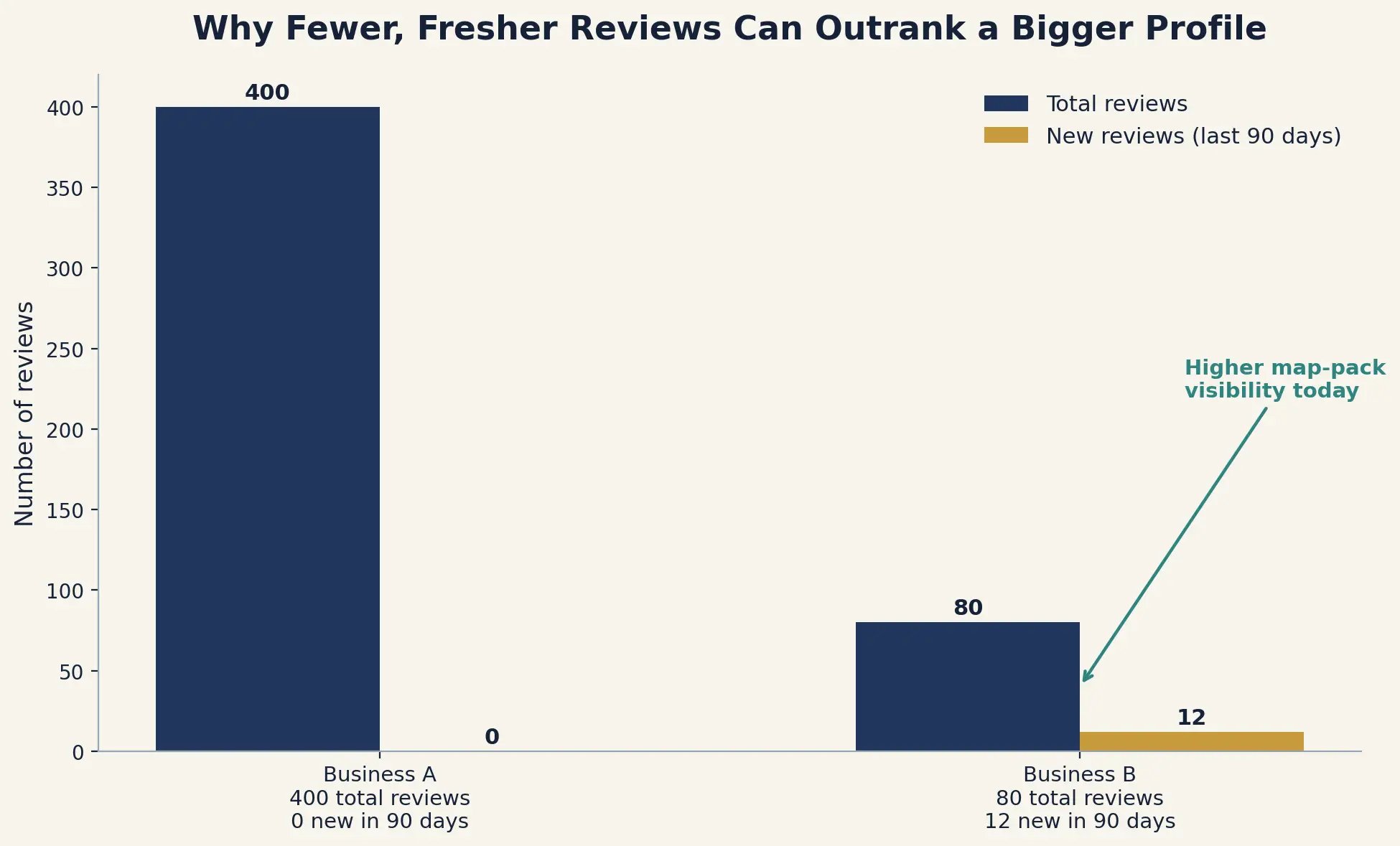
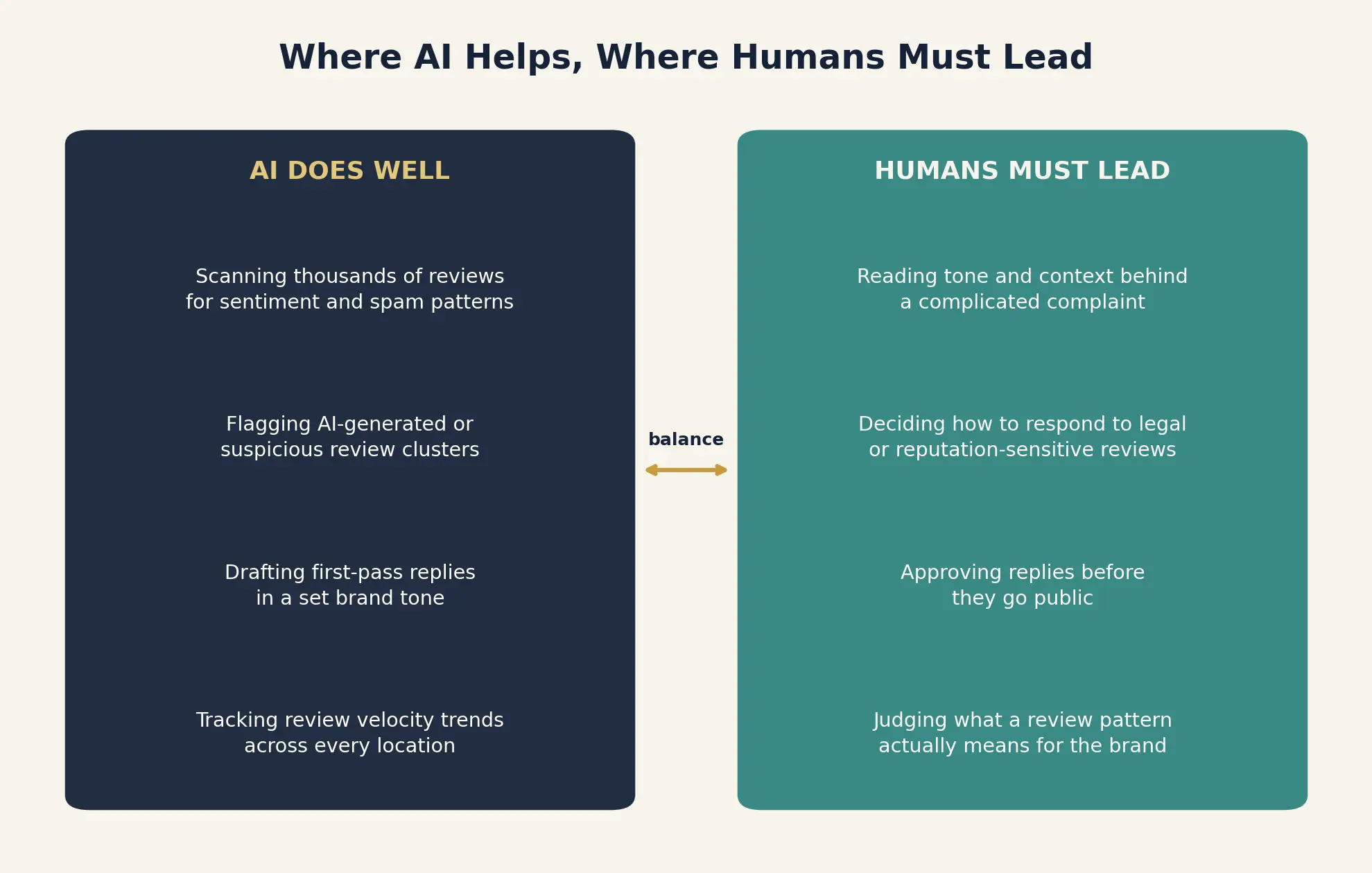
    What Counts as Proprietary Data

    Proprietary research data is any information a business generates through its own operations, client relationships or original testing that doesn’t already exist anywhere else publicly. It’s not a press release restating an industry report; it’s a number that only exists because you measured it.
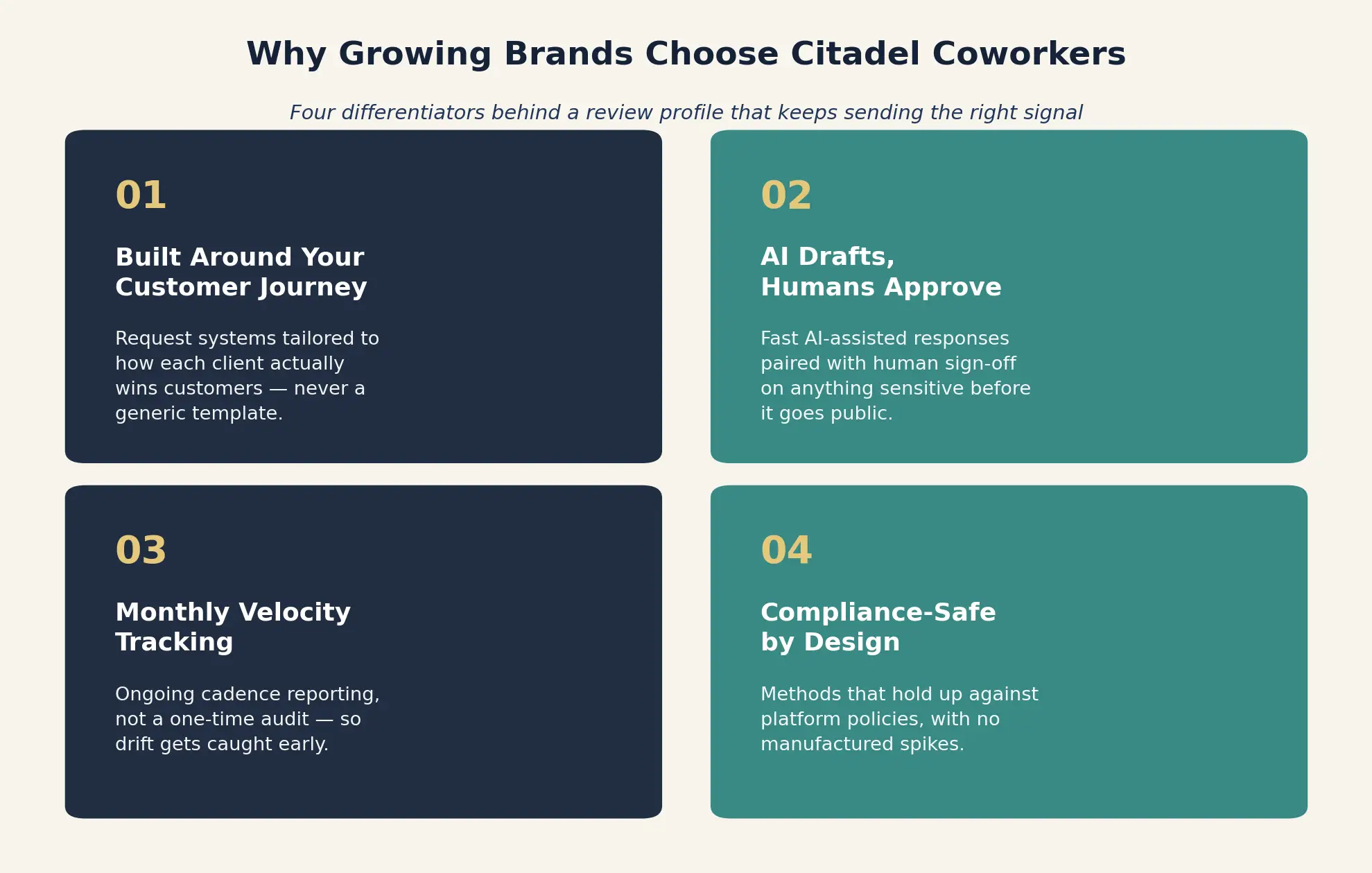
    Tust Citadel Coworkers

    In practice, this tends to show up in a few recognizable forms:

    • Internal performance metrics- patterns pulled from your own campaigns, sales cycles or support logs.
    • Anonymized client or product data- usage trends aggregated across your customer base.
    • Controlled experiments- a test you ran yourself, with a documented method and a real result.
    • Ongoing tracking indexes- a metric you monitor consistently enough that people start watching it for signal.

    None of these require a data science department. They require noticing what your business already produces and deciding to publish it responsibly.

    Turning Internal Numbers Into a Content Marketing Strategy That Compounds

    Most companies sit on more usable data than they realize; it’s scattered across CRMs, support platforms and spreadsheets nobody has opened since the last audit. The work isn’t collecting new data. It’s noticing what’s already there.

    At Citadel Coworkers, research engagements rarely start with a survey. They start with an audit: what does this client’s operational data already show that nobody outside the company has ever seen? That single question usually produces more publishable material than a quarter’s worth of trend-chasing blog posts.

    From there, a durable content marketing strategy follows a simple sequence:

    Tust Citadel Coworkers
    • Pick one narrow, high-intent question your buyers actually ask, not a sprawling “state of the industry” report.
    • Clean and anonymize the dataset so no individual client or user is identifiable.
    • Confirm the sample is large enough to represent a real pattern, not a fluke.
    • Present the finding with a clear headline number, a short methodology note and a scannable table, so both readers and AI systems can extract it in seconds.

    Done consistently, this turns a single data asset into a recurring content engine, one that competitors can reference but never actually replicate.

    Where AI Speeds You Up And Where It Can Quietly Get You Wrong

    AI has become genuinely useful in the research-to-content pipeline. It can clean messy exports, flag outliers, draft first-pass summaries and reformat a dense dataset into a readable table in minutes rather than hours. Marketers using AI well report meaningful time savings on exactly this kind of repetitive work, which frees up hours for the judgment calls that actually move a campaign forward.

    Tust Citadel Coworkers

    The trouble starts when that speed gets mistaken for understanding. An AI model can spot a correlation in a dataset, but it doesn’t know that the spike in March was a one-off promotion or that a client’s numbers looked unusual because of a platform migration that month. It also can’t tell you whether a finding is interesting enough to build a campaign around or whether it contradicts something a client told you off the record last week. That reading of context is still a human skill.

    There’s a brand-trust dimension too. A growing share of consumers say they’re less likely to choose a brand whose marketing feels visibly AI-generated and audiences are getting sharper at spotting content that’s fluent but hollow. The businesses getting this right aren’t avoiding AI. They’re using it for speed while keeping a person accountable for accuracy, tone and the final call on what actually gets published.

    Why Businesses Choose Citadel Coworkers For Research-Led Content Marketing

    Plenty of agencies offer content marketing services built around keyword lists and publishing calendars. Fewer are built around the harder, more valuable work of turning a client’s own operational data into something genuinely citable.

    Citadel Coworkers pairs research discipline with editorial craft: a methodology gets checked before a headline gets written and every dataset is reviewed by someone who understands both the client’s industry and how AI systems now evaluate sources. That combination is why clients stay for the second and third research cycle, not just the first campaign.

    If you’re curious what might already be sitting inside your own reporting dashboards, that’s a conversation worth having before your next content calendar gets planned around someone else’s ideas.

    From One Data Point to a Defensible Market Position

    Differentiation built on proprietary research compounds in a way that opinion-based content never can. Every quarter you track a metric, the dataset gets more credible and harder for a competitor to dismiss. Every citation an AI engine or journalist pulls from it reinforces your brand as the source, not a summary of someone else’s source.

    None of this requires a research team or a six-figure study. It requires an honest audit of what your business already knows, a willingness to publish it clearly and a partner who treats content marketing as a research discipline rather than a publishing schedule. Consider starting with the one question your customers ask most often; the answer may already be sitting in a spreadsheet you haven’t opened this month.

    The internet will keep producing endless variations of the same advice. What it can’t produce is your data. In a search landscape where AI increasingly decides which brand gets remembered and which one gets quietly summarized away, that difference is no longer a marketing detail. It’s the whole game.